The Abbasi Program in Islamic Studies is the central forum for study and research of Islam and Islamicate societies and communities at Stanford University.
Join us for an interdisciplinary graduate workshop featuring student paper presentations on research in Art History, Department of Languages, Cultures, and Languages, History of Science, Ottoman History, and Religious Studies. Each presentation will be 15-20 minutes, followed by a 5-7 minute response from an assigned respondent.
A Q&A discussion will take place after each presentation panel.
9:30-10:00 a.m.: Breakfast and opening remarks
10:00 a.m.-12:30 p.m.: Panel presentation I
12:30-1:30 p.m.: Lunch
1:30-3:00 p.m.: Panel presentation II
3:00-3:30 p.m.: Coffee/Pastries and Closing Remarks
🖋️📜 Join us for this year's Islam & Science Graduate Student Workshop!
🗓️ Saturday, June 6, 2026
⏰ 9:30 AM - 4:00 PM
🏫 Building 200, Room 307
450 Jane Stanford Way, Stanford, CA 94305
🎟️ To RSVP at [email protected]
👉 Sponsored by: Abbasi Program in Islamic Studies, @mideaststanford
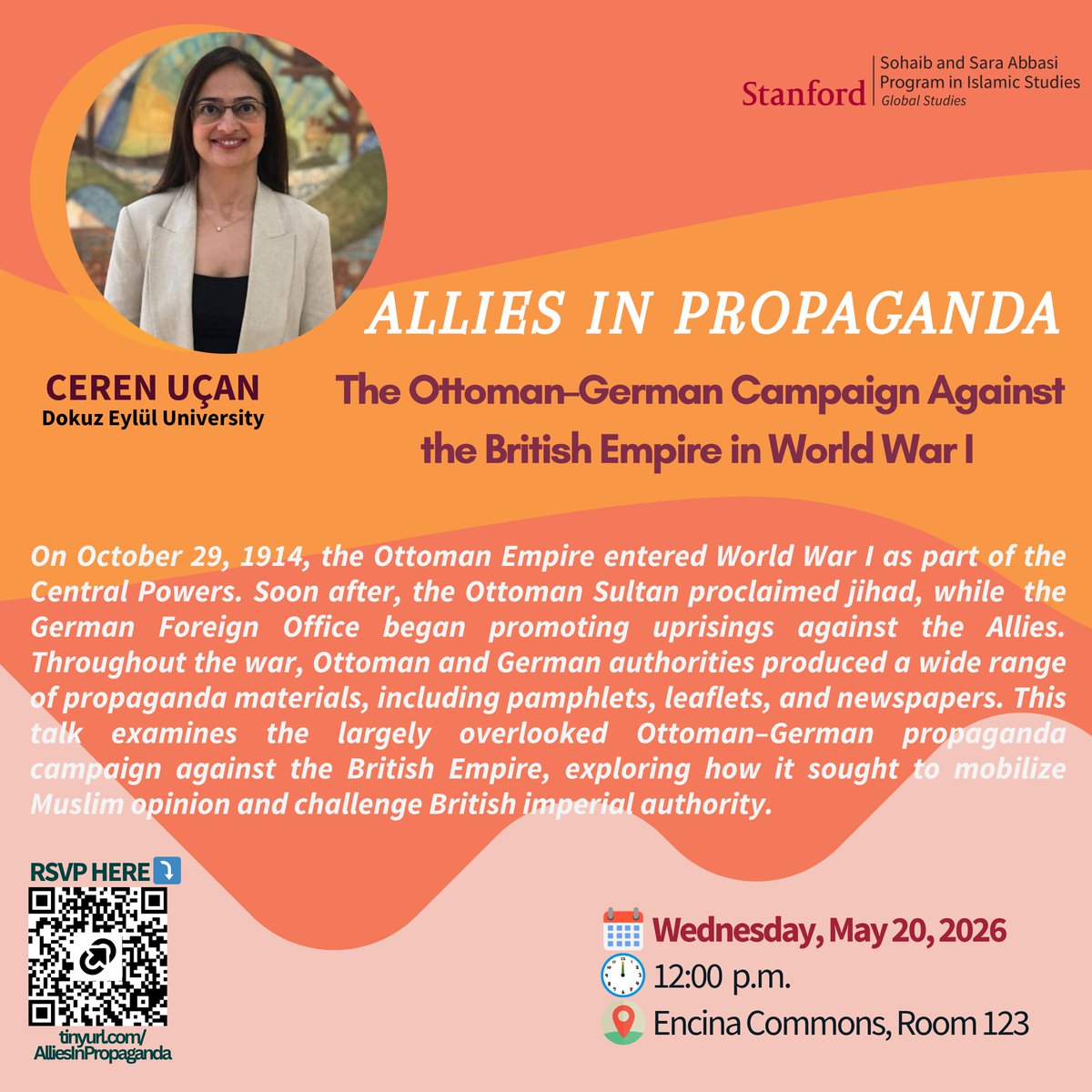
On August 2, 1914, the Ottoman and German Empires concluded an alliance, and on October 29, the Ottoman Empire entered World War I as part of the Central Powers. Soon thereafter, the Ottoman Sultan proclaimed jihad, while from December 1914, the German Foreign Office began promoting uprisings against the Allies. Throughout the war, Ottoman and German authorities produced a wide range of propaganda materials, including pamphlets, leaflets, and newspapers.
This talk examines the largely overlooked Ottoman–German propaganda campaign against the British Empire, exploring how it sought to mobilize Muslim opinion and challenge British imperial authority.
𝗖𝗲𝗿𝗲𝗻 𝗨𝗰𝗮𝗻 is an Assistant Professor of History at Dokuz Eylül University, Turkey, and currently a Fulbright Visiting Scholar at Stanford University.
#AbbasiProgram #StanfordIslamicStudies #Propaganda #WorldWarI #GermanOttomanAlliance
📢🌐📰 Allies in Propaganda: The Ottoman–German Campaign Against the British Empire in World War I with Ceren Uçan
🗓️ Wed, May 20, 2026
⏰ 12:00-1:30 PM
🏫 Encina Commons 123
615 Crothers Way, Stanford, CA 94305
🎟️ Register: https://t.co/WIs8je8tsl
👉 Sponsored by: Abbasi Program in Islamic Studies, Middle East Studies Forum
On August 2, 1914, the Ottoman and German Empires concluded an alliance, and on October 29, the Ottoman Empire entered World War I as part of the Central Powers. Soon thereafter, the Ottoman Sultan proclaimed jihad, while from December 1914, the German Foreign Office began promoting uprisings against the Allies. Throughout the war, Ottoman and German authorities produced a wide range of propaganda materials, including pamphlets, leaflets, and newspapers.
This talk examines the largely overlooked Ottoman–German propaganda campaign against the British Empire, exploring how it sought to mobilize Muslim opinion and challenge British imperial authority.
𝗖𝗲𝗿𝗲𝗻 𝗨𝗰𝗮𝗻 is an Assistant Professor of History at Dokuz Eylül University, Turkey, and currently a Fulbright Visiting Scholar at Stanford University.
#AbbasiProgram #StanfordIslamicStudies #Propaganda #WorldWarI #GermanOttomanAlliance
👉 Sponsored by: Abbasi Program in Islamic Studies, @mideaststanford
This talk will explore one of the most eccentric and brilliant figures of the nineteenth century, Ahmad Faris al-Shidya, who embodied, intellectually and personally, a series of irresolvable paradoxes. PhD student, 𝗔𝗷 𝗡𝗮𝗱𝗱𝗮𝗳𝗳, will examine al-Shidyaq's life and works from his time as a translator for the English Protestant missionaries' printing press in Malta (1836-1848) to his Muslim shift working for the Ottoman Empire as the editor of its Arabic language propaganda press in Istanbul (1859-1887).
𝗔𝗷 𝗡𝗮𝗱𝗱𝗮𝗳𝗳 is a PhD candidate in comparative literature at Stanford School of Humanities and Sciences.
#AbbasiProgram #StanfordIslamicStudies #ArabicLanguage #OttomanEmpire #Modernity
How can a past historical event be transformed by literature that comes after? Pulitzer Prize winning poet 𝗣𝗲𝘁𝗲𝗿 𝗕𝗮𝗹𝗮𝗸𝗶𝗮𝗻 will discuss the impact of the Armenian Genocide on his work. He will explore the transmission of trauma across generations and how poetry’s resources can ingest the past. He will discuss how his ancestors have provided a grounding for his work including his great-great uncle, Krikoris Balakian (Bishop in the Armenian Church), who was one of the 250 cultural leaders arrested on April 25, 1915 at the onset of the Genocide, and his grandmother Nafina Shekerlemdjian, who was a Genocide survivor along with her two young daughters, enduring a harrowing death march into the Syrian desert.
𝗣𝗲𝘁𝗲𝗿 𝗕𝗮𝗹𝗮𝗸𝗶𝗮𝗻 is the author of 9 books of poems, 4 books of prose, 3 collaborative translations and several edited books. Balakian is the recipient of many awards including the Pulitzer Prize for 𝘖𝘻𝘰𝘯𝘦 𝘑𝘰𝘶𝘳𝘯𝘢𝘭. He is a Professor of English at Colgate University.
#AbbasiProgram #StanfordIslamicStudies #ArmenianGenocide #StanfordHistory #Poetry
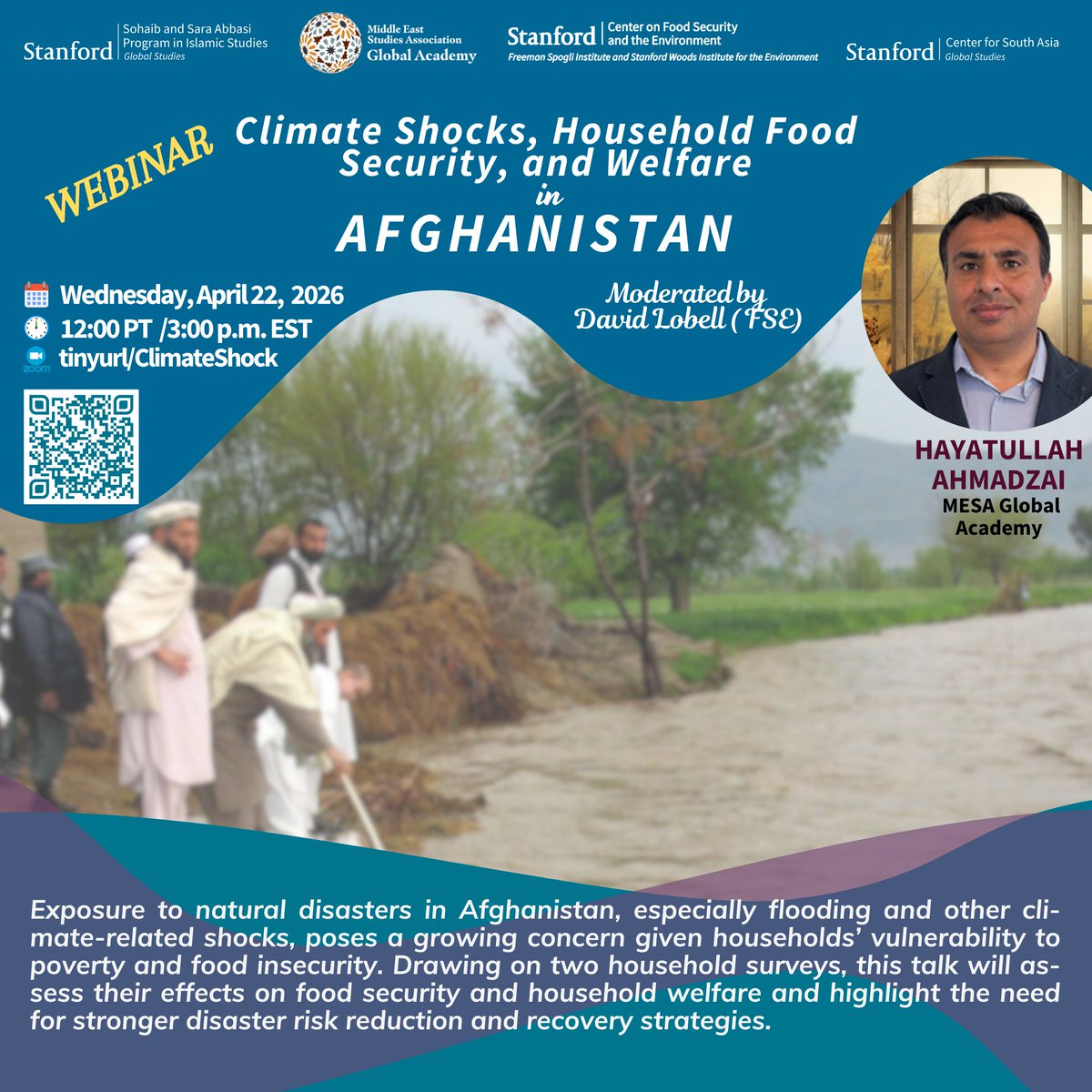
Exposure to natural disasters in Afghanistan, especially flooding and other cli-mate-related shocks, poses a growing concern given households' vulnerability to poverty and food insecurity. Drawing on two household surveys, this virtual talk will assess their effects on food security and household welfare and highlight the need for stronger disaster risk reduction and recovery strategies.
𝗛𝗮𝘆𝗮𝘁𝘂𝗹𝗹𝗮𝗵 𝗔𝗵𝗺𝗮𝗱𝘇𝗮𝗶 is an applied economist and External Research Fellow at the Centre for Research in Economic Development and International Trade (CREDIT) at the University of Nottingham, UK, and is based in North Carolina.
#AbbasiProgram #StanfordIslamicStudies #Afghanistan #ClimateChange #EnvironmentalDisasters
Hosted by: Stanford Department of Art & Art History, Abbasi Program in Islamic Studies
Akcan will introduce her new book that explores architecture’s role in healing after conflicts and disasters by discussing buildings and spaces in relation to transitional justice and energy transition. Focusing on lands held by the former Ottoman Empire and putting forth the concept of resettler nationalism as a source of partition and displacement, the book locates spaces of political and ecological harm, and advocates for healing on individual, communal and planetary levels. It construes healing as a matter of rights and a holistic notion of justice to be achieved retroactively, and calls for instituting accountability and reparations against internal social, state and business-led violence.
𝗘𝘀𝗿𝗮 𝗔𝗸𝗰𝗮𝗻 is professor and director of graduate studies in the Department of Architecture at Cornell University and the 2025-2026 Marta Sutton Weeks Fellow at @HumanAtStanford.
#AbbasiProgram #StanfordIslamicStudies #OttomanEmpire #Resettlement #StanfordArtHistory
Event sponsors: @abbasiprogram, @mideaststanford
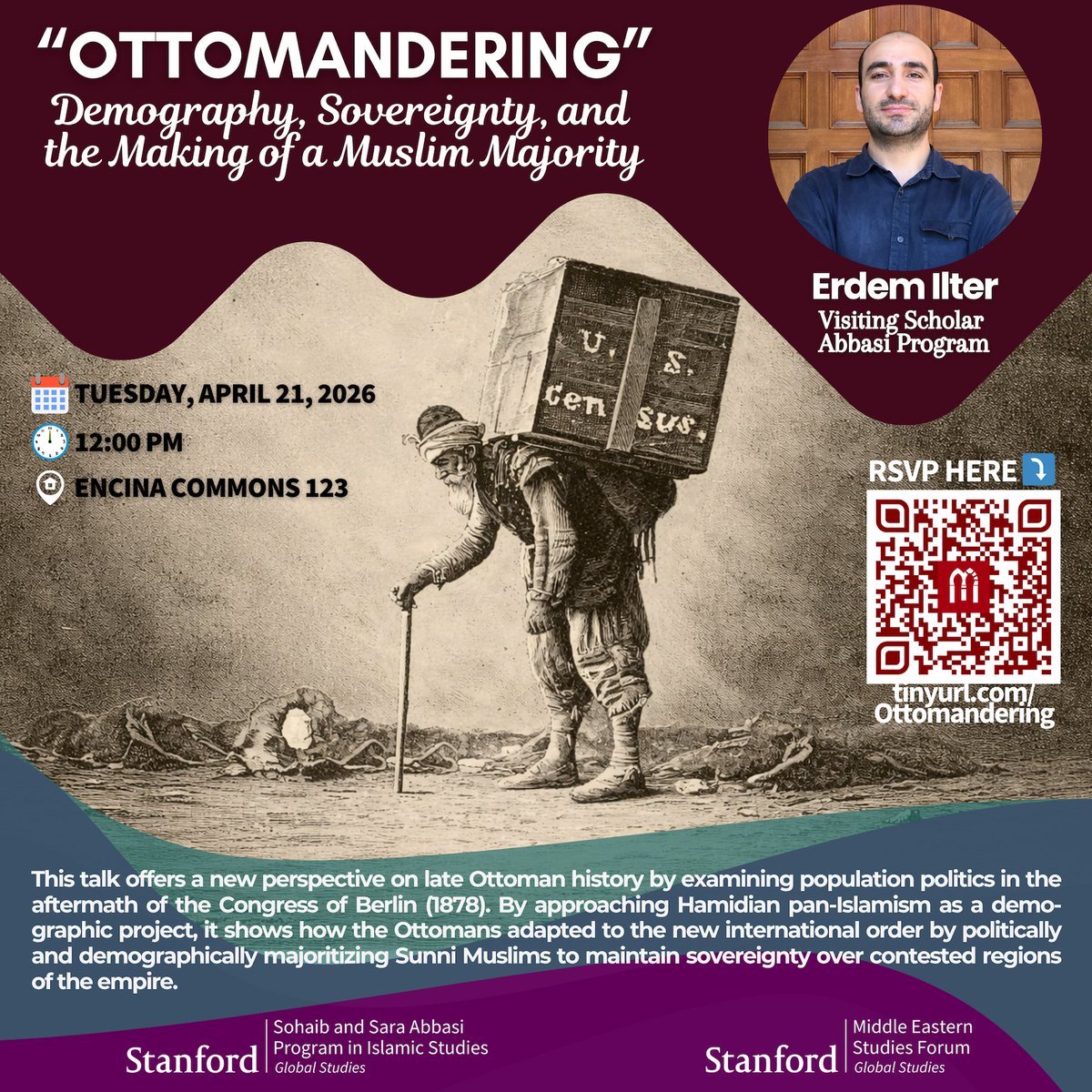
This talk offers a new perspective on late Ottoman history by examining population politics in the aftermath of the Congress of Berlin (1878). By approaching Hamidian pan-Islamism as a demographic project, it shows how the Ottomans adapted to the new international order by politically and demographically majoritizing Sunni Muslims to maintain sovereignty over contested regions of the empire.
𝗘𝗿𝗱𝗲𝗺 𝗜𝗹𝘁𝗲𝗿 is a Visiting Scholar at Stanford University’s Abbasi Program in Islamic Studies
#AbbasiProgram #StanfordIslamicStudies #Ottoman #OttomanEmpire #History
Join us for a conversation with 𝗧𝗮𝗺𝗮𝗿 𝗠𝗮𝗿𝗶𝗲 𝗕𝗼𝘆𝗮𝗱𝗷𝗶𝗮, award-winning author, editor, translator, and 𝗠𝘆𝗿𝗻𝗮 𝗗𝗼𝘂𝘇𝗷𝗶𝗮𝗻, a lecturer in the Department of Slavic Languages and Literatures at UC Berkeley. They will explore the experimental novel, 𝘢 𝘥𝘳𝘰𝘱 𝘰𝘧 𝘸𝘰𝘮𝘢𝘯: 𝘶𝘯𝘯𝘢𝘮𝘦𝘥, 𝘶𝘯𝘸𝘳𝘪𝘵𝘵𝘦𝘯, which resurrects the history left behind by the Adana massacres and illuminates the lived experiences of women shaped by its aftermath.
#AbbasiProgram #StanfordIslamicStudies #AdanaMassacres #Armenia #StanfordCREEES
🎥📜 Watch 𝗝𝘂𝗹𝗶𝗮 𝗧𝗼𝗺𝗮𝘀𝘀𝗼𝗻’s presentation on Arabic geometry in post-classical Islamicate world, examining mathematical manuscripts that demonstrate a shift away from Greek epistemologies and discursive traditions to new Islamic ones.
https://t.co/kBFHjeNe3C
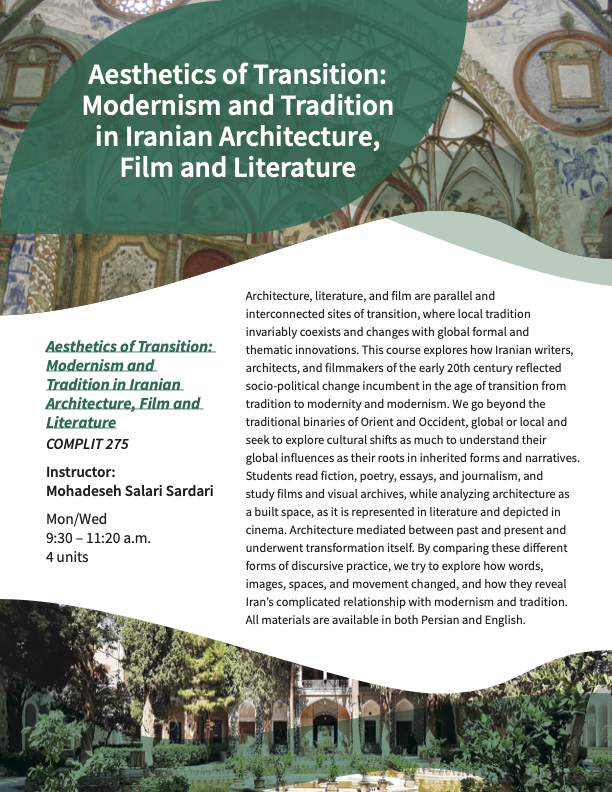
🔔📚🌸 SPRING QUARTER COURSE: 𝗖𝗢𝗠𝗣𝗟𝗜𝗧 𝟮𝟳𝟱: Aesthetics of Transition: Modernism and Tradition in Iranian Architecture, Film and Literature
🎓 Professor: Salari Sardari, M.
🗓️ Mon/Wed: 9:30 AM - 11:20 AM
✅ Units: 4
🔗 Enroll: https://t.co/MggEqPsHxR