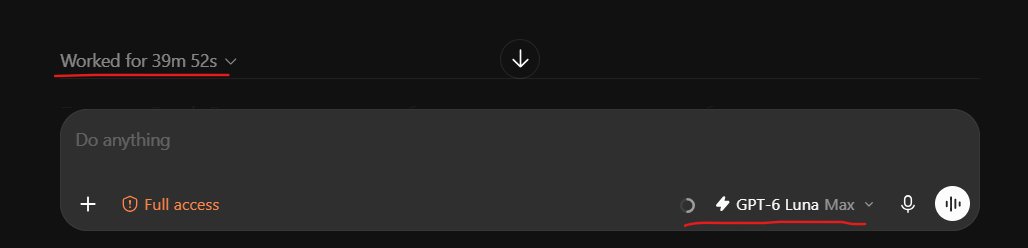
OpenAI is cooked.
They dropped all these trash “updates” and still refuse to bring back normal limits.
Oh, for those who aint knew - Chat GPT-6 (web chat model) is 6 Sol, yeah, the retarded one.
Not a 6.1, but 6 Sol. You heard me right.
since a lot of you asked and i'm not into gatekeeping, here's the skill so you can run the same workflow
people assumed i was using some dedicated upscaler. nope. i don't really like them. they're decent at textures and local detail, but once the image needs actual scene understanding, semantics, or visual reasoning, they start to fall apart
i used chatgpt 6.1 sol. catch is it's very slow. around 10 minutes for two 8k passes
the upside is you're basically throwing frontier model vision and world knowledge at the upscale, so it can reconstruct detail in a way normal super-resolution models can't
the comparison above undersells it because twitter compression absolutely nukes the fine detail obviously
paste this into codex or chatgpt work to install/use the skill:
---
name: flowers-upscale
description: Photo to 8K; 2/3-pass contextual AI crop enhancement and registered blending.
---
INPUT S=uploaded photo; missing→request. Unspecified→ask "2 passes (recommended) or 3? 8K default; another resolution?" Await choice. N=2|3; L=specified longest edge else8192; preserve aspect. Discover available AI image-editing+raster-processing capabilities; missing→report requirement. Use environment-native tools/paths; create helpers as needed. Preserve S; separate outputs. Execute end-to-end after choice.
E(C): inspect; AI-edit inputs=[S=context,C=target], maximum practical supported resolution; retain actual output dimensions. Prompt=Q+only relevant material constraints. Concurrent independent calls where supported; persist outputs+source-coordinate boxes+prompts immediately.
P1: S→3×3 cores; pad each side20% core dimension, clip to S→9 overlapping C→E→register/blend→M1; resize assembled M1 to L.
P2: M1→4–8 padded salient ROIs(face/hair/hands/objects/textiles as present)→E→register/blend→M2. Exclude low-information regions.
N=3: M2→4–8 tighter focal ROIs(individual eyes/lips/nose/fingers/material details as present)→E→register/blend→M3. Keep homologous features consistent. Every E receives S, never crop alone.
Q="1=original: identity/anatomy/color/light authority. 2=target: return exact crop/framing/geometry. Reconstruct plausible photographic detail; preserve expression, pose, contours, clothing, genuine imperfections, focus falloff. Optical clarity; natural edge transitions; spatially varied texture. Repair inherited artifacts. Skin: irregular pores/fine creases, quiet intervals. Hair: cohesive groups, selective fibers, natural sparse fringe. Iris: source color, irregular branching fibers, coherent pupil, restrained reflections. Textiles: original weave direction/spacing/motifs. Avoid invented structures/marks, beautification, relighting, halos, ringing, embossed/crosshatched/repeated texture, synthetic grain, blanket sharpening."
ASSEMBLE: map recorded boxes→master; global similarity registration first; bounded smooth local correction only with reliable correspondence, never distort rigid geometry/repeating patterns. Unreliable→retain prior pixels. Match broad exposure/color without transferring old fine texture. Normalized overlap/multiband blend; feather15–25% border→alpha0 at interior patch boundaries. Preserve native enhanced crops. Before next pass: inspect full image+100% focal/overlap crops; repair doubling/seams/drift/texture mismatch. ≤2 targeted retries/defect; rejected/failed→retain prior content+disclose.
EXPORT: M_N→lossless PNG at L; verify dimensions+decode; deliver file+preview+prompts/settings. Describe detail as reconstructed; distinguish exported resolution from native generated resolution.




![flowersslop's tweet photo. since a lot of you asked and i'm not into gatekeeping, here's the skill so you can run the same workflow
people assumed i was using some dedicated upscaler. nope. i don't really like them. they're decent at textures and local detail, but once the image needs actual scene understanding, semantics, or visual reasoning, they start to fall apart
i used chatgpt 6.1 sol. catch is it's very slow. around 10 minutes for two 8k passes
the upside is you're basically throwing frontier model vision and world knowledge at the upscale, so it can reconstruct detail in a way normal super-resolution models can't
the comparison above undersells it because twitter compression absolutely nukes the fine detail obviously
paste this into codex or chatgpt work to install/use the skill:
---
name: flowers-upscale
description: Photo to 8K; 2/3-pass contextual AI crop enhancement and registered blending.
---
INPUT S=uploaded photo; missing→request. Unspecified→ask "2 passes (recommended) or 3? 8K default; another resolution?" Await choice. N=2|3; L=specified longest edge else8192; preserve aspect. Discover available AI image-editing+raster-processing capabilities; missing→report requirement. Use environment-native tools/paths; create helpers as needed. Preserve S; separate outputs. Execute end-to-end after choice.
E(C): inspect; AI-edit inputs=[S=context,C=target], maximum practical supported resolution; retain actual output dimensions. Prompt=Q+only relevant material constraints. Concurrent independent calls where supported; persist outputs+source-coordinate boxes+prompts immediately.
P1: S→3×3 cores; pad each side20% core dimension, clip to S→9 overlapping C→E→register/blend→M1; resize assembled M1 to L.
P2: M1→4–8 padded salient ROIs(face/hair/hands/objects/textiles as present)→E→register/blend→M2. Exclude low-information regions.
N=3: M2→4–8 tighter focal ROIs(individual eyes/lips/nose/fingers/material details as present)→E→register/blend→M3. Keep homologous features consistent. Every E receives S, never crop alone.
Q="1=original: identity/anatomy/color/light authority. 2=target: return exact crop/framing/geometry. Reconstruct plausible photographic detail; preserve expression, pose, contours, clothing, genuine imperfections, focus falloff. Optical clarity; natural edge transitions; spatially varied texture. Repair inherited artifacts. Skin: irregular pores/fine creases, quiet intervals. Hair: cohesive groups, selective fibers, natural sparse fringe. Iris: source color, irregular branching fibers, coherent pupil, restrained reflections. Textiles: original weave direction/spacing/motifs. Avoid invented structures/marks, beautification, relighting, halos, ringing, embossed/crosshatched/repeated texture, synthetic grain, blanket sharpening."
ASSEMBLE: map recorded boxes→master; global similarity registration first; bounded smooth local correction only with reliable correspondence, never distort rigid geometry/repeating patterns. Unreliable→retain prior pixels. Match broad exposure/color without transferring old fine texture. Normalized overlap/multiband blend; feather15–25% border→alpha0 at interior patch boundaries. Preserve native enhanced crops. Before next pass: inspect full image+100% focal/overlap crops; repair doubling/seams/drift/texture mismatch. ≤2 targeted retries/defect; rejected/failed→retain prior content+disclose.
EXPORT: M_N→lossless PNG at L; verify dimensions+decode; deliver file+preview+prompts/settings. Describe detail as reconstructed; distinguish exported resolution from native generated resolution.](https://pbs.twimg.com/media/HUCyASOWgAA8nyS.jpg)