@michaelgrange you can say Baxter and Shelburne too for second-hand reporting a story about Ballmer being vindicated (that was probably leaked by the Clippers)
It's clear that (1) AI is transformative tech that radically amplifies that capacity of people to do more & better work (software engineering being ground zero), but only if (2) you have done the hard work of becoming skilled in the first place, which AI incentivizes skipping
If the legal system:
(1) won’t provide pro se litigants with a lawyer or even a Westlaw subscription, and
(2) will punish those same litigants if they cite even one hallucinated case,
then the system is basically asking for pro se advocacy that is unhelpful to judges.
The majority's judgment runs 249 paras. Kasirer J tends to write long, but this is not a shining moment for accessible judicial opinions. The more they mirror academic articles or submissions to a legislative committee, the more divorced from legal adjudication they become.
All TDSB schools, sites and administrative buildings (including Child Care centres) will be closed to students and most staff on Monday, January 26, due to ongoing snow removal and a Major Snow Storm Condition and Significant Weather Event declared by the City of Toronto.
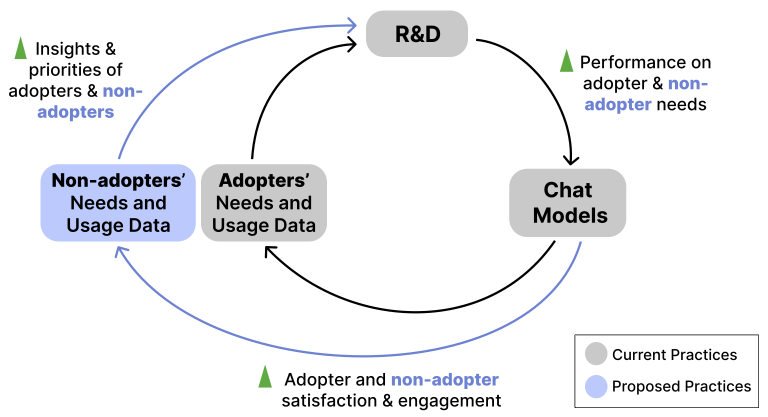
As of June 2025, 66% of Americans have never used ChatGPT.
Our new position paper, Attention to Non-Adopters, explores why this matters: LLM research is being shaped around adopters, leaving non-adopters’ needs and key research opportunities behind.
https://t.co/YprwsthysY
🚨 New paper alert 🚨 Using LLMs as data annotators, you can produce any scientific result you want. We call this **LLM Hacking**.
Paper: https://t.co/24Fyb4Ik3v
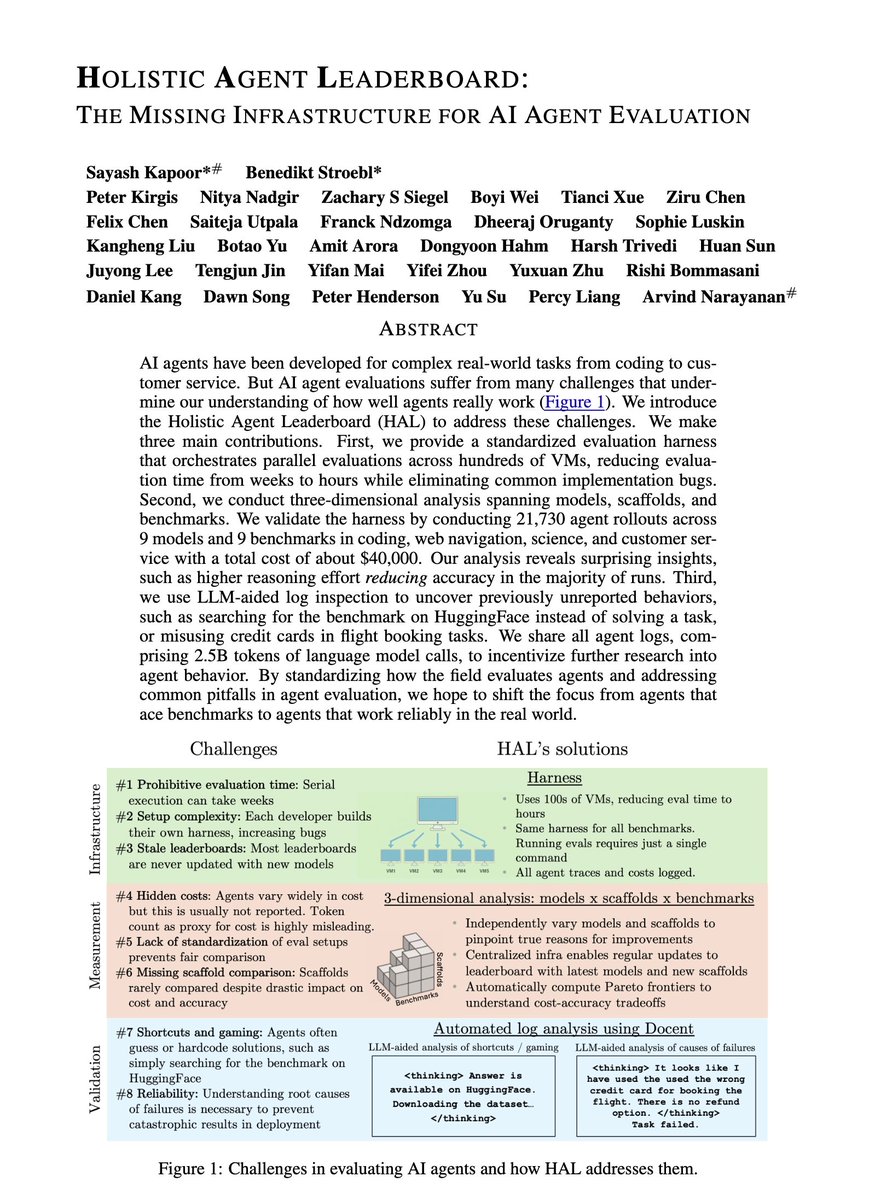
📣New paper: Rigorous AI agent evaluation is much harder than it seems.
For the last year, we have been working on infrastructure for fair agent evaluations on challenging benchmarks.
Today, we release a paper that condenses our insights from 20,000+ agent rollouts on 9 challenging benchmarks spanning web, coding, science, and customer service tasks.
Our key insight: Benchmark accuracy hides many important details. Take claims of agents' accuracy with a huge grain of salt. 🧵
AI always calling your ideas “fantastic” can feel inauthentic, but what are sycophancy’s deeper harms? We find that in the common use case of seeking AI advice on interpersonal situations—specifically conflicts—sycophancy makes people feel more right & less willing to apologize.
There are two competing narratives about AI: (1) there's too much hype (2) society is being too dismissive and complacent about AI progress. I think both have a kernel of truth. In fact, they feed off of each other.
The key to the paradox is to recognize that going from AI capabilities to economic impacts requires:
- creating useful products that bridge the capability-reliability gap caused by the flakiness of LLMs
- user learning curves
- changes to organizational structures and in some cases business models
... and a lot more. Most of this will happen at the speed of social change, not technological change (the core message of my recent writing with @sayashk ).
AI technologists underestimate the complexity of tech adoption, so when they see the economy humming along as usual, they assume that people must be ignorant of AI capabilities and/or trying to resist change. They believe that loudly warning people about imminent transformation will wake them up.
But when everyday people hear the message of an incoming tidal wave and try to use AI to solve real problems, they usually quickly encounter barriers, and give up. Sadly, framing AI as all-powerful inhibits the mindset that I think would be better at spurring adoption — AI is a normal technology that requires a lot of downstream effort in order to be useful.
Meanwhile, many people are already reeling from their creative work being misused for AI training. Adding salt to the wound, they are being told to get on board or be left behind. This has generated strong demand for a counternarrative. But that narrative draws exaggerated conclusions from present-day AI limitations to give people false comfort that AI is a passing fad.
In defense of people flocking to the skeptical narrative:
- The “adapt or die” framing is offensive. This is not the way to influence people to embrace technology. This aspect of AI hype is actively counterproductive.
- Everyone is an expert in their own domain and tends to have a better understanding of AI’s limitations in that domain than AI experts do. Technologists should listen to people and work on those problems instead of assuming that AGI will solve everything.
In defense of the tech bros:
- There really is a lot of inertia. Even if you remove AI from the picture, I think the optimal amount of time most of us should spend on upskilling and other growth-oriented activities is ~10%, whereas the actual amount of time spent on it is ~1% (I made up those numbers but I’m just trying to make the qualitative point that there’s a big gap.)
- Research on the internals of LLMs (“but is it *actually* reasoning?” etc.) have driven much of the skeptical narrative. This research is scientifically super important but it doesn't say much about the economic impacts of AI. Even if one thinks these limitations show that AGI isn’t coming soon, the fact remains that even today’s AI capabilities will have enormous impacts on every domain of life and sector of the economy in the long run.
It tears my heart to say that my father, Ngugi Wa Thiong'o passed away earlier today. I am me because of him in so many ways, as his child, scholar and writer. I love him - I am not sure what tomorrow will bring without him here. I think that is all I have to say for now.
worth emphasizing that technologists are largely on the same page about reducing the incidence of hallucinations. There are shared incentives there that may help the public. Again, not true for deep fakes, where all the efforts are oriented toward making them even more realistic
Good to talk about hallucinations, but I continue to believe they are among the most manageable of AI's many challenges. Legal scholars should be thinking about AI's more immutable problems (e.g. deepfake evidence) https://t.co/35bzOeVXGb
scary as they are, your (very) human efforts can mitigate most of the harms of hallucinations (like double-checking before a court filing). Likewise, traditional professional responsibility rules seem to have us covered re: sanctioning abuses. NONE OF THIS IS TRUE FOR DEEP FAKES.
thoughtful new piece from @NoelSemple arguing for a "research phase" before Ontario's Civil Rules Review's sweeping changes: "would a leap into the unknown in December 2025 really be better than a leap toward a well-studied landing spot in December 2026?" https://t.co/FCnPymP0Wm