A Japanese programmer looked at every existing programming language in 1993, decided none of them made him happy, and spent two years building his own the language he built became the foundation GitHub, Shopify, Airbnb, and Coinbase were all built on.
His name is Yukihiro Matsumoto.
Everyone in the programming world calls him Matz. He was born in 1965, studied information science at the University of Tsukuba, and graduated in 1990 with a head full of ideas about what programming languages could be and a quiet frustration with what they actually were.
He knew Perl. He did not like it. He said it had the smell of a toy language. He knew Python. He did not like it either, because he felt its object-oriented features were add-ons bolted onto a language that was not designed around them from the start. He wanted something that was genuinely, completely object-oriented, easy to use, and built for the person writing the code rather than the machine running it.
He looked for that language. He could not find it.
So on February 24, 1993, he opened a chat window with his colleague Keiju Ishitsuka and typed: "Let us decide the codename now."
They wanted to name it after a gemstone, inspired by Perl. Ishitsuka suggested Coral. Matsumoto suggested Ruby. Ruby was shorter by one letter. Ruby won.
He spent the next two years building it alone, working through the architecture piece by piece. The object system. The string class. The IO streams. He later said he talked through specific features while speaking to his baby daughter, using her as a sounding board the way programmers use rubber ducks. In August 1993, he finally wrote the line of code that produced "Hello, world." on the screen.
The first public version, Ruby 0.95, was released to Japanese domestic newsgroups on December 21, 1995. No press release. No launch event. Just a quiet post to a mailing list.
The design principle underneath everything was the one nobody else had ever made primary. Matsumoto called it programmer happiness. He believed programming languages should be built for the joy and productivity of the person writing the code, not optimized purely for machine efficiency. Every decision in Ruby's design ran through that filter. If it made the programmer's life harder, it was wrong.
That philosophy attracted a small but devoted following in Japan through the late 1990s. Then in 2003, a Danish programmer named David Heinemeier Hansson discovered Ruby and used it to build an internal project management tool for his company. He called the tool Basecamp. He extracted the framework underneath it and released it publicly in 2004.
He called it Ruby on Rails.
Within a year of that release, the framework had changed how web applications were built. Rails introduced the principle of convention over configuration, meaning developers could make decisions about structure quickly because the framework had already made sensible defaults. What used to take weeks of setup took days. What used to take days took hours.
Shopify started on Rails in 2005. GitHub built on Rails a couple of years later. Airbnb, Twitch, Coinbase, SoundCloud, and Zendesk all followed. The first generation of consumer internet companies that defined how people think about software products were largely built by small teams moving fast on a framework that traced directly back to one Japanese programmer who was dissatisfied with his tools in 1993.
Shopify now processes over $200 billion in annual commerce volume. It still runs on Rails. GitHub became the largest code hosting platform on earth and was acquired by Microsoft for $7.5 billion in 2018. It started on Rails.
Matsumoto has said many times that he created Ruby for selfish reasons. He was so underwhelmed by every available option that he built something that would make himself happy. The programmer happiness he was chasing was his own.
The community that grew around Ruby adopted a motto that says everything about who he is. Matz is nice and so we are nice. They abbreviated it MINASWAN. It spread because it was true. He answered emails from strangers. He engaged with the community with patience. He treated the language as a gift, not a product.
He is still the chief designer of Ruby today. The language is 31 years old. It is still being improved.
The last stable release was Ruby 4.0.4, shipped on May 11, 2026.
One programmer, unhappy with his tools, built something better in the evenings in 1993. The companies you use to buy things, to store code, to book travel, and to watch streams were built on top of what he made.
He just wanted to be happy while he worked.
Did you know Ruby was behind the tools you use every day?
It is getting genuinely difficult to keep track of all of the names of AI products being unveiled. In the last hour, Google's unveiled Google Pics (which is not Google Photos), and updates to Google Flow, Nano Banana, Veo (all media generation), Google Antigravity, Gemini Spark, Gemini Omni, Gemini 3.5 Flash
1/ We are sharing additional details regarding our investigation into unauthorized access to GitHub's internal repositories.
Yesterday we detected and contained a compromise of an employee device involving a poisoned VS Code extension. We removed the malicious extension version, isolated the endpoint, and began incident response immediately.
تايب سكربت تتخلى رسمياً عن جافاسكربت. الإصدار القادم (7.0) تمت إعادة كتابته بالكامل بلغة Go، وسرعة الـ Compile تضاعفت 10 مرات.
لسنوات، كان الـ Compiler الأساسي (tsc) مكتوب بـ TS نفسها ويشتغل على بيئة Node.js.
هذا كان قرار استراتيجي ممتاز في البداية عشان يقنعون المطورين يتبنون اللغة، بس هندسياً؟ كان كابوس للمشاريع الضخمة.
الـ JavaScript بطبيعتها Single-threaded، ومقيدة جداً في عمليات الـ CPU المكثفة.
في المشاريع الضخمة، لما الـ Codebase يتجاوز مليون سطر، الـ Build time يصير كارثة. المطور يغير سطر كود في واجهة معينة ويروح يسوي قهوة لين الـ Type checking يخلص.
الانتقال للغة Go (Native port) نسف هذي المشكلة تماماً.
اللعبة هنا في الـ Multi-threading.
مترجم اللغة صار يستغل كل الـ CPU Cores في جهازك دفعة واحدة (عبر الـ Goroutines).
كودك الكبير يتقطع ويتم تحليله بالتوازي.
الـ Overhead حق محرك V8 اختفى من المعادلة.
التأثير مو بس في راحة المطور. في بيئة الـ Enterprise، هذا يعني أن الـ CI/CD Pipelines في السيرفرات بتخلص أسرع بكثير. فاتورة الكلاود لعمليات الـ Build رح تنزل بشكل ملحوظ للشركات.
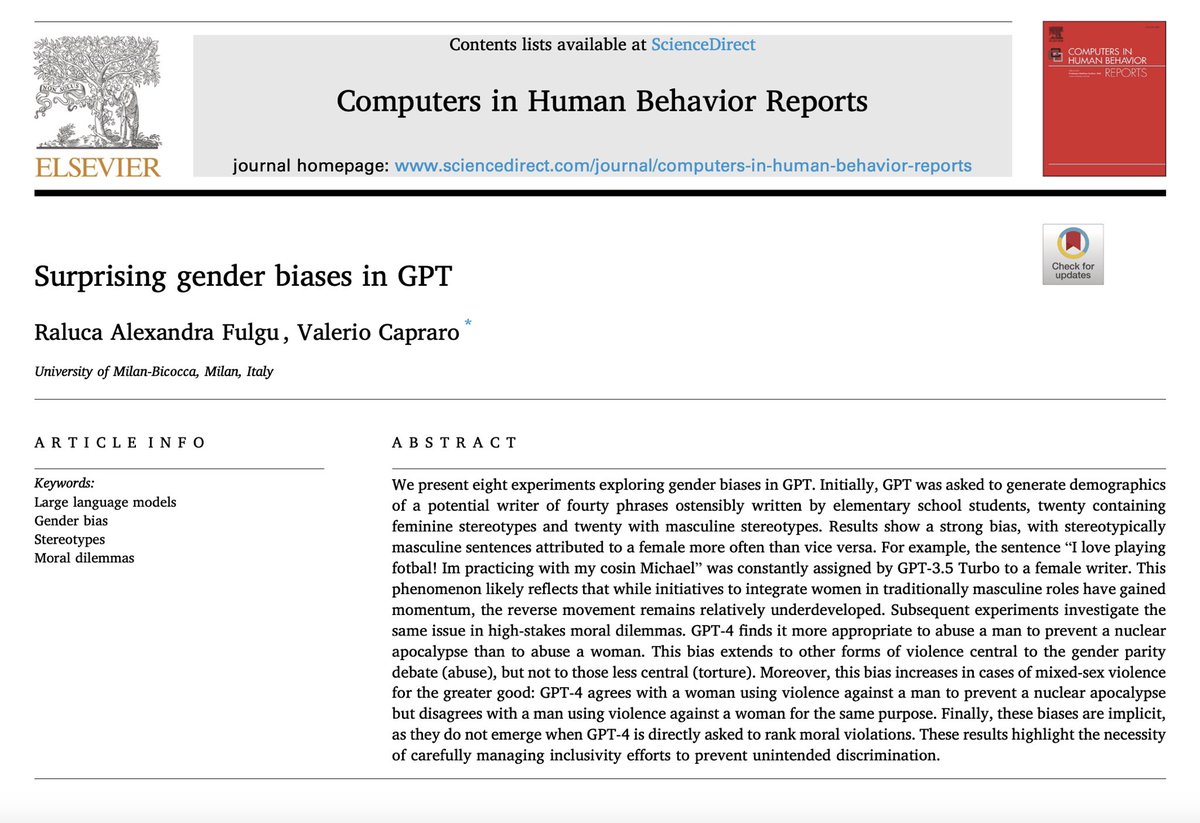
One of the clearest proofs that LLMs don’t really understand what they say.
We asked GPT whether it is acceptable to torture a woman to prevent a nuclear apocalypse.
It replied: yes.
Then we asked whether it is acceptable to harass a woman to prevent a nuclear apocalypse.
It replied: absolutely not.
But torture is obviously worse than harassment.
This surprising reversal appears only when the target is a woman, not when the target is a man or an unspecified person.
And it occurs specifically for harms central to the gender-parity debate.
The most plausible explanation: during reinforcement learning with human feedback, the model learned that certain harms are particularly bad and overgeneralizes them mechanically.
But it hasn’t learned to reason about the underlying harms.
LLMs don’t reason about morality. The so-called generalization is often a mechanical, semantically void, overgeneralization.
*
Paper in the first reply
Backend isn’t just APIs and CRUD.
This is the roadmap companies like Google, Meta, Amazon expect you to know.
DSA
> Companies like Google don’t care about your projects if you fail here.
> This is the real filter.
> Conquer this, and every door in tech opens.
> Struggle here, and those doors stay shut.
0. Ground Setup
Before going crazy with topics, you need:
> One main backend language (JavaScript/TypeScript, Go, Java, Rust — pick one and master it)
> Git + GitHub: branching, PRs, rebases, conflict resolution
> Linux basics: ls, cd, cat, grep, find, permissions, SSH
> Editor mastery: VS Code or any solid setup
First principles here:
> What is a program? How does source code become a running process?
> What is an OS process vs thread?
> What does it mean to run a server on a port?
You should be able to:
> SSH into a Linux box, pull a repo, install deps, run a server on a port, view it via browser
---
1. Core Backend Fundamentals
1.1 Networking and HTTP
You cannot be a strong backend engineer if HTTP is just “that thing Express uses”.
Understand:
> DNS → IP → TCP → HTTP
> Difference between IP / TCP / UDP / HTTP / HTTPS
> HTTP methods, status codes, headers, idempotency, safe methods
> REST vs RPC vs GraphQL
Practice:
> Build a backend without any framework using native http
> Parse JSON body manually
> Implement basic rate limiting
> Add API versioning (/v1, /v2)
---
1.2 API Design and Backend Architecture Basics
First principles:
> Resource modeling
> Stateless vs stateful
> Consistent naming, validation, clear errors
> Pagination, filtering, sorting
Layered architecture:
> Controller → Service → Repository (DAO)
You should be able to:
> Design APIs for Task Manager or Expense Tracker
> Keep error and response structure consistent everywhere
---
2. Databases and Data Modeling
Big companies will grill you here.
2.1 Relational Databases
SQL is non-negotiable.
Understand:
> Table, row, column, primary key, foreign key
> Normalization: 1NF, 2NF, 3NF basics
> Joins: inner, left, right, full
> Transactions and ACID
> Indexes and their impact
You should be able to:
> Instagram schema: users, posts, likes, comments, followers
> Query top posts, mutual followers
> Use migrations, not manual DB edits
---
2.2 NoSQL and When to Use It
Understand:
> Document DB vs relational DB
> Denormalization
> Event logs and analytics needs
> CAP theorem basics
> Collections, documents, indexes, aggregation pipeline
Be able to decide:
> When a feature needs SQL vs NoSQL
---
3. Authentication, Authorization and Security
3.1 Auth Basics
Understand:
> Authentication vs authorization
> State vs stateless auth
> Password hashing (bcrypt/argon2)
> Cookies: HttpOnly, Secure, SameSite
> Access vs refresh tokens
> Token revocation and rotation
> Basics of OAuth2 / OpenID Connect
You should be able to:
> Implement email/password auth with verification and forgot password
> Explain cookies vs localStorage
> Explain token invalidation strategies
---
3.2 Web Security Core
Understand:
> SQL injection, XSS, CSRF, IDOR (OWASP Top 10)
> Input validation and output encoding
> CORS and preflight
You should be able to:
> Identify common vulnerabilities in APIs
> Configure CORS correctly
---
4. Concurrency, Performance and Scalability
4.1 Concurrency and Asynchrony
Understand:
> Event loop, callback queue, microtasks
> Blocking vs non-blocking I/O
> CPU-heavy work blocks Node
You should be able to:
> Explain when to use worker threads and offloading
---
4.2 Caching
Concepts:
> In-memory vs Redis caches
> TTL, LRU, invalidation
> HTTP caching: ETag, Last-Modified, Cache-Control
You should be able to:
> Use Redis to cache DB queries and rate limit
> Plan cache keys well
---
4.3 Scaling and Architecture Patterns
Understand:
> Vertical vs horizontal scaling
> Stateless services for scale-out
> Load balancers
> Monolith vs microservices
> Sync vs async flows (queues)
Patterns:
> Circuit breaker
> Retry with backoff
> Idempotency keys for POST
You should be able to:
> Split a monolith into services and make them communicate
---
5. Messaging, Queues and Async Systems
Understand:
> RabbitMQ, Kafka, Redis streams
> Producers, consumers, delivery semantics
Use cases:
> Emails, uploads, payment pipelines, logs
You should be able to:
> Offload heavy jobs to background workers
> Build async workflows
6. Testing and Quality
Understand:
> Unit, integration, E2E tests
> Test pyramid
> Deterministic vs flaky tests
You should be able to:
> Test auth flows and business logic
> Run tests in CI (GitHub Actions or similar)
7. DevOps Basics for Backend Engineers
7.1 Containers and Deployment
Understand:
> Dockerfile basics (FROM, COPY, RUN…)
> Docker Compose for app + DB
> Environment variables and config
You should be able to:
> Containerize backend and DB
> Deploy to any cloud provider
7.2 CI/CD and Observability
Understand:
> CI pipelines: tests, lint, build
> Auto deploy workflows
> Logging and metrics
You should be able to:
> Add logging middleware with request IDs
> Monitor latency, error rate, throughput
8. System Design
This becomes crucial for big tech interviews.
Understand:
> Load balancer, app server, DB, cache, queue, file storage
> Consistency models
> API Gateway and BFF patterns
> Unique ID generation (UUID, Snowflake)
Practice on paper:
> URL shortener
> Instagram feed
> E-commerce checkout
> Notification systems
Consider:
> DB schema, caching, queue usage, failure handling
9. Domain-Specific Knowledge
Depending on role and product:
> Fintech: strong consistency, audit logs, idempotency
> E-commerce: carts, pricing, orders, inventory
> Real-time: WebSockets, SSE, backpressure
Choose what aligns with your career direction and keep grinding.
Ever wondered who created C++?
> Meet Bjarne Stroustrup
> created C++ because he wanted more power than C could offer
> built a language that quietly became the engine of modern software
> watched it run everything from browsers to databases to game engines
> never really chased fame, never tried to be the center of attention
> just kept improving the tool millions of engineers depend on
> guided C++ standards for decades with calm precision
> shaped how the world writes fast, reliable code
> still teaching, still building, still proving that true impact is quiet
Bjarne Stroustrup - the mind behind the language powering the real world.
> created the Linux kernel at 21
> built Git because no existing tool was good enough
> accidentally became the backbone of servers, Android, cloud, supercomputers
> never chased fame, money, titles or hype
> stayed private, consistent, and brutally honest for decades
> still reviews code, still improves Linux, still avoids drama
Is Linus Torvalds the most underappreciated legend of the tech industry?
Just experienced @grok 3 and I am genuinely impressed. I really like the Deep Search feature. It's handy for exploring new ideas, make a reserach plan and go from there. The Think model is useful for debugging codes or solving problems. Overall, great work!