The notion that your doctor's training is an indicator of their skill is a fallacy. There is no medical school, residency or fellowship that always produces flawless doctors. Any graduate of any training program is capable of making mistakes. I've seen big saves and huge errors in doctors from Harvard. Also seen big saves and enormous errors in community docs who trained miles from Ivy league hospitals outside the US.
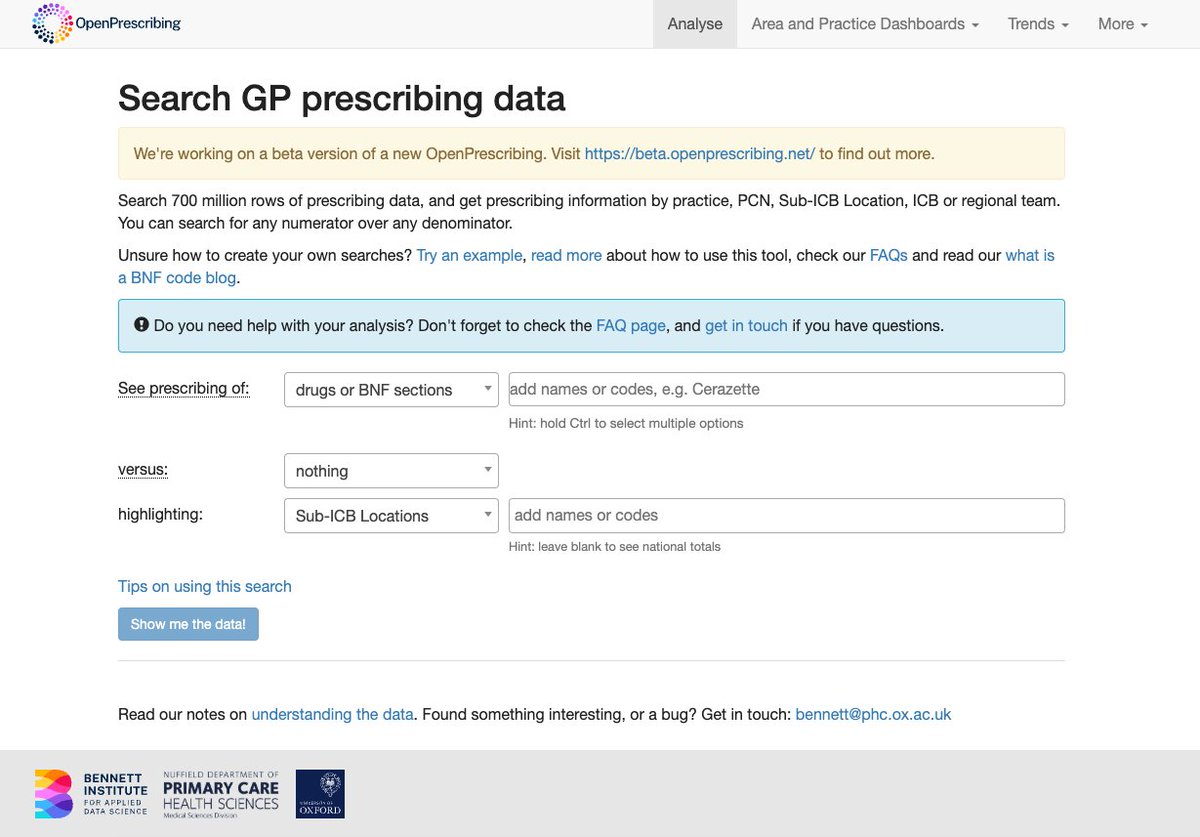
A team at Oxford built a search engine for every drug the NHS prescribes, and it has quietly saved the health service millions.
It's called OpenPrescribing.
The NHS publishes its full prescribing dataset every month. It's 700 million rows of raw numbers nobody could actually read. So Oxford built a tool that turns it into live charts in seconds.
You type a drug name. It shows you which practices over-prescribe it, which regions are slow to follow new guidelines, and where the money is being wasted.
→ Search any drug across any GP practice in England
→ Find safety and cost outliers instantly
→ 70+ ready-made quality measures
→ Updates monthly, automatically
→ Free, open source, MIT licensed
20,000 people use it every month. Doctors. Researchers. Journalists.
Public data that sat unreadable for years is now one search away.
https://t.co/U9KI0mUCAp
👀 Anthropic quietly released an official plugin that scans your project and auto-sets up hooks, skills, MCP servers, subagents, and automations. Most people are only using Claude Code at 20% of its potential.
We’ve shipped a security-guidance plugin for Claude Code that helps identify and fix vulnerabilities as you’re writing code.
Available for all Claude Code users. Install from the plugin marketplace (/plugins).
Claude Code feels completely different once you install this.
Anthropic quietly released an official plugin called claude-code-setup and it basically turns Claude Code from “pretty good” into an actual AI dev environment.
It scans your project and recommends:
→ hooks
→ skills
→ MCP servers
→ subagents
→ automations
Then sets everything up step-by-step for you.
Most people are using Claude Code completely vanilla…
which is why their experience feels messy.
The real power comes from the ecosystem around it.
Install:
/plugin install claude-code-setup@claude-plugins-official
Bookmark this before you forget it.
British consultant billing £650K/year.
HMRC took £287K.
His plan: "I'll become a non-dom."
Non-dom rules got gutted in 2025.
We moved him to Dubai.
No personal income tax.
He invoices through a US LLC.
Banks in Singapore.
Assets in a Nevis trust.
From £287K in tax to £0.
His old accountant said "you'll get caught."
Caught doing what? Being legal?
KIMI FOUNDER JUST DROPPED A 40-MINUTE MASTERCLASS.
The exact architecture behind a $20B valuation — there's no faster way to learn how to build AI agents right now.
Bookmark this for the weekend.
40 minutes. zero fluff. from the person who built it.
Optimization → Linear Attention → Sub-Agents → Open Systems → Cash
CLAUDE CODE CAN NOW PULL LIVE DATA FROM 17,000+ STOCKS, CRYPTO PRICES, AND FINANCIAL STATEMENTS IN SECONDS.
One command. 60 seconds. Done.
Here is the exact setup:
Step 1: Open Claude Code and paste this:
claude mcp add --transport http financial-datasets https://t.co/cupUKrWK0C
Step 2: Authenticate
Type `/mcp` inside Claude Code and complete the OAuth flow in your browser.
Verify the connection anytime:
claude mcp list
Step 3: Start prompting
- "What is Apple's current P/E ratio and market cap?"
- "Show me Tesla's income statement for the last 4 quarters."
- "How has Bitcoin's price changed over the past year?"
That is it.
Claude Code now has direct access to real financial data across 17,000+ stocks, earnings reports, balance sheets, income statements, cash flow data, and crypto prices.
The analysts paying $24,000 a year for a Bloomberg Terminal are not going to be happy this exists.
Before this you needed a Bloomberg Terminal or a complex financial data API or hours of manual research across multiple sources.
Now you need one command and 60 seconds.
The quants, analysts, and portfolio managers who figure out how to combine Claude Code's reasoning with live financial data access will have a research edge that compounds every single day.
Bookmark this before you open your next brokerage account.
Docs if you run into errors: https://t.co/CgF6B3dS5V
Follow @cyrilXBT for every Claude Code integration that changes how you work with data.
THE CREATOR OF MCP JUST SHOWED YOU HOW TO ACTUALLY BUILD WITH IT.
18 minutes. Free. Straight from Anthropic.
You've been using Claude without knowing 50 of its plugins exist.
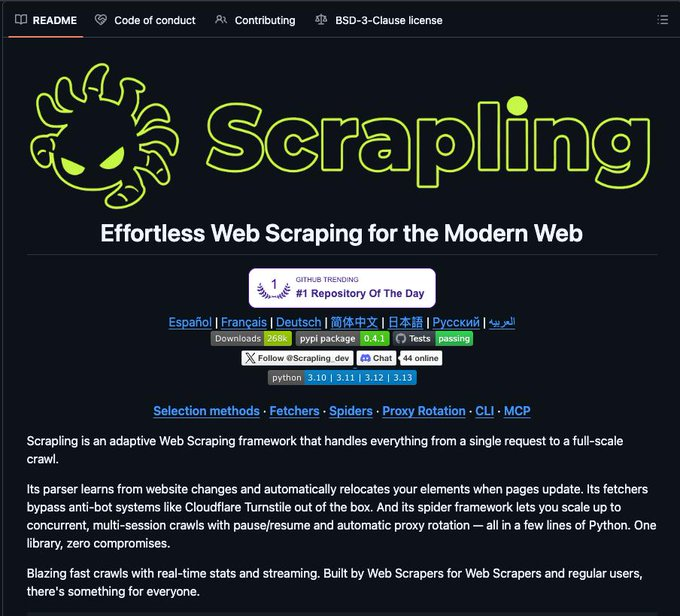
YOUR AI AGENT CAN FINALLY SCRAPE WEBSITES WITHOUT GETTING BLOCKED
- Zero bot detection
- Bypasses Cloudflare naturally
- 774 times faster than BeautifulSoup
- No need for selector maintenance
GitHub: https://t.co/4REiEjgaed
Andrej Karpathy just sat down and built GPT from scratch, line by line, in 2 hours.
For Free. From the man who co-founded OpenAI.
This video is enough to become an AI engineer.
Bookmark it. Watch it tonight. Build your own GPT this week.
$5,000. $15,000. $40,000.
That's what bootcamps charge to teach less than what's in this 2-hour video.
This video fixes that this week.
Follow @codewithimanshu for more high-signal AI content that actually moves your engineering career forward.
↓
Karpathy doesn't explain GPT. He builds it.
Live. From "Attention is All You Need" the original paper. To the same architecture powering GPT-5.
Founding member of OpenAI in 2015. Senior Director of AI at Tesla. Now running Eureka Labs.
He's not teaching you how to use GPT. He's teaching you how it actually works at the source code level.
Most engineers will never understand transformers this deeply. The ones who do build the next generation of AI products.
Follow @codewithimanshu for breakdowns of every must-watch AI lecture worth your time.
↓
Here's what gets built in 2 hours. No fluff.
Tokenization and data loading.
The foundation of every modern LLM. Train/val splits done right. Batch loaders that don't break in production.
Most tutorials skip this. You can't ship anything serious without it.
The bigram baseline.
The simplest possible language model. Karpathy builds it first because it teaches you what every fancier model is actually trying to improve.
Once you understand bigrams, transformers become obvious. Skip this and the rest never clicks.
Follow @codewithimanshu for daily breakdowns of what AI engineers actually need to know.
↓
Self-attention. From scratch. Live.
This is the section that should have its own course.
Karpathy builds self-attention in 4 versions:
> Version 1: averaging past context with for loops
> Version 2: matrix multiply as weighted aggregation
> Version 3: adding softmax
> Version 4: full self-attention
Each version teaches you why the next one exists. Why attention works. Why matrix math replaces explicit loops. Why scaling matters.
You'll never look at "attention is all you need" the same way again.
Follow @codewithimanshu for production transformer breakdowns weekly.
↓
The 6 attention notes that change everything.
Karpathy drops 6 insights most engineers never hear:
> Attention as communication between tokens
> Attention has no notion of space, operates over sets
> No communication across batch dimension
> Encoder blocks vs decoder blocks
> Attention vs self-attention vs cross-attention
> Why we divide by sqrt(head_size)
Each one of these explains a different failure mode in production AI systems.
Most "AI engineers" can't answer these. The ones who can charge $300K.
Follow @codewithimanshu for the engineering insights that turn into job offers.
↓
Building the full transformer block.
Single self-attention head. Then multi-headed self-attention.
Feedforward layers. Residual connections. LayerNorm.
Each piece added with the reason it exists. Why residuals stop the model from collapsing. Why LayerNorm replaced BatchNorm. Why dropout matters at scale.
This is the architectural understanding that lets you debug any modern AI system.
Once you've built one transformer by hand, every paper you read becomes 10x clearer.
Follow @codewithimanshu for transformer architecture content every week.
↓
Scaling up to a real model.
Karpathy goes from baseline to a working GPT.
Hyperparameters. Dropout. Model dimensions. The exact tradeoffs every production model makes.
By the end you have a Shakespeare-generating language model running on your machine. From scratch. Built by you. Understood by you.
That's not a tutorial. That's an architectural unlock.
Follow @codewithimanshu for production model scaling breakdowns.
↓
Encoder vs decoder vs both.
The architecture choice that defines every modern AI product.
Why GPT is decoder-only. Why BERT is encoder-only. Why translation models use both.
Once you understand this, you can read any AI paper and immediately know what kind of system you're looking at.
This is the difference between someone who follows AI hype and someone who builds it.
Follow @codewithimanshu for AI architecture deep dives weekly.
↓
NanoGPT walkthrough.
Karpathy ends with a quick walk through nanoGPT. The repo every serious AI engineer has cloned at least once.
Batched multi-headed self-attention. Production-grade code. The clean version of everything you just built.
This is the bridge from "I built a toy GPT" to "I can read and modify production AI code."
Follow @codewithimanshu for repos every AI engineer should know.
↓
ChatGPT, pretraining, finetuning, RLHF.
The video closes with the full lineage. From your toy GPT to ChatGPT.
What changes when you scale up. Why RLHF matters. The exact path from research model to product.
You finish the video understanding the entire stack from raw paper to deployed product.
Most "AI experts" can't draw this map. After 2 hours, you can.
↓
What you'll be able to do after this.
Read "Attention is All You Need" and understand every line.
Debug attention layers when they break in production.
Build a custom language model on your own dataset.
Modify transformer architectures for specific use cases.
Have technical conversations with AI engineers without faking it.
Train a GPT on any data you want. Shakespeare. Code. Your own writing.
That's not "AI literacy." That's the foundation of an AI engineering career.
The kind of foundation that turns into senior roles and consulting contracts most people will never access.
↓
2 hours. Free. From the engineer who built it.
You'll spend longer in meetings this week and learn nothing.
This compounds for the rest of your career.
People who watch it can build GPT from scratch by Friday.
People who skip it stay confused about why their prompts fail in production.
Save the video. Watch it this week. Build something with the knowledge by the weekend.
Follow @codewithimanshu for more high-signal AI content from the people actually building the future.
Holy shit...someone just built Andrej Karpathy’s idea into a real product… and it’s wild.
This /autobrowse skill doesn’t just run browser tasks.
It learns how to succeed.
Give it anything: → book a flight
→ scrape a site
→ add to cart
It: tries → fails → reads the trace → updates strategy → retries
Until it figures out a workflow that actually works.
Then it turns that into a reusable skill.
So instead of:
write scripts → debug forever → break again
You get:
run once → let it learn → reuse forever
This is the shift:
From “execute instructions”
To “discover the best way to execute”
Most agents today fail because they don’t learn.
This one does.
Every run = smarter system.
Bookmark this.
Retweet before this becomes the default way agents are built.
Why is no one talking about this?
@nvidia is offering around 80 AI models via hosted APIs absolutely for free.
You get access to MiniMax M2.7, GLM 5.1, Kimi 2.5, DeepSeek 3.2, GPT-OSS-120B, Sarvam-M etc.
This plugs straight into OpenClaude, OpenCode, Zed IDE, Hermes agent and even with Cursor IDE.
Setup:
– Grab API key: https://t.co/Wfdclm0hY2
– base_url = "https://t.co/VOGC10LmGP"
– api_key = "$NVIDIA_API_KEY"
– select model (e.g. minimaxai/minimax-m2.7)
If you’re building or experimenting, this is basically free inference.
Lock in and start building today anon.
Thank me later.
a Japanese dev literally found the ultimate Claude Code cheat code before the rest of us 💥💥💥
He simply installs 'Find Skills' and asks:
'Are there any good skills for [GOAL]?'
It instantly hands you the perfect match out of 100s 👀
install guide in 🧵↓
just checked github trending, the #1 repo this week is a CLAUDE.md file. 44,465 new stars this week.
a skill distilling Andrej Karpathy's LLM coding pitfalls into 4 principles:
→ think before coding: ask when unsure, don't silently pick one interpretation and run with it
→ simplicity first: minimum code, any overengineering shows at a glance
→ surgical edits: only touch what's required, don't fix up neighboring code on the way by
→ goal-driven: translate fuzzy instructions into verifiable targets before starting
swapped it into my claude.md, a few tasks in it feels tighter. repo below 👇
Bacterial Vaginitis
WE ARE GOING TO HEAR A LOT ABOUT TREATING THE MALE PARTNER TO PREVENT RECURRENCES
Male partner treatment: metronidazole 400-mg tablets and 2% clindamycin cream applied to penile skin, both twice daily for 7 days