@dansilm1y@GenLayer The independence between validators is what gives the final verdict credibility. If everyone simply copied the first answer, consensus wouldn't mean much.
Whenever a diagnosis is serious, many people don't stop after hearing one doctor's opinion. They ask for a second opinion, not because the first one is wrong, but because important decisions deserve independent judgment.
That's why @GenLayer's approach to AI judgment immediately made sense to me.
Instead of letting one AI have the final word, multiple independent AI validators examine the same case on their own. They're chosen at random, so nobody knows in advance who will judge a dispute, making the system much harder to game.
If they independently reach the same conclusion, the verdict stands, even if every validator explains it differently.
The part that impressed me the most is that even though one validator proposes a verdict first, the others don't simply follow it. Each one reaches its own conclusion before the network compares the results. That feels much closer to real independent judgment than everyone agreeing with the first answer.
It doesn't end there. If someone disagrees, they can appeal, bringing in an even larger group of independent AI validators to examine the case again. That tells me the goal isn't to protect the first verdict. It's to keep testing it until the network has the strongest reason to trust it.
Every validator has real value staked behind their vote, so honest decisions are rewarded while trying to game the system becomes expensive. That gives every verdict real accountability, not just good intentions.
For me, trust comes from a system that can challenge itself, not one that assumes it is always right.
If AI is going to make decisions that affect contracts, businesses, and people, why should one model ever decide alone?
@Unique_Ak2@GenLayer The interesting part isn't that every AI agrees. It's that they're allowed to think independently first. Agreement has much more value when it isn't coordinated.
Five people can watch the same football match and describe it in different ways. They won't all describe it the same way, but they'll still be talking about the same match.
That's exactly what came to mind about how @GenLayer reaches a verdict.
Instead of trusting one AI with the final decision, multiple independent AI validators each examine the same case on their own. They're chosen at random, so nobody knows in advance who will judge a dispute. The network doesn't expect identical answers. It checks whether they mean the same thing.
That's why I trust this approach more than giving one AI the final word.
The part I found even more interesting is that a verdict isn't beyond question. If someone genuinely believes it's wrong, they can appeal, bringing in an even larger group of independent AI validators to examine the case again.
Bad verdicts aren't protected. They're challenged.
Every validator also has real value staked behind their vote, making honest participation worthwhile and manipulation expensive.
I think that's what Optimistic Democracy gets right. Trust doesn't come from one intelligent model. It comes from independent minds reaching the same conclusion, with room to challenge the outcome when it matters.
If AI agents are going to make decisions that affect money, contracts, and people, would you rather trust one AI or a system that's designed to question itself?
As a medical student, most of my evenings are already taken.
When I finally have time for Rally, I don't want to spend half of it deciding where to start or second guessing every idea.
That's when I started using Wingston from @RallyOnChain.
Wingston is Rally's new AI agent, now live on Telegram.
I use him to pressure-test ideas before I spend time on them and help me choose the better idea.
He doesn't just answer questions.
He helps me make better decisions.
I'd rather learn how to use Wingston now than realize everyone else already has.
That's the kind of conversation I want before I commit my time.
https://t.co/rTKwoDK4lM
If Wingston could help you with one part of your Rally workflow, what would you ask him to do?
I've learned that joining every Rally campaign doesn't always mean making the most progress.
Some nights I only have enough time to give one campaign my full attention.
So I'd ask Wingston one question.
"If you only had two hours tonight, which campaign would you focus on first, and why?"
Because I'd rather do one campaign well than rush through three.
That's where Wingston from @RallyOnChain comes in for me.
I'd still make the final call.
He'd simply help me make a better one.
That's a conversation I'd rather have before my next Rally campaign. Wingston is waiting on Telegram.
https://t.co/rTKwoDJwwe
What's one Rally decision you'd ask Wingston to help you make?
@Unique_Ak2@RallyOnChain I don't usually struggle with writing. I struggle with deciding which idea deserves the next hour of my time. That's where I think Wingston could really help.
I spent more time second guessing my Rally posts than actually writing them.
I never knew if I was building on a strong idea or just polishing a weak one.
So I decided to try Wingston, @RallyOnChain's new AI agent that's now live on Telegram.
Before I submit, I ask questions like,
"Is this angle actually original?"
"Am I answering the brief or just explaining it?"
Now I run every Rally idea past Wingston first.
He's helped me spot weak ideas before I waste time on them.
I'd rather use Wingston now than wish I had later.
Try Wingston here:
https://t.co/j6kZShrCd1
What's the first thing you'd ask Wingston before your next Rally submission?
@Unique_Ak2 I think the hardest part isn't finding a good idea. It's letting go of one you've already invested an hour into. That's where an outside perspective probably helps the most.
I spent 50 minutes rewriting a Rally post before realizing I was fixing the wrong problem.
The sentences were cleaner.
The flow was better.
But the main idea still wasn't strong enough to carry the post.
That's the first thing I'd ask Wingston.
"Am I improving this idea, or am I just making a weak idea look better?"
Because sometimes the hardest part isn't writing.
It's knowing when the foundation needs work.
This is where I'd want Wingston from @RallyOnChain involved.
Not for another list of writing tips.
I'd want an AI agent that can look at the idea behind my post, challenge my angle, and tell me things I wouldn't notice myself.
Maybe my opening explains too much before creating curiosity.
Maybe my strongest point is buried too deep.
Maybe the idea sounds good but doesn't give people a reason to remember it.
That kind of feedback before submitting is worth more than another hour of rewriting.
Meet Wingston here:
https://t.co/j6kZShrCd1
What's the one thing about your content you wish someone could point out before you hit submit?
Wingston is finally here, and I think most Rally creators will realize his value after everyone else starts using him.
@RallyOnChain just brought him to Telegram.
He's not another bot waiting for commands.
He's an AI agent you can actually think through ideas with. He understands the campaign you're working on, challenges your assumptions, and helps you see what you're missing before you hit submit.
Before Wingston, I thought improving on Rally meant joining more campaigns.
The more I entered, the more I'd improve.
Instead, I spread my attention across too many ideas and gave none of them the depth they deserved.
What I really needed wasn't another campaign.
I needed someone who could help me decide which ideas were actually worth pursuing.
The first conversations I wanted to have with Wingston weren't,
"How do I finish this campaign?"
They were,
"Is this really the right campaign for me?"
"Is this angle actually different?"
"Would I stop scrolling if someone else posted this?"
From that moment, I stopped thinking about Rally the same way.
I stopped measuring progress by how many campaigns I entered.
I started measuring it by whether each idea was worth remembering.
If you've ever wondered whether your effort would've been better spent on a different campaign or a stronger angle, you'll understand why I keep coming back to Wingston.
The sooner you start those conversations, the sooner you stop guessing and start creating with intention.
I'd rather learn that now than months from now when everyone else already has.
If you're serious about improving on Rally, this is the conversation I'd have before my next submission:
https://t.co/BF6zEB7d4t
What's the first decision you'd want Wingston to help you make before your next Rally submission?
@dansilm1y My only complaint is running out of messages. Every time I start digging into why one campaign performed better than another, the session ends and I have to wait.
The biggest mistake I could be making on Rally is probably one I haven't even noticed yet.
That's the first thing I'd ask Wingston.
Not how to write better.
Not which campaign pays the most.
I'd ask,
"What am I doing in every Rally post that quietly holds me back?"
Because the hardest habits to fix are the ones that feel completely normal.
That's exactly why Wingston immediately made sense to me.
@RallyOnChain built him as an AI agent, not another Telegram bot that throws out generic writing tips.
I'd use him to challenge my thinking before every submission and point out the habits I'd never spot on my own.
I don't need someone to write my posts.
I need someone willing to tell me,
"You're playing it too safe."
"You've leaned on this angle too many times."
"Your strongest idea doesn't appear until halfway through."
That's the kind of feedback that changes more than one post.
It changes the way you approach every post after that.
If Wingston helps me uncover one hidden habit today, every Rally campaign I write after that has a better chance of standing out.
He's already live on Telegram:
https://t.co/BF6zEB6FeV
What's the one thing you'd want Wingston to tell you about your content, even if it's something you might not want to hear?
@paul_0x1 I stopped looking for "perfect wording" and started thinking more about whether I was actually answering the mission. That shift made a bigger difference than I expected.
The hardest part of Rally wasn't finding campaigns.
It wasn't even understanding the brief.
It was writing posts I genuinely believed were good and still wondering why they weren't reaching the top of the leaderboard.
But I still couldn't see what the best creators were seeing.
Then @RallyOnChain launched Wingston, its new AI agent, and everything changed.
He's already become the first place I go before every Rally submission.
Not because he writes posts for me.
Because he understands the campaign I'm working on and helps me think through it.
The conversations quickly changed from,
"How do I write a better post?"
to,
"What is this campaign really asking creators to prove?"
"Is this idea actually original, or does it just sound good?"
"What am I missing that someone at the top of the leaderboard would notice?"
Those questions completely changed how I approached Rally.
Wingston never handed me a template.
He challenged weak angles, helped me understand what the brief was really asking for, and pointed out the gaps I couldn't see on my own.
Then I realized what I'd been missing.
Rally doesn't reward the longest explanation.
It rewards creators who understand the brief, bring an original perspective, and communicate it clearly.
That changed everything.
As a result, I'm currently sitting #11 on the GenLayer Adjudication leaderboard.
He's only just gone live, and I'd rather learn how to work with him now than wait until every serious Rally creator is already doing the same.
Meet Wingston here:
https://t.co/ewhRQJepx9
If you had one conversation with Wingston before your next Rally submission, what would you ask him?
@paul_0x1 I wonder if the best creators aren't the ones who write the fastest, but the ones who recognize their own blind spots the earliest. That's the kind of thing an AI agent could genuinely help with.
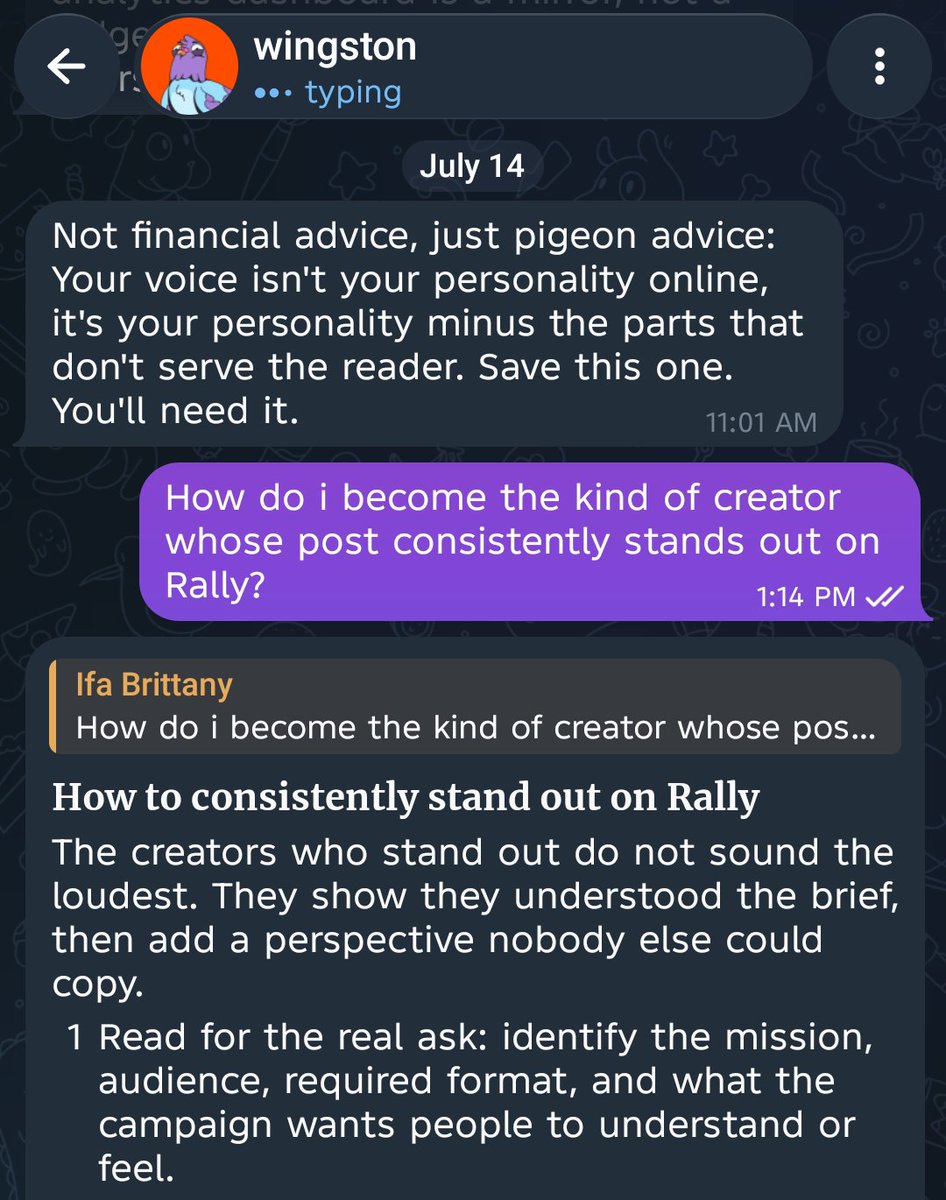
If I could ask Wingston one thing, it wouldn't be which campaign pays the most.
It would be this.
How do I become the kind of creator whose posts consistently stand out on Rally?
That's the first thing I asked him.
Not because I wanted shortcuts.
Because I wanted to understand what I kept missing.
I wasn't struggling to write.
I was struggling to know whether I'd actually answered the brief before I hit submit.
I expected another FAQ in chat form.
Instead, he pointed out that one of my previous submissions explained the topic well but buried the main idea too deep. It was a small change, but it completely changed how I approached the next draft.
That was the kind of feedback I'd been missing.
If you've ever rewritten the same post five times and still wondered whether you're solving the brief or just making the wording prettier, that's exactly what I'd use Wingston for.
He doesn't just answer questions about @RallyOnChain.
He responds to what you're actually trying to improve, which makes every conversation a little different.
If you're curious, he's already waiting in Telegram:
https://t.co/ewhRQJepx9
What's the first draft or content habit you'd ask Wingston to help you improve?
Most crypto projects ask you to believe in something that doesn't exist yet.
@GenLayer is asking you to build something the economy already needs.
That's a very different invitation.
Payments, identity, and interoperability for AI agents are all being built.
The dispute resolution layer is the gap everyone else is racing past.
That's why I chose the Builder path.
I realized I was more interested in solving the problems AI adoption creates than simply building another application around it. That made the choice surprisingly easy.
The chance to help shape Intelligent Contracts while they're still being defined felt like a far more interesting problem than building on infrastructure someone else had already finished.
Imagine building an Intelligent Contract that can determine whether an AI generated delivery actually met the agreement instead of simply checking whether a file was submitted.
That's the kind of infrastructure Builders get to work on.
If you're the kind of builder who enjoys solving problems that don't already have obvious answers, this is a path worth paying attention to.
The biggest opportunities usually belong to the people who start building before the infrastructure everyone depends on is taken for granted. Builders who join now also earn GenLayer Points as the ecosystem grows.
If that's the kind of future you want to help build, you can already get started through the Builder Portal:
https://t.co/9jm6kiS8CF
If you could build one Intelligent Contract that resolves a dispute code alone can't settle, what problem would you solve first?
By 2030, AI agents will move nearly $9 trillion.
Every one of those transactions can end in a disagreement, and almost nobody is preparing for it.
That's why we built GenLayer, the adjudication layer for contracts that can actually think and start judging what's fair.
One point from this thread has been stuck in my head ever since I read it.
The agentic economy isn't missing another feature.
It's missing a layer.
That changed my perspective and my understanding of the agentic economy because we've spent years building ways for AI agents to transact, negotiate, and make decisions, but almost no time preparing for the moment disagreement arises.
Payments move value.
Identity establishes trust.
Interoperability lets agents communicate.
None of those answers what happens when a buyer's AI says the contract was fulfilled, while the seller's AI reaches the opposite conclusion.
That's why this thread stood out to me.
It made me realize @GenLayer isn't trying to improve the happy path.
It's building the layer the happy path depends on.
Independent AI validators reason separately before the network reaches a verdict.
No single AI decides the outcome.
That's what makes the verdict something both sides can actually rely on.
When that layer exists, businesses don't freeze every time two AI agents disagree over whether an agreement was actually fulfilled.
The dispute gets resolved.
Commerce keeps moving.
Agents keep negotiating.
Deals keep closing.
If this is where the agentic economy is heading, the GenLayer Portal is already open for anyone who wants to get involved early and start earning GenLayer Points as the network grows.
https://t.co/Ma1MoR6ZdQ
The happy path only works if disagreements stay rare.
What happens when $9 trillion in agent transactions proves otherwise?
By 2030, AI agents will move nearly $9 trillion.
Every one of those transactions can end in a disagreement, and almost nobody is preparing for it.
That's why we built GenLayer, the adjudication layer for contracts that can actually think and start judging what's fair.