For LDPC and Polar on FPGA/ASIC, the most important number that connect with the real-world is pJ per decoded bit at a fixed BER/BLER.
pJ/bit = (ops per bit) × (pJ per op)
A "cheaper" processing element only fixes the second factor. Extra iterations, a bigger list, or memory traffic quietly multiply the first, and your energy per bit goes up.
Examples in the chart, same IEEE 802.3an code, same target BER: 3-bit LUT messages vs min-sum, 5 iterations each: 22.7 vs 45.2 pJ/bit. On the other hand, 9 vs 30 iterations: 24 vs 81 pJ/bit
Report end-to-end decoding energy at the target error rate, or you're not reporting efficiency.
#FEC #LDPC #PolarCodes #FPGA #ASIC #ChannelCoding #6G #VLSI
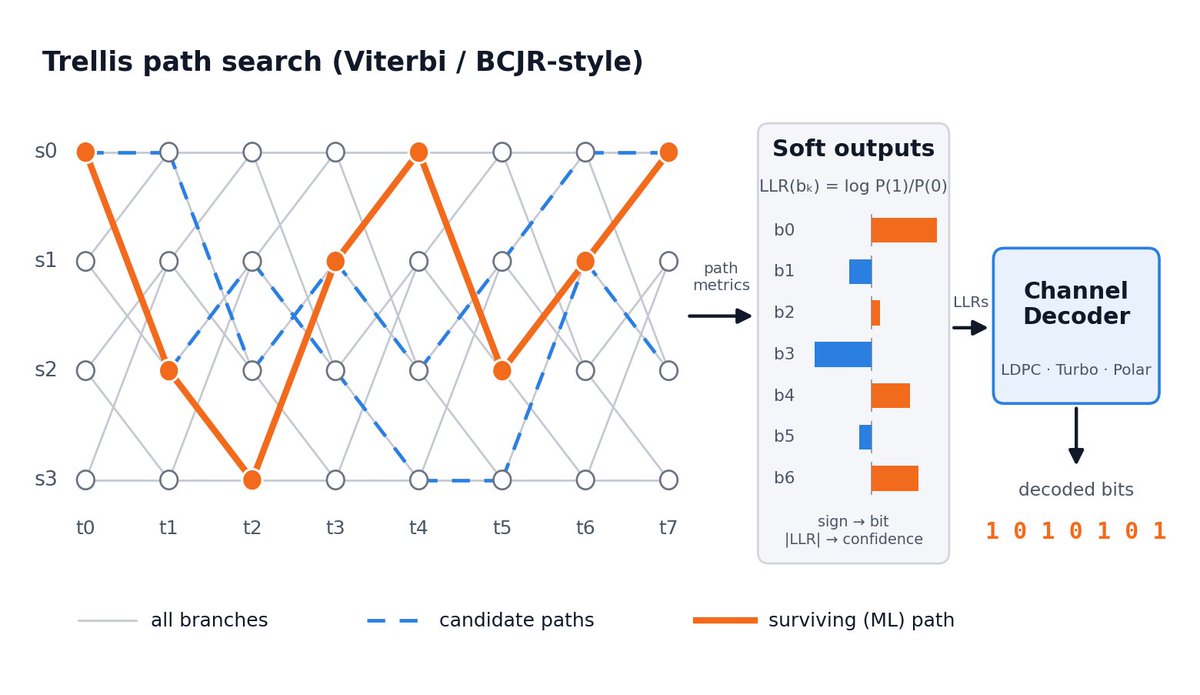
The real challenge in sequential path search over a trellis is producing reliable soft outputs, not just hard decisions.
When a channel decoder operates, those soft metrics become the metrics of performance, and that’s where much of the complexity in detection is actually spent.
#SignalProcessing #WirelessCommunications #ChannelCoding
@alwayspriyesh They shouldn't be worried, actually they should be even more excited!
For them, it is just a tool that accelerates their work in a guided manner. I definitely prefer a software engineer running AI than a kid who doesn't know the difference between different data types 🤷♂️