Behavioural biologist - Social interactions and Individual decisions | Organising conferences at @AnimalBehavLive | Founder & Contributor at @scienceout_ind
📢 Reminder: Tomorrow 3pm GMT we're hosting the first round table of the year to discuss the role that ethnicity plays in academia with Sharlen Moore @Sharizz , Agaba Amos Waseni, Udita Bansal @bansal_udita and Damian Octavio Elias. Join here: https://t.co/rbOz22DuSA
So that’s it – the end of #AnimBehav2023
120 presenters covering the so much animal behaviour. Loads of species, loads of questions, loads of science, free and accessible to all
It’s been great to have you join us for some or part of the marathon event
Loads of folk to thank🧵
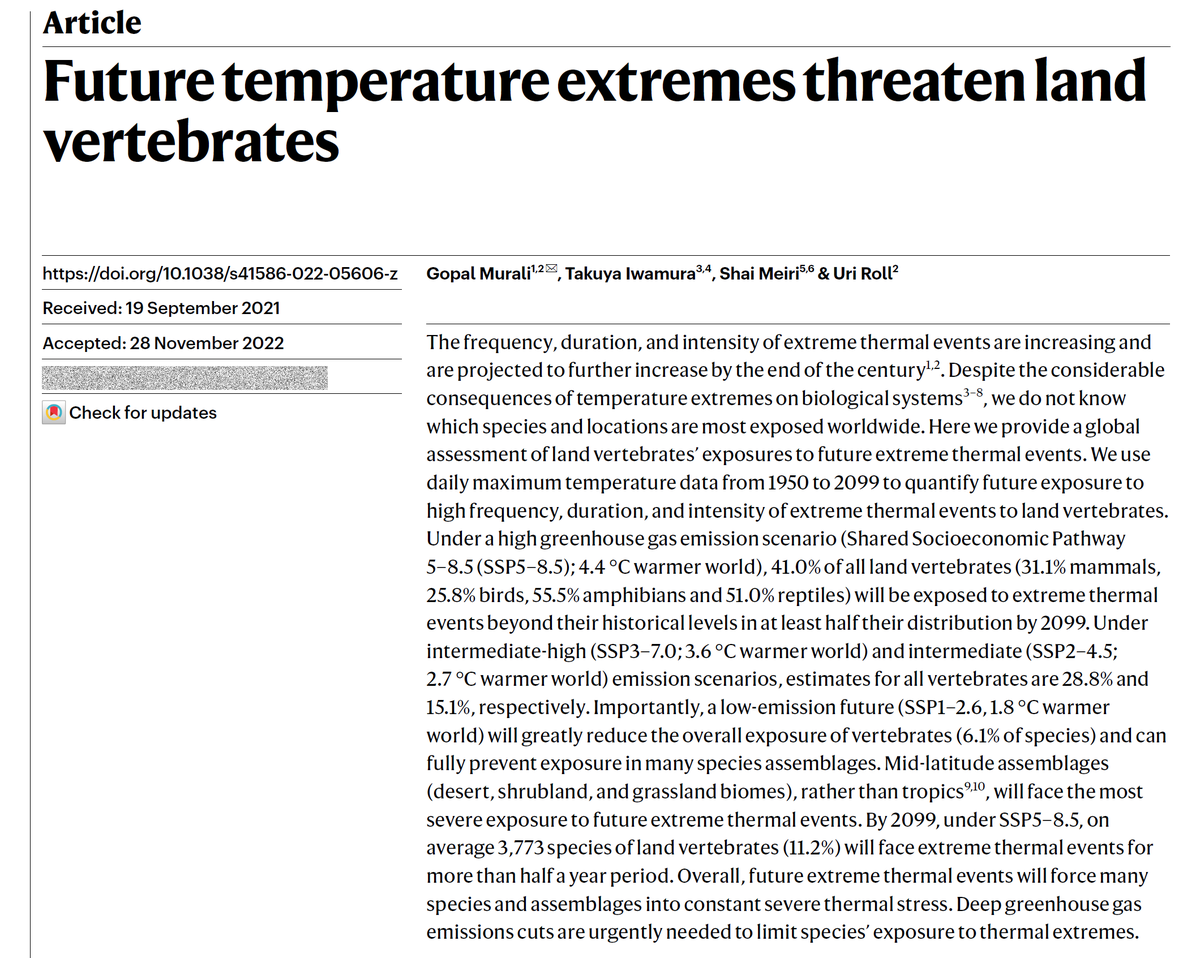
🚨New paper🚨 Heatwaves are on the rise due to climate change. How will extreme thermal events shape the future of the world's biodiversity at different warming levels? Check our study out today @Nature https://t.co/qxUbHmETh3
#ClimateEmergency#Heatwaves#Biodiveristy🐘🦩🐸🐍🦎
@WidowWeb@CanBlackSci Very interesting 🤩. I'm guessing that size also correlates with other behavioural traits - exploration, general activity? Has this been studied in these spiders?
@WidowWeb@CanBlackSci Great talk! I had a Q on the link between density and male arrival in the western widows. Are larger males able to detect smaller quantities of pheromones better (something in their physiology maybe)?
1/15.Hi! I’m Maydianne Andrade! In my evolutionary ecology lab @UtscBiology, we unravel links between sexual selection, behaviour and social context using widow 🕷️. I’m especially interested in how organisms use cues from their environment to predict the future! #AnimBehav2023
And that’s a warp for the ‘Behavioural plasticity’ session. @KayEsHobbs takes over as chair for the next session on ‘Cognition’ at 09:00 GMT, followed by other amazing sessions at #AnimBehav2023. Very grateful to @asab_tweets and @AnimBehSociety for letting me 🪑 this session
1. #AnimBehav2023 Animals change colour rapidly for different purposes including for camouflage to cope with spatiotemporal changes in their visual habitats. This plasticity varies between populations in some species, but there is limited research on aquatic species.
@SaudiZoologist@NicolaNadeau Great talk! I notice that the detectability was similar between black and grey substrates. If so, why do you think they still prefer to spend more time in the black substrate?