0 = 0
That is, starting from zero = zero sense.
Composability means you don’t rebuild what’s already been built. Instead…
You stack your backend faster.
You build your game faster.
You scale faster.
Now THAT makes sense.
Please see the joint press release from @InFlux_Limited,@CloudNexgen, and @nvidia. We are committed to growing our partnership and assisting to open AI and Web3 for all! Adding partners that make sense and advance those goals is essential! We are excited about what the future holds for us.
"Our roadmap for 2025 focuses on expanding our rendering capabilities and enhancing our core infrastructure to meet the growing demands of AI and ML workloads," said InFlux Technologies’ CEO and Co-founder, Daniel Keller. "With our enhanced platform capabilities, we're well-positioned to continue leading the transformation of decentralized computing infrastructure."
Read more here: https://t.co/kGmw770EfT
Smart VCs didn’t wait.
Seed capital flooded into DePIN in 2024.
But now the game shifts, from proving supply-side scale to solving demand-side monetization.
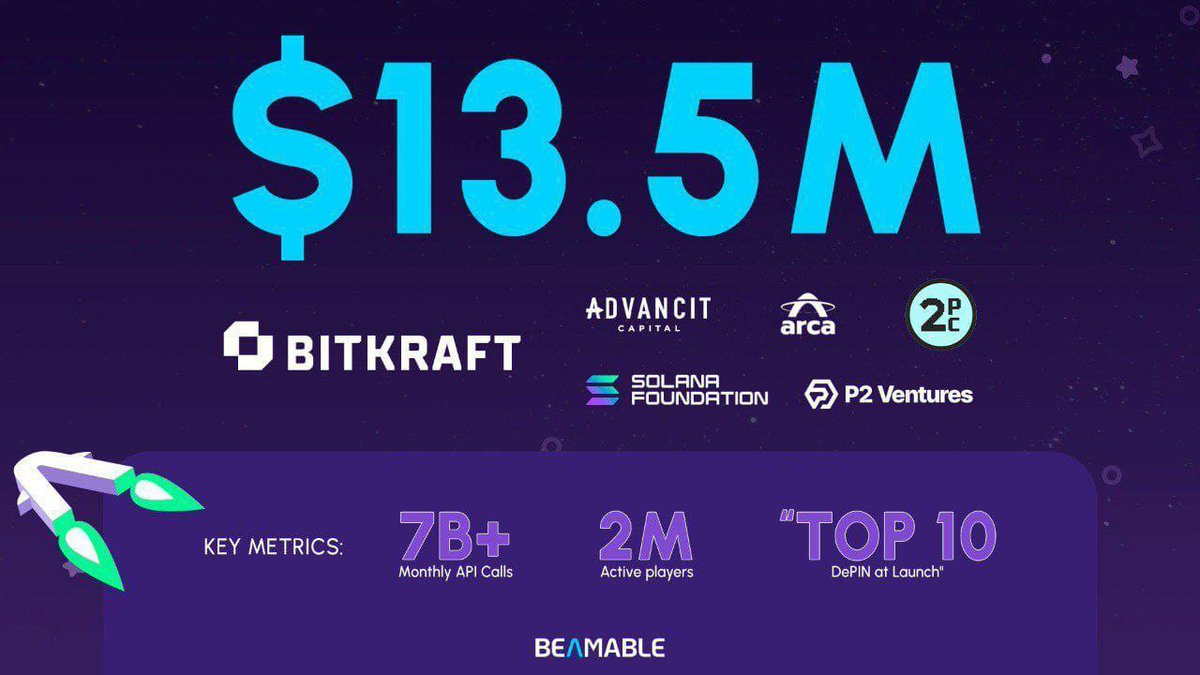
The Beamable Network already has the demand. We're currently processing billions of API calls monthly.
Real studios.
Real LiveOps.
Real revenue.
This Week’s Beamable Spotlight: IMMORTAL: Gates of Pyre.
Command armies as a godlike Immortal across Nuath, Shael, and Xur in this F2P strategy game.
With unique units, epic spells, and world-shaping powers, you’ll wage a cosmic battle for dominance in a living, strategic universe.
Stay tuned as we dive into the world of IMMORTAL: @GatesofPyre all week long.
TLDR: Why Web3 Gaming Actually Makes Sense (Part 1: Infrastructure)
Forget NFTs and tokens for a minute.
It's time to break down Web3 gaming from the backend - where it actually matters.
Traditional game infrastructure is bleeding studios dry. Let's look at real startup costs:
Building a live game right now? You need:
- Custom servers ($30-50K)
- Database setup ($20-30K)
- Load balancers ($10-15K)
- Content delivery network ($15-20K)
- Scaling systems ($25-35K)
- Backend team ($50K minimum)
That's $150k on the lower end.
Plus 6-12 months just to get this running. Before you write ANY game code.
Web3 changes this entire structure.
Instead of building and maintaining everything yourself, you're using a network of nodes that:
- Handle distribution (no dedicated servers needed)
- Run your game logic (through smart contracts)
- Manage assets (on chain, not your problem)
- Scale automatically (through the network)
You write one set of code. The network handles the rest.
This isn't about blockchain hype. It's about infrastructure that makes sense for games.
Next up: Why most Web3 games get this all wrong...
Game developers need three things: speed, reliability, and sensible costs. Everything else is noise.
@solana's architecture matches how games actually work:
- Transactions finish before your next frame renders
- Costs stay low even at massive scale
- Infrastructure that handles millions of players
We're not building for crypto traders. We're building for game developers who need infrastructure that just works.
This is about making games better, not more complicated. 💜
Absolutely thrilled to have been verified from @hotspotty! 💜
Marked against critical criteria for a DePIN project, we’re proud to have received one of the top scores in the history of their evaluations.
DePIN Hub sees the potential. How about you?
TLDR: Why Web3 Gaming Actually Makes Sense (Part 3: Doing It Right)
Let's talk about what works. No hype. No buzzwords. Just real infrastructure that makes sense for game devs.
Web3 gaming done right means one thing:
Everything works in your game engine.
No platform switching.
No extra tools.
Your game needs:
- Asset management
- Player inventories
- Marketplace features
- Social systems
- Trading mechanics
All of this should just... work.
In your development environment. Where you build games. Simple as that.
Here's what we're seeing with games doing it right:
- Devs work in their native language
- Assets move automatically
- Systems scale on their own
- Infrastructure costs drop
- Players keep their stuff
No crypto degree needed.
No blockchain expertise required.
Just tools that work where you already build games.
The big difference? Everything's built for game devs first.
Web3 features are just that - features. Not the whole game.
Next up: The numbers that actually matter...
TLDR: Why Web3 Gaming Actually Makes Sense (Part 4: The Numbers)
Time for real talk about metrics.
Not marketing stats.
Not whitepaper promises.
Actual numbers from live games.
Traditional game infrastructure:
- 6-12 months setup
- $150K minimum to launch
- 30-40% ongoing costs
- Multiple teams needed
- Regional scaling issues
What we're seeing with decentralized infrastructure:
- 85% faster deployment
- 70% cost reduction
- Sub-50ms latency
- 99.99% uptime
- Global coverage by default
But here's what really matters:
Your devs spend time making games better instead of babysitting servers.
Your players get games that work, assets they own, and features that scale.
And the best metric? When your team stops talking about infrastructure because it just works.
Next up: Where this is all heading...
We’re on a mission to provide the infrastructure gaming deserves.
It shouldn't be controlled by a handful of companies.
Beamable Network distributes both the power and the opportunity.
After an incredible turnout at #TOKEN2049 Dubai, we’re bringing the DePIN & Gaming Happy Hour to Toronto — tomorrow night! ⚡
@Beamable & @jradoff + @MomentumX_Global are hosting another evening of real talk, good drinks, and big ideas at the intersection of Web3, gaming, and infrastructure.
📍 Toronto | May 14
🕕 RSVP: https://t.co/hUygdF0Bnz
Don’t miss your chance to connect with builders, VCs, and game studios during @consensus2024.
Looking for real signal in DePIN? 👀
We just dropped a recap on 4 projects that met the Verified standard you’ve all been asking for! 🛠️
💻 @HivelloOfficial – multi-DePIN earnings in one app
🚗 @NATIXNetwork – your dashcam, but onchain
🕵️ @session_app – the most private messenger out
🎮 @BeamableNetwork – 86 live games, and counting
🎥 Watch now: https://t.co/mDeobc58pt
Shipping once isn't enough anymore.
Top titles now dominate engagement and revenue. F2P churn is brutal.
LiveOps cadence is everything.
Live Service isn’t a genre. It’s the market.
So this is a message to current and future game devs:
Power your game with infra built for iteration. We’ve got you covered.
TLDR: Why Web3 Gaming Actually Makes Sense (Part 5: The Future)
Let's cut through the noise about "the future of gaming."
Most of it’s hype. Here's what's actually happening.
Games are getting more expensive to run.
Live service is standard now.
Players expect more features, better performance, instant scaling.
The old way isn't sustainable:
❌ Rising server costs
❌ Complex infrastructure
❌ Centralized points of failure
❌ Assets locked to one game
❌ Teams drowning in maintenance
What decentralized infrastructure enables:
✅ Games that outlive their studios
✅ Tools that devs can share and monetize
✅ Infrastructure that scales with demand
✅ Assets that players actually own
✅ Communities that power their own games
This isn't about blockchain changing gaming.
It's about giving devs better tools to build sustainable games.
Web3 gaming was inevitable - not because of crypto or NFTs, but because game infrastructure needed to evolve.
The future is simple: build games, not infrastructure.
(Web3 gaming is inevitable)
Psst, if you haven’t already, go mint your free @solana Season 0 Gaming Pass.
You’ll get some sweet sweet Beamable Network points in the process too. Win-win 💜
Let's be real about DePIN - beyond the buzzwords, it's fixing actual problems that game devs face daily:
- Your game blows up, but your budget doesn't
- Players get fast response times, no matter where they are
- You're not stuck with one provider forever
- Your backend actually generates revenue instead of just eating it
This is what happens when someone finally builds infrastructure that works for developers, not against them.