This country’s foremost statesman dead in a foreign country surrounded by strangers, men who have never heard his name carrying his coffin. The fate of the African politician.
Shaharah Bridge was built in the 17th Century CE, in Yemen 🇾🇪 and though it may just look like a regular bridge at first, it has interesting stories connected to it. Structure was designed to fall apart in minutes in event that Turks tried to invade and it was also a logical solution to another age-old problem.
Stretching across a 300ft deep gorge between two mountains, bridge is still commonly used by citizens in the neighboring villages. Bridge can be found in the Ahnum Mountain Range in northwestern Yemen in the ‘Amran governorate, 140km away from Sana’a. It connects two mountains, Jabal al Emir and Jabal al Faish, by stretching across a canyon formed where the two come close together. The bridge is 65ft long and 9ft wide. It is primarily made of limestone, which is an abundant material in mountains. Shaharah Bridge leads to the town of Shaharah.
It is not known for how many centuries people have been living in Ahnum Mountains. Yemen itself is one of the oldest centers of civilization in the world. The country is located at the bottom of the Arabian Peninsula. While most of the peninsula is arid, Yemen is fertile and experiences regular rainfall. From very early on, the country served as a natural conduit for trade between the East African and Middle Eastern kingdoms. Archaeological evidence shows that large settlements existed in northern Yemen’s mountains at least as far back as 5000 BC.
For all the millennia that people lived in those mountains, they were faced with the difficulty of getting supplies. This was both a hassle and a danger. Although Jabal al Emir and Jabal al Faish are within shouting distance of each other, in order for villagers to trade goods or meet with neighbors, they would have to climb all the way down to the bottom of the canyon and then back up the other side. Certain segments of journey were especially perilous. And even if one were a daring and nimble enough climber to make the trek, it would be next to impossible to bring back many goods.
In 1500s, Ottoman Turks invaded Yemen and overran Shaharah. Once their freedom was regained sometime in the 1600s, the local Shaharah leader, Al-Usta Saleh, ordered a bridge to be constructed that could be destroyed in event of another invasion. He hired an architect named Salah al-Yaman. That bridge took three years to build and cost roughly 100,000 French Riyals (an extraordinary amount of money in 17th Century). It was constructed using traditional building tools and local supplies, however, bridge is the only entry point for town of Shaharah, which also has fortified walls surrounding it. It remained defended and inaccessible until aerial assaults became the norm in the 1960s-civil strife in Yemen. Still, town (and world) greatly benefited from Shaharah’s 300+ years of peace.
Town is no mere village dwelling looking to be left in peace. Shaharah is the citadel for Imans of Zaidi interpretation of a Shi’a Islam (not to be confused with Kurdish Yazidis). In 10th Century, Islamic scholar and second leader of Zaidis, Abul Qasim Muhammad bin Yahya bin Al-Husayn, chose the northern highlands for the center of Zaidi religious thought and scholarship. Zaidi mosques and schools can now be found throughout northern Yemen. Today, Zaidis are more commonly known by their political/rebel wing, Houthis.
Before Yemen was engulfed in civil war, Shaharah Bridge was one of most popular tourist attractions for those adventurous enough to make the trek out to see it. With time, it earned the moniker ‘Bridge of Sighs’ because the spectacular sight of a rudimentary stone bridge spanning two mountains left onlookers speechless.
#archaeohistories
Days after meeting President Ruto and Mudavadi, Vietnam Gas boss Doanh Chau delivered a diplomatic jab: Kenya talks big but doesn’t build.
All microphones, no machinery.
“No serious execution culture”
What a privilege it is to clean a house made dirty by healthy child playing, to wash dishes because we were able to eat 3+ meals today, to clear away the bath toys because we have running hot water and to do piles of laundry because we all have clean clothes to wear everyday🎈.
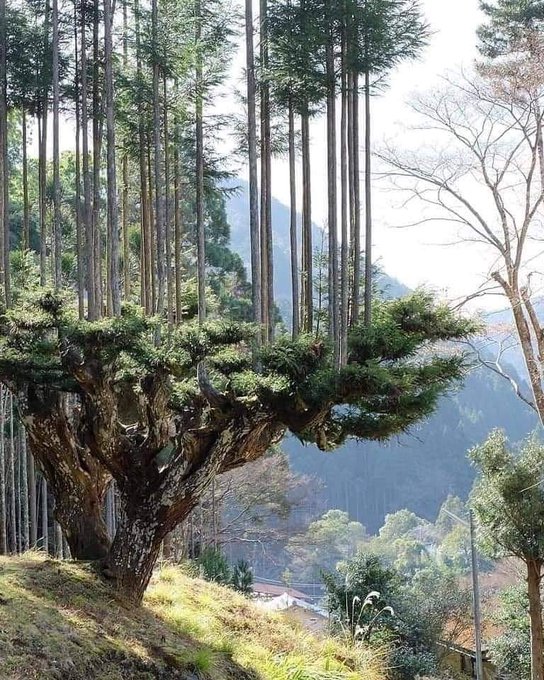
How Japanese have produced wood for 700 years, without cutting down trees.
Daisugi is an ancient Japanese forestry technique developed in the 14th century originally used by people living in the Kitayama region, because the territory was extremely poor in saplings.
They planted cedars pruned in a special way to produce shoots that eventually would become perfect, straight, knot-free lumbers.
The shoots are gently pruned by hand every two years leaving only the top boughs, allowing them to grow straight. Harvesting takes 20 years and old 'tree stock' can grow up to a hundred shoots at a time.
There was actually another reason why the technique was developed: fashion. In the 14th century, a linear, stylized form of architecture known as sukiya-zukuri (数寄屋造り) became popular, and every prominent samurai or nobleman wanted a house built in this way.
There were simply not enough raw materials available to keep up with demand, so daisugi was developed to produce more wood in a shorter time.
The wood produced with this technique has also impressive qualities: it's 140% more flexible than standard cedar and 200% denser and stronger. And, it's extremely durable.
@Morbidful "Oh my God, I'm in a whale's mouth"
Lobsterman Michael Packard says he was diving in Cape Cod, US, when he was gulped and spat out by a humpback whale
Britain will cut taxes for millions of workers starting early next year, the government said. It's part of a slew of measures that the UK's top finance official announced on Wednesday intended to spur business investment and push more people into jobs. https://t.co/s6al8519km
The evolution of spiders has been ongoing for at least 380 million years.
Spider webs have existed for at more than 100 million years. To date, there are five types of spider webs: orb web, cobweb, funnel web, tubular web, and sheet web.
They might tell you that the increase in mobile money transaction limits from 150k per transaction to 250k per transaction is about convenience & financial inclusion, but its simply inflation & the DETERIORATING value of the Kenya Shilling.
Do you know that during dialysis, blood is removed from the body through the red tube, passed through the dialysis machine, and then reintroduced into the body system through the blue tube.
This process is repeated for four hours while the patient remains immobile in bed.
The procedure is carried out three times a week, which results in twelve times a month, and each time it takes four hours, which results in a total of forty-eight hours a month.
For those not affected, this process of flushing your kidneys occurs automatically 36 times every day with zero effort or discomfort.
While you are reading this, quit alcohol, quit processed foods, quit junky fries , quit unnecessary use of sugar and importantly hit the gym. All these are easier and cheaper options to keep your kidneys and liver fit.
Always be grateful for good health ❤️