Through the volatile market, @Kamino stays focused:
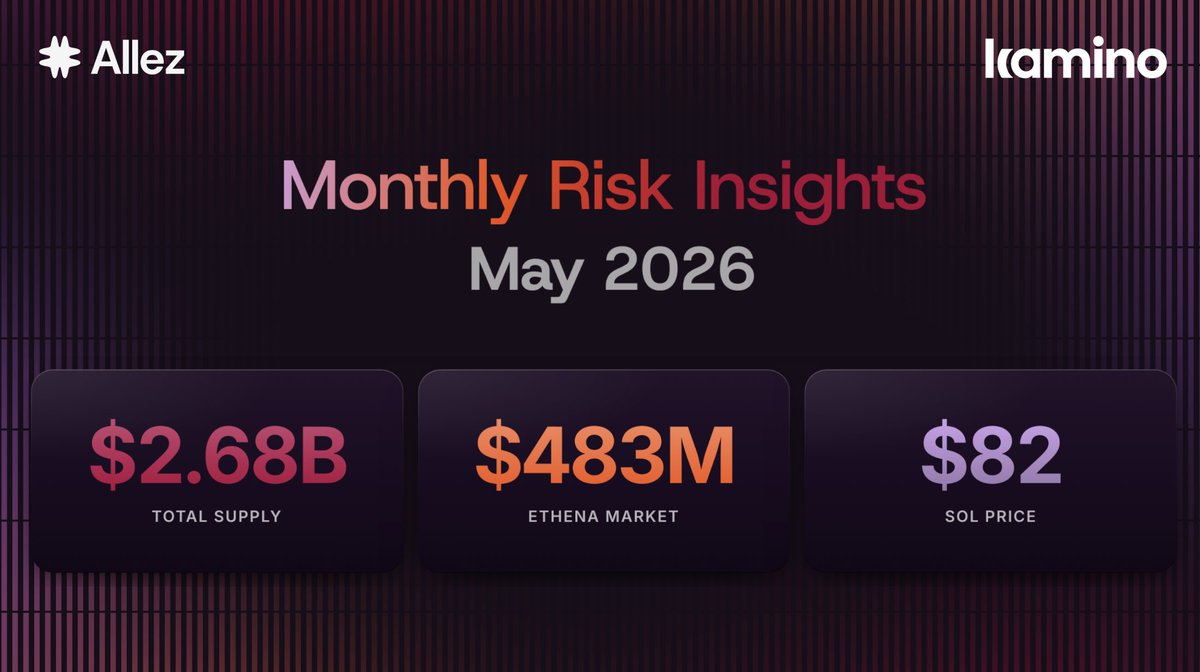
1️⃣ Growth: +10% supply growth in May, driven by the successful launch of @ethena_labs’ USDe market.
2️⃣ Security: Risk management and stack continue to expand, with Kamino’s risk infrastructure being continuously strengthened and refined.
Monthly @kamino Lend Insights - May 2026
The headline: the new @ethena USDe/USDG market launched mid month surpassed $400M in days to become Kamino's second-largest market.
Protocol supply rose 10.1% to $2.68B.
👇
Last month Maple Market move on @Kamino:
3 wallets withdrew $47.3M from PYUSD + syrupUSDC reserves on Apr 18-22:
→ $25.2M: 29KnJ9mtSMbxAFExns4H8e5Tv9AqSb1Qazy1HhHdUbNH
→ $11.4M: J1ChJ8gTCrNG9H4SKYdhWUaxSaayMkUGSojKudqToRfL
→ $10.8M: GVSCWP9YeLZbwvXFzG1y5YDtRJhCDq8htNrqNmzToR3i
A coordinated operator unwind, fully visible onchain - while the rest of the protocol's specialized markets continued expanding:
Monthly @Kamino Lend Insights - April 2026
Kamino navigated April’s DeFi-wide stress cleanly amid two major external incidents.
Risk metrics improved sharply while total supply contracted -17% to $2.4B as users repositioned conservatively.
👇 A thread
Modularity without accountability is just liability transfer by design. The protocol builds the primitive, curators configure the vaults, users deposits the liquidity. When something breaks, the protocol points to the curator, the curator points to the market, and the user is left holding the loss.
Markets are isolated. Vaults are not.
Vaults aggregate deposits across multiple markets, managed by one curator. Curator failure to manage risk properly or misconfiguration exposes all depositors in that vault simultaneously. That is contagion risk, just moved to the curator layer.
We saw this with Stream Finance and Resolv. In both cases. Months later, users are still waiting to know who is actually responsible for paying them back.
Calling yourself infrastructure and calling your design modular are both liability transfers. The risk does not disappear. It just shifts to another layer, and another actor.
No smart contract exploits, but a cascade of failures.
Blame is bouncing between @LayerZero_Core, @KelpDAO, and @aave after the ~$300M rsETH incident.
Aave is left holding the bad debt, Kelp's bridged assets are now unbacked. imo Layer Zero carries the biggest responsibility: their infra stack, and their forged message.
Losses should be socialized across all three.
DeFi works because of composability… but it’s ruthless.
The Arbitrum Security Council has taken emergency action to freeze the 30,766 ETH being held in the address on Arbitrum One that is connected to the KelpDAO exploit. The Security Council acted with input from law enforcement as to the exploiter’s identity, and, at all times, weighed its commitment to the security and integrity of the Arbitrum community without impacting any Arbitrum users or applications.
After significant technical diligence and deliberation, the Security Council identified and executed a technical approach to move funds to safety without affecting any other chain state or Arbitrum users.
As of April 20 11:26pm ET the funds have been successfully transferred to an intermediary frozen wallet. They are no longer accessible to the address that originally held the funds, and can only be moved by further action by Arbitrum governance, which will be coordinated with relevant parties.
Update on this weekend's events:
@kamino has no direct exposure to the Kelp DAO incident. As a precautionary measure assets related to @LayerZero_Core have been derisked early in the incident timeline on Saturday.
Second order effects are rippling through DeFi, high rates, liquidity crunch. Kamino markets and vaults continue to operate normally.
For paused LZ assets, normal operations will resume once a complete assessment of the origins and reproducibility of the incident have been determined
For loopers: utilization is high, which means rates are high. If you're leveraged, check your positions.
No funds at risk across Allez Labs partner protocols markets and vaults.
Partner protocols have taken precautionary measures to protect solvency pending the outcome of the Kelp investigation.
We are monitoring closely; assets will resume as soon as potential risks are cleared.
All funds across Allez Labs & partner protocols and vaults are safe from the @KelpDAO incident. No rsETH exposure.
@kamino, @VenusProtocol, and @hyperdrivedefi acted early, freezing @LayerZero_Core OFT-related tokens and oracles with no impact on solvency.
Kamino users are rotating beyond the Main Market - chasing specialized yield sources like @hastra Prime (heloc), @maplefinance (credit), and @OnReFinance (reinsurance).
RWA market size peaked at $1.275B in March 2026 - making @kamino the go-to venue for real-world assets on Solana and beyond.
Monthly @Kamino Lend Insights - March 2026
Quiet market, but liquidity reshuffle under Kamino's liquidity pools:
RWA token supply hit a new record at 22.5% of protocol liquidity. RWA markets surpassed $1.23B in supply.
👇 A thread
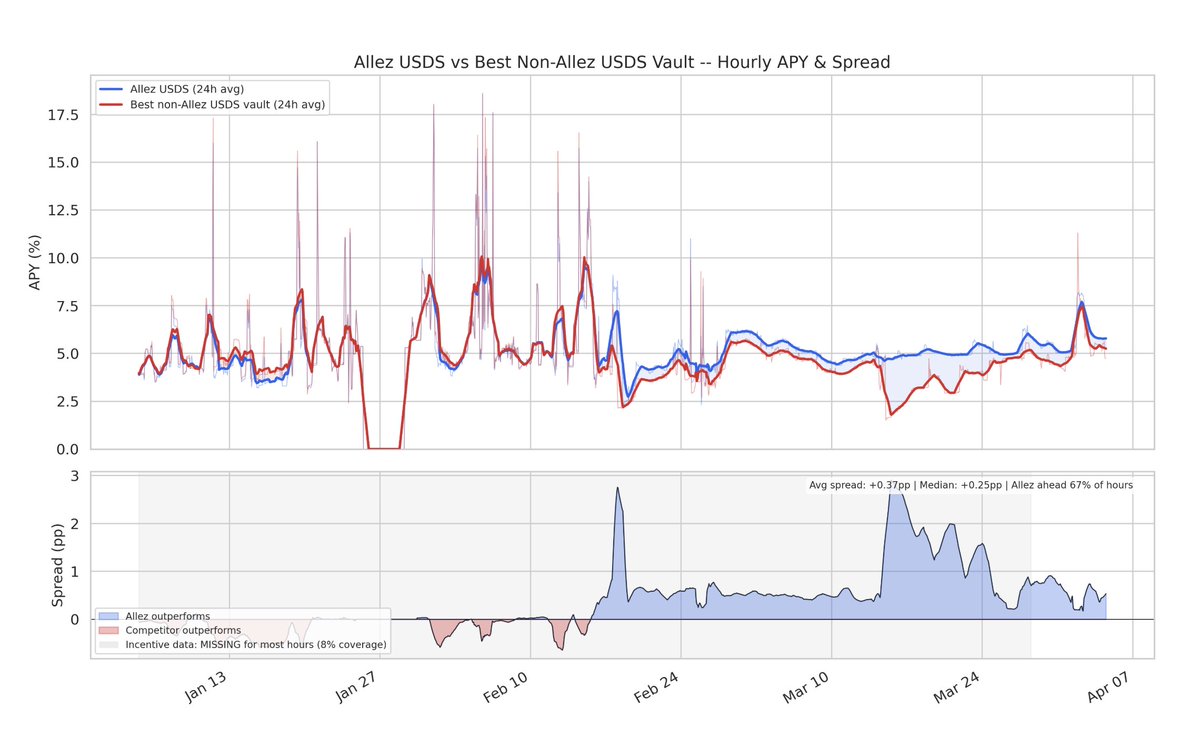
USD Vaults on Kamino are outperforming the DeFi Dollar Benchmark !
Wanted to take this opportunity to give another framework for suppliers entering market.
Generally users look at the yield, do I recognize the curator's logo, hit the supply button.
The yield is not the full picture, getting the best instant yield is an engineering issue. However when there's significant AUM your primary concern should be capping exposure to specific markets.
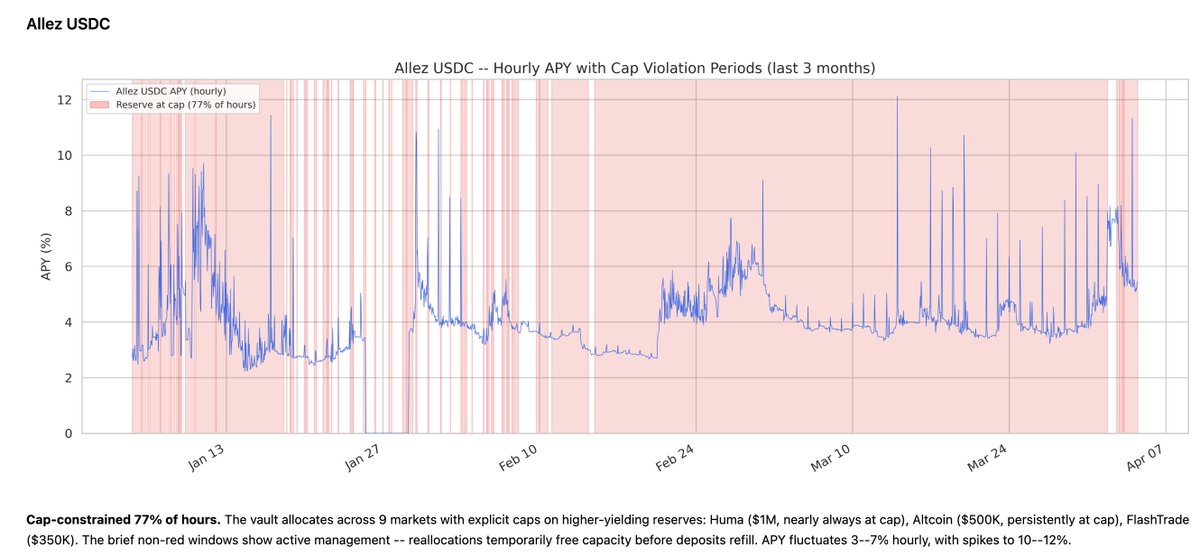
At a certain size you can run after the best instant yield and get out of any market any time, see the difference between Allez USDC and Allez USDS.
1- Allez USDC has hit a reserve's cap 77% of the time in the past 3 months, i.e. the algo could get better yield by allocating more but we've set a cap to limit exposure
2-3- Allez USDS has been unleashed around february, by far the one that outcompetes any other curator, small size, no caps, best yield all the time on USDS
4- Allez USDC's concentration vs other curators of similar size, Allez is the least concentrated, i.e. where the raw number of the vault yield is X%, your curator might be 100% in one market
interesting charts included :)
ONyc has no exposure to Drift Protocol.
As part of our risk framework, OnRe does not deploy treasury assets into DeFi protocols. Capital provider funds are held in a segregated account and remain unaffected. Operations continue as normal.
Update for our LPs:
Our @Kamino lending vaults are functioning as designed with no exposure to @DriftProtocol.
All positions remain healthy and operating normally with zero impact to suppliers. We continue to monitor the situation closely.