ANOTHER VICTORY FOR THE CONSTITUTION AND THE PEOPLE OF KENYA
Fellow Kenyans,
Today, the High Court has reaffirmed a simple but powerful constitutional truth. Public office is not a shield against accountability. Public information belongs to the people, and every State officer has a duty to uphold transparency, accountability, and the rule of law. The court found that my constitutional right to access information held by the Busia County Government had been violated. Judgement in Omtatah v @HonOtuoma issued on 27.07.2026 by the High Court at Vihiga. NO PUBLIC OFFICE IS ABOVE THE CONSTITUTION
This case has never been about personalities. It has always been about protecting public resources, defending the Constitution, and ensuring that no public institution operates in secrecy. The judgment sends a clear message that openness, public participation, and constitutional governance are not optional. They are legal obligations.
I welcome this decision as a victory for every Kenyan who believes that public power must always remain subject to public scrutiny. Our commitment to defending the Constitution remains unwavering. We will continue to pursue accountability lawfully, fearlessly, and without compromise. #ReKe #GetitDone
https://t.co/aEX3PSxmHa
@Football_Kenya surely you can not steal everything. You recurring sound for 5million, then forget tops and mid ranges, woofers only? A stadium with funeral speakers
There's an uncompleted Cape Dutch style home on Thigiri Ridge Road in Nairobi that has been dormant for over a decade.
On Muthaiga Road, there's a Cape Dutch style housing complex.
The few South African Engen petrol stations around Nairobi pre-2010 had some Cape Dutch inspiration. One is located on Waiyaki just past Deloitte under a different brand today.
I'm sure there are plenty of examples around Eldoret.
Nairobi, final reflections.
Despite Nairobi being a haven of NGO work, impact funds, climate workshops and every species of grant funded virtue, one hears far less of the heavy socialist sermonising that so often drifts through Southern Africa. Why is that? I didn’t find a Karl Marx road as we did in Maputo….
Perhaps Kenya’s commercial bloodstream is simply too strong. Nairobi may host the NGO cathedral, but outside its stained glass windows the city is hustling: traders, founders, developers, agents, boda boda, financiers, exporters, coders and small businessmen all trying to make a shilling before the next traffic jam. The traffic jams here in the middle of high traffic and rain are extortion writ large. But the uber driver earning thrice the fee wasn’t complaining. Nor should we, but the wait time at a restaurant can stretch up to two hours, with the usual retort of “I’m almost there” serving as a signal to order the next dawa.
The intellectual mood in Nairobi is softened by enterprise. Even the social impact crowd seems more likely to speak the language of scale, platforms, mobile money and market access than nationalisation, redistribution and state led salvation.
Southern Africa, by contrast, still carries a heavier liberation era grammar. Politics there often begins with the state, the party, the struggle and the promise that history owes someone something. Nairobi feels more impatient with that theatre. It has its own dysfunctions, certainly, but its instinct is more transactional, more entrepreneurial, more “where is the opportunity?” than “where is the manifesto?” That may be why, even in a city full of NGOs, capitalism still manages to keep the microphone.
I like it here….
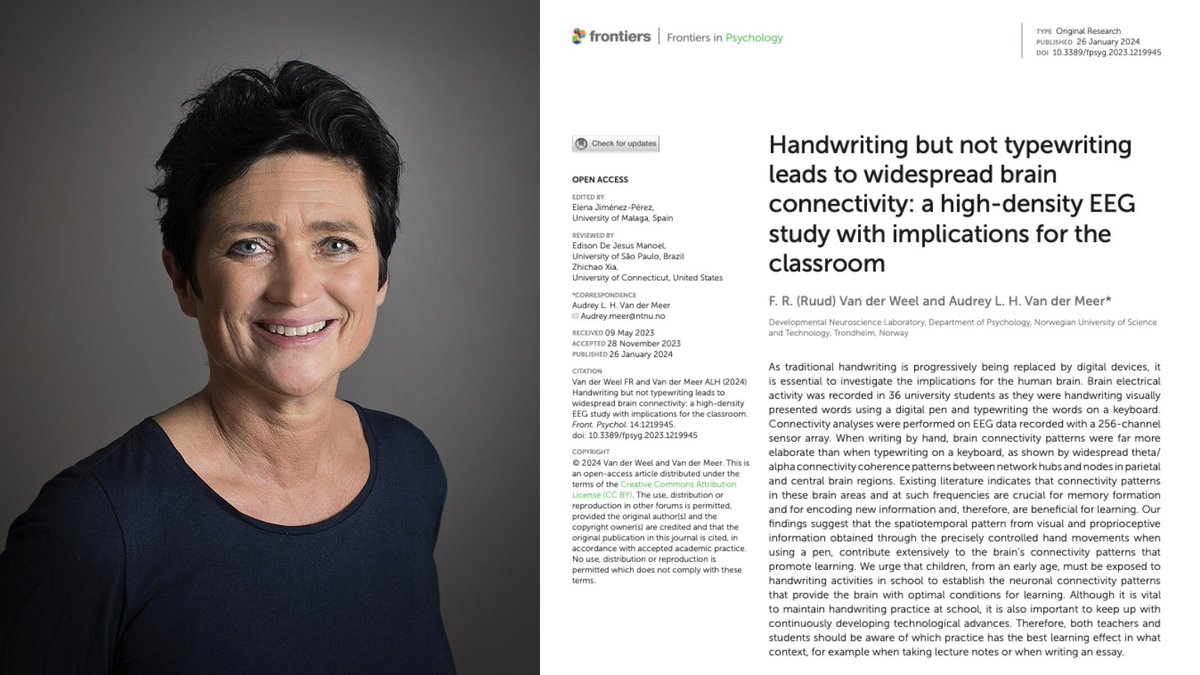
A Norwegian neuroscientist spent 20 years proving that the act of writing by hand changes the human brain in ways typing physically cannot, and almost nobody outside her field has read the paper.
Her name is Audrey van der Meer.
She runs a brain research lab in Trondheim, and the paper that closed the argument was published in 2024 in a journal called Frontiers in Psychology. The finding is brutal enough that it should have changed every classroom on Earth.
The experiment was simple. She recruited 36 university students and put each one in a cap with 256 sensors pressed against their scalp to record brain activity. Words flashed on a screen one at a time.
Sometimes the students wrote the word by hand on a touchscreen using a digital pen, and sometimes they typed the same word on a keyboard. Every neural response was recorded for the full five seconds the word stayed on screen.
Then her team looked at the part of the data most researchers had ignored for years, which is how different parts of the brain were communicating with each other during the task.
When the students wrote by hand, the brain lit up everywhere at once.
The regions responsible for memory, sensory integration, and the encoding of new information were all firing together in a coordinated pattern that spread across the entire cortex. The whole network was awake and connected.
When the same students typed the same word, that pattern collapsed almost completely.
Most of the brain went quiet, and the connections between regions that had been alive seconds earlier were nowhere to be found on the EEG.
Same word, same brain, same person, and two completely different neurological events.
The reason turned out to be something nobody had really paid attention to before her work. Writing by hand is not one motion but a sequence of thousands of tiny micro-movements coordinated with your eyes in real time, where each letter is a different shape that requires the brain to solve a slightly different spatial problem.
Your fingers, wrist, vision, and the parts of your brain that track position in space are all working together to produce one letter, then the next, then the next.
Typing throws all of that away. Every key on a keyboard requires the exact same finger motion regardless of which letter you are pressing, which means the brain has almost nothing to integrate and almost no problem to solve.
Van der Meer said it plainly in her interviews.
Pressing the same key with the same finger over and over does not stimulate the brain in any meaningful way, and she pointed out something that should scare every parent who handed their kid an iPad.
Children who learn to read and write on tablets often cannot tell letters like b and d apart, because they have never physically felt with their bodies what it takes to actually produce those letters on a page.
A decade before her, two researchers at Princeton ran the same fight using a completely different method and ended up at the same answer. Pam Mueller and Daniel Oppenheimer tested 327 students across three experiments, where half took notes on laptops with the internet disabled and half took notes by hand, before testing everyone on what they actually understood from the lectures they had watched.
The handwriting group won by a wide margin on every question that required real understanding rather than surface recall.
The reason was hiding in the transcripts of what the two groups had actually written down.
The laptop students typed almost word for word, capturing more total content but processing almost none of it as they went, while the handwriting students physically could not write fast enough to transcribe a lecture in real time, which forced them to listen carefully, decide what actually mattered, and put it in their own words on the page.
That single act of choosing what to keep was the learning itself, and the keyboard had quietly skipped the choosing and skipped the learning along with it.
Two studies. Two countries. Same answer.
Handwriting makes the brain work. Typing lets it coast.
Every note you have ever typed instead of written went into your brain through a thinner pipe. Every meeting, every book highlight, every idea you captured on your phone instead of on paper was processed at half depth.
You did not forget those things because your memory is bad. You forgot them because typing never woke the part of the brain that would have made them stick.
The fix is the thing your grandmother already knew.
Pick up a pen. Write the thing down. The slower road is the faster one.
In 458 BC, Rome stood on the edge of destruction.
An enemy army had trapped a Roman consul and his legions in a mountain pass. Panic gripped the city. With no other hope, the Senate took a desperate step: they sent messengers to summon a 60-year-old farmer from his fields.
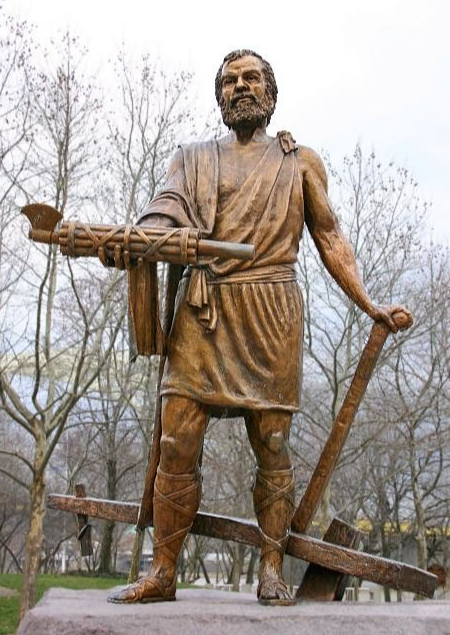
His name was Lucius Quinctius Cincinnatus. Once a respected senator, he had lost his fortune paying his son’s debts and now lived simply on a four-acre farm, working the land himself to support his family.
The envoys found him plowing in the dirt. They asked him to don his toga so they could deliver the Senate’s message: Rome was appointing him dictator—absolute ruler with unchecked power and command of the entire army.
Cincinnatus accepted.
In just 16 days, he assembled an army, marched to the enemy, surrounded them, and forced their surrender. The Republic was saved. He had legal authority to rule for six months. He could have clung to power, expanded it, or crowned himself. History offered countless examples of men who did exactly that.
Instead, on the 16th day, he resigned. He removed the toga of authority, returned to his farm, and finished plowing the very field he had left behind.
Twenty years later, at age 80, Rome called him again during another crisis. He answered, crushed the threat in 21 days, and once more stepped down—returning to his modest life and dying poor on the same small farm.
More than 2,200 years later, when George Washington led America to victory in the Revolutionary War, he too refused offers of kingship and returned to his farm at Mount Vernon. Europeans were stunned. King George III reportedly said that if Washington voluntarily gave up power, “he will be the greatest man in the world.” Washington became known as “the American Cincinnatus.”
The true lesson of Cincinnatus is not mere humility. It is that, throughout most of history, the people best suited to lead were often those who least desired power. When societies begin to reward those who crave it instead, the republic begins to rot.
Cincinnati, Ohio, is named after him and most of its residents have no idea why.
These past three days, and in quick succession;
Governor @GeorgeNatembeya declared that he would not fight @edwinsifuna for the leadership of the Luhya Nation. Enemies of Mulembe had held onto hope of dividing the two.
CS @DrOparanya announced that they were finding it hard to sing TUTAM in Luhyaland, because the people didn't want to listen to anyone who took part in the persecution of Sifuna.
Bishop Titus Khamala of Lurambi has stated that Sifuna went with the people and what they are left holding on is a shell of ODM. He has also revealed that government projects in Western Kenya are launched in fancy ceremonies, but contractors disappear soon after.
Meanwhile, Osotsi of Vihiga was in Bungoma, hosted by Bumula MP Jack Wamboka, in a massive rally in which the people declared they were Sifuna.
For context, Natembeya is Bukusu, Oparanya is Marama, Khamala is Musotso, Osotsi is Munyore and Oundo is Samia, among others. I make this distinction to remind you that the spirit of Musa Amalemba has resurrected, and a young man from the neighbourhood of Prophet Elijah Masinde Wanameme may end up being the one to have found the magic wand.
Anyway, this story, surprisingly, is about Kisumu City.
When the Linda Mwananchi battalion stormed Kisumu City a few Sundays ago, the Luhya Nation watched in apprehension. Their favourite son, now a national sensation, would either be attacked viciously, or would enter the lakeside city in triumph. It ended up being way more than the success anyone had anticipated.
To the Luhya community, it felt the way many Luos felt when they realised in 2002 that Raila Odinga had become this huge national force. Raila had run in 1997 as a mere Luo candidate. But after walking out of Kanu with a huge chunk of of its non-Kalenjin base in 2002, and tapping Kibaki for presidency, the Luo community was amazed to see Raila, then campaigning single-handedly as Kibaki slept in a London hospital, receive a heroes' welcome everywhere in the country. Even though Orengo was also running for President, the Luo promptly knew which of their son had captured the imagination of the nation and would henceforth be the priceless asset. The reaction was "Alaa, if Raila is now this big, we won't be the ones to dim his star. We will turn up for him each time he needs us".
That was what Luhyas felt when Senator Sifuna was welcomed like a rock star in Kisumu City.
To the Luhya leadership, encompassing everything from PCS, Speaker, CS and gun-wielding ruffians like Didimus, it was also a wake up call. Those in the bad books of the young man had to, and have to, find a way to work with him. The panic is still concealed only because that period is still coming, but there will be a stampede towards where the people have moved. Make no mistake, this will be the first all-Luhya movement where there will be no divisions by sub tribe.
And it will be because for the first time since Musa Amalemba and Masinde Muliro, the Luhya suddenly recognise that they have a truly national thing embraced across the country and effortlessly selling itself on the pedestal of integrity and credibility. Today, the whole of the Mulembe Nation in Western and Trans Nzoia is Linda Mwananchi territory. United behind Sifuna.
If you hear anyone saying otherwise, ask him to take his medicine.
Ruth Adhiambo Odinga may not know it, but John Mbadi Ng'ongo left the Odinga orbit much earlier than it seems. Forced to forego the Homa Bay gubernatorial run after the success of Glady's Wanga's blackmail antics, Mbadi felt slighted. He was the ODM chairman and assumed he held enough power and influence to at least determine his own fate.
He was offered a nomination to Parliament, and even then, his name wasn't first on the list. Like an afterthought, the chairman was second. When he got to Parliament, he found that he had been stripped of the seat of Minority Leader, which he had held in the previous parliament, the position going to Opiyo Wandayi. Mbadi had to fight a major battle with Babu Owino for the PAC Chairmanship for a soft landing.
Remember he had all along been the ODM Chair? Well, soon, that seat too was taken away and given to the exact person he had been forced to surrender the Homa Bay ticket to. It was as if they were coming for everything he owned. He was left a bitter man. If Ruth is worried about what Mbadi has said in public about her late brother, she should try and dig into the angry things he says to his close circles in private. She will cringe.
The Ruth-Mbadi verbal war is a manifestation of something we hardly talk about. The Odingas and Kenyattas were raised by pioneering freedom icons. Their national view encompasses political dignity, national unity and a belief in "red lines" where certain topics are off limits. The Rutos and the Mbadis ~ well, no one knows how they were raised ~ are creatures of brawls. They win things by defeating opponents and piling the soil on them. Lacking any aristocratic touch, they know no other way, which is why Mbadi is probably the only person who can say "Raila is dead and buried" and "we are the ones who made Raila who he was" in broad daylight. Even Linda Ground folks were shocked by this one.
Ruth should know that because she is an Odinga, she is a genuinely good person and her genetics have already set for her a path that Mbadi has no capacity to see. But while at it, Mbadi is right in his contention that those who purport to stand in the middle, in this ODM war, are lying to themselves. In fact, Ruth's response to Mbadi should be to join Linda Mwananchi in broad daylight and declare it the side that remains true to the principles of her late brother. It is now clear that there are no birds of her feather left on the other side. Mbadi is also right that since FORD in 1991, there has never been a fallout in any political party that was followed by reconciliation. On that score alone, Mbadi is admitting that the Linda Mwananchi faction, which is now more national and has carried the masses, will run away with the soul of ODM, and the other side, as history confirms, will be squeezed into a village contraption for small time political operations. Perhaps even the registration certificate will follow the majority too!
Most well-meaning people will stand firmly with Ruth Odinga on this one. But given the disrespect that she and her iconic family have already suffered in Linda Ground, the lingering question will be how long she intends to bear the disrespect before she brings her powerful name to the side that values and honours her late brother and family. Her space in Linda Mwananchi is yawning to be filled.
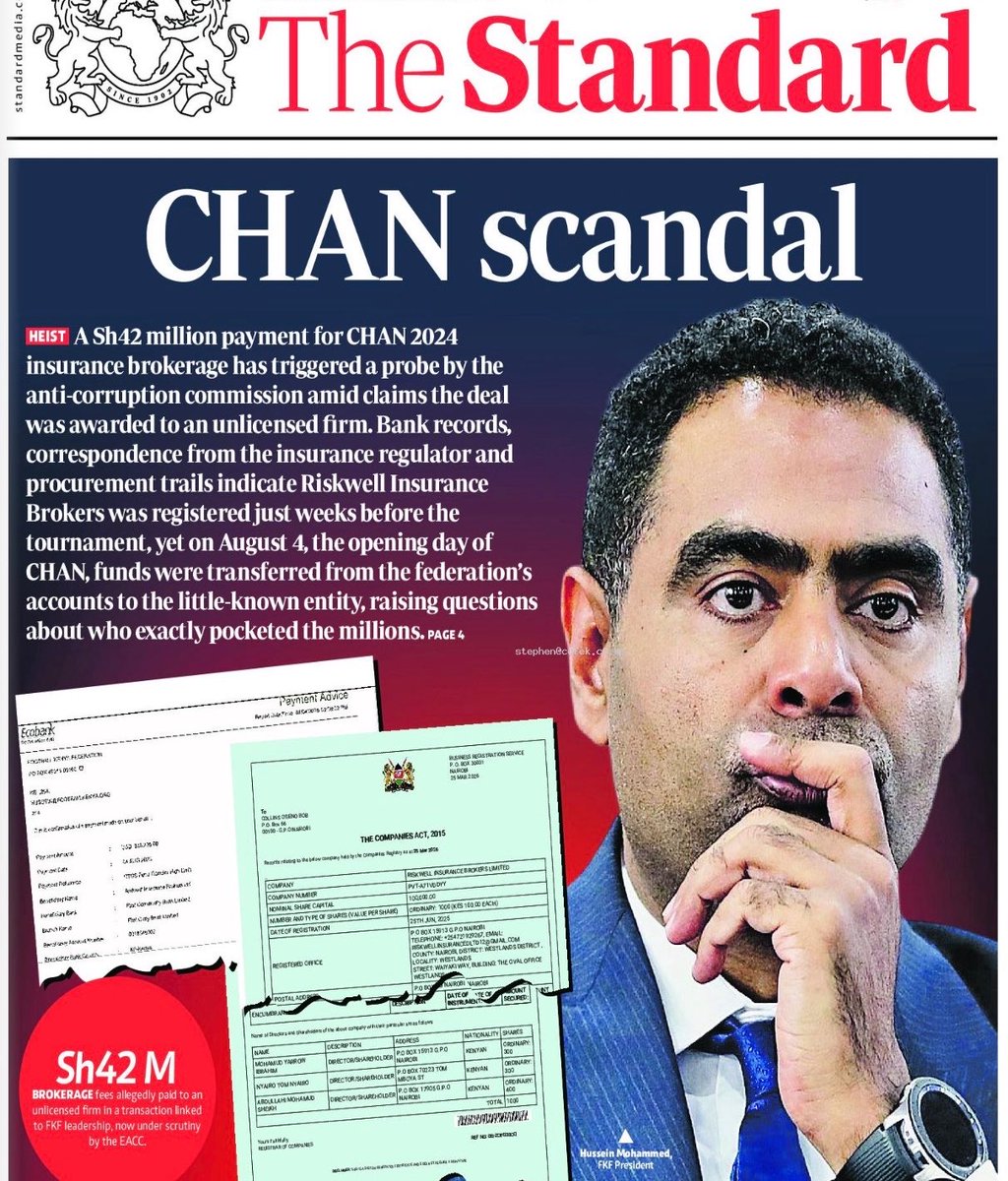
Why Hussein Mohammed Tried — And Failed — To Kill @StandardKenya’s CHAN Insurance Corruption Story
📀Sh42M in public tournament funds wired to an unlicensed ghost broker — Riskwell Insurance Brokers Ltd — on the very opening day of CHAN, August 4, 2025
📀 Riskwell was only 40 days old when it secured the insurance contract — incorporated June 25, 2025, with zero regulatory standing
📀 The @ira_kenya confirmed in writing it had never licensed Riskwell for 2025 or any prior year — making the payment for insurance brokerage a criminal facilitation under the Insurance Act
📀 Competitive bidding was deliberately bypassed — three established insurers (Takaful, Old Mutual, Britam) had submitted valid bids, with Britam’s lowest bid at Sh29.1M — Sh13M cheaper than what Riskwell was paid
📀 Riskwell had no VAT obligation, filed no @KRACorporate returns, recorded zero purchases or sales — a textbook ghost company
📀 One of Riskwell’s three directors is linked to a senior FKF official — a direct conflict of interest Hussein cannot explain away
📀 The @EcobankKenya payment advice — timestamped 3:08PM, August 4 — bears Hussein’s own email address as the account holder’s contact, placing him at the centre of the transaction
📀 @husseinmoha sent four emissaries to The Standard’s newsroom in a desperate bid to stop publication — a move that only confirmed the story’s potency
📀 Rather than address the scandal, Hussein hid in Uganda — claiming he could not respond until he returned
📀 The @EACCKenya had already published a damning Q1 2024 report recommending prosecution of former FKF President @Nmwendwa for the same pattern of financial misconduct — Hussein walked straight into the same fire
📀 Whistleblower Ustadh Okello Kimathi had already formally filed the full dossier with the EACC alongside a public call for Hussein to step aside — the story was already in official hands before it hit the front page
📀 Hussein staying in office now actively obstructs investigations and erodes public trust — the cover-up has become bigger than the crime @CAF_Media@caf_online_AR@fifacom_ar@FIFAcom@fifamedia
Watched an Alex Mwakideu interview the other day he was talking to the legendary judge from Vioja Mahakamani. Millennials, you know her ~That no-nonsense mama who took zero nonsense in that courtroom.
Now here’s the wild part they never had scripts. Not a single one. They’d just show up, pick roles, agree on the case, and go. Cameras rolling, take one, done.
So every punchline Alphonse Makacha and Dot Makokha ever dropped? Pure improvisation. No rehearsal. Nothing prepared. Just talent doing its thing in real time.
Kenya really had something special with that crew.
And here’s the part that gets me AG Amos Wako was fully behind the show. He’d supply them with real court cases and actual judgments from Kenyan courts. So when the judge passed her verdict on screen, it wasn’t made up. It was legally accurate, straight from the constitution.
Comedy on the surface. Civic education underneath.
That’s a level of craft most productions today can’t touch.
Golden era. Salute to those legends. 🫡
The government of Zimbabwe announces temporary suspension of Excise Duty, Road Levy, Carbon Tax & Strategic Reserve Levy on Diesel effective April 3rd.
Collectively, these amount to US$0.54/litre.
See quoted tweets for what Kenya is considering & what Zambia has done.
Sir John Glubb, a British Lieutenant General, spent 36 years commanding armies in the Middle East.
He studied every major empire in recorded history and found something he didn't expect.
Every single empire (Assyria, Persia, Rome, the Arabs, the Ottomans, Spain, Britain) lasted about the same length of time.
250 years.
And they all died the same way. (thread) 🧵
A father told his daughter, "Congrats on your graduation. I bought you a car a while back. I want you to have it now."
Before I give it to you, take it to a car dealer in the city and sell it. See how much they offer.”
The girl came back to her father & said: "They offered me $10,000 dollars because it looks very old"
Father said: "Ok, now take it to the pawn shop".
The girl returns to her father & said: "The pawn shop offered $1,000 dollars because it's a very old car & a lot of work done".
The father told her to join a passionate car club with experts & show them the car.
The girl drove to the passionate car club.
She returned to her father after a few hours & told him, “Some people in the club offered me $100k because its a rare car that's in good condition.”
Then the father said, "I wanted to let you know that you are not worth anything if you are not in the right place. If you are not appreciated, do not be angry, that means you are in the wrong place. Don't stay in a place where no one sees your value ."
The moral of the story : Know your worth and know where you are valued. A diamond doesn't shine on the bottom of a cave.