In past 2-3 days, toning down by China & explicit mention by its spksprsn&Amb of agreed disengagement implies new status-quo. This article by @rwac48 is a fine read to understand points where India needs to stand tall.
I list wht used to happen in past 1/n https://t.co/dq1eOjWKNM
It's a shame no major film has been made about Biju Patnaik. He lived a life that sounds almost fictional:
In 1938, he flew his entire wedding procession by aircraft to Rawalpindi for his marriage to Gyanwati Sethi (who became the first Indian woman to hold a commercial pilot’s license, and the couple later flew daring missions together.)
While serving in the Royal Indian Air Force (including as head of Air Transport Command), he secretly ferried freedom fighters like Jayaprakash Narayan, Ram Manohar Lohia, and Aruna Asaf Ali to their hideouts. He also airdropped 'Quit India' leaflets to Indian troops while evacuating British families.
The British once jailed him for transporting nationalist leaders and distributing anti-British literature but also honored him for bravery in evacuating civilians from Japanese-occupied Burma.
During WWII, he flew daring missions delivering arms and supplies to Soviet forces in Stalingrad, and over the treacherous 'Hump' route to China in
support of Chinese Nationalist forces against the Japanese.
In July 1947, he and his wife flew a Dakota into Indonesia, landed on an improvised airstrip while evading Dutch anti-aircraft fire, rescued Prime Minister Sutan Sjahrir, refuelled using abandoned Japanese fuel, and flew him safely to India via Singapore.
A couple of months later, during the Pakistani invasion of Kashmir, he airlifted one of the first Indian troops into Srinagar.
The same year he founded Kalinga Airlines, one of India's earliest private airlines.
As Odisha CM post-1962 India-China war, he secretly visited CIA headquarters at Langley to forge a covert India-US partnership against China, which led to the Aviation Research Centre (ARC) at Charbatia, which supported U-2 recon missions over Tibet.
He was also a legendary administrator and statesman, laying much of the foundation of Odisha's industrial empire (mines, ports, heavy industries etc).
When he passed away, Indonesia observed 7 days of state mourning. Russia observed 1 day. He remains the only person in Indian history whose body was draped in the national flags of 3 nations - India, Indonesia, and Russia.
Few public figures have left such a footprint.
His extraordinary life needs to be brought to the big screen.
The same dynasty that built the architectural wonders of Belur and Halebidu couldn't save its last king from a tragic fate.
Read this essay by our chief Editor, Pushkar Chaudhary on the fall of Hoysalas and how they stilll survives in our long memory.
The Brahmin’s Prediction: How India Tracked Uranus Before the West
By @shreehistory
On the night of March 13, 1781, the German-born British astronomer William Herschel stood in the garden of his home at 19 New King Street in Bath, England, and pointed his telescope toward the constellation Gemini. He spotted an unfamiliar, slightly diffuse disc. He reported it to the Royal Society as a "comet." Within two years, the scientific community realized it was not a comet at all, but a new planet. History canonized this moment as the first time a planet was discovered in recorded history, and William Herschel was enshrined as the sole visionary who expanded the boundaries of our solar system.
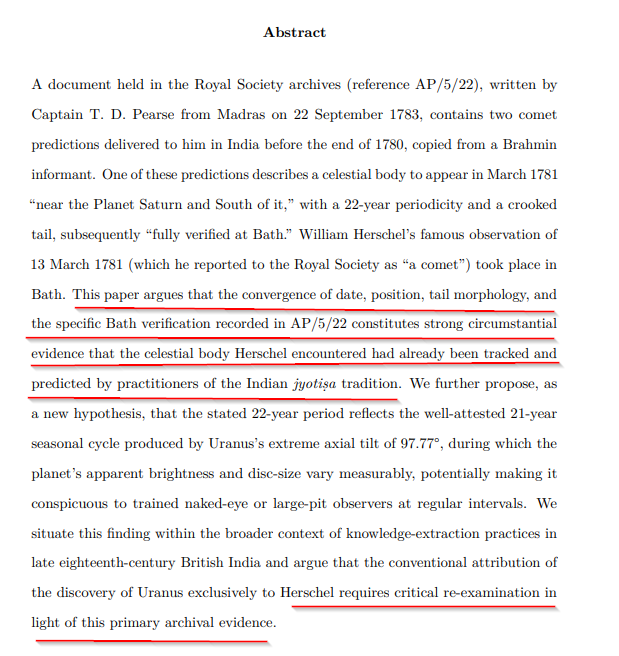
But what if the object Herschel encountered had already been tracked, classified, and predicted by practitioners of the Indian astronomical tradition long before his telescope was ever built?
Deep within the archives of the Royal Society itself, filed away and forgotten for over two centuries, lies a document that profoundly disrupts the conventional narrative of European scientific supremacy. The document is reference AP/5/22, a letter written by Captain T. D. Pearse from Madras on September 22, 1783. Filed under the mundane category of "Unpublished Letters," it contains explosive primary evidence that the celestial body we now call Uranus was under systematic surveillance by Indian astronomers long before the West claimed it. It lay hidden, till @shreehistory downloaded it OCRed it for cursive font and extracted the text and then connected the dots.
The Letter from Madras
Captain Pearse was a British officer stationed in India, deeply engaged in studying local culture. In his letter to the Royal Society, he transcribed two comet predictions that had been delivered to him by a "learned Brahmin" in or around 1780. Pearse explicitly stated that he had transcribed these predictions "before the End of 1780." This timestamp is the crux of the historical intervention. The predictions predate Herschel's observation by at least three months.
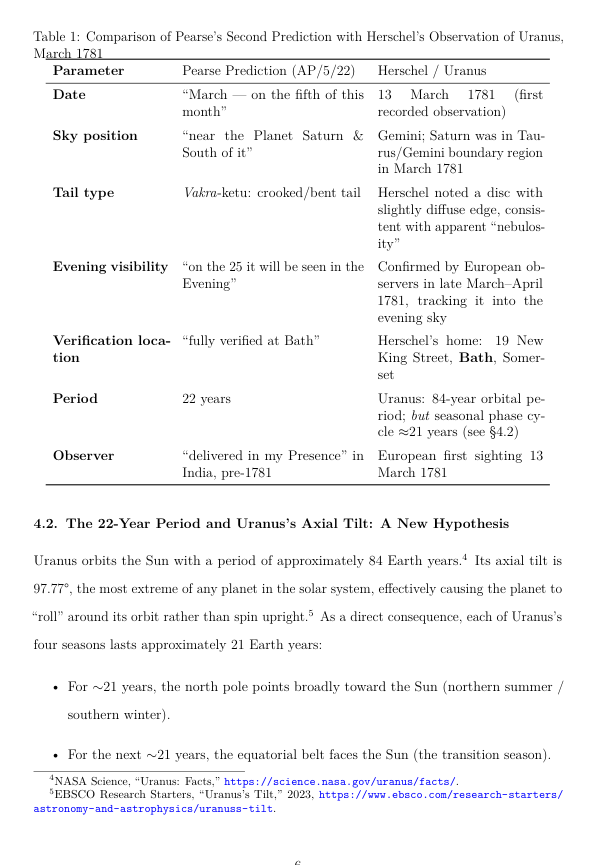
The second of the Brahmin's predictions read: "March, on the fifth of this month another Comet will appear of the kind called Wuckier or crooked from the Form of its Tail. It will appear six Ghurrees before Sun-rise, near the Planet Saturn and South of it. On the 25 it will be seen in the Evening. Its Period is twenty two years."
Later in the letter, Pearse casually notes the fate of this prediction: "I send you the copies of the other two predictions, one of which was fully verified at Bath."
The convergence of data is staggering. The prediction specifies the month of March, the exact proximity to Saturn, the evening visibility by the 25th, a crooked tail, and the specific verification location of Bath. This was not a lucky guess. The probability that a prediction composed in India before 1781 would correctly specify Bath, the month of March, the proximity to Saturn, and a 22-year period for an unknown celestial object, and that Herschel would then observe exactly such an object from Bath in March 1781 by pure chance, is vanishingly small.
The Sanskrit Taxonomy and the 108 Comets
The terms used by the Brahmin were not arbitrary. "Wuckier" is a direct transliteration of the Sanskrit word Vakra, meaning curved or crooked. In the Indian astronomical tradition of jyotisa, this refers to a specific class of comet known as Vakra-ketu, documented extensively in Varahamihira's Brhat-samhita from around 550 CE. The other prediction mentioned a "Dwudge" or flag-shaped comet, directly mapping to the Sanskrit Dhvaja-ketu.
The Indian system was not merely a collection of naked-eye myths. It was a highly sophisticated taxonomic project. Elsewhere in AP/5/22, Pearse records the Brahmin's promise to provide him with the tables of 108 distinct comets. This number is historically consistent with the ancient comet catalogues of Parashara, which classified celestial transients by tail morphology, rising direction, and crucially, periodicity.
The Brahmin informed Pearse that this catalogue was ancient received knowledge, written in the epoch preceding the current one. This implies a tradition of sustained, systematic tracking across many centuries, perhaps millennia. European astronomers like John Flamsteed and Pierre Charles Le Monnier had actually sighted Uranus before Herschel, but they catalogued it merely as a fixed star. They lacked the epistemological framework to recognize it as a moving body. The Indian tradition, by contrast, placed it within a named typology, assigned it a periodicity, and predicted its next appearance relative to Saturn.
The Secret of the 22-Year Cycle
Perhaps the most scientifically profound aspect of the Brahmin's prediction is the stated 22-year periodicity. Uranus has an orbital period of 84 Earth years. If the Indian astronomers were merely tracking the orbit, they would have recorded an 84-year cycle. Why 22 years?
The answer lies in the unique axial tilt of Uranus. The planet is tilted at a staggering 97.77 degrees, effectively causing it to roll around its orbit on its side. This produces four distinct seasons, each lasting approximately 21 Earth years. During these seasonal transitions, the geometry of the planet shifts from pointing its pole toward the Sun to pointing its equator toward the Sun. Modern science confirms that this transition causes measurable changes in the planet's atmospheric band structures, cloud features, and overall brightness.
The 22-year period recorded by Pearse was not an error. It reflects a new hypothesis: the Indian astronomical tradition was tracking the seasonal conspicuousness cycle of Uranus. They were observing a faint, slow-moving object that became notably brighter and more active in the sky roughly every 21 to 22 years. This requires a level of naked-eye observational discipline and data retention over centuries that the West has historically refused to imagine was possible in the Global South.
The Colonial Archive and the Erasure of Knowledge
The Royal Society received this letter in 1783. It was never read to the Society. It was never published in the Philosophical Transactions. It was filed away in the archive, buried in the vaults of the very institution that was simultaneously celebrating William Herschel's "discovery."
This archival suppression is emblematic of the broader history of colonial knowledge extraction. As historians of colonial science have documented, British intermediaries systematically collected indigenous technical knowledge, transformed it into European frameworks, and failed to credit the original sources. The year 1783, the date of the Pearse letter, marks the exact opening of the era where British scientific institutions in India began actively incorporating native knowledge into the matrix of imperial power without granting authorship.
Herschel himself wished to name the planet Georgium Sidus after the British monarch, King George III. It was a cosmic naming ceremony that mirrored the British assertion of hegemony over the Indian subcontinent. The Brahmin tradition, which had tracked this object within its own sophisticated taxonomy, received no acknowledgement then and has received none in two centuries of historiography.
Reclaiming the Cosmic Ledger
The paper authored by @shreehistory, drawing upon this buried primary evidence, does not seek to erase Herschel's telescopic achievement. It seeks to contextualize it. The history of astronomy owes a reckoning with the contributions of the Indian jyotisa tradition.
The conventional Eurocentric discovery narrative is historiographically incomplete. The object known as Uranus had been engaged with, tracked, and predicted by South Asian practitioners long before a European telescope was trained on Gemini. The truth of this history, preserved for over 240 years in the Royal Society's own archives, demands a critical re-examination of how we assign credit for human discovery.
The era of relying solely on the colonial archive to define the limits of indigenous knowledge is over. The time has come to read the Brahmin's predictions not as exotic curiosities, but as the rigorous scientific records they truly are.
All rights reserved. You must get written permission if you want to republish. Twitter users can share, repost, like, comment but please provide attribution to @shreehistory who did all this research.
Paper is in preprint and can be accessed from my site.
https://t.co/WpJ7h9EK6U
The government's response to the killing of 3 Indians by US navy is not just a stark contrast from the past, indicates that it believes the US's enforcement of Hormuz blockade is valid. Slow downward slide in India's commitment to UN-backed actions and sanctions since 2019.
@DivaJain2 By 2060, everyone in active life retires; this dream selling is pure propaganda when a person with 1lac salary cannot afford dignified hassle-free non-EMI life in delhi, everything else is just a hoax. People will keep chasing the unchasable.
#WATCH | Ranchi, Jharkhand | A class 12th student, Sarthak Sidhant, says, “…I have written a blog that compares the tender documents of CBSE. I have uploaded and published it… There were at least 15 discrepancies, as per my blog. I would like to highlight three or four of them. Let me give a background about Coempt. It was known as Globarena, and they have a very shady background. 23 students killed themselves because of coempt… Now, I would like to tell you about RFP (Request for Proposal). What happens is the government issues a tender and asks the bidder to bid for it. CBSE issued this tender three times… I have compared the old RFP and the new RFP, and I found some discrepancies… The first discrepancy is that there were three clauses of poor performances which was completely wiped out from the new RFP. In the earlier RFP, there was a clause called blacklisted earlier, whereas in the new RFP, it was changed to blacklisted currently. Why would the board want a service provider which was blacklisted earlier? The third thing I found out is the 50 crore limit, which you needed to qualify, and coempt qualified that by 1.7% … The time frame of corrupt practices was halved, and there were project criteria changes… It shows a pattern that the industry giant TCS was not preferred, but coempt was preferred, which works as a very fragmented group of institutions…”
“Made in China” is becoming “made by China”—all over the world. Faced with higher Western tariffs and weak demand at home, many Chinese factories are moving abroad, making everything from appliances to cars everywhere from North America to Eastern Europe. https://t.co/ZhiI0CqQAZ
Dharmendra Pradhan's son
is studying in America, so did Nirmala's and Jyotiraditya.
Piyush Goyal's son is studying in Singapore, Anurag Thakur's son is studying in Canada.
S. Jaishankar's son is studying in the UK & even Smriti Irani (who hardly studied) sent son to study there.
Nishikant Dubey's son studied in Scotland
So why would these people bother about NEET paper leak
or CBSE scam or communal distortion of history by NCERT?
Or care about your children getting pushed around in trains and buses or even committing suicide?
Government of Hypocrites from Top to Bottom!!
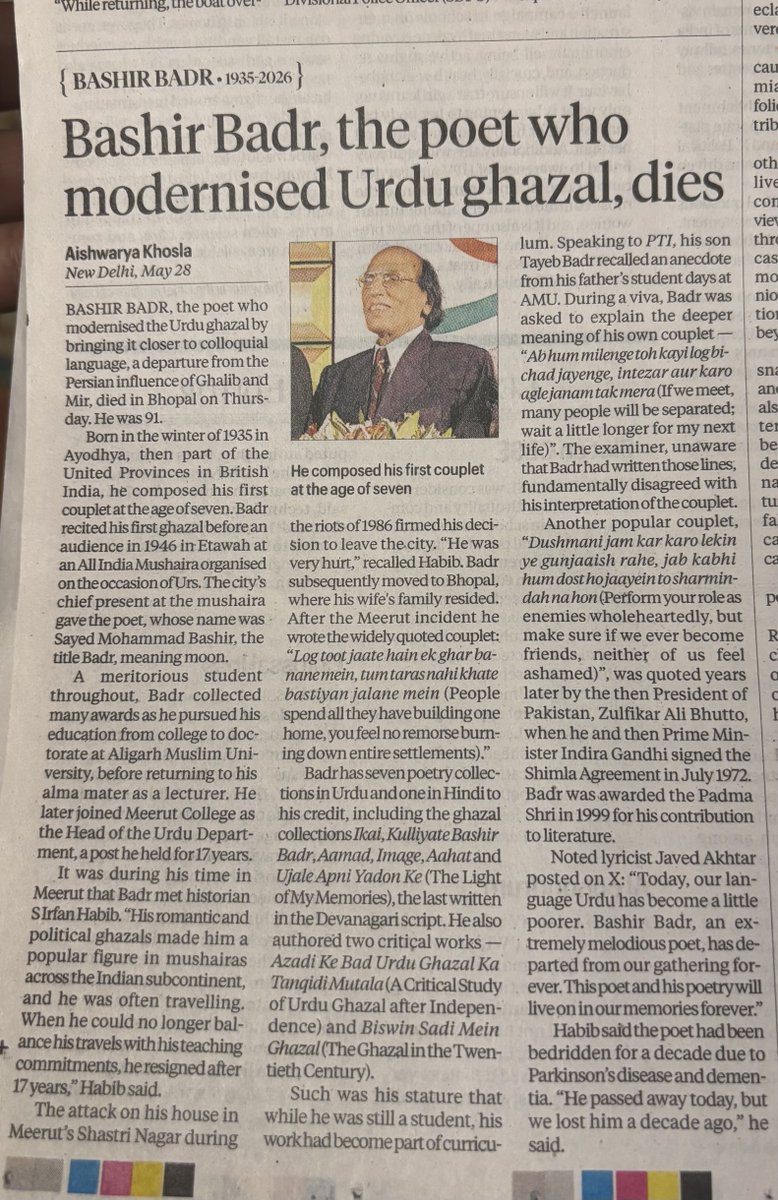
कल मशहूर शायर बशीर बद्र की अंतिम यात्रा में लगभग 20 लोग शामिल हुए।
सोचिए जिसके शेर लाखों लोगों की ज़ुबान पर रहते हैं, उन्हें ऐसी गुमनाम सी विदाई दे दी गई।
सोचिए, भोपाल साहित्य और संस्कृति का गढ़ माना जाता है। पता नहीं कितने, लेखक, कवि, शायर, पत्रकार, कलाकार भोपाल में हैं, मगर उनमें से कितनों को लगा कि इस मौक़े पर उन्हें वहाँ होना चाहिए था और कितने पहुँचे?
ये भी सोचिए कि भोपाल मध्यप्रदेश की राजधानी है। विभिन्न राजनीतिक दलों के तमाम लोग वहाँ रहते हैं। मान लेते हैं कि बीजेपी को मुसलमानों से एलर्जी है, नफ़रत है और वह उनके नायकों को भी पसंद नहीं करती, मगर बाक़ी दल क्या कहेंगे?
दरअसल, बशीर साहब पिछले कई सालों से डिमेंशिया से पीड़ित थे। इस वज़ह से भी वे अलगाव का शिकार हो गए थे। लोगों ने आना-जाना लगभग बंद कर दिया था, मगर ऐसा भी नहीं था कि वे हम सबकी स्मृतियों में भी नहीं थे। वे थे, मगर वे किसी के काम के नहीं रह गए थे, इसलिए लोगों को लगा कि अब क्या फ़ायदा।
यानी बशीर सही कहते थे- ये मतलबों के सलाम थे......
@andymukherjee70 Nice one! Crisis of fresh ideas and Indian capitalists not investing/innovating in strategic sectors. This twin concerns has long term implications on cutting down Indian growth story.
Pakistan's air force will be paying this debt for the next 10 years.
Because India burned through their entire defense budget in 88 hours.
This was not a war of missiles. It was a war of balance sheets. And only one side had the balance sheet to fight it.
India's entire Operation Sindoor cost between 320 and 587 million dollars. Less than 1 percent of India's defense budget. The kind of money India spends building a highway.
Pakistan's losses? 1.4 to 2.6 billion dollars. 16 to 29 percent of their entire annual defense budget. In 4 days. Gone.
Now look at the specific numbers because this is where the real story lives.
One BrahMos missile costs 34 crore rupees. It destroyed Pakistan's AWACS aircraft worth 3000 crore. One strike. 88 times return on investment.
One Harpy drone costs 5.6 crore. It destroyed a Chinese HQ-9 air defense battery worth 636 crore. 114 times return.
These are numbers. No narrative changes them.
The S-400 hit a target 34 kilometres away. The longest confirmed surface to air kill in military history. Ever. Anywhere. By anyone.
11 airbases cratered. Both Pakistani Saab AWACS aircraft, their eyes in the sky, burned inside their own hangars. F-16s grounded. JF-17s destroyed. Chinese radars blinded. Chinese engineers fled.
Then Pakistan launched over 600 drones at India.
Not one got through.
Not. One.
Pakistan is an economy 10 times smaller than India. Already standing in front of the IMF with an outstretched hand before the first missile was fired. They burned through one quarter of their war chest in 88 hours. And kept telling their own people they were winning.
India did not just win a war.
India financially bankrupted Pakistan on the battlefield. And Pakistan will be paying that bill for the next 8 to 10 years.
That is the real legacy of Operation Sindoor. Not the strikes. Not the drones. The arithmetic.
@DivaJain2 Gone are the days of free ride globalization which succeed on the facade of free trade, open markets and financial support from institutions.
Its an era of weaponised economy, you either succeed in indigenous manufacturing or dance on the tunes of China and US.
"Cognitive scientists have a name for the experience of suddenly realizing you've been reading a book for several minutes without absorbing any of the words."
It's called incastellation.
https://t.co/EEUUEZF9Ag