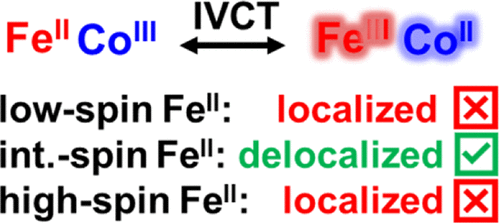
How Does Metal Spin State Affect Electronic Communication in Mixed-Valence Dimers? Insights from Ultrafast NIR and Soft X-ray Transient Absorption Spectroscopy | Inorganic Chemistry https://t.co/JLM3nm3YAh van der Veen, Vura-Weis, and co-workers @InorgChem#iron#cobalt#IVCT
Elucidating Electronic Coupling of Bimolecular Excited State Electron Transfer | Journal of the American Chemical Society @UNC @UNCChem https://t.co/5mnAoOerGU
Our work on Selective Recognition of Physiological Phosphates by Luminescent Eu(III) Probes via Analyte‐Specific EnT Pathways -published Chemistry – A Eur. Journal @ChemEurJ, Congrats Goutam Panigrahi & coauthors @IITKanpur@Chemistry_IITK@ANRFIndia 🙏 https://t.co/V2ZrXN1lC9
Our work on Ru(II) polypyridyl complex as luminescent chemodosimetric probe for selective and sensitive detection of phosgene and nerve agents - published in @InorgChemFront congrats @JuhiSayala@NitinIITiam
from @IITKanpur@Chemistry_IITK https://t.co/zX6LJegR99
A molecular dyad of an iron complex covalently bound to an annihilator exhibits three photoactive excited states — singlet, doublet, and triplet — enabling homomolecular upconversion
@fDoettinger, Jonathan Sagaya, @GiacomoMorsell2 in @J_A_C_S
https://t.co/CSyi69viCV
A water-soluble photolabile
Ru(II) complex with a terpyridyl-dicarboxylate ligand: photocytotoxicity triggered by structural strain - published in Inorganic Chemistry Frontiers-Unique role of pentadentate ligand in strained octahedral geometry... https://t.co/1v0HzXSVrN
Cr(III) complexes with enhanced metal–ligand covalency enable tunable NIR luminescence and endergonic red-light photoreduction.
@GiacomoMorsell2 and team find signs of doublet–doublet annihilation, or excited-state disproportionation.
Now in @J_A_C_S:
https://t.co/0ckIcD4Ppu