Getting out of the killing zone during an ambush is sound battle drill. But here, they appear to be running like lost rabbits.
It reminds me of a conversation I had with a Pashtun jihadist in Kashmir in 1995. He told me, “I have been through many fights, but there is something unique about the Indian Army. You people, instead of running away, run into the bullets. Kya log ho aap?”
Four years later, our youngsters proved that ethos yet again in Kargil.
I am proud of that warrior ethos, and I would wear it on my sleeve any day.
@adgpi
Aur haan, #PKMKB
RIP Alfred: the Bull who Cooked the PAF's Goose
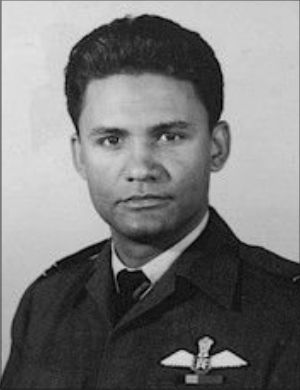
I have long believed that if the Indian Air Force had awarded a Param Vir Chakra for its actions in the 1965 war, it should have gone to Flight Lieutenant Alfred Tyrone Cooke. He was awarded the Vir Chakra for his action over Kalaikunda on 7 Sep 1965. On 18 Sep 2026, sixty-one years later, Alfred took off for Valhalla in Delhi, barely a day before No. 14 Squadron, the Bulls, was due to celebrate its Platinum Jubilee. The timing is difficult to ignore for a man who remained closely attached to a Squadron he had left more than half a century ago.
The broad outlines of Cooke's action over Kalaikunda are well known. He was the tall, lanky Hunter pilot of 14 Squadron who, on 7 Sep 1965, found himself in the middle of the second PAF raid on the airfield. Cooke and his wingman, Flying Officer Subodh Chandra Mamgain, were on combat air patrol when they were directed towards the raiders. Four Sabres of the PAF's own No. 14 Squadron were involved in that second attack, three at low level over the airfield and one above them. Cooke went down after the three.
Squadron Leader @joe_sameer reconstructed the full action from Cooke's own account, gun-camera evidence and Pakistani sources. Cooke shot down the Sabre flown by Flying Officer Afzal Khan, badly damaged Flight Lieutenant Tariq Habeeb's aircraft, engaged Flight Lieutenant Haleem's Sabre and then, having exhausted his ammunition, went after the remaining aircraft when it was engaged with Mamgain. The official record credited him with one confirmed kill. What is beyond argument is that his gun camera recorded him engaging several different Sabres, and that he continued the fight after his guns were empty. His Vir Chakra citation records him getting into position behind another enemy aircraft after his ammunition ran out and continuing to keep it on the run.
Cooke's Hunter returned with vegetation lodged under the aircraft. Years later, when a painting of the combat was shown to him, Alfred's correction was simple: the aeroplane was too high. His wingtip, he said, had been about six to ten feet above the ground.
Cooke himself could be abrupt. Those who knew him remembered high standards and little patience for people who did not meet them. He had great confidence in his own flying and strong views on how an aeroplane should be flown. He also remembered precisely who had taught him much of it.
That man was Squadron Leader O. N. “Piloo” Kacker. Cooke credited Kacker's intensive low-level combat training before the war with giving him the confidence to manoeuvre a Hunter at the heights to which the Kalaikunda fight eventually descended.
His interest in flying began much earlier. He grew up in Agra during the Second World War, with Hurricanes, Spitfires and Mustangs operating in the skies around him, and by his own recollection wanted from a young age to become a fighter pilot. He was educated at La Martiniere College, Lucknow, a school that produced a remarkable number of IAF fighter pilots and war veterans. In 2015, he returned there along with Denzil Keelor when the Air Chief honoured the school's veterans of the 1965 war.
Cooke was commissioned on 19 Dec 1961 with the 80th Pilots Course, and his entire commissioned career lasted only seven years. By 1967 he had decided to migrate and had put in his papers. He had originally been selected among the pilots to convert to the Su-7; once his decision to leave was known, Flight Lieutenant O. J. D'Sena took his place. Cooke finally left the Air Force in December 1968 and settled in Australia.
A seven-year career should ordinarily leave only a modest footprint in a Service's history. Alfred managed the opposite. He left as a Flight Lieutenant and remained identifiable throughout the rest of his life simply as Alfred Cooke of 14 Squadron. No later rank displaced it.
Australia became home, and he built a life there with his family, but his Indian and Air Force connections remained strong. In April 2023, Alfred led the Indian Army, Navy and Air Force veterans at the ANZAC Day march in Brisbane. It rained, but the march went on. More than half a century after leaving the IAF, he was still putting on his medals and walking at the head of a veterans' contingent.
Away from flying, Alfred loved dancing. Even in his later years, he went every week to a sports club for its weekly dance. When Deb Gohain contacted him to reconstruct the Kalaikunda combat for a painting, Alfred quickly dispensed with “Sir”; he was simply Alfred. The two spent hours getting the relative positions of the Hunter and Sabres right and remained friends afterwards.
I continue to find the award difficult to explain. The case for a Param Vir Chakra does not require retrospective embellishment. The official record confirms one kill and records that Cooke continued to pursue the enemy after his ammunition was exhausted. The gun-camera evidence and subsequent reconstruction tell us considerably more. In my view, what Alfred Cooke did that morning merited the Param Vir Chakra.
In 2015, on the fiftieth anniversary of the war, Alfred returned to India and handed his Vir Chakra to No. 14 Squadron. “My Vir Chakra belongs to the squadron,” he said. He later tried to have the monthly Jangi Inam that came with it transferred to the Bulls as well. The medal made it back; bureaucracy defeated the money.
Tomorrow, No. 14 Squadron turns seventy-five. The Param Vir Chakra never came. The Vir Chakra Alfred did receive has been back with the Bulls for eleven years.
#IAFHistory @IAF_MCC
70% of the freedom fighters executed by the British were Brahmins.
They sacrificed their lives for the country. But what exactly did their sacrifice achieve?
Today their children and grandchildren are discriminated against by the Government. They are labelled as "oppressors" and systematically barred from education and jobs.
Is this how a country should honor those who gave up their lives for her?
Source: The plight of Brahmins by renowned historian Meenakshi Jain @IndicMeenakshi
(PS: I have not independently verified the numbers)
Anti-Reservation Protest.
1. Everyone and their aunt knows that NO party can afford to remove reservation. Period.
2. If a party even attempts to temper with it, it is not going to remain in power or come back in power.
- The nation will literally burn even if there is a perception that GOI of the day is tempering with reservation system.
3. It is pure electoral mathematics.
- There is no decisive electoral gain from tempering with this system. But there is one caveat (Read the next point)
4. The rationalization within reservation system - reservation limited to one generation, creamy layer within OBC, SC and ST, high merit reserved category person getting seat in open category etc. - the demand for this will have to come from within reserved category by those who are losing out on reservation opportunities which seem to be concentrated only in some castes.
- That is the only way this demand will have legitimacy amongst the larger population which considers reservation a must.
- Even here, the political arithematic will look at voter% of who currently benefits versus who will benefit if system is rationalized.
5. The other key demand - reservation based on economic status as against blanket caste certificate - this will never happen.
6. Simply because this will seen as UC versus Other Caste conflict and no political party will back it.
7. I had once thought that road to bringing sanity to reservation debate and SC/ST act was through the Courts.
- But the way mass nationwide protests were organized within 10 days of the judgement portraying it as Modi government's attempt at diluting the SC/ST Act, forcing the GOI to bring back diluted provisions, I don't have any hope from this front as well.
8. So, what are your options as a GC/UC person?
- Engage with the government and see how you can make best of this situation.
- The massive pushback against the abomination that is the UGC Act is one such instance.
9. However, if your idea to address this issue is simply to vote against BJP because, well, they haven't done anything specifically for you, well, what can I say.
10. There is nothing wrong in voting for someone driven purely by self interest. Our whole electoral system is build around who gets what from whom.
11. So, the counter-question to those who give gaalis to BJP and want to vote against it - which interest of yours will be served by doing so, except to satisfy your urge to teach BJP a lesson.
- Is the BJP's performance as a party and in government to be judged only on ONE criteria - Reservation reforms?
12. From purely self preservation persepective, ask yourself this - What happens when BJP loses?
- Will Congress and SP coming to power solve your reservation related issue?
- What else will happen when Congress, SP, Commies and all sorts of assorted riff-raffs come to power?
- Remember, Rahul Gandhi has already spoken about reservation in the private sector.
- In the last 10+ years of Modi government, you've lived in a fairly secure India, the economy has done good inspite of massive geopolitical and economic challenges, there is stability in the country and you and me can go about living and building our lives.
13. Finally - All these GC warriors and leaders are like the Pied Piper of Hamelin.
- They're leading you down the garden path.
- Mark my words - these people will be sitting in the lap of Congress and SP if BJP ever loses while you would've ruined your and country's future for good.
14 Forget BJP, forget Modi, forget Ram Mandir or Article 370 or Op Sindhoor, forget everythiing. If self preservation is a skill that you posses, then purely for selfish reason, don't end up bringing those who'll ruin your lives.
#Cabinet approves 'Samudra Manthan' (National Offshore Exploration Scheme) with an outlay of Rs. 84,084 crore.
There are two main components of the scheme:
✴️ Seismic Data Acquisition, Processing & Interpretation
✴️ Offshore Exploration Acceleration, Common Infrastructure & Manufacturing Support
- Union Minister @AshwiniVaishnaw
#CabinetDecisions
Thought I'll give you guys a sneak peek. Here's a video of one of the short duration runs conducted by @dpropulse with its air-breathing rotating detonation prototype at a government facility during July 21-22, 2026. 5 kN burn with reduced air mass flow and reduced fuel flow as well. Aerospike nozzle integration proved. High-speed, High-definition content will also be released by and by.
ORBIT ACHIEVED. 🚀
Vikram-1 Test Flight-1 has reached orbit. India's first privately developed orbital rocket has completed its final burn and injected its payloads into a ~450 km orbit, making India the third country in the world with private orbital launch capability.
History is made. 🇮🇳
#Vikram1 #JourneyToOrbit #SkyrootAerospace
🇮🇳 India Tops the World at the 56th International Physics Olympiad 2026!
🥇🥇🥇🥇🥇India's young physicists deliver an extraordinary performance at #IPhO2026 in Colombia. All five members of the Indian team win Gold Medals. 1/3
@PMOIndia@DrJitendraSingh@HBCSE_TIFR@TIFRScience
India's Integrated Battle Group #IBG doctrine promises manoeuvre & strike in 24 hours. In 2030 scenario that means - generate your own drone superiority bubble, over your axis, organically. Robots make first contact. Manned elements exploit. My essay 👇
https://t.co/MGZh7KuuzJ
This not what the world expects from Bharat !!
India created history by winning its first-ever gold medal at the World Rowing Cup in Lucerne, Switzerland.
Indian Army rowers Lakshay and Ujjwal Kumar Singh achieved the historic feat in the lightweight men’s double sculls final.
The Indian duo clocked 6:26.09 to finish ahead of Hong Kong and the Netherlands, clinching the gold medal.
The 1962 war, The 1984 massacres ,The 1991 collapse. All predicted by one chart cast at midnight.
India was born in debt, in blood, in partition, in chaos - still able to rise high.
Want to understand india ?
Read this astrological thread - 1/N 🧵
Ok, so here is my take on the Fable ban, sovereign AI, Sarvam, etc.
The event is interesting as it has implications from many perspectives.
For AI users, it is clear that you should not confuse access with ownership, or adoption itself as advantage. And if the most significant tech differentiator you are leveraging has external control loops, then you have to accept you are vulnerable.
For AI talent, it is now a precedent that you would be *seen* aligning to national interests more than company interests. And even if its just a whim for now, this trend will be hard to reverse as the world gets more automated…
For AI labs, their offerings will be stratified - general purpose AI would be available as utility, but frontier AI would be gated. This is a fantastic business model for labs - *democratized* AI sucks in all the data liquidity of the world which is locked in higher margin frontier offerings.
I think for the world to be a better place, all three of the above are bad vectors. We need to have more countries and companies owning their own destinies. And in the post AI world, that means being able to use and improve AI systems within their own perimeters - what one may call Sovereign AI.
At Sarvam, Sovereign AI in India was the founding thesis a couple of years back, and continues to remain the core operating principle. From our vantage point, it is super clear that India will build, leverage, and create massive business value and societal impact with sovereign AI. The following is precisely how we at Sarvam are contributing to make that happen.
Several years ago, engineers at a major Indian OEM wanted to add a simple valve to their own engine.
They knew how to do it. The problem: the software running inside their own vehicle's ECU was locked. The key was in Germany.
Three years later, the problem remained unsolved. 🧵
(1) Most countries do not actually have a military.
Instead, most countries outsource their security to the US (most common), to Russia (like Belarus), or to China (like North Korea, partially). Iran is unusual in that they're going it largely alone. They're also unusual in that they actually appear to be winning. And if Iran does manage to drive the US out of not just Afghanistan and Iraq, but the entire Middle East, they'll have unfortunately undermined the idea that America can or will provide any security guarantees at all.
(2) So, with the withdrawal of the American Empire, every country is going to need a new military.
Some countries will "build their own." The ones most likely to go nuclear are Japan and Turkey. Maybe also Germany, South Korea, Australia, Brazil, and Poland. They'll do so both for defense and to guarantee an energy supply now that Hormuz isn't stable. Thus, the Iran war will unfortunately obviate non-proliferation.
Most other countries will not build their own militaries. They'll simply do what's necessary to align with the new regional hegemon. That new hegemon will likely be China in East and Southeast Asia, Russia in North Asia and Eastern Europe, and Iran in West Asia. India has a tough situation in South Asia due to Pakistan. MAGA America will probably refocus on Latin America. And Newsom's Democrats will likely align with China, as Carney's Canadians have already done.
(3) But what about every group in the world that's not running a country? What about every company and community?
They'll need to think about a world where the US military has withdrawn, and isn't there for them. Is there any way to preserve something that looks like the rules-based order without the former guarantor of those rules?
(a) In the physical world, these companies and communities will have to find a country that has either built their own security, as described above, or is aligned with one that has. And abide by whatever new rules they set. From the standpoint purely of tech, dozens of countries are now surprisingly permissive, opening up new special economic zones and digital nomad visas.
(b) In the digital world, a partial answer is the code-based order, protected by encryption rather than weapons. Like the handoff from the British to the Americans, can we hand some of what America did off to the Internet?
Crypto is furthest along here. The anti-government strain within American libertarianism, the Ron Paul strain that says you can't trust the government, well...crypto simply applies that to all of the US government, including the parts run by Republicans, including the dollar that backs the US military. Crypto does not trust the plan. After all, the US has >$175T in compounding debt, and it's financially going to zero, economically doomed just like the USSR, albeit from Keynesianism rather than Communism. Elon is our best guy and couldn't fix it with DOGE. As he said, he did his best.
(4) The closest modern analog to the end of the US empire may be the end of the USSR's empire. Just like the Soviet Union became Russia, the USA is becoming America. Troops are being pulled back from around the world, it's becoming a "republic, not an empire", and everyone has to figure it out for themselves.
Now, many wars did erupt in the aftermath of Soviet withdrawal, like Chechnya and the Tajikistani civil war. But it's not like every single place fell into war. Estonia didn't, Poland didn't. The Czechs and Slovaks had the Velvet Divorce. Countries long under the Soviets worked out local security arrangements between themselves.
That's what's happening now as the American Empire withdraws from the world. Everyone is figuring it out for themselves.
IN SUMMARY
(a) You're correct that a country needs a military, but the world is losing the US military, so they'll build their own or align with a country that has one.
(b) You're correct that the US military historically protected the rules-based order, but in many ways it's abandoning that order, while much of Eurasia is actually going further in the direction of free trade, and the Internet is exporting global rule-of-law via rule-of-code.
(c) You're correct that US military withdrawal will likely result in chaos in parts of the world, like the USSR's military withdrawal did, but I don't think it results in chaos in all of the world, anymore than the USSR's withdrawal did.
(d) Don't take it from me, though. The 2025 US National Security Strategy said that elites "overestimated America's ability" and that "permanent American domination of the entire world" is not in the best interests of the US.
In other words, they've already announced that the world is multipolar, that the unipolar moment is over, that US will no longer pay any price and bear any burdern. So everyone will need to figure out security after the American empire leaves, just as they had to figure out local security arrangements after the British, French, and Soviet empires left.
https://t.co/SWwJETDdbB
Pakistan Army and Tactical Brilliance - Nah! Its plain old stupidity.
Recently @ShekharGupta wrote a piece on the tactical brilliance but strategic stupidity of the Pakistan Army since 1947.
For a very long time, even I believed in this theory.
But when I started re-reading the military history and other ops (I had frankly forgotten a lot of stuff), I realized that this is a very charitable explanation which we extend to what is actually repeated stupidity at play by the Pakistanis.
We do this because we can't seem to digest or accept that someone can be repeatedly so stupid. So, we name it tactical brilliance.
---
"Yes Sir, Three Bags Full, Sir".
As they say, Pakistan doesn't have an army, the Pakistan Army has a nation. PA and its generals are not accountable to anyone. Only potential threat is an internal coup from some other general. Thats it.
So, when plans are finalized within the GHQ in Rawalpindi, there is no-one to provide a counter-view.
A steeply hierarchical organization coupled with a zeal to get even with the 'Kaffir' 'Hindu' 'Baniya' India is a very dangerous cocktail which does not allow critical appraisal or feedback.
So, if the big man and his coeterie says GO, everyone simply follows the order.
---
'Phat Ke Flower'
What follows from the above is the first thing you realize when studying the overall war objectives of Pakistan is that there is no thought given to "What-If Scenarios".
Pakistanis make these simple, straight-forward and linear assumptions, and the whole war plan is predicated on this assumptions holding ground.
There is no stress-testing - There is no 'What-if' scenario assessment. Pakistanis are so cocky about their reading of geopolitics, Indian politics and strategic scenario, and Indian military capabilites and leadership, that they simply don't factor for scenarios apart from the rosy pictures they've built inside their heads.
The moment they counter an alternate scenario and see the script running contrary to what they had gamed (more like dreamed about), they have the proverbial 'Phat ke flower' moment.
And you'll find them running around headless chicken.
---
Kargil - Crown jewel of Pakistan Army's Stupidity
A lot of serious and casual commentators say that the Indian Army did not see Kargil coming inspite of the intelligence warnings.
My counter-question is this - What was Kargil and what should've the Indian Army foreseen coming?
It is known that the Northern Command did run a table-top war-game where Pakistan Army incursion into the Kargil Sector was envisaged by a red-team (Brigadier level officers from Northern Command).
But it was considered as not possible because given the terrain, logistic requirement and Pakistani+own troop disposition, it was simply not sustainable.
But what was the thinking from Pakistan Army's side?
---
Living in La La Land
(1) The Nuclear Shield: They assumed Pakistan's nuclear weapons would completely deter India from launching a major conventional military counter-attack.
(2) Localized Indian Response: They believed India's military reaction would be weak and restricted strictly to minor infantry skirmishes along the LoC.
(3) International Intervention: They expected the international community to panic and force an immediate ceasefire, freezing the captured territory in Pakistan's favor.
(4) Plausible Deniability: They assumed the world would believe the intruders were local Kashmiri freedom fighters rather than regular Pakistani soldiers.
(5) Choking Siachen Supplies: They believed occupying the heights would permanently cut off India's vital NH 1D highway, forcing India to abandon Siachen.
(6) Total Secrecy as a Strength: They assumed keeping the plan hidden from their own Air Force, Navy, and Prime Minister would ensure tactical success without consequence.
---
Even enthu-cutlet defense crowd on X will tell you that all of the above assumptions are pure fantasy and have no relation to the reality as it exists on ground.
I mean, just one change in Assumption (2) [Massive Indian localized retaliation with arty support and Indian Air Force being brought into picture] meant that the whole plan went for the toss!!!
Forget that India had alternate Manali-Leh route to supply Siachen and Ladakh Sector or India could've widened the conflict by crossing LOC at its own area of chosing (which was actually planned and troops put in place in Kashmir for this option).
---
In the end, I again ask - What was Kargil?
It was a fundamentally flawed plan at land-grab to bring about a major change in the alignment of LOC and AGPL with far reaching geo-political consequenes but which was based on iffy assumptions, none of which held in the end, leading the Pakistanis to suffer another humiliating defeat.
So, what was tactically brilliant about occupying un-guarded areas across LOC on Indian side when in the end it led to all-around failure?
As I said earlier - We need to call out the Pakistan Army actions for what they are - plain old stupidity, and not flatter them with terms like tactical brilliance!
---
Before I close, let me circle back to an earlier question - What did the Indian Army not envisage when it came to Kargil?
- First, purely from military logic, the Indian Army was absolutely correct in its assessment that no operation in Kargil is sustainable by the Pakistanis given myriad of factors.
- The mistake it did was to assume that Pakistan Army will think on rational lines with rigorous military logic.
- That it will initiate ops based on fundamentally flawed assumptions and in the process, initiate hostilities and war.
- Having committed itself to an ops without thinking through the whole scenario, Pakistanis ended up suffering another humiliating retreat and defeat.
- But we paid the price in 500+ bravehearts to clean up the mess.
- Any opportunity to harm India is to Pakistan Army what a shot of drugs is to a junkie - consequences be damned.
Lesser Known Facts : Their is a Indian private company called Raj Hamsa been exporting ultra light aircraft globally since 90s and the model below called "Hanuman", it cost 14 Lakh in kits for export and half in India in ready to fly conditions, it's really a cute aircraft. 🇮🇳💕
Emerging-market currencies depreciate against the dollar largely because of higher relative inflation and the Balassa-Samuelson effect, not because the country is failing. India's real per capita income has roughly doubled in 15 years. The middle class is materially better off, not poorer.
The underlying error is treating a bilateral nominal exchange rate as a measure of household welfare. The correct measures are domestic CPI for the cost of living, real per capita income for living standards, and real return on saved assets for retirement wealth. On all three, the 15-year picture is the opposite of the one suggested.
Did you know that the U.S. defaulted on its sovereign obligations in 1971 when it unilaterally reneged on dollar-gold convertibility.
Russia defaulted in 1998 and 2022.
Argentina: 9 times since independence.
Pakistan: required IMF bailouts 23 times.
Greece defaulted in 2012.
And India? Zero defaults. Not even in 1991!
Yet Western investors classify India as "emerging risk" and call U.S. Treasuries the "risk-free rate."
This isn't risk analysis. This is cognitive bias a la Daniel Kahneman's book "Thinking, Fast and Slow". Humans systematically overweight culturally proximate information while underweighting statistical patterns that don't fit our mental models.
Western strategic planners trust Western partners not because the data supports it, but because the cultural markers feel familiar.
Three facts that challenge everything about how we assess partnership risk:
FACT 1: Across 5,000 years of recorded history, India has rarely waged wars of territorial conquest. Not in 3000 BCE when the Indus Valley Civilization had technological superiority. Not in 1000 CE when Indian mathematics and metallurgy exceeded Europe by centuries. Not in 2026 when it possesses nuclear weapons and the world's 4th-largest military. Not in 2047 when it projects to be a top-two economy.
Compare: China (annexed Tibet 1950, 14 territorial disputes, South China Sea expansion). Russia (Georgia 2008, Crimea 2014, Ukraine 2022). Europe (500 years of colonial conquest across three continents). U.S. (military interventions in 20+ countries since 1945).
This pattern is observable strategic behavior anchored in the Arthashastra, Kautilya's 2,300-year-old treatise arguing that short-term territorial expansion undermines the systemic conditions for sustained prosperity. The concept of "mandala" (circle of states) recognizes that each power's long-term interest depends on system equilibrium.
FACT 2: India has never defaulted on debt, treaties, or security guarantees since independence in 1947. The most revealing test: 1991 balance of payments crisis. Reserves fell to $1.2 billion = just three weeks of imports. Default appeared certain. Instead, India implemented painful reforms, honored every obligation. India didn't use political costs as an excuse to default. Commitments were kept.
This behavior isn't accidental. It's anchored in the Sanskrit concept of ṛṇānubandhaḥ, that obligations are metaphysically binding across time. The Mahabharata established 2,000 years ago that rulers who break commitments violate cosmic order and create systemic instability.
Philosophy became institutional architecture: investment-grade credit through multiple crises, $600B forex reserves (6th globally), zero defaults on government securities across 77 years.
FACT 3: During COVID-19, India exported 300 million vaccine doses to 110 countries while its own vaccination was incomplete. 96 countries received doses free through "Vaccine Maitri."
Meanwhile: U.S. ordered 1.2 billion doses for 330 million people (4x population). EU ordered 4.6 billion for 450 million (10x population). Canada ordered 400 million for 38 million people (10x population).
Western nations didn't begin international distribution until domestic targets were substantially met.
The distinction? India's Economic Survey 2020-21 quoted Sanskrit: "āpadā hi prāṇa rakṣā hi dharmasya prathama aṅkuraḥ" (in calamity, protecting life is the first duty). Not Indian life. Life in general.
This aligns with Vasudhaiva Kutumbakam (the world as one family), not as rhetoric but as policy. India supplies 60% of global vaccines and 20% of generic medicines normally, maintained production during its own constraints, built digital public infrastructure (UPI processes more transactions than all nations combined) and offers it open-source to developing countries.
WHY THIS MATTERS NOW:
Every CFO, sovereign wealth fund, and policymaker is asking: "Who can we depend on for the next 50 years?"
Ukraine shattered the illusion that economic integration prevents aggression. COVID exposed single-source dependencies. Taiwan reveals semiconductor concentration risk.
The global economy is re-optimizing from efficiency to trust.
But here's where Kahneman's research becomes critical: most strategic planners are making decisions using "System 1" thinking (fast, intuitive, pattern-matching based on cultural familiarity) rather than "System 2" thinking (slow, analytical, data-driven assessment of long-horizon behavioral patterns).
The result? Systematic mispricing of partnership risk.
Strategic planners face a choice:
- China: manufacturing efficiency + demonstrated willingness to weaponize interdependence (sanctions on South Korea over THAAD, Australia over COVID inquiry, Lithuania over Taiwan, Belt & Road debt traps in 60+ countries)
- Russia: resource access + repeated weaponization (invaded Ukraine despite economic integration, cut gas to freeze European cities)
- U.S.: innovation + extraterritorial enforcement (billions in fines on European banks for transactions legal in Europe, CLOUD Act overrides local privacy laws, "America First" tariffs hit Canada, Mexico, EU alongside rivals)
- India: 5,000-year track record of territorial restraint + zero defaults + systemic thinking during crises +
challenges (infrastructure gaps, bureaucratic complexity, uneven state capacity).
The question isn't perfection. It is: which risk profile aligns with 50-year partnership objectives when analyzed through System 2 rather than System 1 thinking?
THE UNCOMFORTABLE TRUTH:
If India's pattern suggests lower long-duration risk, why is trust in India still "emerging"?
Kahneman would predict exactly this outcome. Three cognitive biases at work:
1. **Availability bias:** We assess risk based on vivid, recent, culturally proximate information. NATO expansion incorporated Poland, Czech Republic, Hungary rapidly because they registered as "European." India's democracy, rule of law, English-language business environment gets discounted because cultural markers differ.
2. **Confirmation bias:** Western institutions have decades of frameworks built around current partnerships. New data contradicting established models gets filtered out rather than integrated.
3. **Status quo bias:** Existing relationships are comfortable. The U.S.-Europe alliance, U.S.-Japan partnership, Five Eyes intelligence sharing operate with established protocols. Structural change requires crisis-level disruption to overcome inertia.
The crisis arrived.
For boards evaluating long-term partnerships—semiconductors, pharmaceuticals, digital infrastructure, maritime security, critical minerals—India presents a risk profile worth systematic, System 2 analysis.
Because of demonstrated behavior across sufficient time horizons to be statistically meaningful.
In an era of fragmentation, weaponized interdependence, and trust deficits, historical patterns become predictive indicators.
Kahneman spent decades showing that intuitive judgments systematically diverge from statistical reality. Strategic partnership assessment is no exception.
The question is: Are we assessing risk based on data, or based on what feels familiar?
In the 21st century, power matters. But trust may matter more.
And trust should be measured by track record, not by cultural proximity.