I’m at a point in my life where I pray to keep meeting the right people. People who genuinely want the best for me, hold me in high regard, add value in my life, prioritize me and add peace to my life.
Girl to girl: be that girl again.
Get disciplined again. Take care of yourself again. Eat better & move your body again. Oil your edges & drink your water again. Start praying & reading your Bible again. Get your money up and sleep 8 hours again. Find your spark and put yourself first.
Yesterday's High Court judgment on the impeachment of H.E. Rigathi Gachagua raises serious and legitimate questions that our constitutional jurisprudence must grapple with honestly. The three-judge bench found that the Senate violated the former Deputy President's right to a fair hearing under Article 50 of the Constitution specifically by declining to grant an adjournment when he was unable to attend the proceedings. The court acknowledged that violation, issued a declaratory order and awarded Ksh.50 million in constitutional damages. Yet the bench ultimately upheld the impeachment itself. I respect the court and the constitutional role it plays. But I believe this outcome calls for serious reflection on the coherence of our remedial framework.
The tension in the judgment lies in this, if the Senate's refusal to adjourn was a constitutional infirmity serious enough to warrant a finding of violation and a Ksh.50 million award, then the question that naturally follows is whether that infirmity was capable of tainting the entire removal process. The right to a fair hearing is not procedural decoration. It is a substantive constitutional guarantee, particularly in proceedings that result in the removal of a person from high public office. Courts must therefore grapple carefully with what it means to vindicate a right while simultaneously affirming the outcome that flowed from its violation. It is a difficult balance and I appreciate that the bench was navigating complicated constitutional terrain.
It is instructive to recall the reasoning of the Supreme Court in the landmark 2017 presidential election petition delivered by the then Chief Justice David Maraga. The court, in a 4-2 majority, nullified the presidential election not on the basis that the outcome was necessarily wrong but on the basis that the process through which it was arrived at did not conform to the Constitution and the law. The court found that irregularities and illegalities in the transmission of results had compromised the integrity of the election and that the constitutional standard required more than a plausible result, it required a process that was itself constitutionally compliant. That principle that a flawed process cannot produce a constitutionally valid outcome remains a pillar of our public law.
When we place that 2017 reasoning alongside yesterday's judgment, a legitimate concern emerges. Both cases involved constitutional violations in the course of a high-stakes removal or electoral process. In 2017, the violation of constitutional standards was sufficient to nullify the result entirely. Yesterday, a violation of the right to a fair hearing was found, remedied in damages but the result was preserved. These are not necessarily irreconcilable positions, courts do have discretion in fashioning remedies but the distinction must be clearly reasoned and transparently justified because the precedent being set will govern how future impeachments are conducted and how future courts respond to violations within those processes.
My concern is about the precedent this decision may establish. If a constitutional violation during impeachment proceedings can be remedied by damages without disturbing the outcome, future Parliaments and Senates may not feel the full weight of their constitutional obligations when handling removal proceedings. The court itself noted the urgent need for Parliament to enact a dedicated statutory framework under Article 150 governing the removal of a Deputy President which is a legislative gap that should never have existed this long. That recommendation must not be ignored. A constitutional democracy is built on the integrity of its processes not merely its outcomes. We must ensure that the right to a fair hearing in Kenya remains substantive and not merely symbolic.
Is this the plan?
1. Kill agriculture
2. Kill the informal economy
3. Kill SMEs
4. Defund education and health
5. Kill the people
6. Share land and loot with foreign corporates.
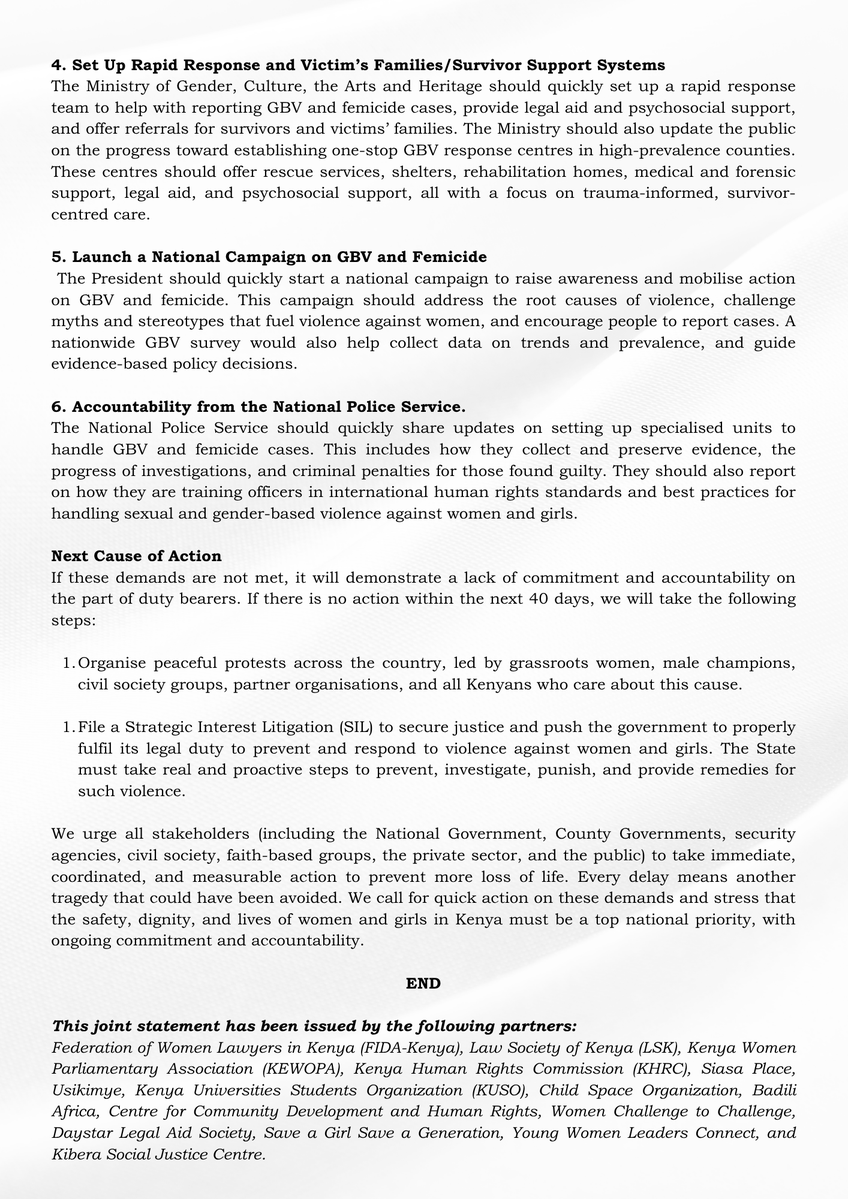
STATEMENT: If these demands are not met, it will demonstrate a lack of commitment and accountability on the part of duty bearers. If there is no action within the next 40 days, we will organise peaceful protests across the country and file a Strategic Interest Litigation (SIL)
The sad reality is that we are in cyclic loop and I don't see that changing anytime soon. Protest, people get killed and shops get looted, someone somewhere does a handshake, back to normal with no meaningful changes. Repeat.