Andrej Karpathy spent 2h showing how he actually uses AI day to day
he's a co-founder of OpenAI and led AI at Tesla, so when he shows how he works, it’s worth watching
and the whole session is just him telling the machine what he wants in simple terms, like he's briefing a coworker
watch what's actually happening the entire time:
> he describes the task in normal words
> it goes off and does the work
> he glances at the result and nudges it with one more sentence
that's the whole skill, and you've had it since you learned to talk
the only gap between that and a worker that runs on its own is handing that sentence a schedule and the tools to act
check his work, then build the version that keeps working when you stop
I’m looking for people who are ready to lock in with zero distractions for the next 3 months.
Let’s commit to this roadmap and actually follow through.
Forget the AI noise for now. Focus on becoming solid in backend engineering and system design.
It might sound unrealistic, but you’ll be surprised at how much you grow by the end of June / early July.
Read below 👇🏿
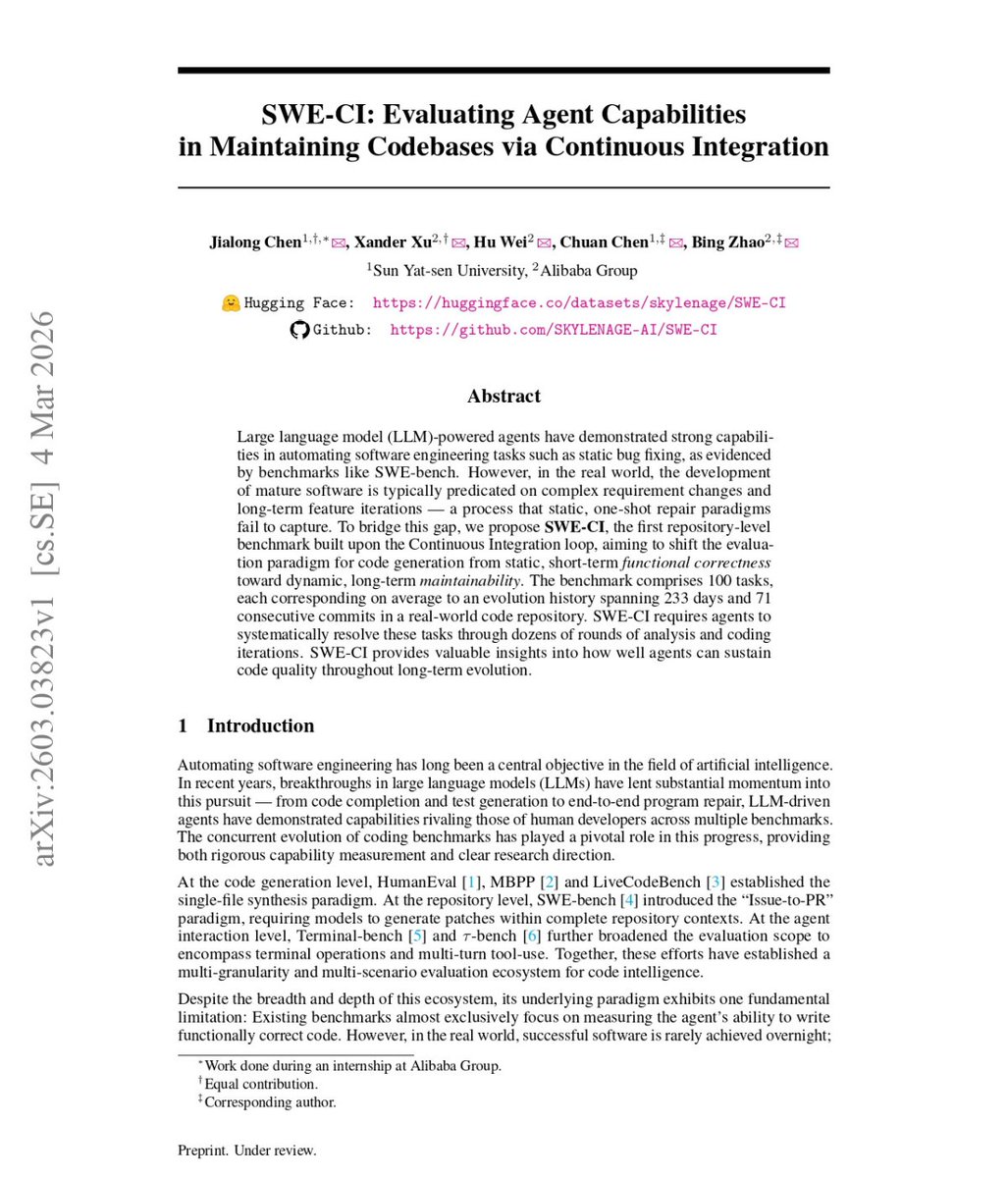
🤯BREAKING: Alibaba just proved that AI Coding isn't taking your job, it's just writing the legacy code that will keep you employed fixing it for the next decade. 🤣
Passing a coding test once is easy. Maintaining that code for 8 months without it exploding? Apparently, it’s nearly impossible for AI.
Alibaba tested 18 AI agents on 100 real codebases over 233-day cycles. They didn't just look for "quick fixes"—they looked for long-term survival.
The results were a bloodbath:
75% of models broke previously working code during maintenance.
Only Claude Opus 4.5/4.6 maintained a >50% zero-regression rate.
Every other model accumulated technical debt that compounded until the codebase collapsed.
We’ve been using "snapshot" benchmarks like HumanEval that only ask "Does it work right now?"
The new SWE-CI benchmark asks: "Does it still work after 8 months of evolution?"
Most AI agents are "Quick-Fix Artists." They write brittle code that passes tests today but becomes a maintenance nightmare tomorrow. They aren't building software; they're building a house of cards.
The narrative just got honest: Most models can write code. Almost none can maintain it.
Crawling an entire website used to take:
A Python script.
Playwright or Selenium.
Proxy rotation.
Rate limiting logic.
Error handling.
3 hours of debugging why page 47 returned a 403.
Now it's one API call.
Every web scraping startup that raised millions to solve this problem just became a single endpoint.
Every freelancer charging $500 to "extract website data" just lost their entire business model to a /crawl command.
HTML. Markdown. JSON. Pick your format. No scripts. No browser. No headache.
The entire web scraping industry just got reduced to one line of code.
Someone is going to use this to clone every competitor's website by Friday. 💀
I built PageServe — a platform to host single HTML or Markdown pages instantly.
No Git.
No deployment.
No full website needed.
Custom domains, SEO controls, analytics, version history.
https://t.co/QTxy4iEDtP
#BuildInPublic#Indiehackers#WebDevelopment
This was an eye opener from Jensen Huang
When asked whether he would rather relive his 20s or be 20 years old today, this is what he had to say:
"I thought our 20s were happier than these 20s. I think everyone deserves some time to be oblivious, and not wear all of the world's problems on their shoulders on Day 1
We are raising a generation that is very cynical and too informed
They are cynical, not because they are inherently cynical. They are cynical because they see so much stuff. It is too much stuff
You have to build up some internal reserve of optimism. You have to build up some reserve of goodness."
@CodeEdison This is a great breakdown.
The real deciding factor is who owns the state.
If you want full control + instant logout, sessions win.
If you want cross-service auth without central storage, JWT wins.
@bearlyai Code has been the easiest layer to automate for a while. The real leverage is in system boundaries, invariants, and risk ownership. Until AI owns production incidents, humans will still be in the loop.