“If you have like 7 million Naira in your account and you can work well, relocate to China. Nigerian youths are wasting their time and their youthful life in Nigeria,our youths are just wasting away in Nigeria”
Lady says
StandX is starting to feel less like a typical perps platform and more like a full system where every action feeds into rewards.
If you’re trying to position early, there are basically four main ways you can farm points right now on @StandX_Official and they’re not all equal.
First is the simplest: holding $DUSD.
Just by keeping $DUSD in your perps wallet, you’re already earning holding points. No extra steps, no locking. It’s the base layer your capital is active even before you trade.
Then comes trader points, which are the most important.
Every time you trade perps, you earn them. And from everything so far, these carry the highest weight when it comes to future airdrop rewards. So while other methods help, this is where most of the real positioning is happening.
Next are maker points.
If you’re placing limit orders on the order book instead of just aping market orders, you earn here. It rewards liquidity providers people who actually help build the market, not just take from it.
And finally, there’s activity on the DEX side:
Swaps and vault deposits also earn points. So even outside perps trading, you’re still feeding into the system and stacking rewards.
What’s interesting is how all of this ties into the bigger picture especially with SIP-3 now live.
SIP-3 adds another layer to $DUSD that makes the whole ecosystem more connected.
Before, $DUSD already had yield coming from market-neutral strategies. Now, perps trading fees are added as an extra source. So the more the platform gets used, the more value flows back to holders.
It’s a simple loop:
more trading activity to more fees to more yield to stronger $DUSD
And it doesn’t stop at just active users.
With Universal Distribution, every wallet holding $DUSD benefits. You don’t need to be constantly trading or managing positions to tap into it. Just holding puts you in the flow of rewards.
That’s a big shift from how most systems work.
Usually, rewards are isolated: traders earn one thing, LPs earn another, holders get nothing.
Here, everything is connected.
Hold $DUSD – earn
Trade perps – earn more (and most important)
Provide liquidity – earn
Use the DEX – earn
And now with SIP-3 The entire system feeds back into $DUSD holders
It creates a kind of layered participation model where you’re not limited to one role. You can stack across multiple activities and increase your exposure to rewards over time.
If you’re approaching this strategically, the obvious focus is trader points since they carry the most weight. But ignoring the other layers would be leaving value on the table.
StandX is clearly designing toward one thing:
an ecosystem where usage = rewards, and
activity compounds across layers.
And with SIP-2 already rewarding positions and SIP-3 boosting $DUSD yield through real platform activity, it’s starting to look like a system where both your capital and your behavior are constantly being monetized.
That’s not something you see often in perps platforms yet.
Stand.
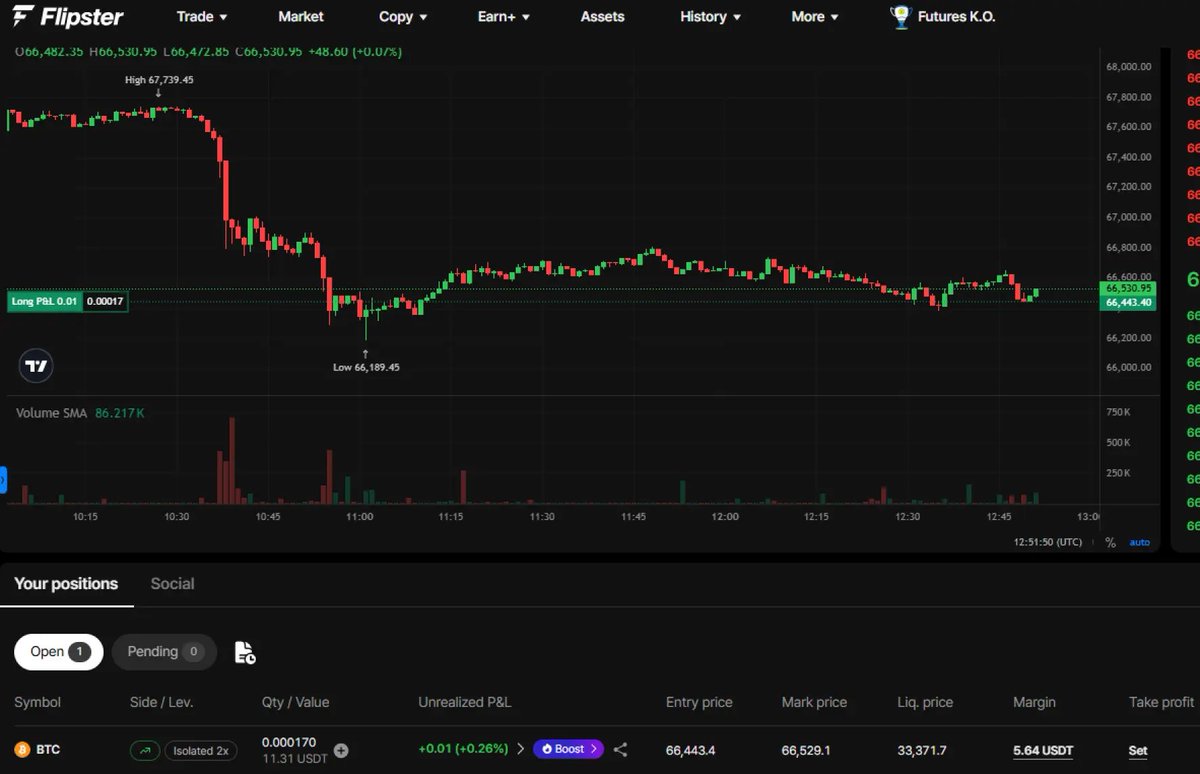
What flipster is building is pretty straightforward: a trading platform designed for execution, not distractions.
At its core, it’s a centralized exchange focused on perpetual futures built for traders who care about speed, simplicity, and cost. The interface is clean, easy to navigate, and doesn’t overload you with unnecessary features. Everything is where it should be, which matters more than people think when you’re actively trading.
Execution is where flipster really leans in. Zero spread on major pairs, fast order fills, and a system designed to minimize slippage especially during volatile market conditions. When price moves fast, getting in and out efficiently is the real edge.
They’ve also added tools that fit different types of traders. Features like copy trading allow newer users to follow experienced traders and learn from their strategies, while more advanced users can take advantage of things like “Profit Boost” to maximize short-term opportunities.
Another thing worth noting is cost. Compared to bigger exchanges like Binance, Bybit, and OKX, flipster positions itself with lower trading fees, which can make a real difference for high-frequency or active traders over time.
Security and transparency are also part of the product experience. With daily Proof-of-Reserves and no reported security issues, users have a clearer view of how assets are handled something that’s becoming more important across the industry.
And beyond the trading itself, @flipster_io leans into transparency with daily Proof-of-Reserves, giving users more visibility into how assets are managed.
It’s not about being flashy.
It’s about building a platform where traders can move fast, stay focused, and execute with confidence.
SIP-2 [SIP (StandX Improvement Proposal) #2] on @StandX_Official adds a new layer to trading that most platforms have never really explored getting paid not just for what you do, but for how you stay in the market.
Traditionally, once you open a position, your outcome is tied to two things: price movement and funding. That’s it. Your capital is exposed, but it isn’t actively working beyond those variables. Even if you hold a well-structured position, there’s no additional reward for simply being part of the market.
SIP-2 changes that by introducing Position Yield.
Now, eligible positions earn a share of protocol fees over time. This is not a replacement for existing mechanics, but an additional layer that sits on top. It’s also completely separate from the base yield already generated by $DUSD margin, which means you’re effectively stacking two different earning streams on the same capital.
What’s interesting is how broad the system is. It doesn’t matter whether your position comes from the orderbook, a market order, or even a Block Trade as long as it contributes to the market, it qualifies. That inclusiveness signals that the goal here isn’t to favor a specific strategy, but to reward overall participation.
At the core, the system is simple: the more meaningful your position, the more you earn.
Position Yield scales with: size, duration, and exposure.
Bigger positions held for longer periods naturally receive a larger share. This creates a direct link between commitment and reward, pushing traders to think beyond short-term flips and toward more deliberate positioning.
The leverage component adds another layer to this.
Instead of just amplifying risk and potential PnL, leverage now also amplifies yield. A position with higher exposure contributes more to the system and is rewarded accordingly. That changes how leverage is perceived it’s no longer just a tool for aggressive trading, but also a multiplier for participation rewards.
The mechanics become clearer with a simple example.
0.02 \times 3 = 0.06
Assume a base Position Yield of 2%, and an average protocol leverage of 1x. If a trader uses 100 $DUSD as margin to open a $300 position at 3x leverage, the effective Position Yield becomes 6%.
Now factor in the existing $DUSD margin yield.
0.06 + 0.04 = 0.10
If the base margin yield is 4%, the total yield on that same capital reaches 10%. That’s not coming from a single source, but from two independent layers working together one tied to holding capital, the other tied to maintaining a position.
This dual-yield structure is where SIP-2 becomes more than just an added feature.
It introduces a system where: your capital earns, and your exposure earns.
Even in conditions where price action is slow or indecisive, there’s still a mechanism generating value in the background. That reduces the pressure to constantly rotate positions or chase volatility just to stay profitable.
Over time, this can influence behavior in a meaningful way. Traders are no longer incentivized purely by short-term outcomes. There’s now a reason to stay in valid positions, to size them properly, and to think in terms of sustained participation rather than constant execution.
It also ties users more directly into the protocol itself. Since Position Yield is derived from protocol fees, earning from it effectively means sharing in the activity you help create. The more you contribute to liquidity and market depth, the more you benefit from the system as a whole.
SIP-2 shifts the model from a purely transactional experience to something more continuous.
Instead of: open → manage → close
it becomes: enter → stay → earn → optimize
And when combined with $DUSD’s base yield, it creates a structure where both layers of your capital are always working.
That’s a level of capital efficiency that most trading platforms still haven’t reached.
Products that rely on real-time public data don’t fail because of bad logic.
They fail when the data layer can’t keep up.
Verifying something like user-submitted X posts sounds simple, until demand spikes.
APIs start rate-limiting.
Responses slow down.
And workflows that were meant to be automated suddenly require manual checks.
That’s the bottleneck.
@teneo_protocol approaches it differently.
Instead of querying a single API, applications tap into a decentralized agent network that is continuously ingesting and structuring public web signals in real time.
So when a verification request comes in, it’s not starting from scratch.
It’s querying an already-active intelligence layer.
The impact is clear.
What used to be slow and inconsistent becomes fast, reliable, and fully automated, even under heavy load.
In a real production workflow, this shift led to a 50× improvement in processing speed.
No redesign.
No added complexity.
Just replacing a fragile dependency with infrastructure that actually scales.
Most people think the future of AI will be decided by better models.
It won’t.
It’ll be decided by who controls the quality of data those models learn from.
That’s where Perle Labs comes in.
They’re building a sovereign data layer for AI and that matters more than most people realize.
Because right now, AI isn’t failing due to lack of intelligence.
It’s failing at judgment.
It struggles with nuance.
With intent.
With edge cases that don’t have clean, binary answers.
And these are exactly the situations that define real-world use.
Throwing more data at the problem doesn’t fix it.
You need high-quality human reasoning structured, evaluated, and reliable.
That’s #PerleAI + #ToPerle edge.
Instead of treating human input as noise, they turn it into verifiable signal.
Every contribution is designed to capture not just answers, but thinking: Why something is correct
– What the intent is
– Where ambiguity exists
And more importantly, that input is measured for accuracy and consistency.
Behind the scenes, this creates something powerful:
A dataset built not just on information but on trust.
This is the kind of data AI systems actually need to operate in high-stakes environments.
Finance. Health. Decision-making systems.
Anywhere mistakes aren’t acceptable.
Perle is opening this system to a wider network not just to scale participation, but to stress-test how humans and AI collaborate at scale.
And the points system?
It’s not just gamification.
It’s a reputation layer where:
Accuracy matters more than volume
Consistency defines value
And quality shapes opportunity
This is how you align incentives with truth.
The bigger picture is clear:
AI won’t be defined by who builds the fastest models…
But by who builds the most reliable learning layer.
Perle isn’t just another platform.
It’s positioning itself at the point where human intelligence meets machine learning and making that interaction structured, measurable, and trustworthy.
That’s not hype.
That’s infrastructure.
— participating in @PerleLabs community campaign
MUST WATCH!!! They conducted tests on some popular Nigerian bottled water brands, and the results might make you think twice before grabbing just any water on the street.
A man used a TDS meter (Total Dissolved Solids tester) to test different bottled waters like Eva, C-Way, and Jazmyne to check their purity levels. The results were sh0cking, only Jazmyne water passed the test. 😳💧


![freewayOnchain's tweet photo. SIP-2 [SIP (StandX Improvement Proposal) #2] on @StandX_Official adds a new layer to trading that most platforms have never really explored getting paid not just for what you do, but for how you stay in the market.
Traditionally, once you open a position, your outcome is tied to two things: price movement and funding. That’s it. Your capital is exposed, but it isn’t actively working beyond those variables. Even if you hold a well-structured position, there’s no additional reward for simply being part of the market.
SIP-2 changes that by introducing Position Yield.
Now, eligible positions earn a share of protocol fees over time. This is not a replacement for existing mechanics, but an additional layer that sits on top. It’s also completely separate from the base yield already generated by $DUSD margin, which means you’re effectively stacking two different earning streams on the same capital.
What’s interesting is how broad the system is. It doesn’t matter whether your position comes from the orderbook, a market order, or even a Block Trade as long as it contributes to the market, it qualifies. That inclusiveness signals that the goal here isn’t to favor a specific strategy, but to reward overall participation.
At the core, the system is simple: the more meaningful your position, the more you earn.
Position Yield scales with: size, duration, and exposure.
Bigger positions held for longer periods naturally receive a larger share. This creates a direct link between commitment and reward, pushing traders to think beyond short-term flips and toward more deliberate positioning.
The leverage component adds another layer to this.
Instead of just amplifying risk and potential PnL, leverage now also amplifies yield. A position with higher exposure contributes more to the system and is rewarded accordingly. That changes how leverage is perceived it’s no longer just a tool for aggressive trading, but also a multiplier for participation rewards.
The mechanics become clearer with a simple example.
0.02 \times 3 = 0.06
Assume a base Position Yield of 2%, and an average protocol leverage of 1x. If a trader uses 100 $DUSD as margin to open a $300 position at 3x leverage, the effective Position Yield becomes 6%.
Now factor in the existing $DUSD margin yield.
0.06 + 0.04 = 0.10
If the base margin yield is 4%, the total yield on that same capital reaches 10%. That’s not coming from a single source, but from two independent layers working together one tied to holding capital, the other tied to maintaining a position.
This dual-yield structure is where SIP-2 becomes more than just an added feature.
It introduces a system where: your capital earns, and your exposure earns.
Even in conditions where price action is slow or indecisive, there’s still a mechanism generating value in the background. That reduces the pressure to constantly rotate positions or chase volatility just to stay profitable.
Over time, this can influence behavior in a meaningful way. Traders are no longer incentivized purely by short-term outcomes. There’s now a reason to stay in valid positions, to size them properly, and to think in terms of sustained participation rather than constant execution.
It also ties users more directly into the protocol itself. Since Position Yield is derived from protocol fees, earning from it effectively means sharing in the activity you help create. The more you contribute to liquidity and market depth, the more you benefit from the system as a whole.
SIP-2 shifts the model from a purely transactional experience to something more continuous.
Instead of: open → manage → close
it becomes: enter → stay → earn → optimize
And when combined with $DUSD’s base yield, it creates a structure where both layers of your capital are always working.
That’s a level of capital efficiency that most trading platforms still haven’t reached.](https://pbs.twimg.com/media/HFX7V7Aa8AAyUcz.jpg)


