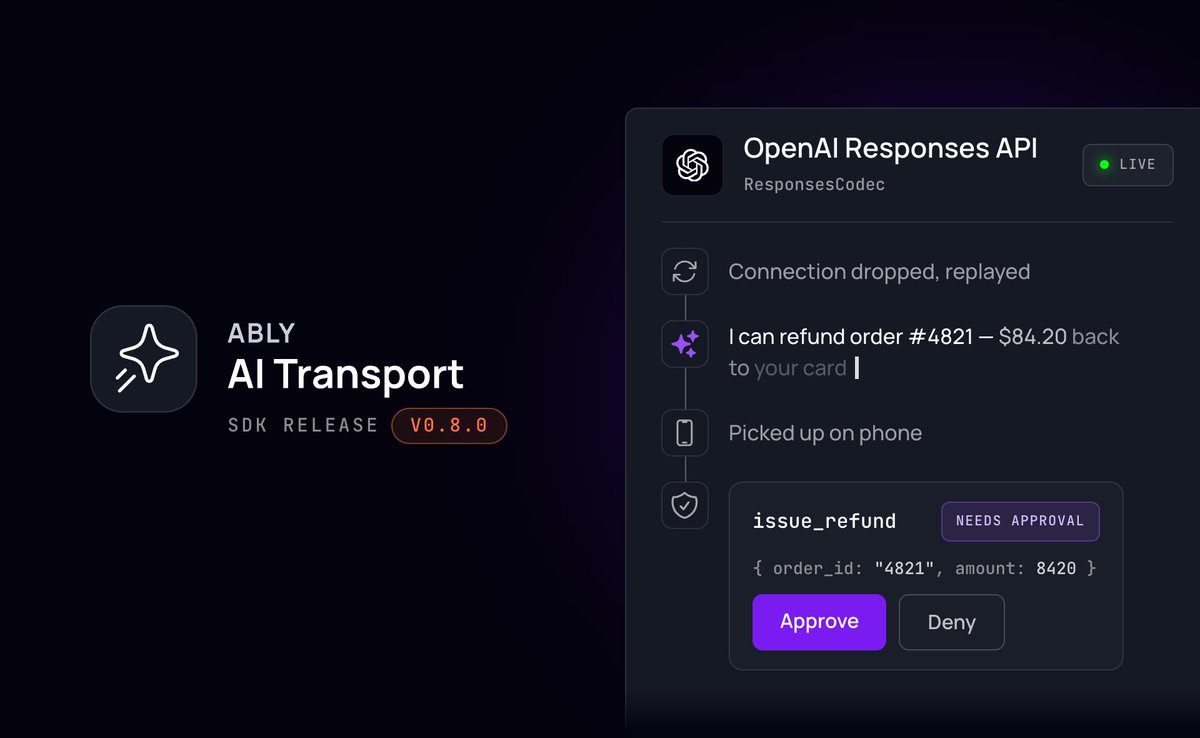
Your @OpenAI agent's answer now survives a refresh or a dropped connection, because the reply lives on a session instead of on the connection. Any device can pick the same thread back up. Demo: https://t.co/IyUnoeXmaD
#AIAgents
Your bill used to grow every time your users got more engaged. Now it grows when you get more users.
Ably now prices on monthly active users, with Chat, Spaces, and AI Transport in the same package.
Read the announcement: https://t.co/6HN4n3JazH
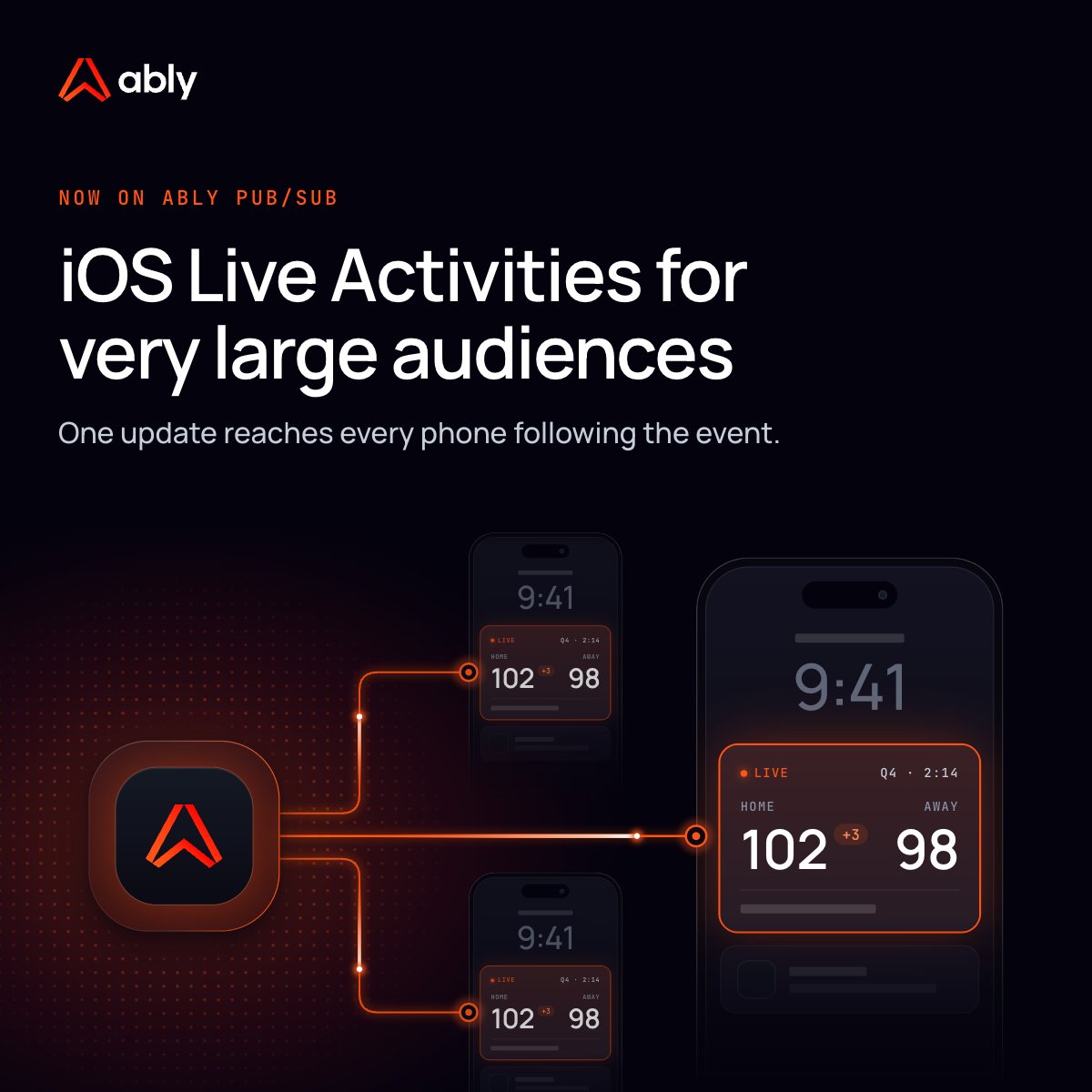
Your Ably push registrations now work for iOS Live Activities too.
Add a push-to-start token, and your server can start an activity on every phone following a game.
Docs: https://t.co/sdnC5x163y
Storing every chunk of a streamed AI answer can mean thousands of writes. Ably message appends keep each answer as one message: https://t.co/cLXOJvn6Dj
A fallback doesn’t help if it shares the dependency that took down your primary.
Ably’s SDKs can route around our CloudFront path using fallbacks on a separate domain and DNS provider. It can add latency. Slower beats down.
More from Matt Hammond: https://t.co/s8nKiz0iAP
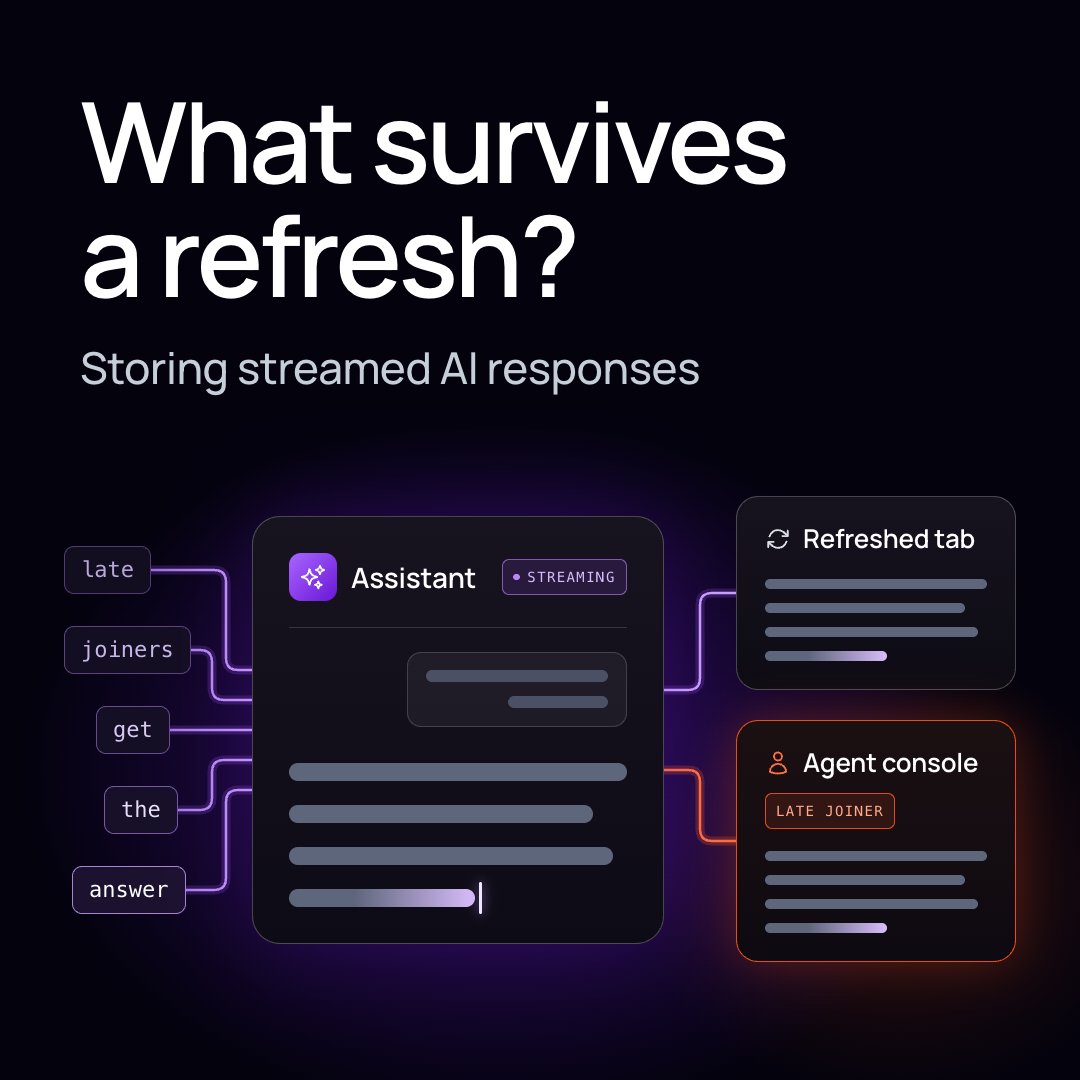
A user refreshes halfway through an AI response. What comes back?
Store tokens as separate events, and every client has to rebuild the answer.
We compared four ways to store streamed AI responses, and how Ably’s message appends solve it:
https://t.co/EGAGK8n5iH
WebSockets let users interrupt or approve an AI agent mid-stream. They don’t handle session recovery, fan-out or delivery guarantees on their own. When does running that layer yourself make sense?
Here's a breakdown of the technical and cost trade-offs: https://t.co/nUAKTHOnVK
Guaranteeing WebSocket order in production isn't a one-time fix. TCP's guarantee ends at one connection. So past that, sticky routing, a shared coordination layer, and replay sequencing are system requirements. But should you manage the infra?
https://t.co/L2PVZPg28O
Fin's Colin Kennedy, on deciding whether to keep maintaining your own WebSocket infra for AI streaming: "Is maintaining this system helping you build a better product?"
The framework to work through that decision: https://t.co/f3FQjcsuZk
Building LLM streaming? You've probably got session IDs, a Redis buffer, and dedup logic. That's five systems you maintain forever, and there's a sneakier failure too: streams that look fine while nothing confirms delivery. The fix: https://t.co/PYKDIdfMLJ
#AIEngineering
Your AI agent goes quiet mid-task. Thinking, stalled, or dead? From the client, you can't tell.
That's because most AI infrastructure has no signal for it, as Vercel's own maintainers have said.
Ably AI Transport gives you one.
https://t.co/yVob6e2u5q
Three agents check flights, hotels, visa rules in parallel. Your UI: one status line, "Working on it..."
That's structural. Change a hotel mid-search, and the UI won't show it until the orchestrator reports back.
See what real collaboration needs.
https://t.co/lFjV4v2Fho
Presence and shared state used to mean building your own layer for it.
AI Transport v0.3.0 builds presence in: one call answers whether the agent is online and who else is watching. LiveObjects, opt-in, syncs shared state too.
See what shipped, with code.
https://t.co/RuRaAb5r2f
Your AI chat demo works ✅
Then you ship it - and a refresh mid-response restarts the conversation 🔄
HTTP streaming hits limits past simple prompt-response:
- Lost context on refresh
- No agent visibility
- Can't interrupt a stream
See how a session layer fixes this - and when you need to introduce one.
https://t.co/QSntruciwa
Model providers handle inference. Agent frameworks handle orchestration. Temporal makes the backend crash-proof. Every layer has a name.
Except for the one between the agent and the user's device. Discover what this looks like 👇 https://t.co/b3yEAwam8A