La vivienda será la gran causa nacional de la próxima legislatura.
Va a dejar de ser un problema para convertirse en un derecho constitucional.
Os comparto mi entrevista en @El_Plural:
https://t.co/bGeRMPPHBa
La vivienda será la gran causa nacional de la próxima legislatura.
Va a dejar de ser un problema para convertirse en un derecho constitucional.
Os comparto mi entrevista en @El_Plural:
https://t.co/bGeRMPPHBa
Biosecurity is one of the most urgent challenges for the AI era. Bringing SynthID to biology so AI-generated proteins can be watermarked is a critical step - and we’re open sourcing SynthID Bio tools so the research community can build on this work. Published in @Nature today, congrats to the team! https://t.co/Y4sv8bnGQY
La caída de la información web es BRUTAL.
El % de españoles que consumió noticias en webs la semana pasada (fuente: @risj_oxford). Se desploma desde 2016 a 2026:
🔻18-24 años: 80% → 38%
🔻Todos: 72% → 44%
On August 8, 2022 (Sol 3556), the Curiosity rover took a panoramic image of the Martian surface using its Right Navigation Camera (Navcam), not its Mast Camera (Mastcam), that was compiled into a 360-degree cylindrical projection.
The "cylindrical object" is not a physical object on Mars but rather a cylindrical projection of the rover's flat images into a panorama.
This misconception has caused some confusion on social media, where some posts mistakenly suggest a physical cylindrical object was discovered.
NASA's Curiosity rover has encountered several visually unusual features on Mars that have sparked public interest and speculation. In all cases, scientific explanations attribute these to natural geological and atmospheric processes, or sometimes rover-related activity.
Here are some notable "anomalies" and their explanations:
Geological Formations & Optical Illusions
The "Doorway" (2022): An image captured in May 2022 showed an almost perfect rectangular shape in a rock face, which some thought looked like a portal or alien dwelling. Scientists explained it as a natural fracture in the rock, likely caused by ancient stress or erosion. The opening was only about a foot high.
"Finger-like" or "Spike-like" Rocks (2022): Curiosity spotted small, vertical, spire-like rock formations. These were explained as mineral cements that had filled cracks in softer rock due to ancient groundwater flow. Over millions of years, wind eroded away the softer surrounding rock, leaving the harder, mineral-rich spires standing.
"Flower" or "Coral" Mineral Formations (2022): Tiny, intricate, branching structures resembling coral or flowers were found. These are delicate mineral formations, likely made of calcium sulfate, that formed as minerals in water were left behind in the rock.
The "Floating Spoon" (2015): An image showed a rock formation that appeared to be a wooden spoon floating in mid-air. This was an optical illusion (a ventifact) caused by wind erosion, where the "handle" part of the rock jutted out from a larger formation and cast a shadow, making the "spoon" appear to float.
"Humanoid" or "Face" Rocks (Various years): Rocks occasionally appear to have shapes resembling human bones (like a thigh bone), faces, or figures. These are classic examples of pareidolia, the psychological phenomenon of seeing familiar shapes in random patterns, combined with the effects of natural wind and water erosion.
"Tile Floor" Polygons (2021): The rover found a pattern of interlocked polygons in the ground that resembled a tile floor. These are naturally occurring mud cracks that formed when the sediment in an ancient lake bed repeatedly dried out and re-wetted.
"Spiderweb" Formations (2024-2025): Intricate, zigzagging mineral ridges were observed up close for the first time. These "boxwork" structures formed from groundwater depositing minerals into fractures, with the softer surrounding rock later eroding away, leaving the hardened mineral network.
Material Discoveries
Shiny Objects/Foreign Debris (2012): The rover found a couple of bright, shiny objects that initially caused concern they might be parts of the rover itself. One was confirmed to be a small piece of plastic that had fallen off, while another was determined to be a naturally occurring, bright Martian rock.
Elemental Sulfur Crystals (2024): Curiosity accidentally drove over and crushed a rock, revealing unexpected yellow crystals of pure elemental sulfur inside. This was a surprise to scientists, who have no clear explanation for how it formed in that location, making it a current puzzle.
Organic Molecules (2018): The rover detected complex organic molecules (building blocks of life) preserved in ancient mudstone rock in Gale Crater. While not direct proof of life, their presence is a significant find that points to a potentially habit.
Water-Rich Halos (2022): Curiosity discovered widespread fracture networks containing opal.
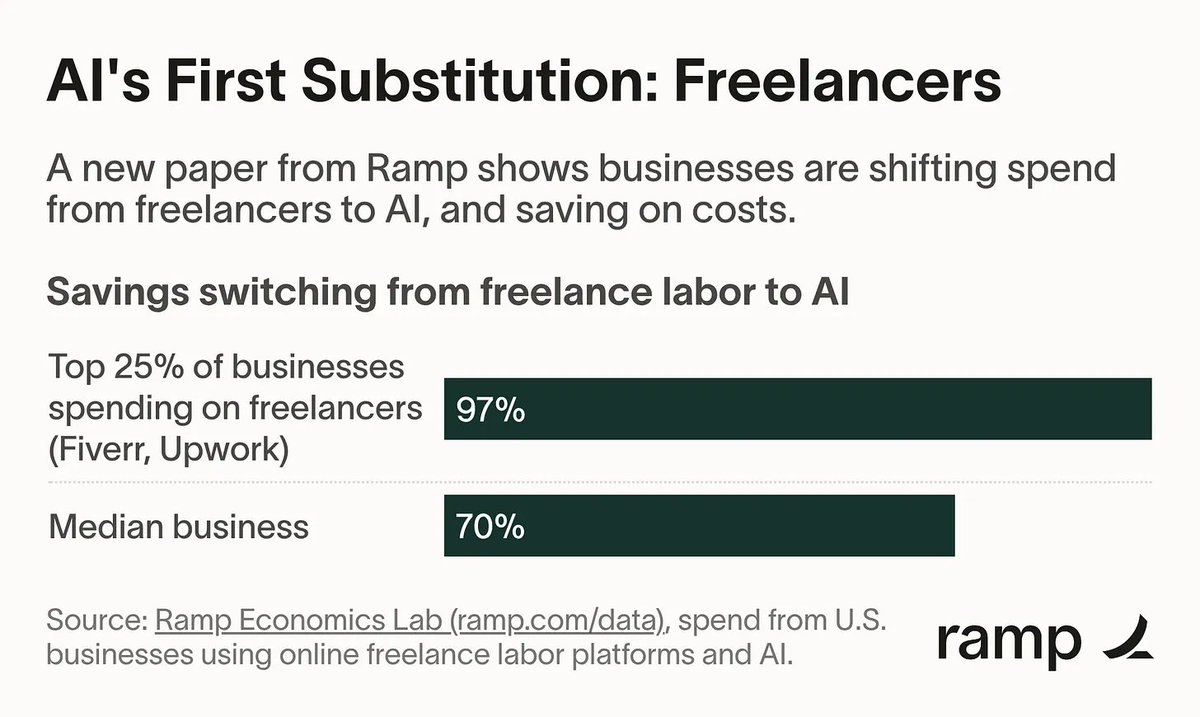
Un nuevo estudio que analiza cómo está afectando la inteligencia artificial a los trabajadores freelance.
TLDR: mucho y rápido.
Más de la mitad de las empresas que recurrían a trabajadores autónomos en 2022 han parado de hacerlo por completo. Es EEUU y es tremendo este dato.
La proporción del gasto empresarial destinado a plataformas de trabajo freelance cayó de 0,66% a 0,14%, mientras que el gasto en IA pasó de cero a casi el 3% (también para otras cosas, claro).
Las empresas que solían gastar más en trabajadores autónomos fueron las que migraron a la IA más rápidamente.
La IA es bastante más barata: las empresas más dependientes de estos trabajadores que apostaron por IA redujeron su gasto en freelancers en aproximadamente 1 dólar por cada 3 centavos invertidos en IA, un ahorro de unas 25 veces.
Está basado en gasto de empresas eeuu en plataformas como Upwork y Fiverr vs. proveedores de IA como OpenAI y Anthropic, entre 2021 y 2025.
Los autores del estudio destacan un punto: si hace pocos años la preocupación era que el trabajo "gig" erosionara el empleo formal, ahora es la primera víctima de la automatización. De la uberización a los primeros de los que se prescinde.
https://t.co/aJM3z8OJq8
@jlhortelano@Recuenco Muy de acuerdo. Ya en 2018 los autores de 'Prediction Machines' dedicaban buena parte del libro a hablar sobre este tema: "The most significant implication of prediction machines is that they increase the value of judgment." https://t.co/pXs1da62ZC
This essay by @Noahpinion is an excellent, balanced, and well-argued summary of what we know (and what we still do not know) about the recent global collapse in fertility.
Before jumping to quick conclusions and skipping the piece, consider one striking fact. Perhaps the fastest decline in fertility ever recorded has taken place in Guatemala’s poorest, least educated, and indigenous majority rural areas, where women’s rights are weakest, between 2006 and 2025.
In 2006, Guatemala’s total fertility rate was 3.8, comparable to that of a sub-Saharan African country. By 2025, it had fallen to 1.8, only slightly above the fertility rate of non-Hispanic Whites in the United States (around 1.6).
At the current pace, Guatemala will have a lower fertility rate than non-Hispanic Whites in the U.S. before 2030.
Does your preferred explanation (women’s education, feminism, smartphones, or women choosing holidays in Bali over children) fit that pattern?
https://t.co/93oxbxMVrZ