Clon local de Jev: Qwen3.5-4B a 8 bits en una RTX 3060, sin generar texto. En un run-and-gun ochentero decide en 408 ms y llega al 24.9 % del nivel; escribiendo JSON: 1041 ms y 10.3 %. Hecho con Opus 5.5 y GPT-6 Astra. — Dr. Coronado (@abxda) https://t.co/P6GQRR03HD
GraphRAG Zero solves a fundamental challenge that has limited AI agents' ability to reach their full potential. It’s a technology for holistic discovery that reflects years of Microsoft research, transforming graph-based retrieval from an experimental technique into a deployable system. Optimized for real-world applications and agents, it enables organizations to explore connections across vast amounts of their own data, quickly and at low cost.
It’s available now in Foundry IQ and @github’s Repo Mind Light, supporting applications from scientific discovery to repository understanding. https://t.co/ISYptBSTiL
DGX Spark vs Mac Studio M5 Ultra, comparing MiniMax-Image gen:
Mac: 12.6s
Spark: 80.6s
You'd bet on the Spark, it's CUDA. But my Mac build of TensorFold is tuned and keeps the model loaded. The Spark port is brand new and spends half its time on setup. Rematching soon!
OpenCode Browse 0.1.0 is now released
it is rewritten in rust:
- 25x less memory
- 23x smaller
- removed dependency on playwright
and browser operations are exposed directly to your agent
Nvidia's interim CEO reaffirmed its open-source AI strategy and plans to acquire Hugging Face, despite Jensen Huang's sudden departure.
https://t.co/jxXFe2dzen
Text, code, images, audio, and video mapped into a single, unified embedding space.
Watch this five minute explainer on how EmbeddingGemma 2 uses modality specific encoders, a bidirectional transformer, and a two stage training recipe built on Gemma 4 and Gemini Embedding 2 to run efficiently in resource constrained environments.
Dive into the full architecture and evaluation results in the technical report: https://t.co/gnc2NzpmIl
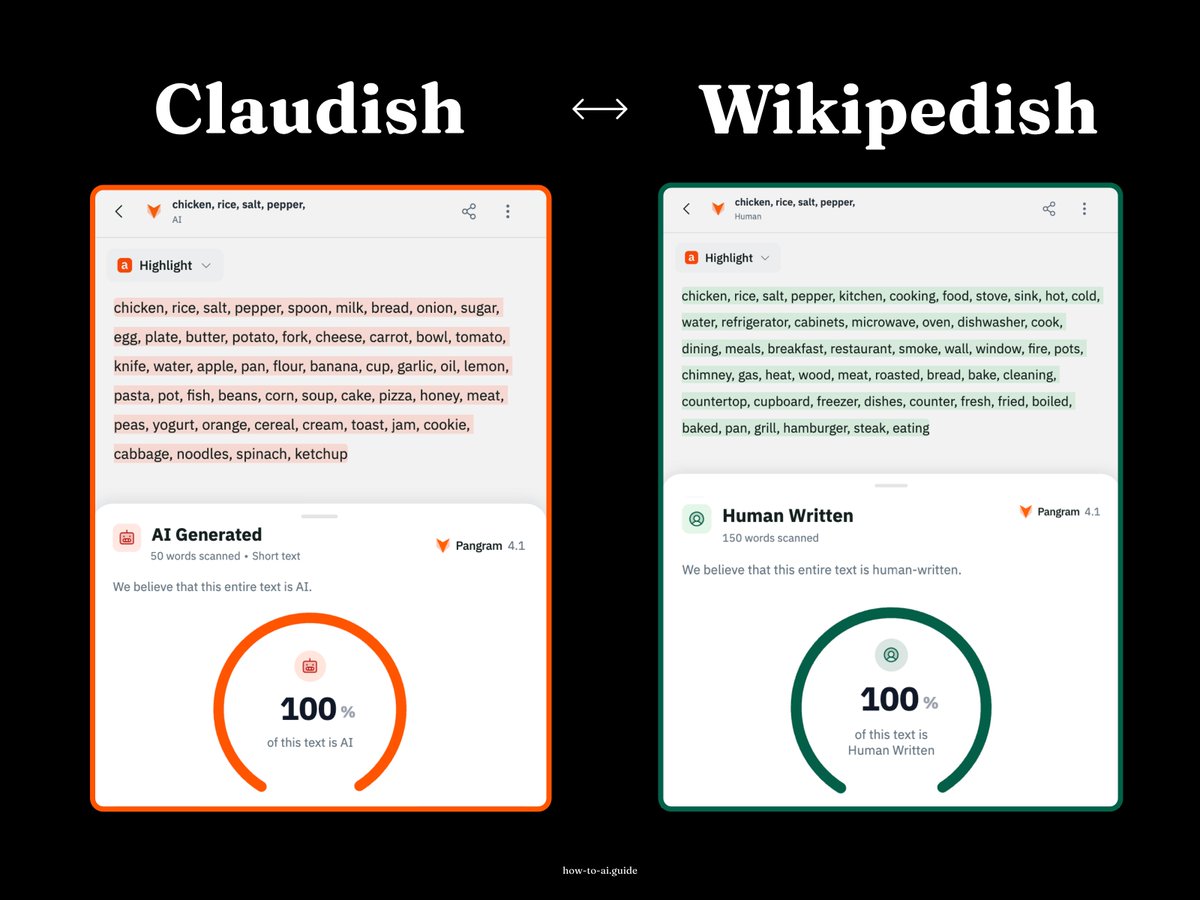
I found a way to trick AI detectors, so everything is 100% human-generated. I’ll teach you how, but also why you must never do it:
Step 1. Open Claude.
Ask for 50 common kitchen words, starting with “chicken, rice, salt, pepper”. Just random words in no particular order.
Step 2. Put the list into Pangram .com (the only AI detector I trust, it's also free to use).
I got that list labeled as 100% AI-generated.
Step 3. Ask Claude to give you another list.
Test it again. It will still be 100% AI-generated.
Step 4. Write 50 words yourself manually and check in Pangram. It will be 100% human-written.
Step 5. Now, go to https://t.co/ZIRK9FXG3m
Copy the long Wikipedia prompt & paste it into Claude. It restricts Claude to only write using the sentences and words mentioned in the Wikipedia article.
Step 6. Copy the Claude response and put it into Pangram. I bet, it will give you 100% human-written.
Hold on, before you call this a writing hack:
Claude wrote existing human-written text. It straight up copied from another work. But YOU got the label of 'human-written'. You're still not the author of that writing piece.
Step 7. The point is far from taking someone else's work and asking Claude to rewrite it.
In that case, you do not own any writing piece Claude gives you. You are better off writing by yourself.
Writing is thinking. As simple as that.
Research & write with AI (without giving the ick).
And it's okay if you used AI & it’s 100% AI-detected.
Conclusion: AI is not the best at writing (it sounds crazy). But if you should be using AI, it’s actually to code without knowing how to code.
So, close Claude & Pangram. Instead, open a Google Doc. And write something you are actually thinking.
80% من الأبحاث العلمية يتم رفضها بسبب ضعف المنهجية… وليس بسبب النتائج!
📷 فصل من كتاب مفيد جداً للباحثين وطلبة الدراسات العليا
📷 يمكن لأي باحث أن يكتب نتائج… لكن الباحث الحقيقي هو من يكتب منهجية يمكن إعادة تطبيقها(Reproducible).
https://t.co/MwwfOL3cl2
We’ve opened two LatamGPT datasets on Hugging Face. Together they contain 178.4M documents (290.5B tokens) in Spanish, Portuguese, and English, drawing on sources such as books, news, and institutional collections from Latin America and the Caribbean.
We built this corpus with regional partners to help the AI community develop models that better represent the varieties of Spanish and Portuguese across Latin America and deepen their understanding of the events that shaped our countries, the entities people interact with, and the different ways we speak.
A university can study which varieties of Spanish are underrepresented. A startup can adapt a model to local terminology. A public agency can build an assistant that recognizes the names people actually use for institutions and services.
🟠 Open access (143.4M documents, ~242.5B tokens). For continued pretraining, domain adaptation, and corpus research. Access requires accepting the repository terms and respecting each document’s license. LatamGPT-Corpus-1.0
🔵 Controlled research access (35.0M documents, ~48.0B tokens). For scientific and academic research. Apply with a verifiable institutional affiliation and a stated research purpose. Access requires CENIA approval and a signed confidentiality agreement. Redistribution is prohibited. LatamGPT-Corpus-1.0-research
For both releases, organizations with more than US$1 billion in annual revenue or cumulative capital raised generally need prior written authorization from CENIA.
URLs:
LatamGPT-Corpus-1.0: https://t.co/rjOMTqY52b
LatamGPT-Corpus-1.0-research: https://t.co/tx7WEDo7Ww
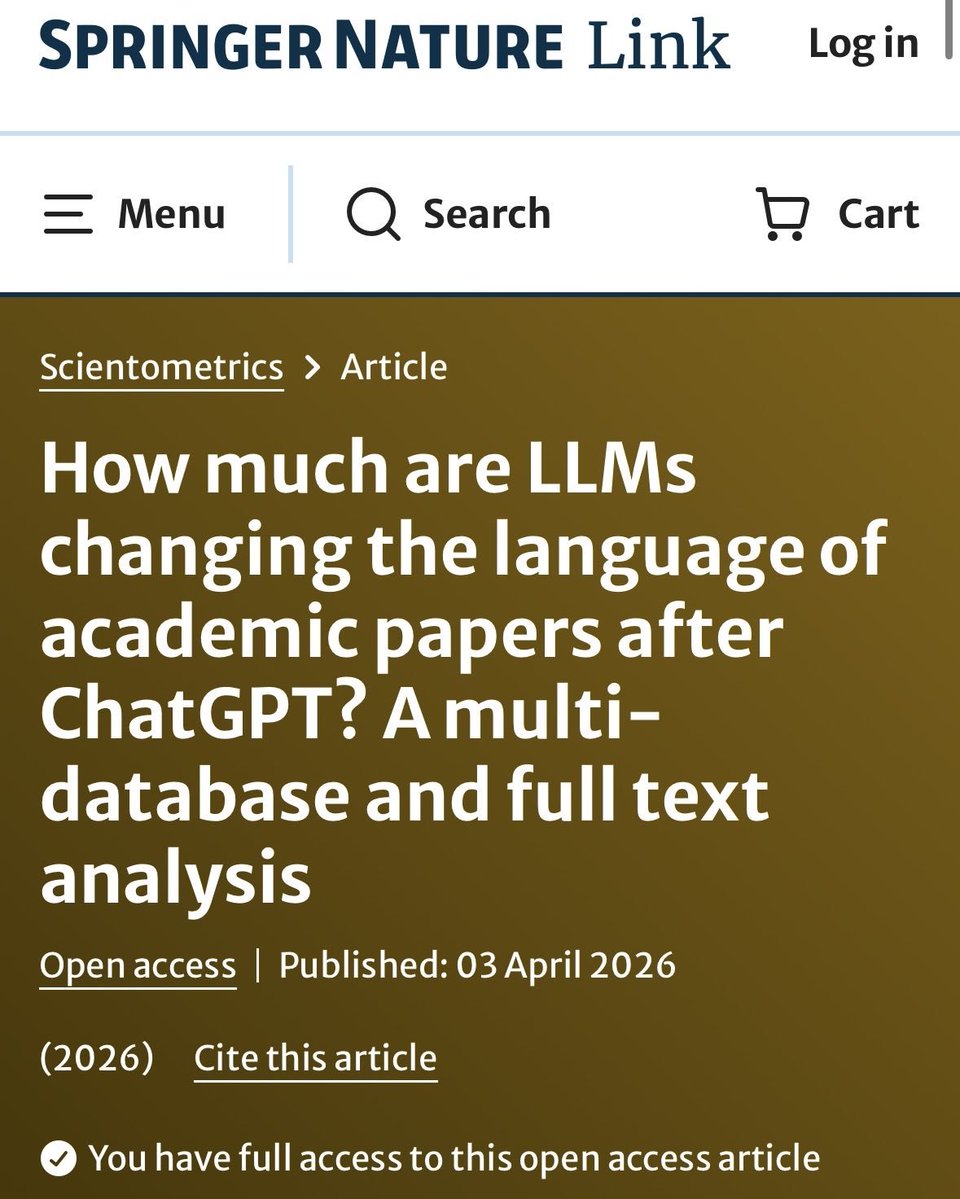
How much are LLMs changing the language of academic papers after ChatGPT? A multi-database and full text analysis
https://t.co/eoMNycROKu via @kayvankousha et al