It’s so unfortunate that they got used to hyping up something and “crying out wolf” that wether they have a good product now or not is almost irrelevant because they lost my trust a while ago. I hope they get back their integrity and reputation with proper more humble and honest communications, I love Google and don’t want them to fail, we need competitors in this market:)
When @ChrisGPT and I said Google hadn’t “solved” a damn thing with RSI, people acted like we were crazy.
A few days later, that whole RSI story already looked much weaker than the hype made it sound.
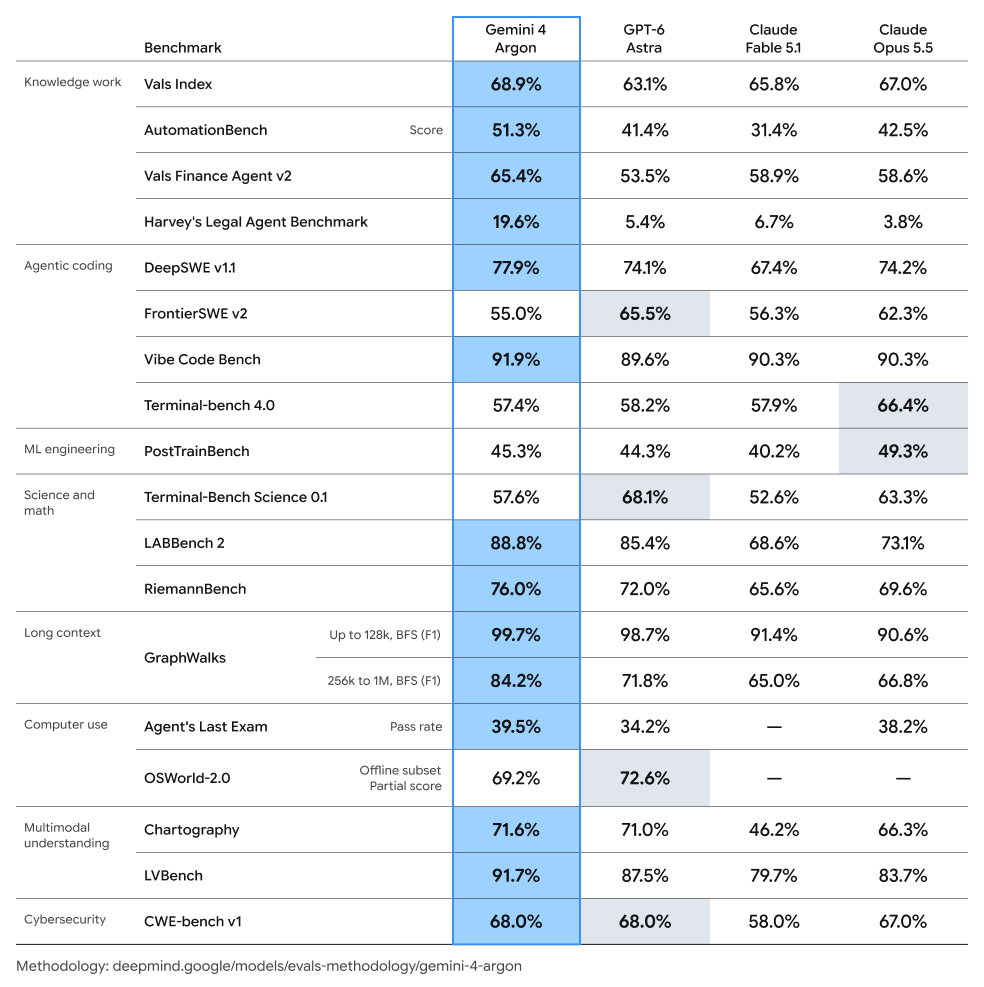
And now we have highly credible journalists reporting that Google is struggling internally to get real-world performance to match what the benchmarks are showing on paper.
That’s exactly why I’m so skeptical of these massive claims before people can actually test the models themselves.
Benchmarks can look incredible. Internal hype can sound incredible. None of that matters if the model can’t reproduce that strength in real tasks.
Google is about to find out what happens after lying over and over again about their model capabilities. I wouldn’t trust them until there is absolutely no doubt that this is not benchmaxxxed.
Introducing Gemini 4 Argon – our new frontier model.
It’s built for complex workflows across coding, enterprise knowledge work, and cybersecurity defense – rolling out today to a set of trusted testers through our Fairwind Program.
UniMate can animate any skeleton from a text prompt. We stress-tested it on real rigs. Here's what actually holds up.
UniMate (SIGGRAPH Asia 2026, from Princeton, Berkeley, MIT and NTU) is a single text-to-motion model for any skeleton: dogs, birds, spiders, snakes, rigged objects. One set of weights, no per-rig training, and the code (MIT licence) and checkpoints are public.
We plugged it into a real pipeline, auto-rigged meshes included, and measured what it does.
How it worksEvery joint in every frame becomes a token. Attention runs across the joints of a frame, biased by how far apart they are in the hierarchy, and across frames for each joint. The skeleton's rest pose and its joint names (embedded with T5) tell the model what body it's driving. It's a 74M-parameter flow-matching model that generates 2-second clips.
The surprising part: it reads anatomy from the skeleton's shapeWe swapped the "head" and "tail" labels on a quadruped. "Shake your head" still moved the real head. The model finds front, back, legs and tail from the skeleton itself, not from names.
Names still matter, though. With every bone renamed "Bone", "wag your tail" put about half as much of the motion into the tail. Auto-riggers emit placeholder names like bone_1, bone_2, so we label bones from geometry before sending them.
Where it's strongFour-legged ground animals. Trot, gallop and sit come out plausible on rigs it has never seen, with real forward root motion.
Where it's weakWinged creatures. Ask a dragon to walk and it flies, even with "wings folded" in the prompt; the data prior wins. Also: • clips are 2 seconds • end bones (tail tips, paws) get no rotation of their own • it's floppier on unfamiliar skeletons
We measured that last one. On rigs from its own training set, its output is smoother than the training animations themselves. On a new fox rig it's about 2× as jittery. More training steps didn't close the gap, which points to the rigs being unfamiliar rather than to under-training.
What it took to make it usableThe raw output isn't game-ready, so we wrapped it: • foot-contact locking: about 3× less foot sliding • seamless loops, where the model writes its own transition back to the start and root speed stays constant for clean root motion in an engine • automatic grounding, so creatures stop sinking into the floor or hovering • rig cleanup: driver and IK bones are ignored, the pelvis is used as the root, and huge rigs are trimmed to fit the model's limit • placeholder-named rigs (bone_1, bone_2…) are labelled from the skeleton's shape
Takeaway"Any skeleton" text-to-motion is real, and for quadrupeds it's already useful. For the long tail of creatures, the bottleneck is training data, not model size. The path forward is more clean animal motion on the kinds of rigs people actually use, plus good post-processing.
Huge credit to the authors for releasing everything openly. Paper: https://t.co/eYAr9cRcx7 Code: https://t.co/G17B8gT1PO Weights: https://t.co/GMxZa21Mn1
@ashebytes The blossoming of faith—both within tech circles and beyond—driven by new advances in science and engineering, will be a beautiful display of the unity of the transcendentals; it is awe-inspiring, much like you wearing a rosary today.
@dangreenheck Port it to Godot, C# and typescript are made by the same guy and so the AI can port it fairly easily and Godot is one of the only engines that is essy for the AI to read. Check Summer Engine! (Not sponsored haha but I am using it!)
You guys don’t need to spend your time monitoring people’s tweets, GitHub repos, issues, slugs, or any of that.
You’ve got a Gremlin doing it for you, saving you time and energy so you can comfortably live your life.
@SummerEngineCom Once I finish this huge sprint I'm at right now I can send you some results, I am pretty happy with what I have achieved so far, I'll be running some tests this week and send you a video:)!
Thanks again!
Dear @marvel@marvelstudios: Please, for the love of it all, give us a one-shot of Michael Pena as Luis doing a recap of the entire MCU saga leading up to @Avengers: Doomsday.
A year's worth of progress is now happening in months. Months' worth of progress will start to happen in days. Days’ worth of progress will soon begin to happen in hours.
Guys, relax, OpenAI will be more than just fine! Some members of the general public are a bit moody since every week looks like Christmas; they remind me of Dudley Dursley from the first Harry Potter book when poor Dudley only got 36 presents instead of 39 like the year before. Can’t wait for Dev Day, though; it’s gonna be glorious. IYKYK!