‘Documentary will always exist, because we need to understand ourselves...’
Fascinating interview with film-maker @markcousinsfilm from @ThisHeadStuff:
https://t.co/cQ4KoT39tl
We were proud to publish Mark’s ‘Dear Orson Welles & other essays’ in 2024:
https://t.co/tdGuN1am4t
Mario Bava on the troubles he faced while making 'Planet of the Vampires' (1965):
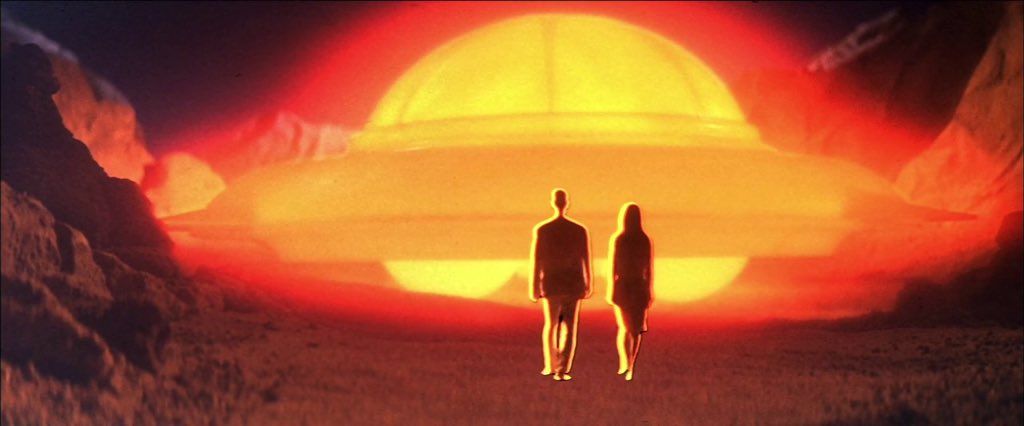
"I wish that the audience and the critics knew the conditions under which I am forced to make movies. For 'Planet of the Vampires' (1965), I didn’t have anything to work with. There was only a studio, completely empty and squalid, because there was no money: I had to turn that into a [mysterious, alien] planet.
So what did I do? In the studio next door there were two big plastic rocks, a leftover prop from a sword-and-sandal movie or something. I took these two rocks and I put them in the middle of my studio, then I covered the floor with smoke and I darkened the white wall in the background.
I shot the whole movie by moving the two rocks around the studio. Can you believe it? And, while I was shooting, there was this American screenwriter who kept rewriting the script, changing scenes and dialogues… After a while, I stopped listening to him.
Do you remember that, at the end of the movie, the astronauts land on planet Earth at the beginning of its existence? Well, the screenwriter wanted the astronauts to get off the spaceship and meet Adam and Eve in the Garden of Eden, which was located in Missouri, USA. Naturally, I refused to shoot this kind of stuff."
(Mario Bava's interview with Luigi Cozzi, translated by Cinepugno, 1970)
Madonna explains why she got mad & cried because of Al Pacino's method acting in "Dick Tracy" (1990):
"Interviewer: Describe the relationship between the two characters, Breathless and Big Boy.
Madonna: I had nothing but contempt for Big Boy. And he would treat me like a bad little girl. He was always slapping me and spanking me. And in terms of being on the set, whenever Al Pacino put his prosthetics on, his suit, he was a gross pig. And he’s not that way in real life—he’s very gracious, and well-mannered, and gentlemanly, and sweet... .
As Big Boy, he would tell me the dirtiest jokes and suck on his cigar like it was some sort of weird phallic symbol, and just be a pig. He was always smacking my butt and my face. I hated him, I loathed him, I was disgusted with him. And so what happened off-camera was that I’d always try to be moving away from him, and he’d always grab me and go “Get over here!” which is exactly what happened in the movie. Every time I expressed my distaste for him, he would smack me, which is also what happened in the movie. I got mad. He made me cry sometimes.
There was a scene where he kept smacking me in the stomach, and it would sting, and what made me cry was not so much the hit, but the fact that Warren Beatty wouldn't stop. He would just keep going, and I was humiliated. So it worked, because that’s what’s happening to Breathless—she’s totally humiliated by Big Boy.
Interviewer: Did you always stay in character off-camera?
Madonna: Yes. I always do, in all my movies."
("Dick Tracy: The Making of the Movie", Mike Bonifer, 1990)
Paul Verhoeven on whether the events that take place in "Total Recall" (1990) are real or just a dream:
"It is both. To be honest, that’s what I want. I made the movie in a way that it would be true on both levels, and I spent a lot of time to get that. If you want a scientific explanation, you know, of course, in quantum mechanics there is a very interesting principle, the principle of uncertainty, Heisenberg’s principle.
If you have a big object and if you try to measure the place of the object and the velocity of the object at the same time, the more precisely you measure velocity the less precise place gets. So that’s the principle. That means, of course, that there are different realities possible at the same moment. What I wanted to do in 'Total Recall' is to do a movie where both levels are true. I mean for me, of course, the film anyhow has to do with two realities, one being the reality of going as a secret agent to Mars and discovering that there is a problem, and solving the problem, which is starting the nuclear reactor and helping the guerrillas and destroying Cohaagen.
The second level of the movie, of course, is that from the moment that he goes into the Rekall chair ‘til the end it’s a dream, and I tried to make that second level work throughout the whole movie.
So there’s the dream level which starts when he gets into the chair and the thing is in his neck, and that would go throughout the whole movie, so in the next scene where they say, Oh, there’s a problem, there’s a big glitch here, that would be already the dream, of course. That’s where the dream starts. And the next scene where they are fighting and stuff would be part of his dream, convincing him that it is real, because there is a glitch but that would be part of the program. It would be built into the program to make him accept the fact that it’s real, but it’s a dream.
If you look at the movie, if you haven’t seen it, or for the second time, you’ll see that the whole program that’s set up at the beginning when he goes to the Rekall office and he talks to this guy who sells him the program on Mars, you’ll see that he gets everything that he wants: he gets the trip to Mars, he gets the girl, the exotic girl, he ki!!s the bad guys, and he saves the entire planet. That’s what he does. And that’s basically the dream.
Even halfway through the movie, you may remember, this other guy comes in, Dr. Edgemar, and tells him that he’s in a dream, that he’s still in the Rekall chair, and then Arnold says, “If I’m there, I can ki!! you.” And he puts a gun to his head and the guy says, “Sure, no problem for me, big problem for you, because you will be psychotic from now on because the walls of reality will fall apart. One moment you will be the savior of the rebel cause, the next moment you’ll be Cohaagen’s bosom buddy, but in the end—you will even have these strange fantasies about alien civilizations—but at the end you will be lobotomized.”
And then if you see the movie, you realize that all these things happen. I mean he is lobotomized at the end. That’s why at the last shot, when they are so happy and kissing each other, it slowly fades to white, which for me meant, “OK, there he goes. That’s the end-that’s the dream—they lobotomized him.” And all the other things happened, he finds the alien civilization, he rescues the planet, he finds the good girl, he k!!ls the bad guys, but it’s a dream. Now, of course you can see it as a reality, too. So at the end of the movie, getting to white means either it’s a happy ending or he loses his brains . . . which is probably also a happy ending, I don’t know.
That was basically what l wanted—that at the end there would be two possibilities, and they would be both true—for me they are both true—it’s not either one or the other. It’s not that either it’s a dream or it is a reality. It is a dream and it is a reality. And I think they’re both there."
(Paul Verhoeven's interview with Chris Shea & Wade Jennings, 1992)
P.S: On this day, 36 years ago, "Total Recall" (1990) premiered in Los Angeles, California, USA.