His reasoning for those curious:
“Most recent efforts at whole body imaging screening have been whole body mri. The incidental findings for each patient can run hundreds of thousands of dollars, last for years, and lead to innumerable unnecessary biopsies, surgeries and complications.
There are some definite screening interventions we can take, but most require preventing damage (blood pressure and lipid control for blood vessels) at a microscopic level or extremely early detection of cancers (mucosal lesions on colonoscopy, subtle lesions on breast mammograms or breast ultrasounds/ breast MRIs). Almost anything you detect on these imaging scans will be damage already done or metastatic disease and will result in a lead time bias with no true evidence of decreased morbidity or mortality.
The physics for doing this with ultrasound are also against them. For proper deep tissue entrance and reasonable scan times, even with “advanced tech”, the energy of ultrasound source has to be high enough that they will be limited by tissues getting hot. Even if the whole thing is a failure, there may be some important technical developments that come out of the ashes.”
@midjourney What is the purpose of this tech? Are you trying to detect early cancer? If so, what is the scientific evidence supporting this claim? Also, are the scans interpreted by a radiologist or not?
@midjourney This is being sold as a good screening exam superior to MRI.
Very irresponsible from Midjourney and very telling of the critical thinking in the tech community.
Pure bullshit with great marketing.
The US government, citing national security authorities, has issued an export control directive to suspend all access to Fable 5 and Mythos 5 by any foreign national, whether inside or outside the United States, including foreign national Anthropic employees.
The net effect of this order is that we must abruptly disable Fable 5 and Mythos 5 for all our customers to ensure compliance.
Access to all other Claude models is not affected.
We apologize for this disruption to our customers. We believe this is a misunderstanding and are working to restore access as soon as possible.
Read our full statement: https://t.co/bwn0sximKZ
Un target muy esperado, considerado imposible desde que estudié bioquímica en pregrado: el bloqueo de múltiples mutaciones de RAS es logrado por primera vez por Daraxonrasib marcando una revolución en el tratamiento contra el cáncer de páncreas
One of the most amazing things I’ve ever seen: a standing ovation for the full Daraxonrasib results
I feel inspired and energised, to put it mildly — we have a targeted therapy for pancreatic cancer now, and nothing is undruggable anymore
First images from the GE Omni 128 cm Total Body PET/CT 🚀
The new scanner detected a <5 mm local recurrence of prostate cancer missed by standard PSMA PET/CT - despite 79% shorter acquisition ⏱️
Delayed imaging boosted lesion uptake and informed dose-painted salvage RT 🎯
@JournalofNucMed@PeterMacCC@declangmurphy@_ShankarSiva
https://t.co/Kiq9PHC12X
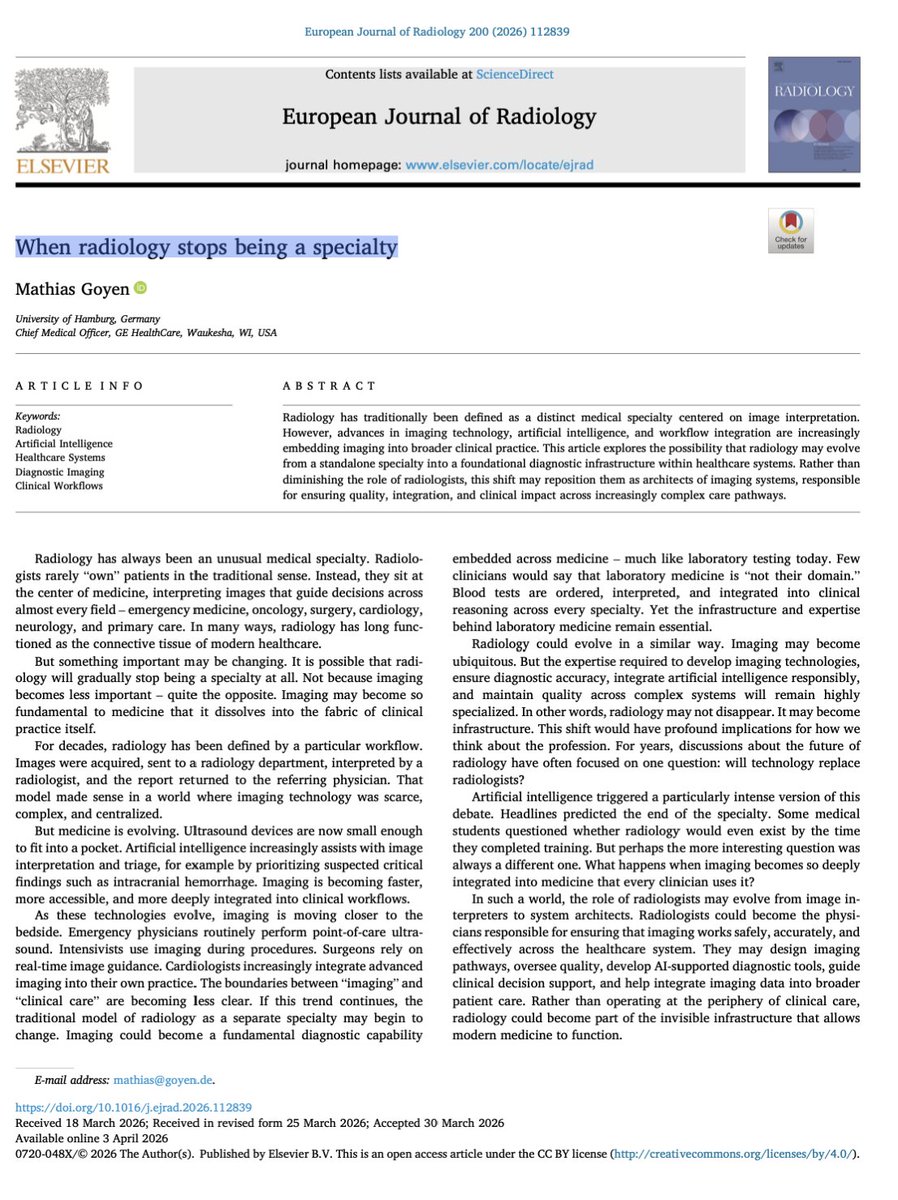
🩻⚠️ Radiology is not dying. It’s becoming electricity.
✅ Invisible.
✅ Everywhere.
✅ Absolutely essential.
And most people won’t notice until it fails.
This paper makes a provocative argument:
👉 Radiology may stop being a “specialty.”
Not because imaging matters less.
But because it may become:
the operating system of medicine.
Honestly?
That’s probably already happening.
For decades, radiology worked like this:
👉 image acquired
👉 radiologist reads it
👉 report sent back
👉 everyone pretends the PDF is the actual product
Classic.
But modern medicine broke the old model.
Now:
- emergency physicians scan at bedside
- intensivists use procedural imaging
- cardiologists own advanced cardiac imaging
- surgeons navigate in real time
- AI pre-triages findings before humans even open the study
Meanwhile radiologists are still arguing on LinkedIn about who owns ultrasound.
The uncomfortable truth
Imaging is no longer a location.
It is becoming: infrastructure.
- Like electricity.
- Like Wi-Fi.
- Like cloud computing.
Nobody says:
👉 “The electricity department diagnosed my patient.”
But try running a hospital without it.
The paper’s strongest point
Radiologists may evolve from: ❌ image interpreters
to: 👉 system architects
Meaning:
- workflow orchestration
- AI governance
- quality control
- imaging pathways
- multimodal integration
- diagnostic ecosystems
Translation
The future radiologist may spend less time:
👉 describing a 4 mm cyst
And more time:
👉 designing how an entire healthcare system sees disease.
And AI accelerates this dramatically
Because once AI handles:
- triage
- segmentation
- measurements
- prioritization
- preliminary pattern recognition
…the bottleneck is no longer image interpretation.
It becomes:
👉 integration
👉 accountability
👉 orchestration
My provocative take
Radiology spent years asking:
👉 “Will AI replace radiologists?”
Wrong question.
The real question is:
👉 “What happens when imaging belongs to everyone?”
Because here’s the irony
Radiology may become:
❌ less visible
but
✅ more central than ever
Final thought
The most powerful technologies eventually disappear into the background.
Nobody talks about:
👉 electricity
👉 TCP/IP
👉 oxygen in the OR
They just become essential infrastructure.
⚡ Imaging may be heading there too.
And if that happens:
Radiology won’t vanish.
It will become the invisible nervous system of medicine.
#Radiology #AI #MedicalImaging #Healthcare #DigitalHealth #FutureOfMedicine #PhotonCounting #PrecisionMedicine
@FCademartiri@docskalski The technological leap needed to read any multiplanar image is equivalent to or greater than that which occurred before and after LLMs. We would need AGI, and radiology would face the same destiny as any other specialty. Before that, radiologists will only get more efficient.