Most people in Medical Affairs have tried AI by now. The harder question is the one that comes next: okay, I have used it, so where do I go from here?
On this episode of OnPoint, Scott Thompson sits down with Nandini Sabharwal, Field Medical Director at Pfizer, who leads her team's Field Medical AI workstream. Her core argument is a practical one: AI adoption does not start with an enterprise rollout. It starts with you.
The fluency that eventually powers compliant field workflows is built through everyday personal use first. You get comfortable, then you translate that comfort into work, then into actual projects. She shares how she used AI to structure her own content, from building reusable prompt frameworks to generating use-case examples, and how that same approach carries into planning and insight capture.
A few threads worth listening for:
🔸 Where public AI tools fit for learning, and where company-approved tools are required for real work product
🔸 How a tool like NotebookLM speeds up scientific literature review without replacing your judgment
🔸 Why the practical wins for MSLs already exist today, not just in some future state
🔸 How to bring your leadership and coworkers along once you have built the skill yourself
The framing throughout is that AI expands your impact rather than replacing the human core of the role. Scientific exchange stays yours. AI just clears the runway.
If you have experimented with AI but are not sure how to turn it into real value at work, this one is a workable first step. #MedicalAffairs #ArtificialIntelligence #FieldMedical
Press play. 👇
https://t.co/buuN579bf9
Ask ten Medical Affairs teams what omnichannel means and you will get ten different answers. That ambiguity is often the real reason a strategy never gets off the ground.
On this episode of OnPoint, Scott Thompson sits down with Joyce Lo, PharmD, Director of Medical Omnichannel Strategy at Blueprint Medicines, to strip the concept back to something you can actually build.
Her starting premise is refreshingly simple: define the goal first, then choose the channels. Most teams work backward, mapping tactics to whatever platforms they have, then wonder why nothing connects. Flip the order and the strategy gets clear.
From there, Scott and Joyce get into what makes omnichannel work at scale:
▶️ Segmentation anchors the journey. Where an HCP sits in their journey decides which touchpoints and messages actually add value.
▶️ Compliance is a strategic input, not an obstacle. Bringing legal and compliance in early builds a more sustainable approach than treating them as a final gate.
▶️ Measure what matters. Clicks and open rates miss the point. Half of senior Medical Affairs leaders name enhanced engagement as the top enabler for reinventing the function, per ZS's 2025 Medical Affairs Outlook Report.
▶️ Aim for one coherent experience. When every touchpoint, MSL and digital, points to the same goal, the HCP gets a unified experience instead of scattered outreach.
The throughline is that omnichannel is not a channel problem. It is a strategy and coordination problem, and it is cross-functional by design.
If your team is still mapping tactics to channels instead of channels to strategy, this conversation is a clearer place to start. #MedicalAffairs #Omnichannel #HCPEngagement
Press play. Link in comments. 👇
https://t.co/r6NyJa5V75
More than half of your KOLs are discussing science in public, on social, in the news, across the web. The question is whether your team knows which voices actually matter.
An Acceleration Point study of more than 50,000 KOLs found that 54% take part in scientific discussions online. But volume is not the story. Buried in that activity is a small, specific group: your Digital Opinion Leaders, the credentialed experts who reach a real and relevant audience. Most companies have only 30 to 50 genuine global DOLs, concentrated in areas like oncology and cardiology.
The hard part is telling a true DOL from someone who simply posts often. It comes down to three things. Enough reach to matter. An audience that is genuinely made up of healthcare professionals, ideally a quarter or more. And content that actually aligns with your therapeutic area, because reach without relevance is just noise.
Social media has handed Medical Affairs a compliant new way to gather insight and spot emerging influence. The teams that win are the ones who can separate the signal from all that noise.
If you know your KOLs but could not name your DOLs, this article is a clear place to start. #MedicalAffairs #DigitalOpinionLeaders #SocialListening
Read the full article. 👇
https://t.co/aRiZJiAXRs
Tomorrow · 11am ET · Medical Planning: How to Build a Plan You Can Defend All Year
With Scott Thompson and Linda Traylor.
60 minutes. 3 decisions. Your 2027 plan
Add to calendar + join. 👇
https://t.co/DPHECYowsC
A meeting note is not an insight. A trend is not an insight. The gap between collecting data and actually acting on it is where most Medical Affairs teams get stuck.
Strong insights do not happen by accident. They get built, and the people who build them well tend to master three skills.
First, they start with the decision. Insights are only insightful when you know who they are for and what choice they need to support, so the strongest leads define the question before they go get the data.
Second, they build confidence in the data. One source and one voice is thin. Pulling from field, advisory boards, social listening, and medical information gives you the volume, specifics, and breadth to act instead of guess.
Third, they drive the action. This is where most programs stall. It takes a documented, facilitated process to run an insights-to-action meeting, commit to a decision, and feed the outcome back to the people who contributed it.
Get all three right and insights stop piling up and start moving strategy.
If your team is collecting plenty
but acting on too little, this is a practical place to start. #MedicalAffairs #MedicalInsights #FieldMedical
Read the full article. 👇
https://t.co/xgr7DvEt5J
The habits that made you a great MSL are often the exact ones holding you back as a leader.
On this episode of OnPoint: The Mentor Sessions, Linda Traylor sits down with Sarah Cross, PhD, who works in Global Medical Affairs and External Engagement at Sanofi. Her career has taken a winding path, from MSL to headquarters roles to the CRO side, and now to co-creating research with patient communities.
The mindset shift she keeps
coming back to is deceptively simple: what got you here will not get you there. As an individual contributor, success was rolling up your sleeves and getting it done yourself. As a leader, that same instinct becomes the ceiling. The job stops being about doing and starts being about empowering others to do. Recognizing that turning point, she argues, is what separates people who get promoted from people who actually grow into the role.
The conversation goes further:
1️⃣ Why owning a mistake fast, instead of sitting on it, is what lets a team recover
2️⃣ Why the best leaders lift up individuals and clear barriers for the team, without trading one for the other
3️⃣ Why careers are a jungle gym, not a ladder, and parallel moves can matter more than climbing
4️⃣ Why the next decade of Medical Affairs will reward those who can look around the corner and anticipate gaps before they appear
If you are stepping into leadership, or coaching someone who is, this one is worth a close listen. #MedicalAffairs #MedicalAffairsLeadership #FieldMedical
Press play.⬇️
https://t.co/1kRGXlStAG
Your KOLs are having the scientific conversation online. The question is whether your team is there to hear it.
An Acceleration Point study of more than 50,000 KOLs found that 54% take part in online scientific discussions, and the digitally active ones mention a product or disease around 60 times a month. That is a steady stream of scientific signal, and most of it never comes up in a scheduled engagement.
The catch is that most experts do not post it themselves. They get quoted, mentioned, and cited by others, so the real picture only appears when you monitor the full conversation, not just their own accounts.
This article breaks down how to turn that noise into insight, and there are two high-value ways to use the data:
▶️ Global trends. Analyze discussion across your whole KOL list to spot shifts and activity spikes around new data, studies, or conferences, then segment by specialty and geography.
▶️ Single-expert triggers. Catch the moment one KOL is about to discuss a mechanism of action, gets quoted by a peer, or posts something that lines up with an upcoming engagement.
It starts with mapping the right experts, using follower count, platform, share of HCP followers, and content relevance, then letting AI and alerts surface what matters instead of scanning thousands of sources by hand.
If your team is trying to keep up with KOL activity across too many channels, this is a practical place to start. #MedicalAffairs #SocialListening #KOLEngagement
Read the full article. 👇
https://t.co/hBaRbwJtLy
This week decides it.
Two kinds of Medical Plans are being finalized this month.
The first will be a solid Document of Record. Activities, timelines, KPIs. It will be presented in October. It won't be opened again until next September.
The second will be a Document of Direction. Anchored to a named shift. With a contribution claim that survives the room. It will get quoted back in March.
The difference isn't the template. It's three decisions made in the next 48 hours.
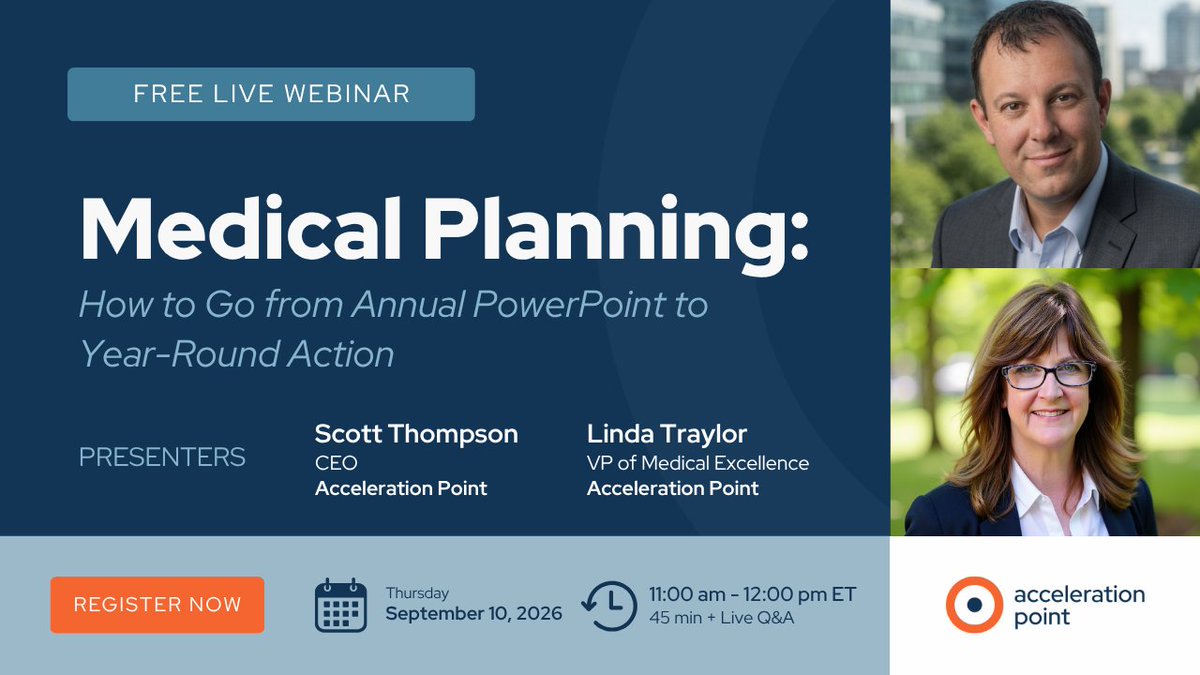
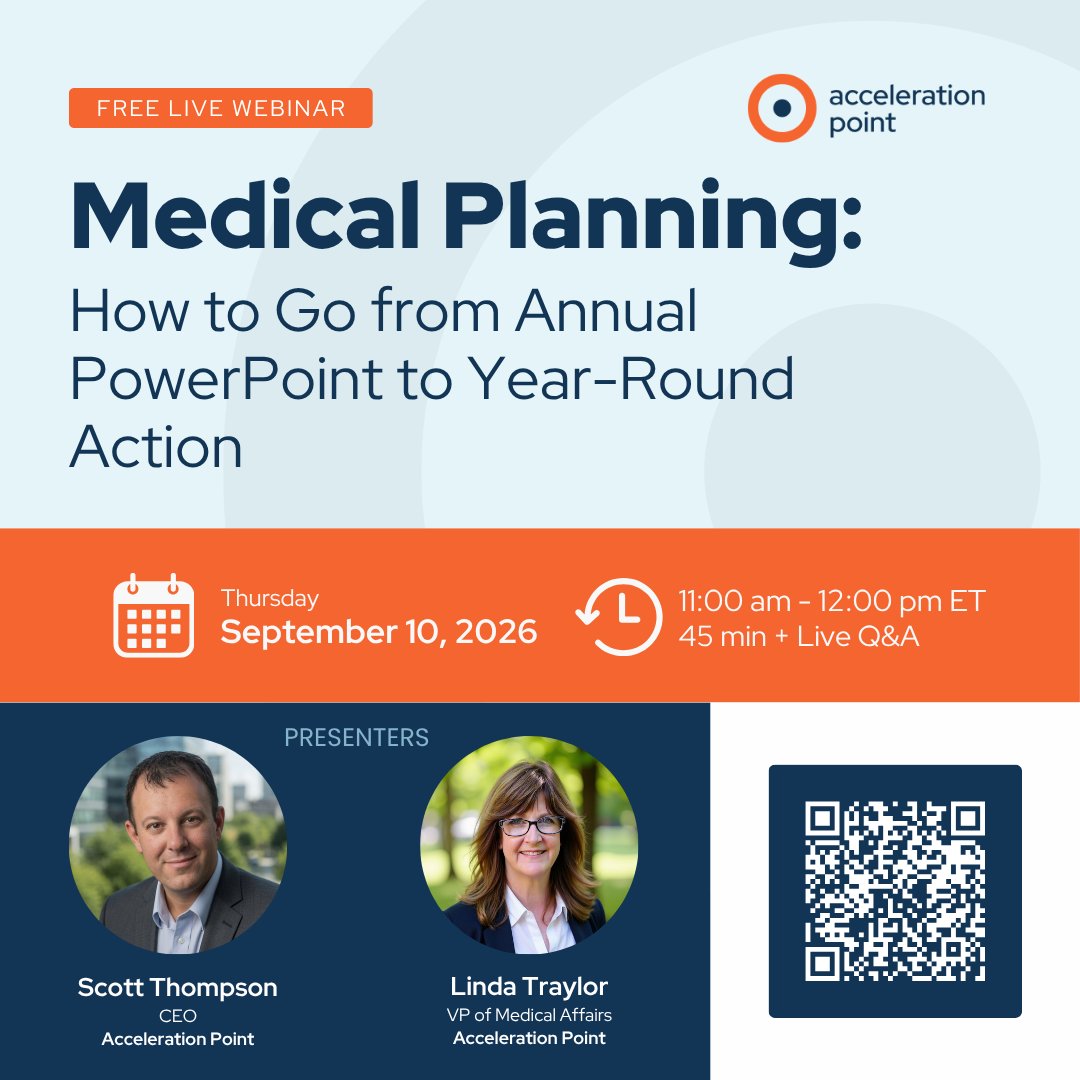
On September 10, Scott Thompson and Linda Traylor will walk through all three.
📅 Thursday, September 10 | 11:00 AM ET | Free
Registration link in comments. 👇
https://t.co/sXhuHq4nXk
#MedicalAffairs #MedicalPlanning #MedicalStrategy #MedicalExcellence
Today we're thinking about the people behind the science.
The MSLs, the Medical Affairs teams, the researchers, and every professional whose work moves patient care forward, often without the spotlight.
Thank you for what you do. Happy Labor Day from all of us at Acceleration Point.
#LaborDay #MedicalAffairs #ThankYou
Ten years ago, a great MSL was someone who hit their numbers, answered every KOL question, and executed. Tom Caravela used to believe that too. He does not anymore.
On this episode of OnPoint: The Mentor Sessions, Linda Traylor sat down with Tom Caravela, Managing Partner of The Carolan Group, who has placed Medical Affairs leaders and MSLs across the industry for more than two decades.
His reframe is one every aspiring MSL should hear. The role was never meant to be transactional. The difference between a good MSL and an exceptional one is not whether you show up and answer questions. It is whether you go in asking the right ones, and bring back insights the organization can actually act on. Execution versus impact.
The conversation goes deeper from there:
▶️ Why presence and energy separate elite leaders more than polish
▶️ How a growth mindset drove his biggest career turns
▶️ Why adaptability, not scientific acumen alone, is the real differentiator now
If you are building a career in Medical Affairs, or leading people who are, this one rewards a close listen. #MedicalAffairs #FieldMedical #MSL
Listen here👇
https://t.co/F7scnOUrJ6
Two MSLs can present the exact same data and get completely different receptions. The difference is rarely the science. It is whether the KOL actually heard it.
On this episode of OnPoint, Scott Thompson sits down with Dalila Masic, Regional Medical Director, and this thread is a standout. She uses a color-based personality framework to read how a KOL prefers to engage. Everyone carries all four energies. The skill is knowing which one is in front of you:
▶️ Analytical thinkers who want the data and the detail
▶️ Intuitive communicators who lead with the big picture
▶️ Relational people who engage through connection
▶️ Decisive personalities who want the point, fast
Her own example makes it click. She is naturally enthusiastic and big-picture, but much of her work is with deeply analytical specialists. So she adapts, changing how she frames and presents data to match how they are wired to receive it. Because credibility does not come from how you communicate. It comes from what the other person actually hears.
It is a sharp reminder that as AI makes information easier to access, the human skill of truly understanding your KOL is what sets an MSL apart.
If you lead or coach field teams, this conversation reframes what real KOL fluency looks like. #MedicalAffairs #FieldMedical #MSL
Press play.👇
https://t.co/spzwrpMcJv
This is what changes when the plan names what should be different.
Not "improve understanding." Not "increase confidence."
A specific belief shift. In a specific audience. With a specific contribution claim.
That's the difference between a plan that gets filed and a plan that gets quoted.
On September 10, we walk through how to build one. Registration is now open👇
https://t.co/sXhuHq4nXk
One MSL. One territory. Over 1,200 KOL publications, 1,400 congress presentations, and 4,000 digital scientific mentions to keep up with.
Nobody stays on top of that by logging into five systems and searching by hand. What matters slips past simply because no one had time to look.
That is the case for automated alerts. Instead of hunting for updates, the updates come to you, triggered the moment something relevant happens. Follow the KOLs in your territory and get notified when they publish, present, or post. Or save a search around a product, congress, or study and have the matches land in your inbox on a schedule.
Less time searching, more time engaging, which is where your value actually is.
If your team is drowning in KOL activity across too many systems, this one is worth a read. #MedicalAffairs #KOLEngagement #SocialListening
Read the full article. 👇
https://t.co/Beh1b875UA
Most Medical Affairs teams do not have a strategy problem. They have a translation problem: turning a sound strategy into measurable impact across the organization.
That gap is where Acceleration Point's consulting practice lives. Not a generic playbook handed over at the start, but a partnership built around your team's strategy, systems, and goals, delivered in a model that matches how you actually work.
The support spans four connected areas. Medical Impact, defining and measuring what your medical strategy actually changes, from care gaps to belief journeys to insight programs. Omnichannel Strategy, aligning field and digital into one engagement model that connects with HCPs. Medical Operations, building the people, processes, and tools that keep strategy running, from MLR and contracting to territory planning. And Medical Affairs Technology, selecting, configuring, and driving real adoption of the platforms behind it all.
The throughline is that impact is not a slide. It is strategy, systems, and execution working together, with someone in your corner who knows Medical Affairs deeply.
If your team is ready to move faster and prove its impact, take a look at how the consulting practice can help. #MedicalAffairs #MedicalExcellence #MedicalOperations
Explore our consulting services. 👇
https://t.co/KPXtrgrBzP
A meeting note is not an insight. A trend is not an insight. Most Medical Affairs teams have plenty of both, and still struggle to act.
The difference matters more than it sounds. Data is what your MSLs collect: verbatim notes, observations, records of HCP interactions. A pattern is what you see when you group that data by specialty or region. But an insight only exists once someone analyzes and validates those patterns into a conclusion you can actually act on, one that identifies a gap, informs strategy, or confirms a view.
That gap between collecting and concluding is where most value leaks out. Teams gather constantly, but the analysis and validation step gets skipped, so the data never becomes anything decision-makers can use.
This article walks through how to close it:
▶️ The path from data, to patterns, to validated insight, and why each stage is distinct
▶️ The insights loop: define topics, gather from multiple sources, analyze together, refine strategy, and iterate
▶️ Why breadth matters, since many teams still pull only from field interactions and miss literature and social signals
▶️ The six core insight types, from patient and HCP insight to landscape and value insight
▶️ Where AI fits, automating routine collection so your team can spend its time on analysis and interpretation
The takeaway is simple. Collecting more data is not the goal. Turning it into validated understanding is.
If your team is sitting on plenty of data but not enough insight, this is a clear place to start. #MedicalAffairs #MedicalInsights #FieldMedical
Read the full article. 👇
https://t.co/dy7Y5Wf4b9
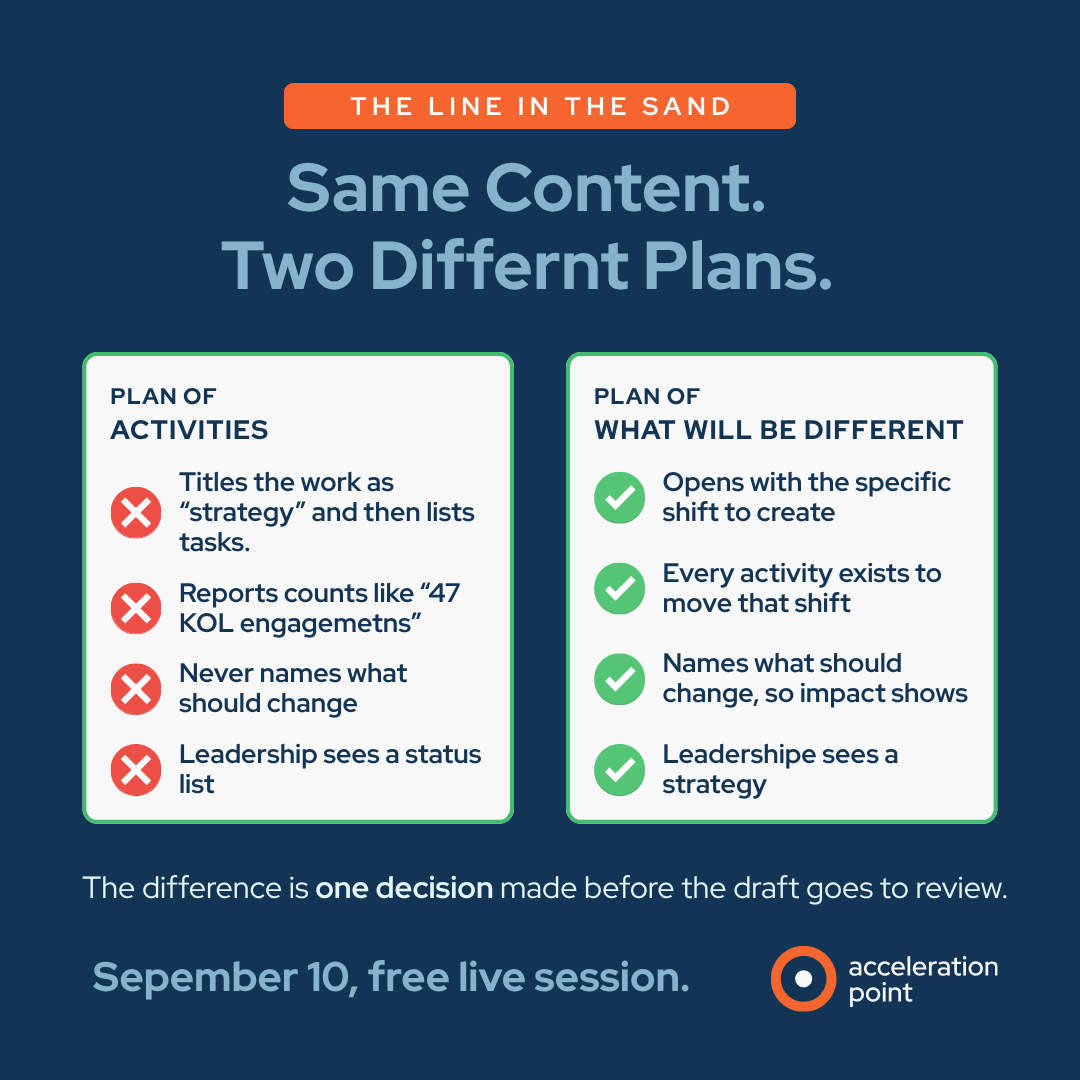
Two kinds of Medical Plans are being drafted this month. One is a list of activities with the word "strategy" above it.
The other is a sentence describing what will be different, with activities below that earn their place by moving it.
The difference is not effort. It is one decision, made before the draft goes to review.
On September 10th, we walk through it. 👇
https://t.co/E46olk8t86
Your CRM was built to log sales calls. So why is your Medical team using it to plan KOL engagement?
That mismatch is one of the quietest sources of friction in Medical Affairs. Local CRMs rarely give you global access, built-in compliance controls, or a heads-up when two teams are about to engage the same expert. So planning gets fragmented, and the science suffers for it.
This article breaks down five common challenges in KOL engagement planning, and how to solve each:
▶️ Cross-functional competition. Medical, Commercial, and R&D often chase the same top KOLs. A transparent, shared process keeps everyone coordinated without compromising Medical's independence.
▶️ Prioritization. A clear framework tied to strategic goals, KOL influence, and expected value keeps day-to-day activity anchored to your scientific objectives.
▶️ New engagement methods. Web chats, portals, content hubs, and DOL engagement let you reach a broader set of stakeholders across channels.
▶️ CRM gaps. A purpose-built KOL engagement platform supplements local CRM, giving the whole team one compliant, shared view of top thought leaders.
▶️ Global versus local alignment. The two follow different objectives, so they need complementary processes, not one forced workflow.
The throughline is that better KOL planning is rarely a technology problem first. It is a coordination problem, and the right shared system is what makes the coordination possible.
If your team is stretching a sales CRM to do work it was never built for, this is a practical place to start. #MedicalAffairs #KOLEngagement #MedicalOperations
Read the full article. 👇
https://t.co/lfm5cjtHX2
You mapped your DOLs. The list is built, the conversations are visible. So what are those voices actually for?
Most Medical Affairs teams get stuck right here. The listening is done, but the next move is fuzzy.
This guide makes the case for a simple reframe: HCP social influencers are an awareness channel. Not a strategy on their own, not a metrics program. A channel that puts your
science in front of clinicians who would otherwise never encounter it, then points them to the content that does the real educating.
Because an influencer post is not the education. It is the doorway that gets a busy clinician to the education. Scientific content rarely fails on the science. It fails when the clinicians who need it never learn it exists.
What is inside:
▶️ 10 compliant plays that build awareness of your science
▶️ 2 engagement lanes to structure how you activate DOLs
▶️ 1 DOL matching worksheet to pair the right expert with the right opportunity
It is built to be practical, not theoretical. Read it, then put it to work the same week.
If you have been listening to DOLs and want to know what to do next, this guide plus worksheet is for you. #MedicalAffairs #DigitalOpinionLeaders #FieldMedical
Download it free.👇
https://t.co/8uzKqkG0KH
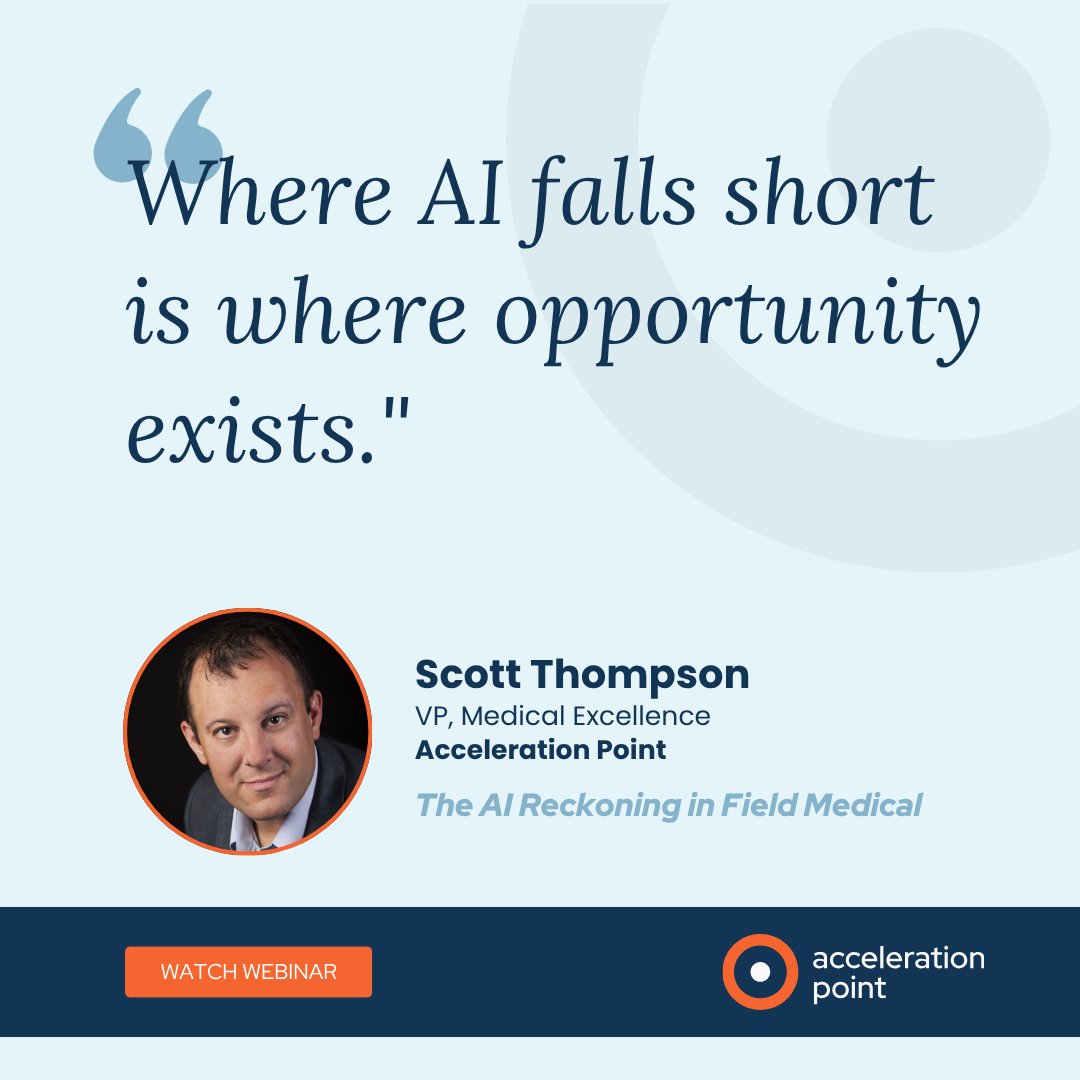
Only 6% of MSLs believe AI will significantly change their role. That number is not reassuring. It is the warning.
In a recent session, Scott Thompson and Linda Traylor make the case that the 6% figure, from an MSL Society survey, dramatically underestimates what is already happening. Digital MSLs are not a future scenario or a pilot. They are in production right now, monitoring HCPs, predicting behavior, drafting communications, and planning engagement.
Here is the uncomfortable part. An estimated 70 to 80% of MSL time goes to awareness, understanding, and admin, which is exactly the work AI does best. That is the exposed zone.
But the conversation is not a doomsday take. It is a roadmap. Scott and Linda map the work to a scientific engagement spectrum: awareness and understanding are where AI already wins, while belief and impact are where humans still own the outcome. Trust, conviction, follow-through, and showing up when things get hard are not soft skills anymore. They are the hard skills of the future.
They close with a five-step playbook Field Medical leaders can start this week, built around a single shift: stop presenting data, start architecting belief.
If you lead or coach field teams, this is a clear-eyed look at what AI actually changes, and what only your people can do. #MedicalAffairs #FieldMedical #ArtificialIntelligence
Watch the full session on-demand.👇
https://t.co/lgzbGGvua5
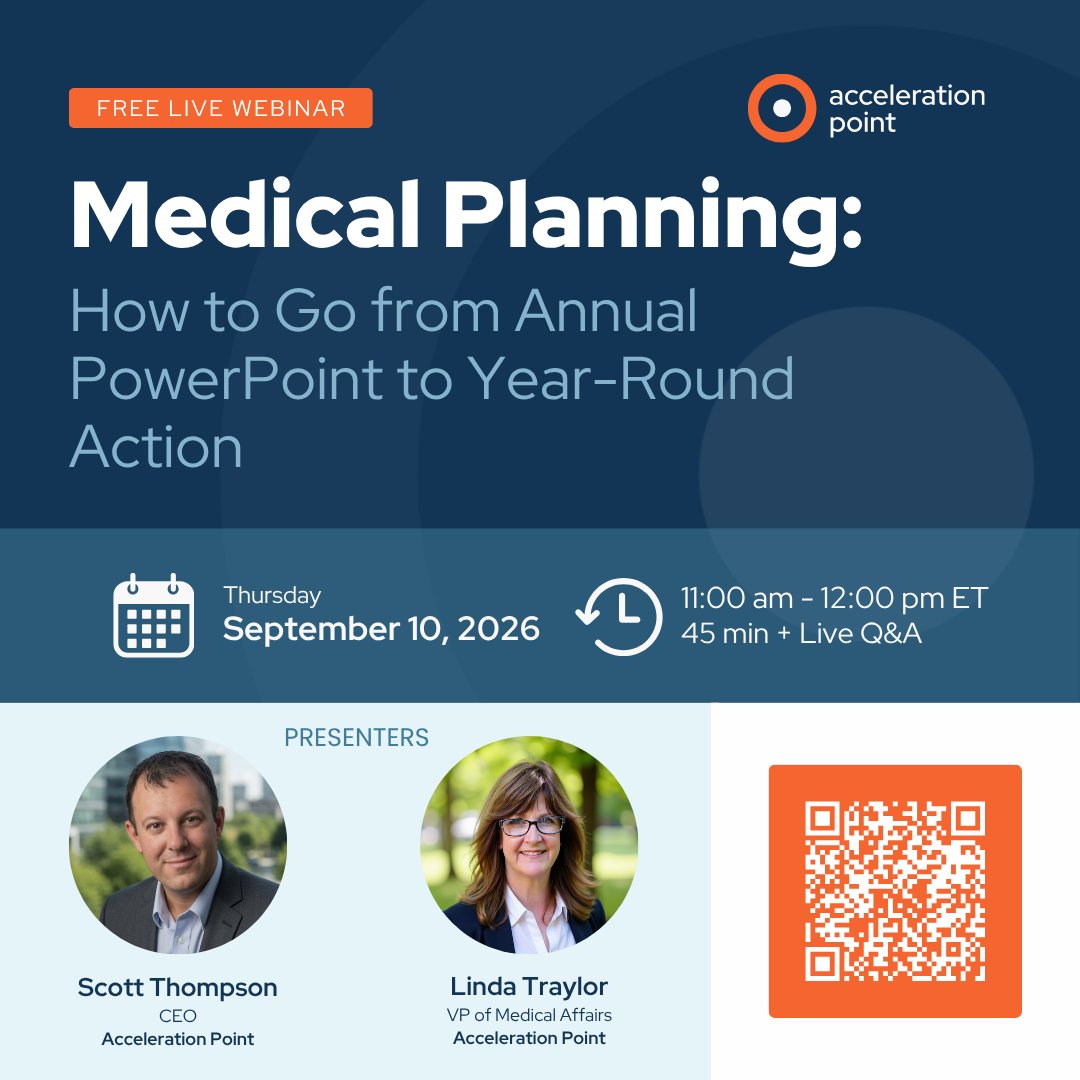
A lot of sessions talk about medical planning. This webinar is different.
Medical Planning: How to Go from Annual PowerPoint to Year-Round Action on September 10th is built around the real constraints Medical Affairs leaders face every year.
Scott Thompson and Linda Traylor are structuring the session around four practical moves:
🔸 Define the outcome on a scale you can read — the product, the patient profile, the specific clinical decision
🔸 Say what the measure conveys, and what it doesn’t — so your team gets credit without over-claiming it
🔸 Translate it into a language commercial and executives don't just approve, but reference
🔸 Build the year-round rhythm — so the plan is a document of direction, not a document of record
60 minutes. Free. Highly interactive. Tools you can bring into your 2027 planning immediately.
📅 September 10th | 11:00 AM ET
Registration now open👇
https://t.co/I7FDKZJeaF
#MedicalAffairs #MedicalPlanning #MedicalStrategy #MedicalExcellence #Pharma #LifeSciences