#WATCH Jeffrey Sachs Blasts US Power Grab Over Venezuela, Maduro Capture at Historic UN Meeting
🇺🇸 US military interventions in foreign countries since WWII (incomplete list):
🇮🇷 Iran: 1946
🇨🇳 China: 1946 - 1949
🇬🇷 Greece: 1947 - 1949
🇮🇹 Italy: 1948
🇵🇭 Philippines: 1948 - 1954
🇰🇵 Korea: 1950 - 1953
🇮🇷 Iran: 1953
🇻🇳 Vietnam: 1954
🇬🇹 Guatemala: 1954
🇱🇧 Lebanon: 1958
🇵🇦 Panama: 1958
🇭🇹 Haiti: 1959
🇨🇩 Congo: 1960
🇻🇳 Vietnam: 1960 - 1964
🇨🇺 Cuba: 1961
🇨🇺 Cuba: 1962
🇱🇦 Laos: 1962
🇪🇨 Ecuador: 1963
🇵🇦 Panama: 1964
🇧🇷 Brazil: 1964
🇻��� Vietnam: 1965 - 1975
🇮🇩 Indonesia: 1965
🇨🇩 Congo: 1965
🇩🇴 Dominican Republic: 1965
🇱🇦 Laos: 1965 - 1973
🇬🇭 Ghana: 1966
🇬🇹 Guatemala: 1966 - 1967
🇰🇭 Cambodia: 1969 - 1975
🇴🇲 Oman: 1970
🇱🇦 Laos: 1971 - 1973
🇨🇱 Chile: 1973
🇰🇭 Cambodia: 1975
🇦🇴 Angola: 1976 - 1992
🇮🇷 Iran: 1980
🇱🇾 Libya: 1981
🇸🇻 El Salvador: 1981 - 1992
🇳🇮 Nicaragua: 1981 - 1990
🇱🇧 Lebanon: 1982 - 1984
🇬🇩 Grenada: 1983
🇭🇳 Honduras: 1983 - 1989
🇮🇷 Iran: 1984
🇱🇾 Libya: 1986
🇧🇴 Bolivia: 1986
🇮🇷 Iran: 1987 - 1988
🇱🇾 Libya: 1989
🇵🇭 Philippines: 1989
🇵🇦 Panama: 1989 - 1990
🇱🇷 Liberia: 1990
🇮🇶 Iraq: 1990 - 1991
🇮🇶 Iraq: 1991 - 2003
🇭🇹 Haiti: 1991
🇸🇴 Somalia: 1992 - 1994
Yugoslavia: 1992 - 1994
🇧🇦 Bosnia: 1993 - 1995
🇭🇹 Haiti: 1994 - 1996
🇭🇷 Croatia: 1995
🇨🇩 Zaire (Congo): 1996 - 1997
🇱🇷 Liberia: 1997
🇸🇩 Sudan: 1998
🇦🇫 Afghanistan: 1998
🇮🇶 Iraq: 1998
Yugoslavia: 1999
🇲🇰 Macedonia: 2001
🇦🇫 Afghanistan: 2001
🇮🇶 Iraq: 2003
🇮🇶 Iraq: 2003-present
🇭🇹 Haiti: 2004
🇸🇾 Syria: 2011-present
🇺🇦 Ukraine: 2014-present
🇻🇪 Venezuela: 2026
The UN Security Council witnessed a rare, explosive intervention as economist Jeffrey Sachs delivered a sweeping warning on Venezuela. Speaking during an emergency session, Sachs framed the crisis as a test of international law itself, not leadership politics. He traced decades of U.S. regime-change actions, questioned the legality of force and sanctions, and warned of catastrophic consequences if UN rules collapse in a nuclear age.
Since 1947, United States foreign policy has repeatedly employed force, covert action, and political manipulation to bring about regime change in other countries. This is a matter of carefully documented historical record. In her book Covert Regime Change (2018), political scientist Lindsey O’Rourke documents 70 attempted US regime-change operations between 1947 and 1989 alone.
These practices did not end with the Cold War. Since 1989, major United States regime-change operations undertaken without authorization by the Security Council have included, among the most consequential: Iraq (2003), Libya (2011), Syria (from 2011), Honduras (2009), Ukraine (2014), and Venezuela (from 2002 onward).
The methods employed are well established and well documented. They include open warfare; covert intelligence operations; instigation of unrest; support for armed groups; manipulation of mass and social media; bribery of military and civilian officials; targeted assassinations; false-flag operations; and economic warfare aimed at collapsing civilian life.
These measures are illegal under the UN Charter, and they typically result is ongoing violence, lethal conflict, political instability, and deep suffering of the civilian population.
The case of Venezuela
The recent United States record with respect to Venezuela is clear.
In April 2002, the United States knew of and approved an attempted coup against the Venezuelan government.
In the 2010s, the United States funded civil society groups actively engaged in anti-government protests, notably in 2014. When the government cracked down on the protests, the US followed with a series of sanctions. In 2015, President Barrack Obama declared Venezuela to be “an unusual and extraordinary threat to the national security and foreign policy of the United States.”
In 2017, at a dinner with Latin American leaders on the margins of the UN General Assembly, President Trump openly discussed the option of the US invading Venezuela to overthrow the government.
During 2017 to 2020, the US imposed sweeping sanctions on the state oil company. Oil production fell by 75 percent from 2016 to 2020, and real GDP per capita (PPP) declined by 62 percent.
The UN General Assembly has repeatedly voted overwhelmingly against such unilateral coercive measures. Under international law, only the Security Council has the authority to impose such sanctions.
On 23 January 2019, the United States unilaterally recognized Juan Guaidó as “interim president” of Venezuela and on 28 January 2019 froze approximately $7 billion of Venezuelan sovereign assets held abroad and gave Guaidó authority over certain assets.
These actions form part of a continuous United States regime-change effort spanning more than two decades.
Recent United States global escalation
In the past year, the United States has carried out bombing operations in seven countries, none of which were authorized by the Security Council and none of which were undertaken in lawful self-defense under the Charter. The targeted countries include Iran, Iraq, Nigeria, Somalia, Syria, Yemen, and now Venezuela.
In the past month, President Trump has issued direct threats against at least six UN member states, including Colombia, Denmark, Iran, Mexico, Nigeria and of course Venezuela. These threats are summarized in Annex I to this statement.
What is at stake today
Members of the Council are not called upon to judge Nicolás Maduro.
They are not called upon to assess whether the recent United States attack and ongoing naval quarantine of Venezuela result in freedom or in subjugation.
Members of the Council are called upon to defend international law, and specifically the United Nations Charter.
The realist school of international relations, articulated most brilliantly by John Mearsheimer, accurately describes the condition of international anarchy as “the tragedy of great power politics.” Realism is therefore a description of geopolitics, not a solution for peace. Its own conclusion is that international anarchy leads to tragedy.
In the aftermath of World War I, the League of Nations was created to end the tragedy through the application of international law. Yet the world’s leading nations failed to defend international law in the 1930s, leading to renewed global war.
The United Nations emerged from that catastrophe as humanity’s second great effort to place international law above anarchy. In the words of the Charter, the UN was created “to save succeeding generations from the scourge of war, which twice in our lifetime has brought untold sorrow to mankind.”
Given that we are in the nuclear age, failure cannot be repeated. Humanity would perish. There would be no third chance.
Measures required of the Security Council
To fulfill its responsibilities under the Charter, the Security Council should immediately affirm the following actions:
The United States shall immediately cease and desist from all explicit and implicit threats or use of force against Venezuela.
The United States shall terminate its naval quarantine and all related coercive military measures undertaken in the absence of authorization by the Security Council.
The United States shall immediately withdraw its military forces from within and along the perimeter of Venezuela, including intelligence, naval, air, and other forward-deployed assets positioned for coercive purposes.
Venezuela shall adhere to the UN Charter and to the human rights protected in the Universal Declaration of Human Rights.
The Secretary-General shall immediately appoint a Special Envoy, mandated to engage relevant Venezuelan and international stakeholders and to report back to the Security Council within fourteen days with recommendations consistent with the Charter of the United Nations, and the Security Council shall remain urgently seized of this matter.
All Member States shall refrain from unilateral threats, coercive measures, or armed actions undertaken outside the authority of the Security Council, in strict conformity with the Charter.
In Closing
Mr. President, Distinguished Members,
Peace and the survival of humanity depend on whether the United Nations Charter remains a living instrument of international law or is allowed to wither into irrelevance.
That is the choice before this Council today.
Thank you.
Artificial Intelligence is not a threat to the physical security profession—it is a force multiplier.
Bridging the Gap: Why Physical Security Professionals Must Understand Artificial Intelligence—Now https://t.co/eV8NWsCjKp
In 1983, Steve Jobs predicted the next 50 years of technology.
His predictions:
• iPhone
• Internet
• Softwares
• App stores
• Artificial Intelligence
10 futuristic predictions from this talk that came true:
1. Every major revolution starts ugly
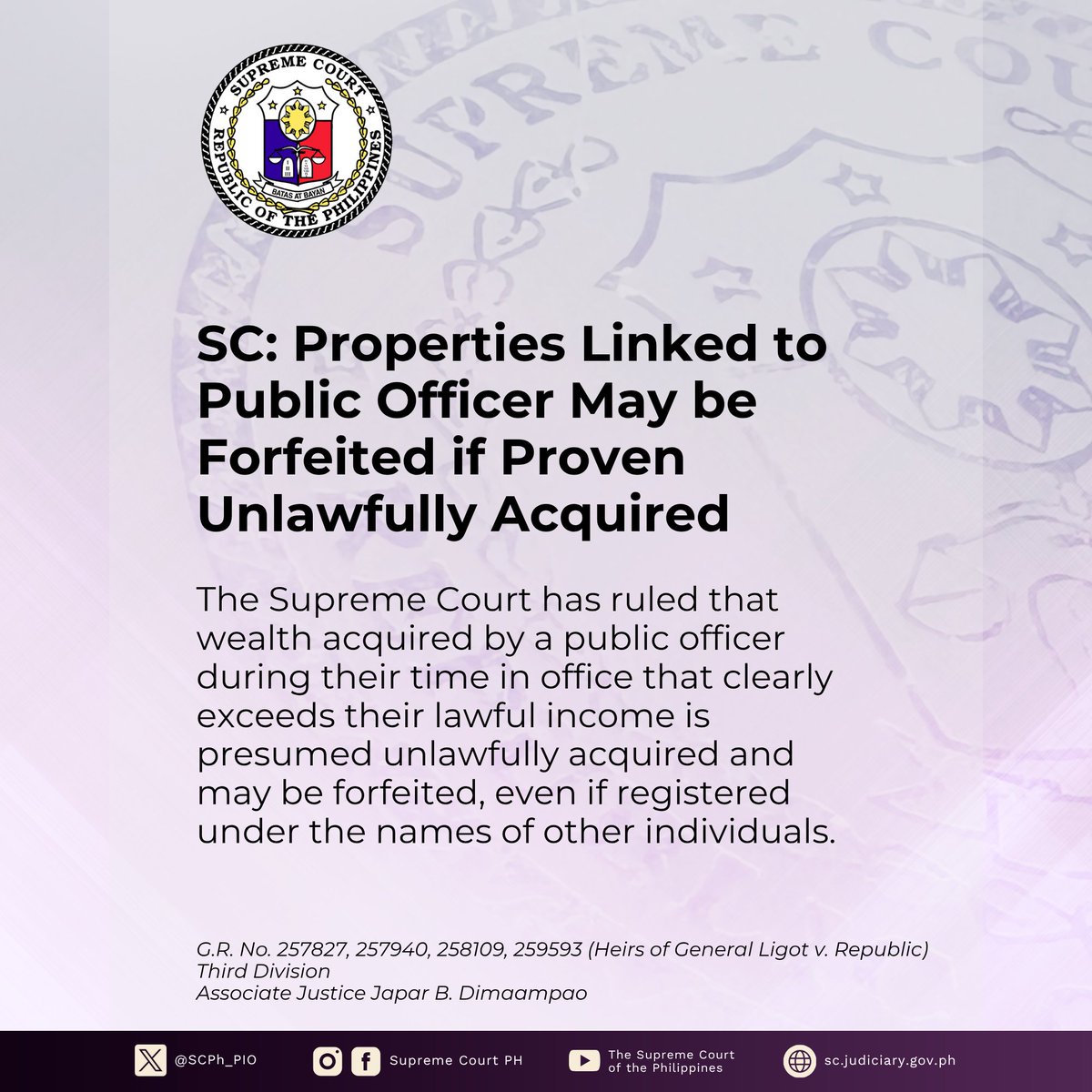
The #SupremeCourtPH has ruled that wealth acquired by a public officer during their time in office that clearly exceeds their lawful income is presumed unlawfully acquired and may be forfeited, even if registered under the names of other individuals.
In a Decision written by Associate Justice Japar B. Dimaampao, the SC’s Third Division upheld the forfeiture of properties, bank deposits, and investment accounts in the name of retired Lieutenant General Jacinto C. Ligot (General Ligot), as well as assets traced to him but registered under his wife, children, and relatives.
The Ombudsman conducted a lifestyle investigation on General Ligot—who served in the Armed Forces of the Philippines from 1970 until his retirement in 2004, and was a commissioned comptroller during the relevant period—to determine whether the properties he acquired during active service exceeded his salary and other lawful income.
Its probe into General Ligot’s declared assets in his Statements of Assets, Liabilities, and Net Worth from 1982 to 2003, which did not reflect the actual properties under his name and those of his close family members, led to a petition for forfeiture filed against him before the Sandiganbayan. Also named in the petition were his wife, their children, and his sister and brother-in-law, who were allegedly used as fronts to conceal his assets.
The Sandiganbayan ordered the forfeiture of the properties worth PHP 102 million as well as deposits and investment funds amounting to PHP 53 million after finding that the same were unlawfully acquired.
The SC upheld the Sandiganbayan’s ruling, noting that General Ligot’s wife and children did not have independent income sources but still owned properties and held significant bank and investment accounts under their names.
Regarding the condominiums, even though they were titled in his sister’s name, the amortizations were paid by General Ligot. The condominium listed under his brother-in-law’s name was initially bought by General Ligot’s wife, who lacked her own income.
The SC held that these circumstances indicate that General Ligot was the true owner, even if the legal titles were in other people’s names.
Under Republic Act No. 1379, properties of public officers are presumed to be illegally acquired when they are manifestly out of proportion to their lawful income.
This presumption applies not only to properties under the public officer’s name but also to those hidden or transferred to others, as long as true ownership can be traced to the public officer.
The SC emphasized that registration under another person’s name does not prevent forfeiture when true ownership can be traced to the public officer.
Read the full text of the Press Release at https://t.co/TL0WkBtqrs.
Read the full text of the Decision at https://t.co/RElGPqJUqP.
Copying of this content is subject to the SC PIO’s Credit Attribution Policy: https://t.co/F48RF1vtzZ.