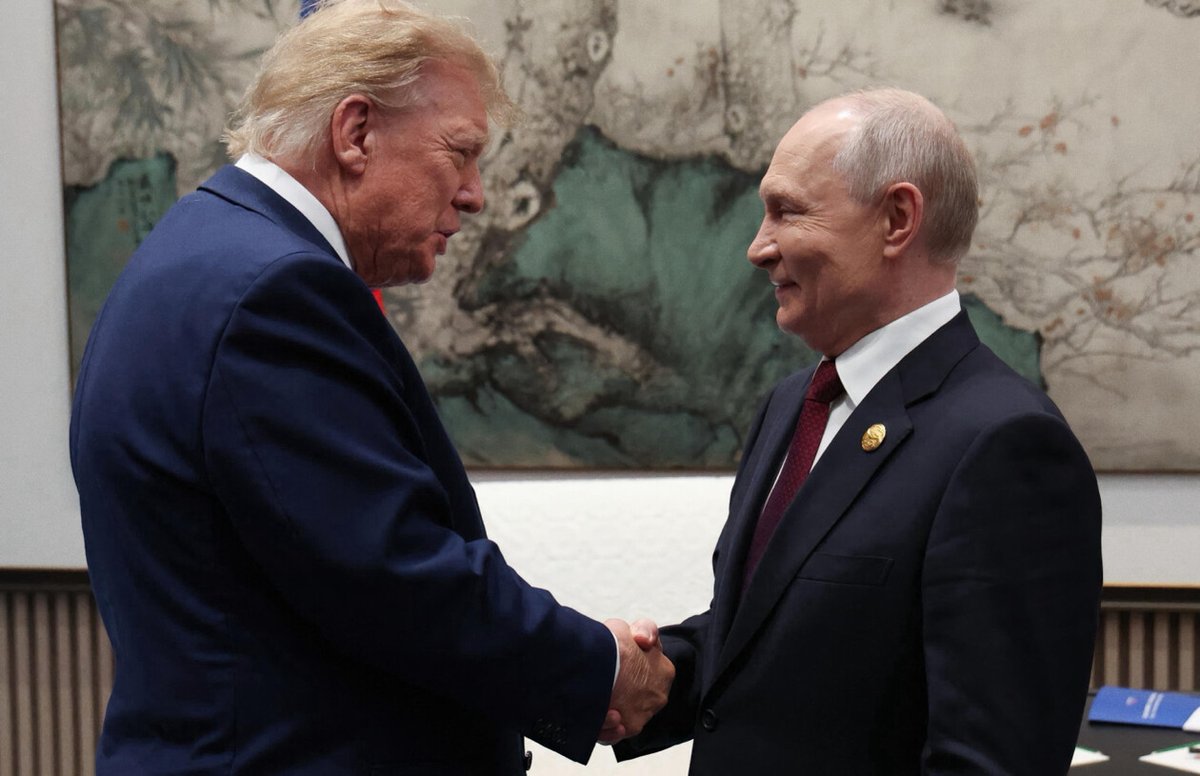
@andrewmichta Nice try. One American President rejects what other American President did, said or agree to. Now "Americans", who have elected said President are distancing from what their Commander in Chief did or said. And all this is the fault of... rest of the World ! 🤡
Una bimba russa ha disegnato una mamma ucraina che alza una mano per fermare i missili russi. La scuola ha consegnato il disegno alla polizia, la quale a sua volta lo ha dato al FSB. Risultato? Il papà single della bimba è stato condannato a due anni e la piccola è finita in orfanotrofio.
La Russia è una nazione da incubo
@thelefttake@Debb227timi@HotSotin That's a deep argument, you must be a true scholar 🤡 Repeating same claim over doesn't somehow make it true (or stronger)
@J_Jakobowski I think you are confusing two things : being friendly with and treating them as an equal. It may take more time to give orders to subordinate than chat in general with your equal etc
Warto podsumować, jak w 4 lata Władimir Putin doszczętnie pozbawił Rosję jej największej broni, czyli energii.
Jeszcze w 2021 roku Rosjanie byli głównym dostawcą ropy, gazu i węgla do Unii Europejskiej. Kontrolowali rafinerie, gazociągi przesyłowe i magazyny gazu w krajach UE, budowali potężne projekty infrastrukturalne pokroju magistrali Nord Stream, a każdy komunikat Moskwy dotyczący surowców energetycznych był czytany z najwyższą uwagą przez europejskich polityków, finansistów i przedsiębiorców.
A dziś?
Udział Rosji w dostawach gazu do UE spadł z 45 do 12%, a w przyszłym roku Unia wprowadza zakaz zawierania umów gazowych z Rosjanami, dotyczący tak LNG, jak i gazu rurociągowego. W kwestii dostaw ropy sprawy rysują się dla Moskwy jeszcze gorzej, bo jej udział w unijnym imporcie spadł do 3%. Z kolei rosyjskiego węgla UE od 2022 r. w ogóle nie sprowadza.
To wszystko przełożyło się na straty finansowe - w 2025 r. kraje UE zapłaciły za rosyjskie surowce o 85% mniej niż w roku 2021.
Rosjanie przestali też dysponować zdolnościami przesyłowymi. Gazociągi Nord Stream i Nord Stream 2 nie działają, 3/4 ich mocy zostało uszkodzonych. Gazociąg Jamalski nie działa, a kontrolę nad jego cześcią przejęła Polska. Gazociąg Braterstwo nie działa, bo Ukraina nie przedłużyła umowy przesyłowej z Rosją. Przy pracy został jedynie Turk Stream.
Mówiąc krótko: Rosja z absolutnego giganta, trzęsącego całym rynkiem energetycznym UE i wywierającego presję za pomocą kurków z gazem i ropą stała się podrzędnym dostawcą surowców, z pomijalnym udziałem w importach. Co więcej, Europejczycy wyzbyli się psychologicznego strachu przed zerwaniem rosyjskich dostaw. Ale to nie wszystko.
Rosjanie stracili kontrolę nad własnym przemysłem rafineryjnym, co jeszcze mocniej uderzyło w ich możliwości eksportowe i dochody budżetowe. Wszystko ze względu na ukraińskie ataki.
Według Międzynarodowej Agencji Energetycznej w pierwszych ośmiu miesiącach 2026 roku ukraińskie drony trafiały rosyjską rafinerię średnio raz na trzy dni. W czerwcu 2026 roku rosyjski przerób ropy spadł do najniższego poziomu od ponad 20 lat. Według danych ukraińskiego wywiadu na koniec września, aż 15 z 38 największych rosyjskich rafinerii zostało wyłączonych z eksploatacji, a kolejnych 12 musiało ograniczać produkcję. Przełożyło się to na straty szacowane na ponad 23,2 mld dolarów. Wszystko to wywołało kryzys paliwowy w Rosji, który wymusił z jednej strony: wprowadzenie zakazu eksportu rosyjskich paliw, a z drugiej: import np. z Białorusi czy Indii. Zwłaszcza indyjskie rafinerie robiły tu niesamowity biznes, bo kupowały bardzo tanią rosyjską ropę, a sprzedawały Rosjanom drogie, wysokomarżowe paliwa.
I tak Rosja w 4 lata została pozbawiona swojej energetycznej broni, którą wykuwała w pocie czoła przez dekady, inwestując pieniądze i wpływy polityczne. Nie wiadomo, jak skończy się wojna na Ukrainie, ale tę energetyczną rozgrywkę Putin już przegrał.
Whenever someone points out that Russia's economy is smaller than Italy's, countless Russian bots and useful idiots reply that in purchasing power terms terms it's very different and Russia is really strong. No, it isn't. Russia is a paper tiger in both nominal GDP and PPP terms. Just look at the chart below, even in PPP terms, Russia is a clear outlier, two in five Russians lack decent sanitation.
The reason is simple, Russia is a deeply corrupt state with one of the highest wealth concentrations in the world. Putin's cronies are billionaires who loot the country by transferring hundreds of billions into offshore accounts, while many ordinary Russians must go outside in winter, lack decent healthcare, and live in deep poverty, resulting in a life expectancy eight years lower than in Europe. Or should life expectancy also be adjusted for PPP?
There is no innovation, future technologies, or decent infrastructure. Young talent emigrates en masse, and the economy is held together by weapons production fired up on neighboring countries. That's not GDP creation, it's a desperate attempt to keep a house of cards together.
Imagine Americans, Brits and Canadians marching through the streets in the 1940s, demanding their governments stop wasting taxpayers’ money liberating Italy from the Nazis.
“Not our war, not our bill!”
And they would have had a pretty fucking good argument, considering Italy had willingly joined Hitler, invaded other countries and helped start the very war it later needed rescuing from.
Fortunately for Italy, the Allies didn’t think that way.
Americans, Brits, Canadians, Poles, French, Indians, New Zealanders, South Africans, Brazilians and countless others fought their way through Italy, alongside Italian anti-fascist partisans. From Monte Cassino to Anzio, tens of thousands of Allied soldiers died fighting the Nazis on Italian soil.
Think about that for a second. People from halfway around the world died liberating a country that had originally been fighting on Hitler’s side.
Nobody owed Mussolini’s Italy a fucking thing. Yet those soldiers came, fought and died, and Italy eventually got its freedom back.
Now, 80 years later, you’ve got Italians marching through the streets complaining about the cost of helping Ukraine defend itself against an invasion it never provoked.
“Not our war, not our bill!”
The sheer fucking hypocrisy is breathtaking.
Imagine where Italy would be today if the Americans, British, Canadians, Poles and everyone else had decided that fighting for another country’s freedom wasn’t worth their money.
And unlike fascist Italy, Ukraine didn’t invade its neighbours, join forces with a genocidal dictator or start a world war. It was invaded.
You don’t have to support every policy concerning Ukraine to recognise the irony here. Your country owes an enormous part of its liberation to foreigners who were willing to pay a price you now seem unwilling to pay for anyone else.
Some people really ought to open a history book before taking to the streets. Or opening their fucking mouths.
@Syorito94@jxzdmzw There was no any "agreement " (proof me wrong, show it); there was no any orange revolution (see below); and if you are not clear on who is an aggressor in Ukrainian war, you need to see a doctor, I can't help you
No. There is no public evidence that the CIA led or orchestrated a regime change in Ukraine in 2014.
Euromaidan began as large domestic protests after President Yanukovych rejected an EU association deal. The US provided long-term democracy and civil-society funding plus diplomatic support for the opposition, and a leaked call showed American diplomats discussing preferred post-crisis leaders. CIA-Ukraine intelligence cooperation started only after Yanukovych fled. Claims of CIA direction remain unsubstantiated.
@daria_sev You are arguing a straw man : nobody literally mean its 100% (so technically you are right on that). Very few things in life are certain though, so we go by placing bets according probabilities we assign to events. And honestly, the chances are very very low here
Sytuacja wygląda tak:
Rosja jest najsłabsza od dekad. Została wyparta z europejskiego rynku energii. Nieustannie uszkadza się jej infrastrukturę krytyczną - rafinerie, terminale naftowe, rurociągi. Tegoroczny kryzy paliwowy dotknął nawet Moskwę i Petersburg. Równolegle Rosjanie ugrzęźli w wojnie, która trwa już dłużej niż Wielka Wojna Ojczyźniana, przy czym po czterech latach tego drugiego konfliktu Armia Czerwona stała już w Berlinie, a tymczasem wojska Władimira Putina doznają spektakularnych klęsk oraz ciosów wizerunkowych, takich jak np. zniszczenie drogowej części Mostu Krymskiego.
W tym samym czasie Europejczycy przeszli głęboką zmianę mentalną - nie dość, że wdrożyli daleko idące restrykcje na rosyjską energię, to jeszcze planują kolejne, kończące ostatecznie relacje na tym polu (jak np. zakaz umów gazowych z Rosją w 2027 r.), a przede wszystkim: zmieniają Unię Europejską w sojusz militarny, inwestujący niespotykane wcześniej środki w zbrojenia.
A co robi w tym czasie prezydent USA? Daje tlen Rosji i Putinowi.
Tylko w ciągu ostatnich kilkunastu miesięcy Donald Trump zorganizował szczyt na Alasce, stawiając Putina na równi sobie, drastycznie poluzował sankcje na rosyjskie surowce energetyczne, niwecząc przy tym wysiłek legislacyjny śp. Lindsaya Grahama, zawarł umowę paliwową z Rosjanami, naciskał na Ukrainę, by ta nie atakowała rosyjskich rafinerii, symetryzował odpowiedzialność za wojnę między Rosję i Ukrainę, nawoływał Ukraińców do znalezienia sobie "nowego prezydenta", zaproponował ponowne przyjęcie Rosji do G7, naciskał na Europejczyków, by ci odmrozili rosyjskie aktywa i przekazali je pod zarząd specjalnego amerykańskiego podmiotu, no a teraz nazywa Putina "przyjacielem". I to dość stanowczo, biorąc pod uwagę jego publikacje w mediach społecznościowych.
Wiecie, w Polsce wciąż przeżywamy katastrofalny reset z Rosją z czasów Baracka Obamy. Z tym, że wtedy Rosja była głównym dostawcą energii do Europy, ściśle współpracowały z nią największe unijne gospodarki, nie mieliśmy wojny na Ukrainie, a sami Amerykanie mogli jeszcze liczyć na przeciągnięcie Moskwy na swoją stronę w rozgrywce z Pekinem. Dziś żaden z tych argumentów nie tłumaczy już tak dalekosiężnej uległości Donalda Trumpa wobec Władimira Putina.
No i teraz dochodzimy do sytuacji, w której przywódca Zachodu zamiast scementować jedność swojego świata rozbija ją, dając się przy tym wielokrotnie upokarzać watażce, który nie jest nawet w stanie podbić kraju kilkukrotnie mniejszego pod względem liczby ludności, dysponującego nieporównywalnie skromniejszymi zasobami gospodarczymi, wojskowymi i surowcowymi.
The art of the deal po prostu.
So I woke up in the middle of the night and started thinking about the fate of Russia. And here are my thoughts.
In Russia, there is a chronic reluctance to admit one’s mistakes. It is not something a real dude does. It shows weakness. The Middle East, by the way, has a similar problem.
I’m quite certain that the vast majority of Russia’s population couldn’t give a damn about invading Georgia, annexing Crimea, or any of the military actions that followed.
But the moment an invasion begins, a very familiar form of great-power Russian psychosis kicks in for a great many people: “We shouldn’t have done this, but now that we’ve started…”
The very idea of admitting a mistake and correcting it is seen as outrageous.
This is also where the utter failure of some otherwise staunchly anti-Putin Russians to understand that Ukraine will have to be compensated for the damage comes from. And that it is the Russian state, as a legal entity, that must pay those reparations. Which means that every Russian taxpayer will be affected by this, just as they are currently affected by the war.
Another widespread phenomenon is the complete disregard for the fact that Russia was the one that attacked first (most people know this, even if they claim otherwise). Instead, the focus is entirely on Ukraine attacking Russia, on Russophobia in Europe, and so on. And if that’s the situation, then one’s motherland must be defended against these attacks. Even if that motherland is collectively devouring people as we speak.
I’m tired of having to add the disclaimer that not everyone is like this. And it’s true, not everyone is. But I’m fairly certain that some form of unwillingness to acknowledge one’s country’s mistakes is present in the majority.
Even among emigrés, it’s surprisingly difficult to find people who can hold all three of these positions simultaneously: “We were wrong to get involved in the first place + now we need to withdraw our troops, return the territories and resources we’ve stolen + compensate for everything we’ve destroyed.”
If you admit you’ve made a mistake, you’re not great enough.
Of course, in reality, the opposite is true. But the psychological age of most Russian citizens is that of a teenager.
Russia is not unique in this respect. It’s just that the damage it causes is greater. I’ll leave it to citizens of other countries to write about the similar problems in theirs.
@gugaga_carapuz@Brainless_Void Nah... This only showed everyone in the World what kind of mafia state Russia is - and how valuable NATO membership really is. Even some countries who been neutral for years now decided joining NATO. Opposite result for Russia
No. There is no public evidence that the CIA led or orchestrated a regime change in Ukraine in 2014.
Euromaidan began as large domestic protests after President Yanukovych rejected an EU association deal. The US provided long-term democracy and civil-society funding plus diplomatic support for the opposition, and a leaked call showed American diplomats discussing preferred post-crisis leaders. CIA-Ukraine intelligence cooperation started only after Yanukovych fled. Claims of CIA direction remain unsubstantiated.