For this month’s column for my series “Therapeutic Window” for The New York Times, I address the question: what do personality traits have to do with mental disorders?
I use the recent Nature paper by Schwaba et al. on the genetics of personality and the correspondence of HiTOP psychopathology dimensions to personality trait dimensions to establish that there is a relationship. Then I introduce various models in the literature to explain this relationship: vulnerability, pathoplasticity, spectrum, common cause, and scar. I then tie this discussion to… drumroll… DeYoung and Krueger’s “cybernetic theory of psychopathology” and I offer a brief and simple version of what the theory says about personality and psychopathology. And then I sneak in a jab at the DSM for the neglect of psychological factors in the proposed organization for the future manual.
https://t.co/PMuMbG9uiL
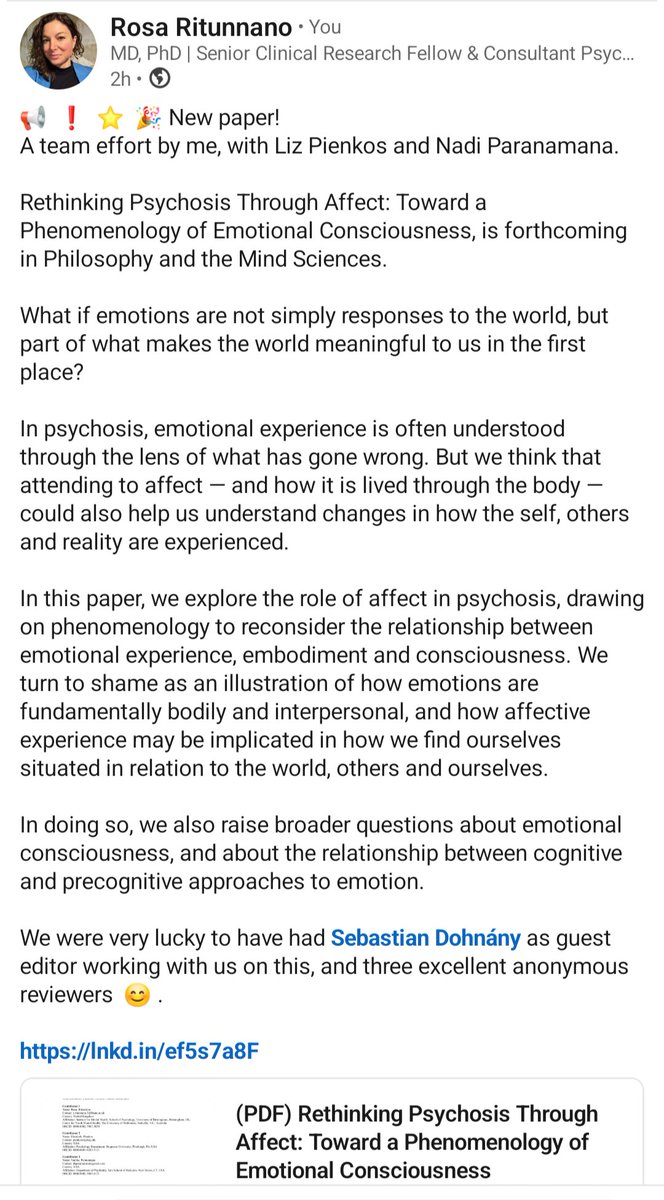
✨🌷New paper🌷 ✨
Rethinking Psychosis Through Affect: Toward a Phenomenology of Emotional Consciousness
Forthcoming in Philosophy and the Mind Sciences
Rosa Ritunnano with Elizabeth Pienkos & Nadika Paranamana
May be of interest @AnnaCiaunica
Chat GPT:
Freud: Human beings have fundamental life and destructive drives.
Klein: Aggression creates anxieties about destroying the loved object.
Winnicott: The object survives destruction, making genuine object relatedness possible.
Bion: Emotional experience can be contained and transformed into something that can be thought.
Kernberg: Love and aggression become integrated into a more cohesive personality organization.
Personality (Disorder), Character (Disorder), and Relational (Disorder)
A first principles perspective
Guest post by Orestis Zavlis (@OrestisZavlis )
https://t.co/0TrFLKNtvz
If, like me, you have searched for years for a suitable introductory text on psychosis that your students can use, then you will, like me, be delighted that such a book has just been published. A brief note here:
https://t.co/Gfg8MAbLM8
"DBT and DBT-based programs have helped a lot of people, I agree, but if I had to generally talk about what I think works in the clinic for the chronically suicidal, when something works, it would be some combination of radical attention, human presence that serves as a container
Covid eclipsed the release of her book, always thought that was a shame. She did have a lot of non DBT therapy for better or worse over the years - that may have been of more help to her than she realized. She is someone who made a real change in the world - no small task, admire her for concern for other people, genius and determination.
Through it all I found this particular CD to be the most valuable resource.
Unfortunately the recording is not available any longer for purchase.
One 10 track recording with all of Linehan’s wisdom and so much more presented succinctly.
That was Marsha’s gift - communication. 🙏🏼
Marsh Linehan has died.
Marsha was most impactful woman in history of psychology/her DBT is among best treatments ever developed/her life an inspiration of self healing & giving to others.
Marsha cured her first & toughest patient- herself- after a 2 yr hospital stay as teenager & then went on to help millions of people.
Marsha's special "dielectic" was to be the most validating of therapists, but also the most demanding. She gave patients more than anyone I've known, but expected them to work as hard as she did.
2 work things I'm proudest of are helping Marsha get her first NIMH funding/write her books. I think of Marsha & often will miss her always.
Separation insecurity - fears of being alone due to rejection by and / or separation from significant others, based in a lack of confidence in one's ability to care for oneself, both physically and emotionally.
Understanding the PID - 5, p.2
@awaisaftab Well that is very interesting. Reason #912 to stay very humble about the certainty of any particular interpretation we might have about what is going on with anyone.