Founder, ThesisIQ. Deal Sourcing AI for Lower Mid-Market Private Equity. Former Nokia (corporate strategy) · Bain (private equity) · LBS MBA · Edinburgh CS
@linasbeliunas Software architecture output is better but the code output is way too buggy. Some people are speculating worse performance due to lack of compute.
@haider1 Eg. in management consulting, AI replaces consultants in strategic analysis so consultants move into implementation consulting. On the back of stellar AI demand, the market for consultants gets 10x bigger.
@The_AI_Investor This model looks way too optimistic.
1. Projected revenue growth requires insane penetration and taking share from OAI and open source.
2. I can't see training costs decreasing in 2030 unless there's a research breakthrough at a fundamental level.
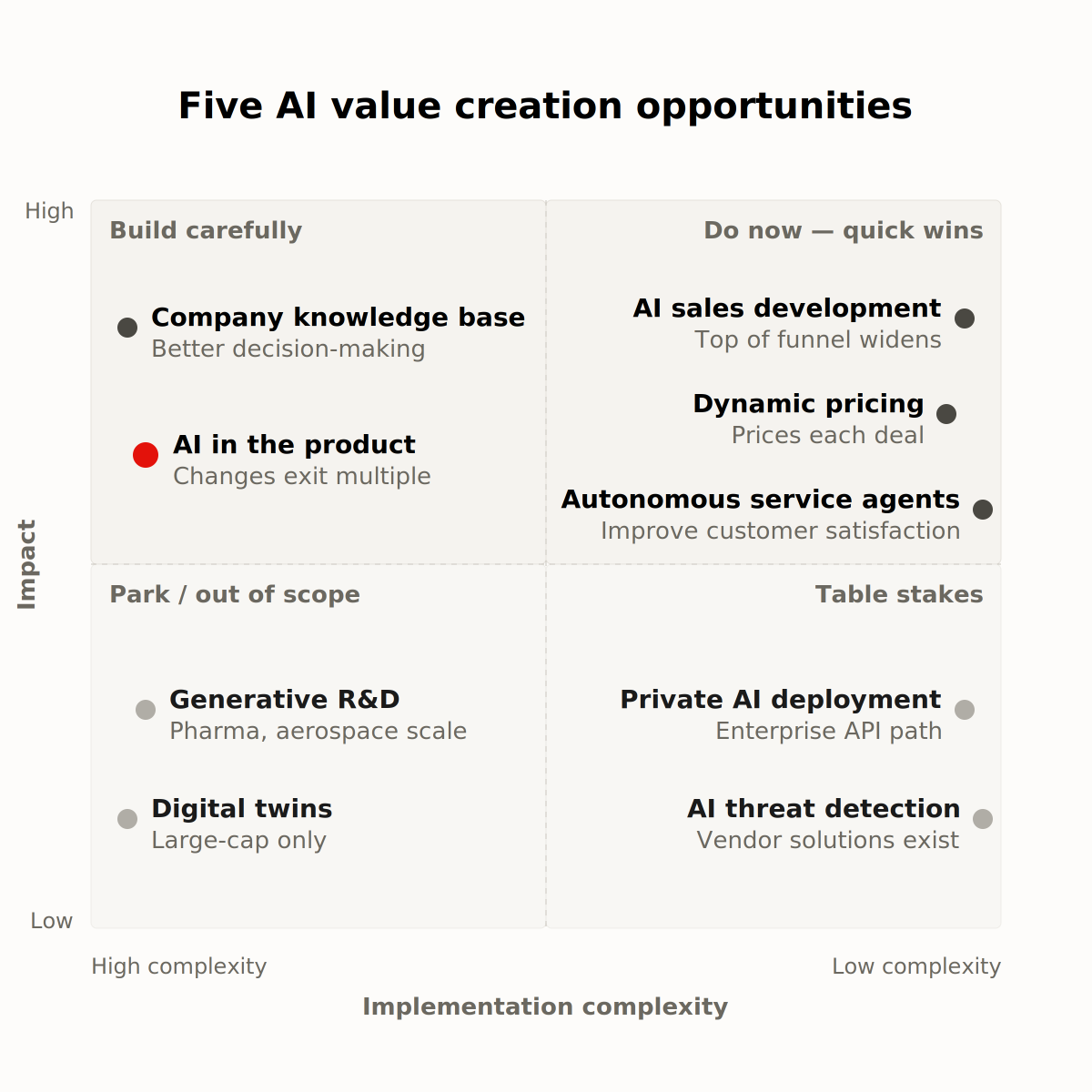
Five AI value creation opportunities now move the value of a business.
Dynamic pricing. AI that prices each deal based on demand, competitor moves, inventory, and customer segment. Was the preserve of airlines and Amazon; now economic for any business with a price list. (revenue, margin)
AI sales development. Software that researches prospects at scale, drafts personalised outreach for each one, qualifies the replies, and books meetings. Top of funnel widens, conversion at each stage improves, sales reps spend their time with buyers rather than spreadsheets. (revenue)
AI in the product, not just in operations. Software, services, healthcare, and intelligent equipment companies can now embed AI into what the customer pays for, building a data and experience moat competitors cannot copy. (exit multiple)
Company knowledge base. Plain-English questions answered from across finance, sales, ops, and customer systems. Top management gets visibility into the bottom of the organisation; every employee sees beyond their own function. (productivity)
Autonomous service agents. AI that holds a real conversation — reads tone, asks the right follow-up, holds context across turns — and resolves end-to-end across systems. The team handles only the complex cases. (margin)
Execution speed depends entirely on the data the business already has.
@FredaDuan Also, rethink pricing for agentic consumption. Incumbent data companies should model outcome-based, task-based, or usage-based pricing. Else agents will go elsewhere especially if data is not the moat.
@PEoperator Many knowledge workers are concerned that AI will replace them. Most domains aren't as well defined as writing code. Data is messy, queries are multi-step and problem-solving requires intuition to poke in the right direction. So the fear of losing one's job is misplaced.
We'll have more open source projects because open code is still safer. We'll see more complex projects because AI 10-100x output. The more complex the project, bigger the pool of contributors. People will still learn but at an architecture level. What are the trade-offs. How do I engineer in a group. I'm bullish on open source overall.
OpenAI at $852B valuation is cheap.
$25B ARR today. Growing 3x YoY.
900M weekly active users.
Google monetises at ~$60/user/yr from ads.
OpenAI is at ~$3.50.
Conservatively:
→ 1.5B WAUs by 2030
→ Half Google's ad ARPU (~$30/user)
→ That's $45B in ad revenue alone
Now add:
→ Enterprise (already 40% of revenue)
→ API (15B tokens/min and growing)
→ Codex (1.6M weekly users, tripled since Jan)
Subscriptions + enterprise + API already at $25B and compounding. Stack $45B+ in ads on top.
$852B is cheap.
@FinanceJack44 Have you tried using any Adobe AI products? Integration is clunky and an after-thought. Ability to build great products declines with bureaucracy. Tools like Canva do it much better.
@rohit4verse Code more complex software is the right direction. 90% of software usecases remain untapped as previously too expensive. Seek them out in boring industries.
@haider1 Opus 4.6 started overwriting my production database because it thought some of the data was corrupt. Lost 2 days trying to replace everything.
@Obius_Maximus@VraserX Interesting thought experiment. I was expecting a solution. What happens if unemployment rises to 30% by 2035 because of AI automating knowledge jobs? How do you tackle that scenario?