Arrived in Saudi Arabia. Important meetings are scheduled. We appreciate the support and support those who are ready to work with us to ensure security.
BREAKING:
Huge anti-separatist protest taking place in Barcelona now.
Around 300 000 ppl took to the streets against the Sanchez gov's plans to give amnesty to the separatist leaders behind the 2017 referendum & risk of a new independence referendum.
@vox_es stands to benefit
4 años de Geología para celebrar el DÍA INTERNACIONAL de la GEODIVERSIDAD. He estado en muchos lugares acompañada de personas guais, rocas estupendas y paisajes flipantes ❤️
#TikTok https://t.co/odtrT3CbUd
Another new paper to check out - 'High-magnesium calcite skeletons provide magnesium for burrow-selective dolomitization in Cretaceous carbonate'
Find at: https://t.co/cVPRcoZWml
Tabla del Tiempo Geológico incluyendo facies, actividad orogénica, biocronología, paleoclimatología, paleogeografía y paleomagnetismo
Por Ángel Caballero García de Arévalo
Disponible en 🇪🇸 e 🇬🇧
https://t.co/rWb0SLQJYM
#Today, Moungi G. Bawendi, Louis E. Brus and Alexei I. Ekimov have been awarded the Nobel Prize in Chemistry 2023 for the discovery and development of quantum dots.
Quantum dots are nanoscale semiconductor particles, typically composed of materials like cadmium selenide or indium phosphide. Their size is incredibly small, usually in the range of 2 to 10 nanometers, which is about 50 to 100 atoms wide. This minuscule size grants them remarkable properties.
One of the most distinctive features of quantum dots is the phenomenon known as quantum confinement, which arises due to their nanoscale dimensions, which lead to quantum behaviors.
Picture quantum dots as being so tiny that they force electrons to behave differently within them compared to bulk materials. When confined in such a small space, electrons can only occupy certain discrete energy levels, similar to how steps on a staircase work.
This quantum confinement leads to a fascinating outcome: the quantum dots emit light of specific colors based on their size.
Imagine each quantum dot as a microscopic color factory, with the size of the dot determining the color of light it produces. Smaller quantum dots emit bluish light, while larger ones emit reddish light. This property is called "tunability," and it has numerous applications, especially in display technologies like quantum dot TVs.
On top of display technology, quantum dots quantum dots serve as efficient and precise contrast agents for imaging. They help doctors visualize and diagnose diseases more effectively. They catalyse chemical reactions and their clear light can illuminate tumour tissue for a surgeon.
They can be used in solar panels as well, to capture a broader spectrum of sunlight, making them more efficient at converting light into electricity.
And they are being explored as qubits (quantum bits) in quantum computing due to their unique quantum properties.
In a nutshell, quantum dots are related to chemistry, but today's Nobel Prize undoubtedly has a strong physics flavor.
[read more: https://t.co/wNiP6qbwTK]
A round of applause!
Students and colleagues at @lunduniversity came together to recognise newly named physics laureate Anne L’Huillier.
Drop a 👏 in the comments to congratulate our new Nobel Prize laureate.
Video credit: Nina Ransmyr, Lund University
BREAKING NEWS
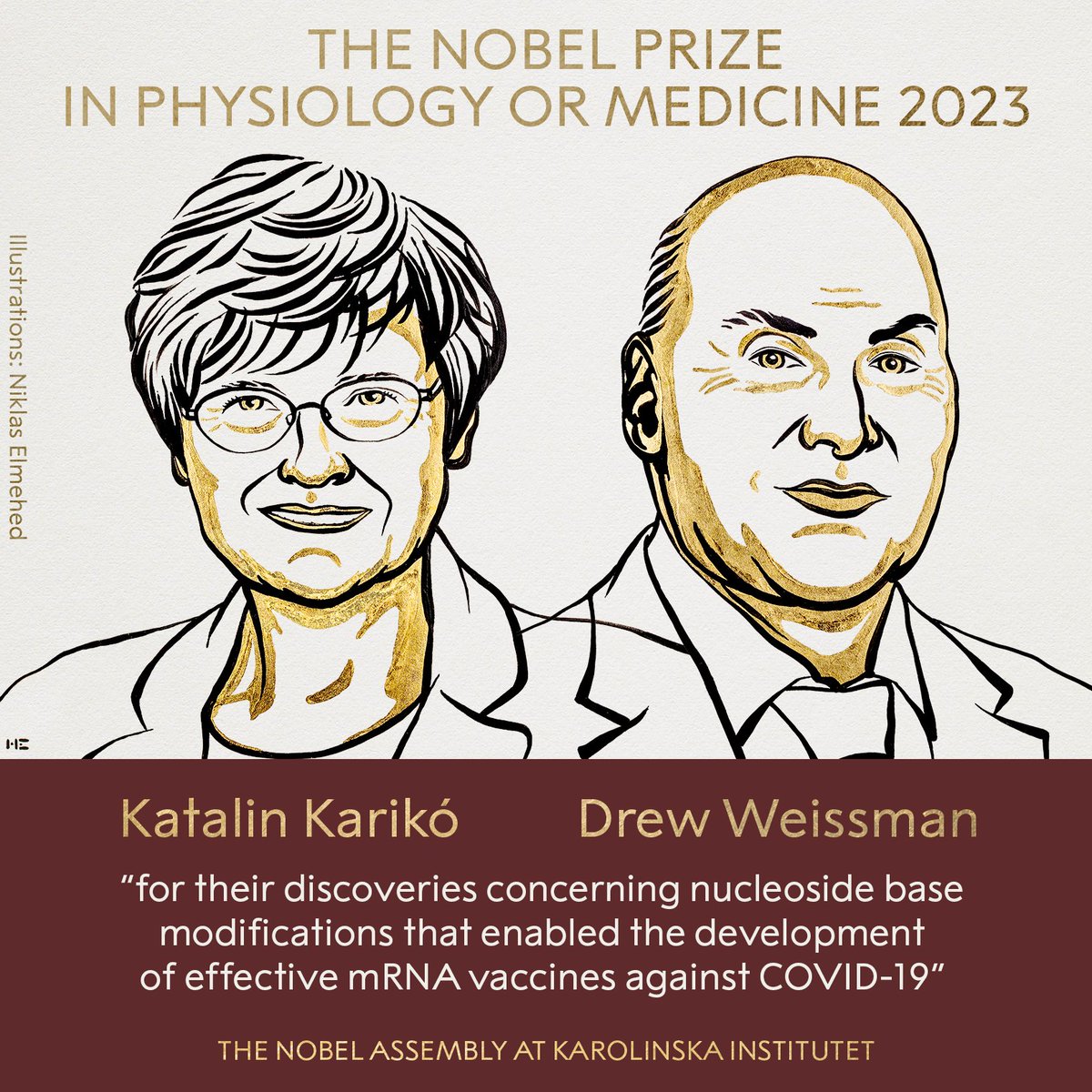
The 2023 #NobelPrize in Physiology or Medicine has been awarded to Katalin Karikó and Drew Weissman for their discoveries concerning nucleoside base modifications that enabled the development of effective mRNA vaccines against COVID-19.
When people say that Pearl Jam is like religion, we think of this moment from 19 yrs ago today. PJ returned to an indoor Boston arena after the '03 Mansfield success, and the classic opener with that crowd was transcendent. #tfh
"Release," Sept. 28, 2004: https://t.co/tDmatXYJZH
¿Cómo funcionan la karstificación? ¿Qué espeleotemas te puedes encontrar en una cueva? ¿Qué procesos químicos forman las estalactitas? Puedes verlo en esta página del "Domo de Ataun"




![Rainmaker1973's tweet photo. #Today, Moungi G. Bawendi, Louis E. Brus and Alexei I. Ekimov have been awarded the Nobel Prize in Chemistry 2023 for the discovery and development of quantum dots.
Quantum dots are nanoscale semiconductor particles, typically composed of materials like cadmium selenide or indium phosphide. Their size is incredibly small, usually in the range of 2 to 10 nanometers, which is about 50 to 100 atoms wide. This minuscule size grants them remarkable properties.
One of the most distinctive features of quantum dots is the phenomenon known as quantum confinement, which arises due to their nanoscale dimensions, which lead to quantum behaviors.
Picture quantum dots as being so tiny that they force electrons to behave differently within them compared to bulk materials. When confined in such a small space, electrons can only occupy certain discrete energy levels, similar to how steps on a staircase work.
This quantum confinement leads to a fascinating outcome: the quantum dots emit light of specific colors based on their size.
Imagine each quantum dot as a microscopic color factory, with the size of the dot determining the color of light it produces. Smaller quantum dots emit bluish light, while larger ones emit reddish light. This property is called "tunability," and it has numerous applications, especially in display technologies like quantum dot TVs.
On top of display technology, quantum dots quantum dots serve as efficient and precise contrast agents for imaging. They help doctors visualize and diagnose diseases more effectively. They catalyse chemical reactions and their clear light can illuminate tumour tissue for a surgeon.
They can be used in solar panels as well, to capture a broader spectrum of sunlight, making them more efficient at converting light into electricity.
And they are being explored as qubits (quantum bits) in quantum computing due to their unique quantum properties.
In a nutshell, quantum dots are related to chemistry, but today's Nobel Prize undoubtedly has a strong physics flavor.
[read more: https://t.co/wNiP6qbwTK]](https://pbs.twimg.com/media/F7nJVL3WMAALjYo.png)