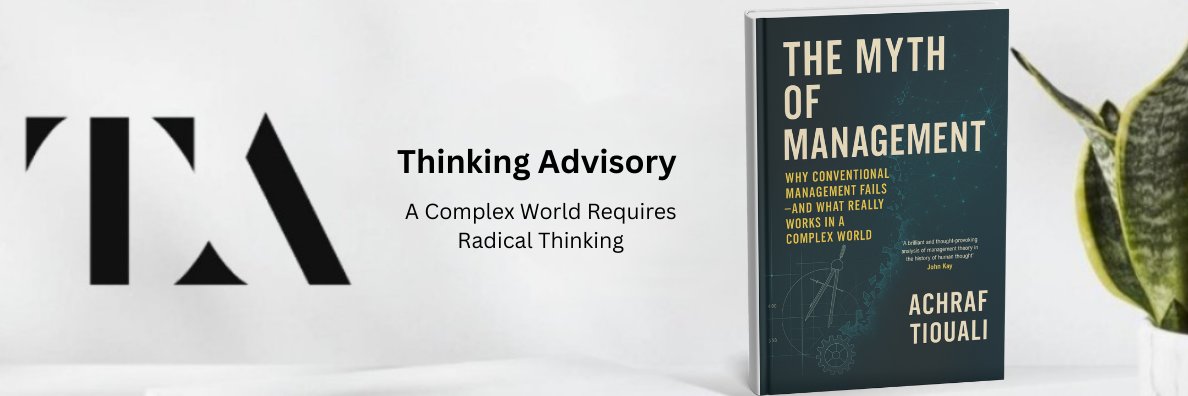
Here's the recording of my book event at the bookstore Quartier Libre in Brussels. Discussion in french but subtitles in english
https://t.co/5r4gv8TEni
@rorysutherland I could have added the idea of loose fitness function to my notion of assumptive evolution I coined in my book where we go from assumption to assumption to do things in an ever changing enviornment which increases substantially the variety
Let's assume that we find a fundamental law of success that many are chasing and that any company can implement.
Do you think that all companies will succeed ?
Absolutely NOT
Why is that ?
OK, let's talk about the elephant in the room, especially for indie authors: AI or more precisely 𝗟𝗮𝗿𝗴𝗲 𝗟𝗮𝗻𝗴𝘂𝗮𝗴𝗲 𝗠𝗼𝗱𝗲𝗹𝘀.
My perception of AI changed significantly while writing my book, 𝗧𝗵𝗲 𝗠𝘆𝘁𝗵 𝗼𝗳 𝗠𝗮𝗻𝗮𝗴𝗲𝗺𝗲𝗻𝘁.
During the first few months, I didn't want to use it at all.
But as I progressed with my research, I discovered that it could be very helpful in finding relevant materials, especially when you already have a clear idea of what you want to investigate.
That proved extremely useful. However, I always went back to the original sources and read them myself (see the book notes).
I also used a LLM for some basic copy editing, but I ended up working with a professional copy editor. When it comes to writing and generating ideas, LLMs can certainly make the process much easier (especially if you're lazy).
But in my experience, nothing replaces the power of human thinking. That's why writing, sometimes even by hand, and thinking on my own terms remained a non-negotiable part of the process.
There are signs that management is on the cusp of a major shift, but it is very difficult to let go of the conventional model because it reinforces the prevailing narrative and culture.
Even the great Einstein found it very difficult to let go of the deterministic nature of physics.
What is required is not an abrupt change, but a smooth transition toward a model that not only recognizes the fundamental complexity of reality, but also harnesses it to achieve desired outcomes.
This transition starts from everyone’s own perspective, regardless of its inherent validity, and works toward a better model, in an evolutionary sense, by combining critical thinking with deep humility.
Conventional management popularizes the use of theories and models regardless of the context, the companies, or the people involved, as if they were divine laws.
Even in hard disciplines such as physics, where we once believed we had immutable laws, it turned out that these laws are observer-dependent. And we, humans with our specific sensing apparatus, are the observers.
Every individual, manager, or executive has his or her own model of the world, formed through experience and continuously co-evolving with it. Any management practice that ignores this frame of reference is destined to fail.
Every time I introduce the book to someone, I get the same question: What model do you propose? And that is exactly the issue I have written about.
There is a widespread belief that there must be something fundamental that explains how organizations work — strategy, marketing, investment, change management, and much more. But what is it? This question has attracted academics for over a century.
The assumption is that if we can discover these fundamental laws, we can understand, predict, and control organizations in the same way we have domesticated the laws of motion.
Unfortunately, this quest is fundamentally — and ontologically — misleading.
@AlexAndBooks_ I disagree, there is no general rule for reading a book. Many times I found a book tedious but I persisted and tuned out to be a great read.
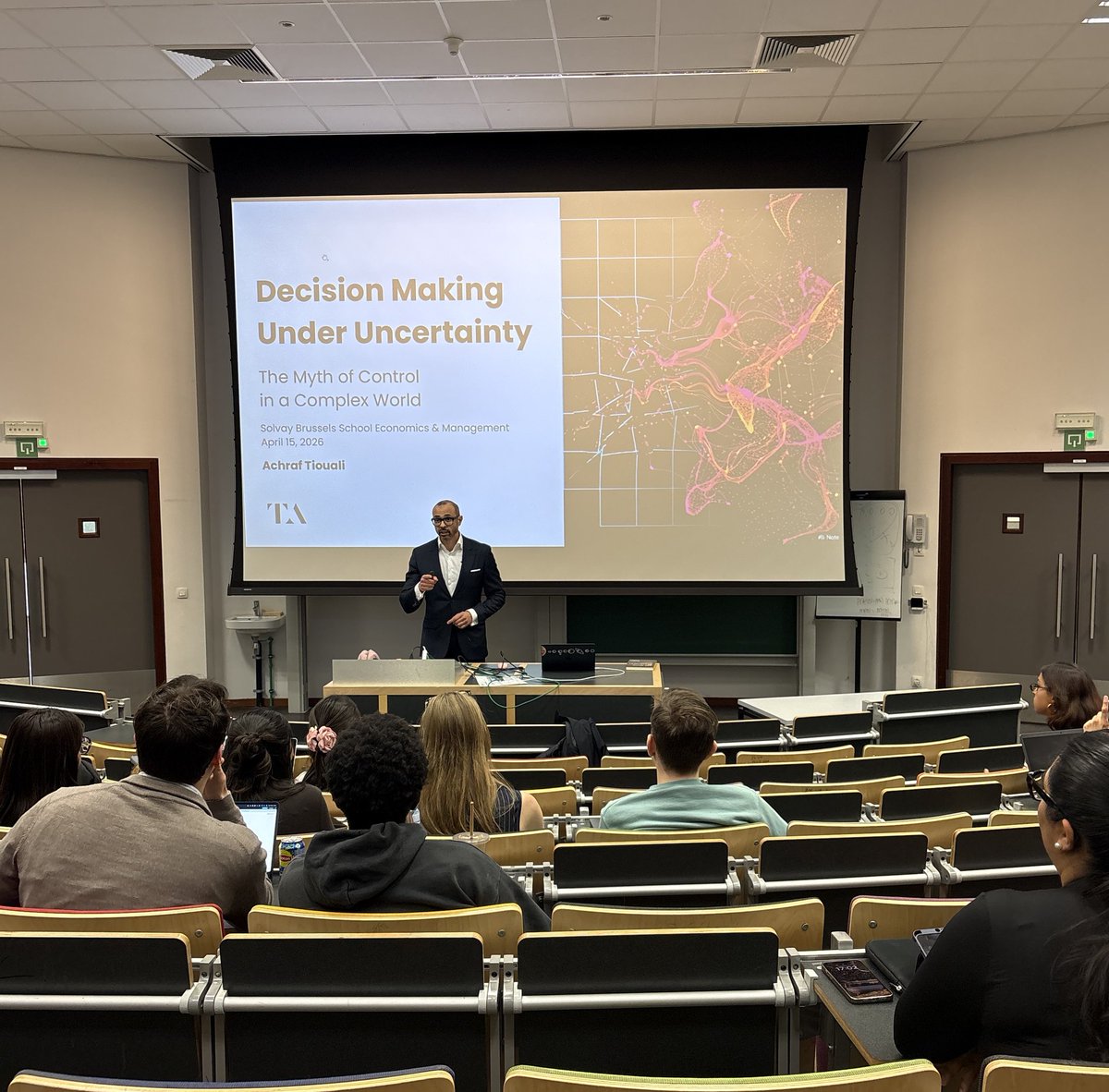
How we make decisions in a world we don't fully understand? A lecture on convexity, optionality, experimentation and ultimately survival
Inspired by @nntaleb@ole_b_peters and Gerd Gigerenzer.