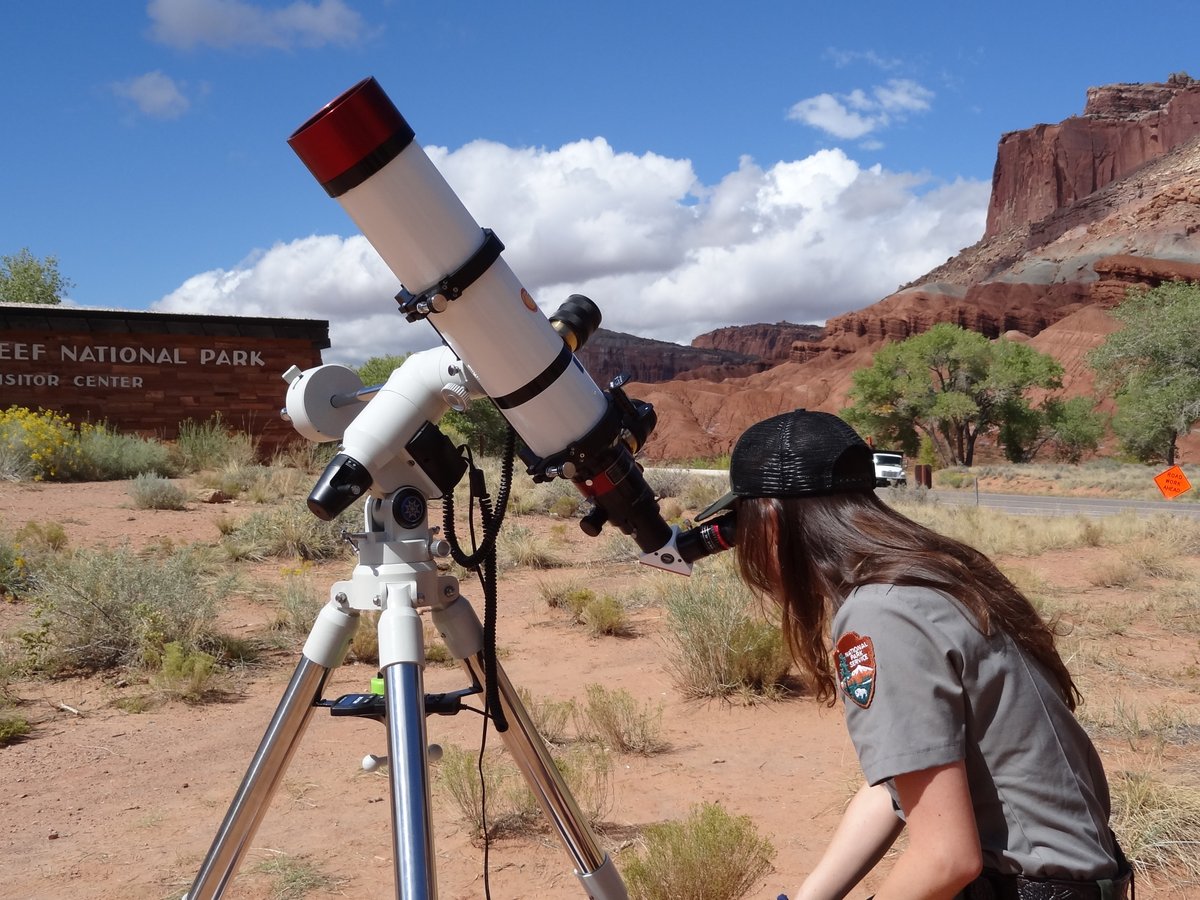
I'll be giving a public talk here next Friday at 3-4 pm, so anyone in the area interested in the science of great comets and viewing the upcoming display of C/2023 A3 (Tsuchinshan-ATLAS) should come by the Capitol Reef Visitor Center then!
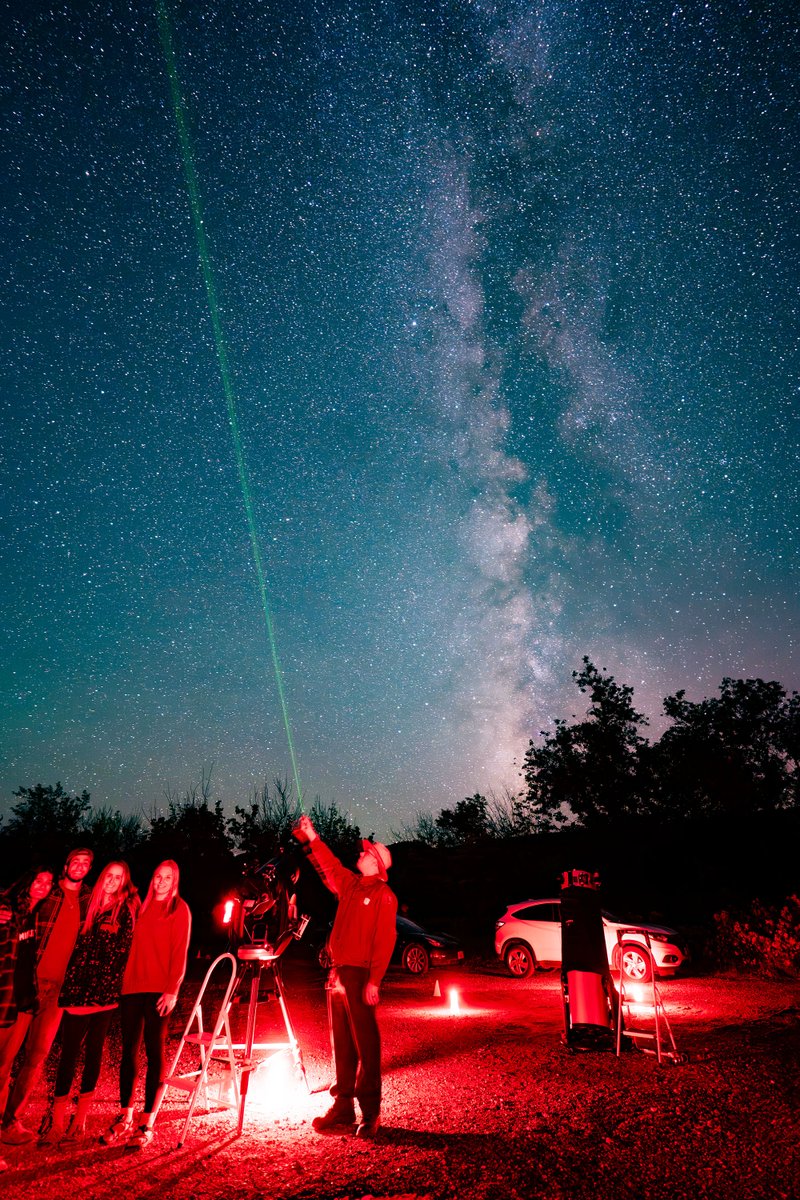
One week away! The 14th annual Heritage StarFest begins next Friday! Hosted by Capitol Reef and community partner, Entrada Institute, this year's events will take place next week on Sept. 27 and 28. For more: https://t.co/PvQtp1Zgdf.
Attention night sky and astronomy enthusiasts! The 14th annual Heritage StarFest is two weeks away! Hosted by Capitol Reef and community partner, the Entrada Institute, this year's events will take place on Sept. 27 and 28. More info: https://t.co/msEJ4hLU5m
@cosmos4u Article seems to be wrong. The associated paper doesn't say anything about a day ever having been 2 hours longer than at present, just that it increased by that much over a period in the past when the day was still shorter than today: https://t.co/3QxUJDMfCs
@cosmos4u Yes, the delay is usually less than 8 hours. Major limit of CCOR is it doesn't have interchangeable color filters, which is a big drawback for comet studies. CCOR-1 might also have stray light problems from the Earth for part of each day, being so close by.
Correction: This was the 19th definitive observation by LASCO, excluding the 1996 apparition where Phaethon wasn't clearly detected in the limited data of that year.
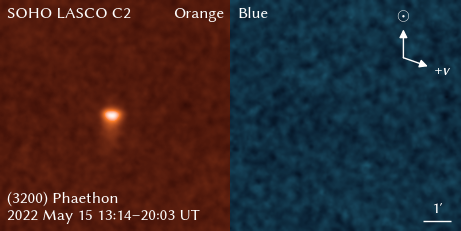
Asteroid (3200) Phaethon paid another visit to the Sun last weekend, when its sodium emission brightened into view of SOHO's LASCO C3 coronagraph for the 20th time. More details on the science, from a paper published earlier this year: https://t.co/sc0XNiVoSK
Comet C/2023 P1 (Nishimura) was only discovered two weeks ago on August 12 by Hideo Nishimura, but STEREO-A actually saw the comet a month earlier through its HI1 camera. Here's a short animation of the comet brightening in July.
@phi48@AstroJaws@DaveAtCOGS Looks a little off, if that timestamp is correct. https://t.co/IUxbvrZTuC puts the streak pretty close to where the comet is right now, but maybe 10 degrees off from where it was two days ago: https://t.co/xPBEerBMKq
@roussos_g@SungrazerComets Too far for SOHO/LASCO, but it should appear near the upper right corner of STEREO-A/HI1 on the 17th. Probably bright enough to even show up in the beacon images here: https://t.co/5Nbd86IQX2
@astroskii77 Note that it will be <15 degrees from the Sun around that time, so will be much harder to see than whatever magnitude it ends up as may normally imply.
Here's a peek at the approaching Oort cloud comet C/2023 A3 (Tsuchinshan-ATLAS) by the 200-inch Hale Telescope at Palomar Observatory last month. Coma was at an r' magnitude of ~16.3.
Mercury reaches inferior conjunction today. While not a "proper" transit, Mercury's lack of a substantial atmosphere makes it dark at high phase angles, which lets @MissionSOHO's LASCO C2 coronagraph see it silhouetted as a black dot against the bright solar corona.
@areoinfo@MissionSoho See this for a more detailed explanation on how differently sized dust move: https://t.co/x04JpZKDf2 Sodium moves like very light dust. Ions move with the solar wind, so does not fit in that framework.
Asteroid (3200) Phaethon brightens and grows a tail like a comet near the Sun. Thanks to @MissionSOHO, we now know that activity is not from comet-like dust as previously assumed, but from sodium atoms escaping the asteroid under intense solar heating: https://t.co/sc0XNiVoSK
@areoinfo@MissionSoho Dust takes so long to move down the tail that it's curved by the Coriolis effect, where the direction of the Sun from the comet (thus the acceleration) rotates as the comet moves around the Sun. Sodium moves quickly, so the Sun/acceleration doesn't get a chance to rotate much.
@areoinfo@MissionSoho Solar wind can also change velocity, which bends the ion tail, but doesn't affect sodium since it's not attached to the solar wind.
@areoinfo@MissionSoho Ions are "attached" to solar wind, which mostly flows directly away from the Sun. Comets move relative to the Sun, so their ions also feel an extra "headwind" so are also dragged backward in addition to antisunward. Neutral sodium is only pushed antisunward by sunlight.