This codelab provides the ultimate guide to Cloud Run: from zero to production.
Walk through the basics of getting started with Cloud Run + learn how to use features, including VPC access, Secret Manager, and ADK for AI agents hosted on Cloud Run → https://t.co/TGGfsXJwN3
Si querés crecer en puestos de marketing, ops, product, data o business, ya no es suficiente saber Excel, Sheets, y Power BI… Python o R sirven, y también aprender Data Storytelling 👇
Este curso de @DeepLearningAI es gratis por 7 días,con certificado:
https://t.co/AWhkSQNPUc
Conoce esta herramienta totalmente GRATUITA y de CÓDIGO ABIERTO para aprender y enseñar a programar. 🧩✨
La sintaxis compleja y las pantallas negras intimidan a cualquiera que esté empezando. Te presentamos Blockly, la solución para que te enfoques en la lógica y no en el código:
✅ Visual e intuitivo: Transforma líneas de comandos complejas en bloques fáciles de conectar.
✅ Cero frustraciones: Olvídate de los errores de sintaxis o de que tu código falle por un punto y coma.
✅ Personalizable: Permite integrar este editor visual directamente dentro de tu propia app.
Conoce cómo implementarlo aquí: https://t.co/JpYbd0eeiL
🚨 𝟔 𝐓𝐲𝐩𝐞𝐬 𝐨𝐟 𝐋𝐋𝐌𝐬 𝐩𝐨𝐰𝐞𝐫𝐢𝐧𝐠 𝐭𝐨𝐝𝐚𝐲’𝐬 𝐀𝐈 𝐚𝐠𝐞𝐧𝐭𝐬
1️⃣ 𝐆𝐏𝐓 – 𝐆𝐞𝐧𝐞𝐫𝐚𝐭𝐢𝐯𝐞 𝐏𝐫𝐞-𝐭𝐫𝐚𝐢𝐧𝐞𝐝 𝐓𝐫𝐚𝐧𝐬𝐟𝐨𝐫𝐦𝐞𝐫
(𝑇ℎ𝑒 𝐺𝑒𝑛𝑒𝑟𝑎𝑙𝑖𝑠𝑡)
Trained on massive datasets, these autoregressive models are the foundational engines for writing, reasoning, coding, and open-ended conversation.
➜ Highly versatile across diverse domains
➜ Excels at zero-shot and in-context learning
➜ The ultimate foundation for downstream fine-tuning
2️⃣ 𝐌𝐨𝐄 – 𝐌𝐢𝐱𝐭𝐮𝐫𝐞 𝐨𝐟 𝐄𝐱𝐩𝐞𝐫𝐭𝐬
(𝑇ℎ𝑒 𝑆𝑐𝑎𝑙𝑒𝑟)
Instead of activating the full neural network, MoE uses sparse routing to send each input only to the most relevant subset of "expert" sub-networks.
➜ Radically higher compute efficiency during inference
➜ Scales seamlessly to trillions of parameters
➜ Achieves deep specialization without sacrificing overall performance
3️⃣ 𝐕𝐋𝐌 – 𝐕𝐢𝐬𝐢𝐨𝐧-𝐋𝐚𝐧𝐠𝐮𝐚𝐠𝐞 𝐌𝐨𝐝𝐞𝐥
(𝑇ℎ𝑒 𝑀𝑢𝑙𝑡𝑖𝑚𝑜𝑑𝑎𝑙)
Combines advanced vision encoders with language models to natively process and reason over spatial data—like images, complex diagrams, and video streams.
➜ Understands deep visual and spatial context
➜ Perfectly aligns pixel data with semantic text
➜ Enables rich multimodal tasks (like visual QA and image-based telemetry)
4️⃣ 𝐋𝐑𝐌 – 𝐋𝐚𝐫𝐠𝐞 𝐑𝐞𝐚𝐬𝐨𝐧𝐢𝐧𝐠 𝐌𝐨𝐝𝐞𝐥
(𝑇ℎ𝑒 𝑇ℎ𝑖𝑛𝑘𝑒𝑟)
Built for "System 2" thinking. Optimized for multi-step reasoning, logical problem-solving, and planning through explicit verification and self-correction loops.
➜ Elite mathematical and logical planning
➜ Drastically reduced hallucinations through step-by-step verification
➜ Excels at complex, highly constrained problem-solving
5️⃣ 𝐒𝐋𝐌 – 𝐒𝐦𝐚𝐥𝐥 𝐋𝐚𝐧𝐠𝐮𝐚𝐠𝐞 𝐌𝐨𝐝𝐞𝐥
(𝑇ℎ𝑒 𝐿𝑖𝑔ℎ𝑡𝑤𝑒𝑖𝑔ℎ𝑡)
Compact, highly optimized models engineered specifically for edge devices, offline execution, or highly cost-sensitive environments.
➜ Ultra-low latency and blazing-fast inference
➜ Highly cost-effective to deploy and maintain
➜ Ensures data privacy through strictly on-device processing
6️⃣ 𝐋𝐀𝐌 – 𝐋𝐚𝐫𝐠𝐞 𝐀𝐜𝐭𝐢𝐨𝐧 𝐌𝐨𝐝𝐞𝐥
(𝑇ℎ𝑒 𝐷𝑜𝑒𝑟)
Designed not just to generate text, but to execute real-world tasks using tools, APIs, and external environments. It operates on a continuous agent loop:
🔄 Plan ➟ Action ➟ Observation ➟ Reflect ➟ Update Memory
➜ Autonomous real-world execution
➜ Native integration with external systems and software
➜ Dynamically adapts to environmental feedback
Agents aren’t just chatbots anymore. They see, act, reason, and run anywhere from cloud GPUs to edge devices. 𝐶ℎ𝑜𝑜𝑠𝑖𝑛𝑔 𝑡ℎ𝑒 𝑟𝑖𝑔ℎ𝑡 𝐿𝐿𝑀 𝑡𝑦𝑝𝑒 𝑑𝑖𝑟𝑒𝑐𝑡𝑙𝑦 𝑖𝑚𝑝𝑎𝑐𝑡𝑠 𝑐𝑜𝑠𝑡, 𝑙𝑎𝑡𝑒𝑛𝑐𝑦, 𝑟𝑒𝑙𝑖𝑎𝑏𝑖𝑙𝑖𝑡𝑦, 𝑎𝑛𝑑 𝑟𝑒𝑎𝑙‑𝑤𝑜𝑟𝑙𝑑 𝑐𝑎𝑝𝑎𝑏𝑖𝑙𝑖𝑡𝑖𝑒𝑠.
Cc : Author
Google tiene un curso intensivo (5 días) sobre cómo construir agentes.
El primer cohort lo tomaron 1.5M de personas y el segundo acaba de abrir.
Es 1-2h al día del 15 al 19 de junio.
Link abajo
Existe un repositorio que te enseña Ingeniería de IA desde cero.
Incluye más de 435 lecciones y 320 horas de contenido sobre cómo construir sistemas reales de IA paso a paso.
En él aprenderás:
→ Python, TypeScript y Rust
→ Prompts y skills
→ Agentes y servidores MCP
→ LLM Engineering
→ Sistemas multiagente
→ Infraestructura y producción
→ IA multimodal y modelos generativos
Y lo más interesante:
Cada fase incluye ejercicios prácticos, proyectos reales y herramientas que puedes utilizar directamente.
Se trata de un roadmap completo para aprender a construir sistema de IA de verdad.
Tiene más de 23.2k stars en GitHub, es 100% open-source y gratuito.
Enlace abajo 👇
Nos aliamos con @OpenAI para el lanzamiento de The OpenAI Deployment Company.🤝
Una unión que nace para ayudar a tu empresa a construir e integrar sistemas de IA en los que tus equipos puedan confiar y usar en su trabajo diario.
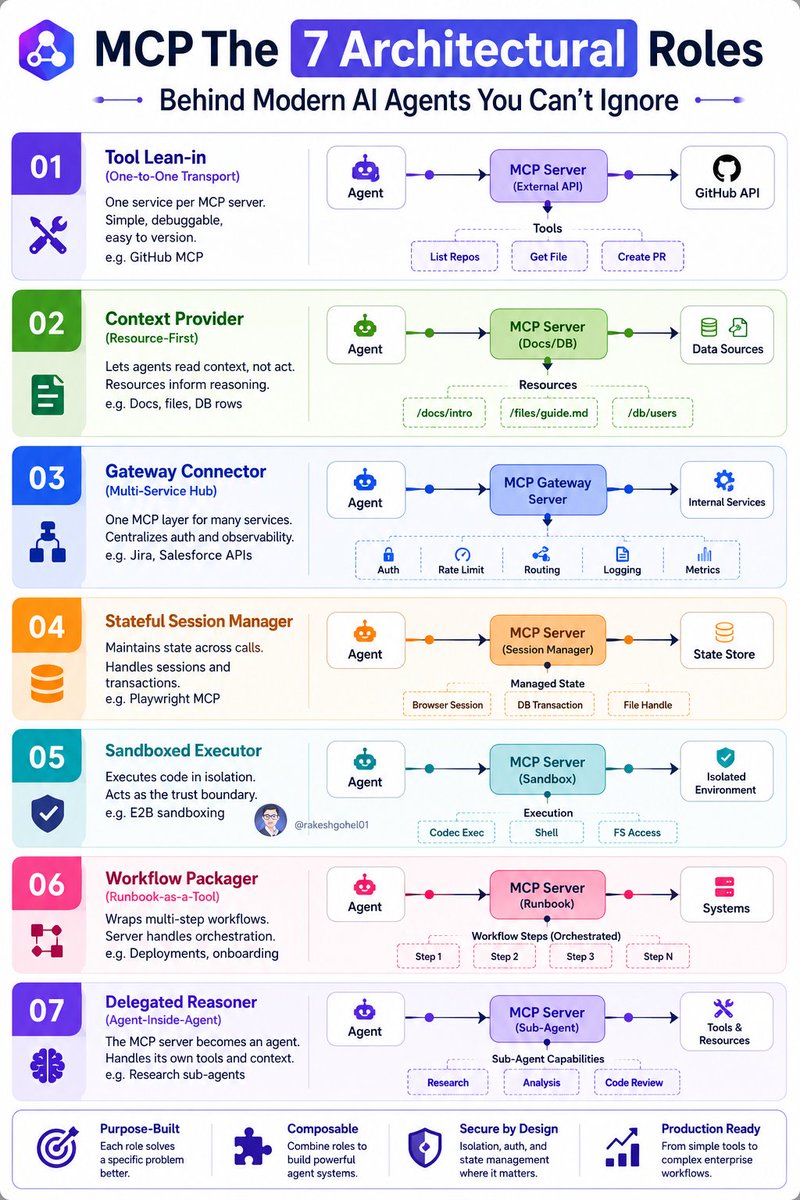
MCP is becoming the default “socket” between AI agents and everything else.
When someone says “build an MCP server,” they’re often talking about one of seven very different roles.
Here’s what they are, when to use them, and how to start:
Tool Lean‑in (One‑to‑One Transport)
- Wrap a single service (GitHub, Slack, Stripe) into one MCP server, with each API endpoint as a clean tool.
- Use this when you want the agent to hold a well‑defined handle on one system.
- How to do it: expose each endpoint as a tool def; keep stateless and versioned.
Context Provider (Resource‑First)
- Turn data into MCP resources, not tools. Agents read context instead of taking actions.
- Use when models need to pull files, docs, or DB rows into context on demand.
- How to do it: expose data as resources with clear scopes; keep mutations out.
Gateway Connector (Multi‑Service Hub)
- Build one MCP server that fronts many internal APIs. It consolidates auth, rate‑limiting, and observability.
- Use when you have a dozen services and don’t want every agent talking to a dozen endpoints.
- How to do it: route, log, and enforce policies in one place.
Stateful Session Manager
- Design a server that holds live state across calls: browser sessions, DB transactions, file handles.
- Use when agents need continuity (browser automation, long‑running workflows).
- How to do it: attach state to session IDs; enforce expiry and cleanup.
Sandboxed Executor
- Create an isolated environment where code, shell commands, or filesystem ops run safely.
- Use when agents execute untrusted workloads (code interpreters, ephemeral containers).
- How to do it: run in isolated containers; enforce strict boundaries.
Workflow Packager (Runbook‑as‑a‑Tool)
- Wrap multi‑step workflows into single tools. The server orchestrates; the agent just calls.
- Use when steps are predictable and you don’t want to burn tokens on reinventing logic.
- How to do it: encode runbooks behind one tool; keep the agent simple.
Delegated Reasoner (Agent‑Inside‑Agent)
- Make the MCP server itself an agent. The main model calls a specialized sub‑agent for a scoped task.
- Use for deep research, code review, or complex analysis.
- How to do it: design clean input–output contracts; isolate context.
If you’re planning your first MCP server: start with Tool Lean‑in, add a Context Provider, and design a Gateway Connector before you scale.
👇 comment What’s the first MCP pattern you’re building?
💾 save it
♻️ share to your team.
If you want to become good at AI engineering (in 3 weeks), then learn these 15 concepts:
1 AI Agents: Memory, State & Consistency
→ https://t.co/v8H7O00jub
2 Machine Learning System Design 101
→ https://t.co/9MkHcLb5e0
3 Design Personal AI Chat Assistant
→ https://t.co/nNWq3onTnW
4 How RAG Works
→ https://t.co/cGmunPTUlb
5 LLM Concepts - A Deep Dive
→ https://t.co/5lCKxq2g4N
6 How to Design an AI Agent
→ https://t.co/JvnPd9773A
7 What is Reinforcement Learning
→ https://t.co/AVpl9j1oit
8 How Vector Databases Work
→ https://t.co/FVxan8xHH3
9 Context Engineering 101
→ https://t.co/OMkiZhkODL
10 AI Coding Workflow 101
→ https://t.co/paIf9ksIU9
11 LLM Evals Explained
→ https://t.co/nv3Ol8W53p
12 How AI Agents Work
→ https://t.co/tk3zkCjRvg
13 How MCP Works
→ https://t.co/wgf8gHnnkn
14 Agentic Patterns Explained
→ https://t.co/8YdBBWvTj1
15 Multi-Agent Architecture Explained
→ https://t.co/rS5QQS7Jln
What else should make this list?
===
👋 PS - Want my System Design Playbook for FREE?
Join my newsletter with 210K+ software engineers right now:
→ https://t.co/ByOFTtOihX
===
💾 Save & RT to help others ace AI engineering.
👤 Follow @systemdesignone + turn on notifications.
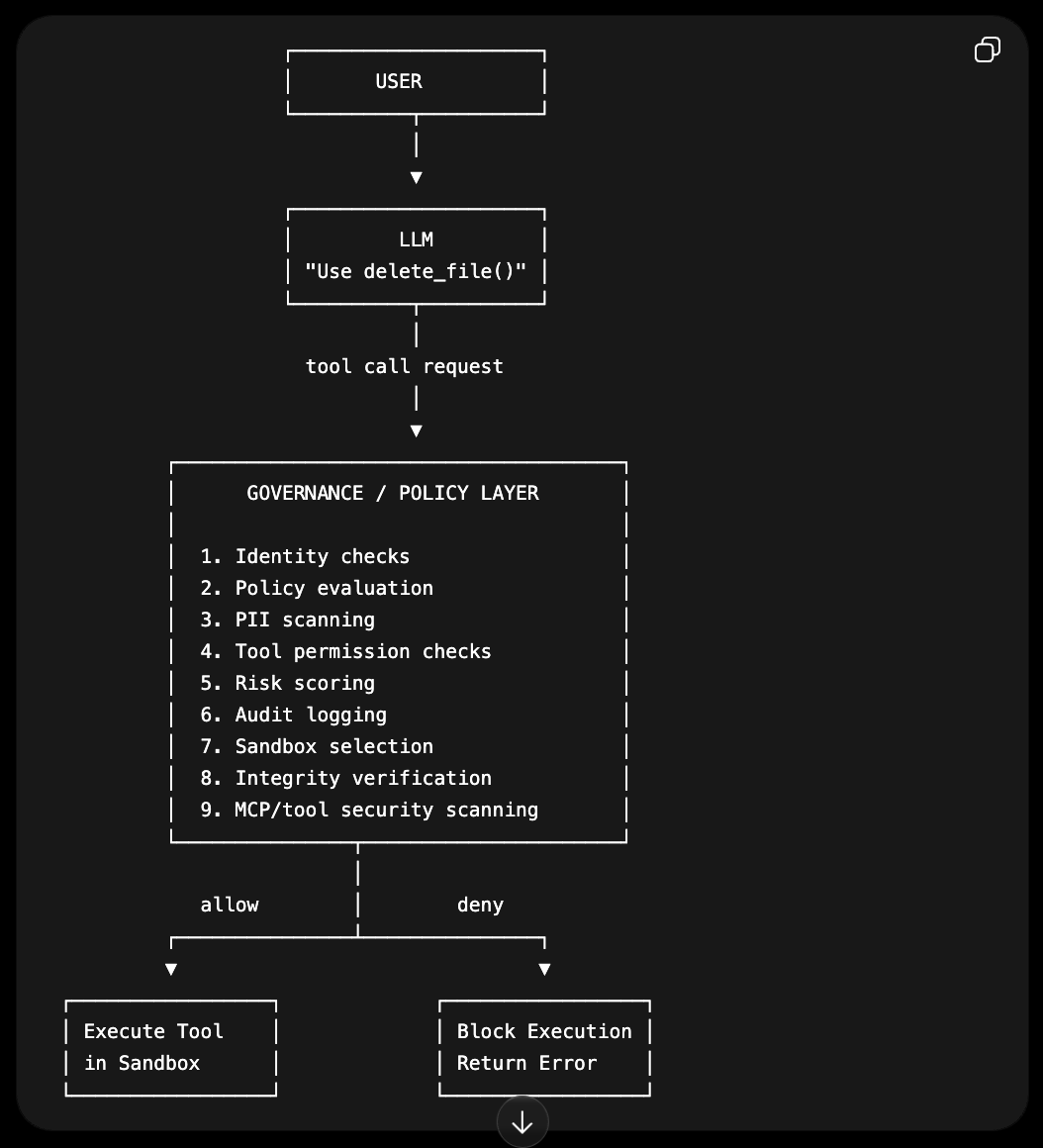
AI Agent Governance Toolkit - by Microsoft
Runtime governance for AI agents through deterministic policy enforcement, zero-trust identity, execution sandboxing, and SRE for autonomous agents. Covers all 10 OWASP Agentic risks with 13,000+ tests.
https://t.co/sONejSjsrX
En 3 horas comienza la clase gratuita de AWS en directo que va a dar BettaTech:
→ Cómo desplegar Lambda con buenas prácticas
→ Exponer APIs REST con API Gateway
→ Procesar trabajos asíncronos con SQS
→ Fan-out a varios consumidores con SNS
→ Event-driven con EventBridge
Al final montará una app serverless completa con los 5 servicios conectados.
18:30h España
Bonus: Guía resumen serverless al apuntarse
Link en el comentario ↓