Acre, explained in 5 minutes:
1. What Acre is: the one-paragraph version.
2. How it works: the loop: fees in, stake LP, earn SOL.
3. FAQ; liquidity vs. rewards, custody, fees, impermanent loss, 0% APR, eligibility, claim vs. compound.
4. Security: what you trust, what you don't, audit status.
5. Single-sided LP: entering with one asset (roadmap).
6. Additional pools: creators growing liquidity beyond the launch pool (roadmap).
7. How tokens benefit: the core thesis: idle fees become a liquidity engine.
8. Roadmap: live now and what's next.
@acreliquidity Just got my first reward from the test funds for those saying its a larp dev has been updating website alot scicne yestaday seems like its ready to cook now
Your LP is your position and it always stays yours. Your rewards are SOL paid on top, funded by creator fees.
Claiming never touches your LP, and unstaking never costs earned rewards.
Rewards are split proportionally: your share tracks how much LP you've staked and for how long.
It's handled on-chain with per-share accounting that settles each balance precisely, so someone staking late can't dilute what you've already earned.
Emissions print new tokens to pay you, and that supply weighs on the price over time.
Real yield pays from trading fees, so the rewards don't come out of the token itself.
Same APR on paper, very different over time.
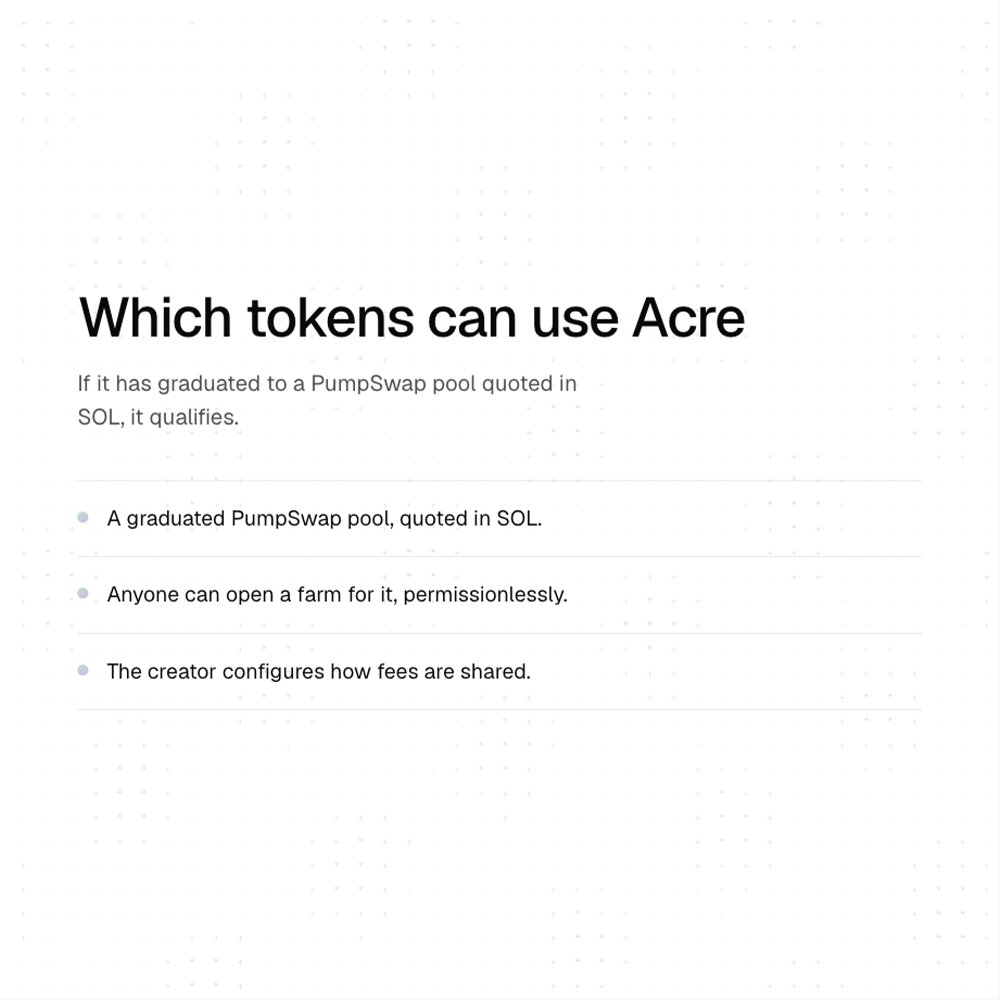
Any token that has graduated to a PumpSwap pool quoted in SOL can use Acre.
Once that pool exists, anyone can open a farm for it permissionlessly, and the creator decides how fees are shared.
Your rewards trace back to real activity:
A trade happens, a creator fee is charged, Acre routes a share to LP stakers, and you earn it in SOL.
No new tokens minted. Just fees from people trading.
When you provide liquidity, you get an LP token.
It represents your share of the pool's two reserves, SOL and the token.
Stake that on Acre and your share starts earning creator fees in SOL.
Where Acre is headed:
The core staking loop is live now. Next comes single-sided deposits, then creator-managed pools, then auto-compounding of fee-routed liquidity, then a formal third-party audit.
Each step makes Acre easier to join and liquidity stronger.
Claiming pays you now.
Compounding adds your rewards back into your staked LP, so your share of fees grows each cycle.
Same fees, a bigger slice over time.
https://t.co/hDcYdtau5B
A liquidity pool is two reserves that rebalance on every trade.
Buy and SOL flows in, tokens flow out, price ticks up. Sell and it reverses. The deeper the pool, the less each trade moves it.
The more stakers > the stronger the chart > the more holders get rewarded.
Why stake your LP on Acre?
It earns a share of the token's creator fees, paid in SOL.
Real yield from real trading, self-custodial the whole way, and you can claim or compound anytime.
The Acre flywheel:
Creator fees → LP staked → stakers earn → repeat.
every trade feeds the loop, and the loop pays the people who provide the liquidity.
https://t.co/hDcYdt9Wg3
How it works:
→ Creators configure and fund LP farms through the Acre dashboard. Farms can be funded through creator rewards or manually.
→ Traders add liquidity and stake it.
→ Stakers earn rewards in SOL.
Read more: https://t.co/y4fvSUrqFS