🚨 It's official. Toyota Industries ($6201.T) is going private — and activist fund Elliott just scored.
Yesterday (May 12), the Tokyo Stock Exchange confirmed the delisting. Last trading day: May 31.
The $38bn take-private (one of Japan's largest ever) is locked in.⬇️
Scoop this AM: A significant shareholder in Xerox is pushing the company to take action to unlock shareholder value and is asking for a strategic review of its financial services business https://t.co/V7LKmWkChc
Bill Ackman offered Elon Musk to launch SpaceX IPO without banks - through his company, guaranteeing an investment of his own $4B
- he silently rejected the offer, now he officially filed for a traditional IPO
SpaceX urgently needs $75 billion, and Elon is rushing to take the company public
knowing this, Ackman stepped in with a proposal - Musk wouldn't have to pay massive Wall Street fees to launch the IPO
he offered to bypass the entire traditional market entry system through his own company "SPARC "
- by distributing SpaceX share purchase rights to Tesla shareholders
bookmark & watch it today
Bill Ackman just exposed a silent killer of value creation in public markets:
“The problem of being a public company today is the very short-term nature of markets, analysts, etc. A good business is a forever thing. You want to make decisions in the context of decades — and how can you do that when someone's asking about the tax rate in the second quarter?”
___
This is one of the most important things any investor or operator can internalize — because the disease he’s describing has infected nearly everyone.
We live in an era where everyone—corporate managers and individual investors—has been trained to chase the next quarterly dopamine hit.
Markets reward the immediate and punish the patient. Analysts grill executives on next quarter’s tax rate while the company is trying to reinvent its entire industry over the next decade. Boards panic at any sign of short-term pain.
And for some individual investors? Even worse.
You see the exact same mindset on X, Reddit, and every investing forum:
“So-and-so stock hasn’t done anything for 2 years! Why would I own it?”
That sentence is the sound of someone voluntarily building their investing foundation on sand.
Because here’s the brutal truth Ackman is pointing at:
Real, durable wealth is created by thinking and acting in decades, not days.
It requires deliberately suppressing the most primal human impulses—fear of missing out (FOMO), impatience, the desperate need for immediate validation. Most people simply refuse to do it. They’d rather feel smart for two straight years of “I told you so” than actually compound capital over ten.
Stock price in the short run reflects sentiment, positioning, and the mood of the marginal trader, none of which tell you anything about what the business is actually worth.
The fundamentals ARE the foundation.
The price eventually follows the fundamentals, but it can lag by years — and the investors who get shaken out during that lag are the ones who hand their returns to the patient.
@BillAckman point isn’t just about having a big shareholder on the board (though that can help enormously). It’s a deeper lesson for all of us:
Managers: Stop managing to the short-term consensus estimate. Manage to the 5 and 10-year outcome. Use your big owners as a sounding board.
Investors: Stop using the short-term stock price action as your primary research tool. If the business is getting stronger and the price isn’t reflecting it yet, that’s not a problem—that’s an opportunity.
Everyone: Train yourself to feel discomfort when you catch yourself thinking in quarters instead of decades. That discomfort is your edge.
The market will always try to drag you back into short-term noise. Be disciplined.
I love this clip because Bill Ackman didn’t just describe a governance hack. He diagnosed a cultural disease (STT or “short-term-thinking”) that is quietly destroying trillions in potential value—both inside companies and inside portfolios.
The cure is simple, but almost no one has the stomach for it:
Think long-term. Act long-term. Ignore the noise.
As Benjamin Graham said: “In the short run, the market is a voting machine, but in the long run, it is a weighing machine.”
___
🎙️ All-In Podcast | Bill Ackman (06/03/26)
My conversation with @DanielSLoeb1, his first ever podcast and one I've been wanting to do for years.
Dan started Third Point in 1995 with $3 million. Today the firm manages over $24 billion across equities, credit, venture, and insurance.
Along the way he wrote some of the most iconic activist letters.
We discuss:
- Why deep value stopped working
- The power of writing
- The Twitter and XAI credit trades
- Lessons from FTX and Danaher
- The Sony and Sotheby's stories
- What makes a great analyst today
- The importance of kindness
I feel lucky we all get to learn from one of the greats.
Enjoy!
Timestamps:
0:00 Intro
2:48 Macro Views and Tech Trends
5:13 The Roots of Third Point
10:30 Evolving to Quality and Thematic Investing
19:07 Market Psychology and Inefficiencies
24:10 Good and Bad Corporate Governance
29:19 Activism
31:23 Sotheby's
41:37 AI
44:28 Sony
52:50 Danaher's Operating System
56:31 Building an Insurance Business
59:25 FTX
1:05:17 What Makes a Great Analyst Today
1:07:24 The Next Decade
1:10:00 Kindest Thing
Craig Coben on SpaceX' prospectus:
❝ To paraphrase George Orwell’s Animal Farm, all joint-bookrunning managers are equal but some are more equal than others. ❞ https://t.co/hRg48d5HYN
Bolloré bought a decaying African logistics network.
He realized a port concession in a one-port country is a toll booth on an entire economy.
He ends up with operations across 47 African countries and 21,000 employees running terminals that handle the commercial lifeblood of entire nations.
By 2022, MSC paid $6.1B for Bolloré Africa Logistics alone.
@EmmanuelInvest EBITDA at €251m beat the highest estimate (€247m) and is ~5% above the mid (€239m). But -13% organic YoY, and against a consensus that re-anchored to the FY guidance they had just cut by 17% three months earlier.
According to Solvac's own AGM deck, Syensqo ($SYENS) was comfortably outperforming peers until the February drop. Makes you wonder what exactly is being reset.
Syensqo ($SYENS.BR) outperformed peers right up to the February guidance reset. Then it didn't.
Hard to argue it's fundamentals; the chart says otherwise until Feb. Looks more like a self-inflicted wound: new CEO sandbagging guidance, plus unexplained governance and exec turnover
@LeStocksPicker Après Soitec $SOI.PA grimpe surtout sur les upgrades récentes - Morgan Stanley à 200€ hier (de 70€, passage à surpondérer), et Nomura à 250€ plus tôt en mai + quelques shorts pris à contre-pied
@LeaBourseFR D'ailleurs le classement LCH (@FT) place TCI 5e mondial en gains nets (68,4 Mds$ depuis sa création). Remarquable pour un fonds concentré face aux multistrats du top (Citadel, Millennium). Et un des plus jeunes du classement - Pershing Square (fondé la mm année) est tout en bas!
@IQInvestFR C'est vrai qu'il est connu comme activiste à cause de certaines de ses campagnes qui sont restées dans les annales (LSE, Safran/Zodiac) mais dans le fond c'est plus un value investor à la Buffett
@IQInvestFR Ça fait un moment qu’il n’a pas été activiste, il ne l'est que sur certaines positions en portefeuille, et encore occasionnellement (la dernière fois c'était sur Airbus/Atos en 2023 il me semble). En revanche ses résultats sont impressionnants !
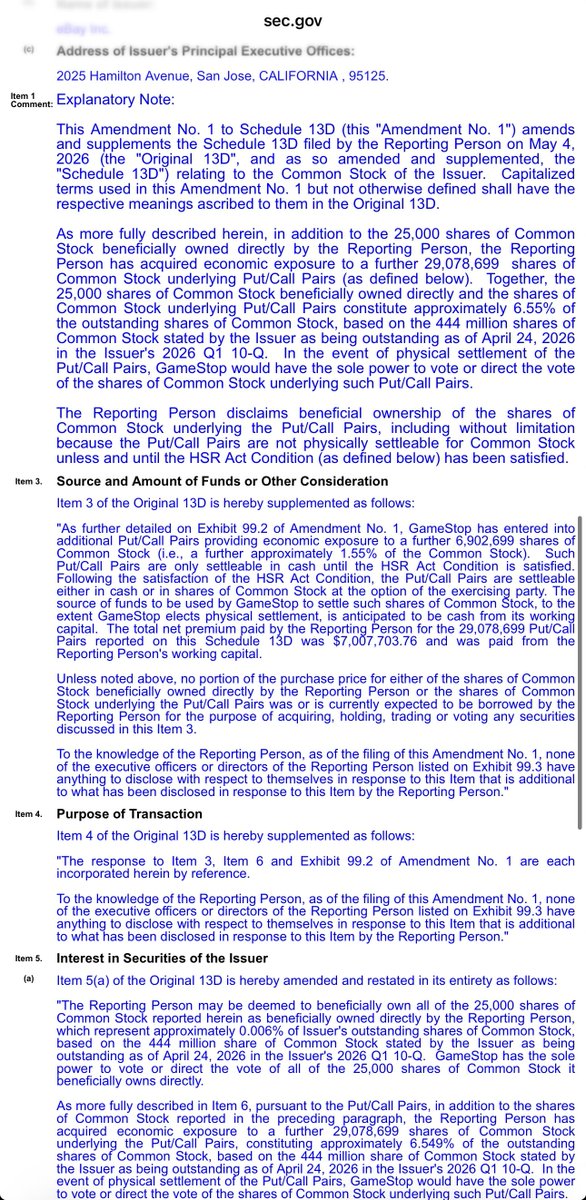
What are the options for next steps for the $GME + $EBAY takeover bid?
While a lot of folks have mentioned Proposal 4 on their upcoming annual meeting agenda, which is a shareholder proposal to lower eBay’s special meeting threshold from 20% to 10% proposed by John Chevveden, what they haven’t mentioned is that this proposal has already received ~47% support three prior times, making it genuinely passable. eBay immediately hired proxy defense firm Innisfree after rejecting Ryan’s initial bid, which signals to me they fear this vote most.
If Proposal 4 passes and GameStop builds its stake to 10% (currently ~5%), Ryan can call his own special meeting at any time, put his acquisition proposal to a vote, and nominate directors: all outside eBay’s normal advance notice deadlines.
Ryan Cohen can also communicate directly and publicly with eBay shareholders without running a full proxy contest, and this is called an “exempt solicitation.” He is already doing this via social media, letters, press releases, and his SEC Form 425 filings. He can urge shareholders to vote against management on all items, support Proposal 4/5, and build pressure heading into June 17 without needing to be on the ballot himself. The GameStop retail investor community essentially functions as a free, distributed proxy solicitor for this purpose.
Alternatively, he could launch a formal tender offer directly to shareholders, bypassing the board entirely, though that requires closing a significant financing gap beyond his current $20B TD Securities commitment + the $9B cash on hand, which I firmly believe he can raise quite easily from Middle Eastern sovereign wealth funds (QIA, PIF and EIA) or other private investors at a post acquisition combined entity valuation of ~$66-111B.
There are a few other options but these are the most likely, in this order.
As two of the largest forces in equity markets -- growing index ownership and increasing amounts of capital controlled by extremely short-term-oriented, leveraged, volatility-intolerant investors -- converge, we have found occasional opportunities to acquire some of the most dominant long-term compounding franchises at attractive valuations.
For example, we acquired Alphabet $GOOG when the stock declined substantially on the release of ChatGPT in late 2022, Amazon $AMZN in the weeks following Liberation Day, and $META more recently on the market's response to the company's unexpectedly large cap ex guidance and expenditures.
In our 13F which we will file later today, we will disclose a new position in Microsoft, a company we have followed for many years now offered at a highly compelling valuation. While $PSUS will not be filing a 13F tomorrow, it has also recently made $MFST a core holding.
Microsoft operates two of the most valuable franchises in enterprise technology, which account for approximately 70% of the company's overall profits: M365 and Azure.
M365, the company's productivity suite, is the dominant operating platform for knowledge work, with over 450 million workers using Word, Excel, PowerPoint, Outlook, and Teams on a daily basis.
Azure is the world's second-largest hyperscaler cloud platform and, like AWS in our Amazon investment, is a direct beneficiary of the multi-decade migration of enterprise IT workloads to the cloud, which is now further accelerated by surging demand for AI inference workloads.
Both M365 and Azure are underpinned by Microsoft's unparalleled enterprise distribution and the security, compliance, and identity infrastructure it has built and refined over decades.
Beyond these core franchises, Microsoft also owns a portfolio of other leading businesses, including LinkedIn (the world's largest professional network with 1.3 billion members), its gaming platform (Xbox and Activision Blizzard), and search and news advertising (Bing and the Edge browser).
We began building our position in MSFT in February following a meaningful share price decline after the company reported its fiscal Q2 2026 results. We were able to establish our position at a valuation of 21 times forward earnings, broadly in line with the market multiple and well below Microsoft's trading average over the last few years.
Notably, MSFT's headline multiple does not reflect the value of Microsoft's approximately 27% economic interest in OpenAI, which would represent approximately $200 billion, or 7% of Microsoft's market capitalization, at OpenAI's most recent funding round valuation.
We believe Microsoft's recent share price decline has been principally driven by investor concerns around two key issues: i) the competitive positioning of M365 against increasingly capable AI lab offerings (notably Anthropic's Claude Cowork), and ii) the durability of Azure's growth, especially in light of Microsoft's evolving relationship with OpenAI.
In our view, investors underestimate the resilience of the M365 franchise given its deeply embedded role across enterprises and highly attractive price-value proposition. Unlike point software solutions, which may be vulnerable to disintermediation by better-performing AI alternatives, M365 is tightly integrated into the daily workflow of nearly every large enterprise and is supported by Microsoft's identity, security, compliance, and data governance infrastructure, which would be nearly impossible to replicate.
Attractive bundle economics further reinforce Microsoft's advantage, with monthly average revenue per user on the M365 suite at approximately $20, less than half of what customers would pay to purchase the underlying applications individually from different vendors.
Moreover, we are encouraged to see Microsoft prioritizing its R&D efforts and investment in Copilot, its own AI agent embedded across M365, with direct involvement from CEO Satya Nadella. We believe these efforts will translate into improved product velocity and greater customer adoption over time.
Alongside Copilot's rollout, the company has also begun shifting its pricing model from pure per-seat licensing to a hybrid model of seats plus metered consumption, which helps expand the company’s revenue opportunity as AI agents drive incremental usage that a seat-only structure would not capture. These initiatives should help sustain M365’s strong underlying growth momentum, which was already evident in the business unit’s 15% revenue growth (in constant currency) last quarter.
We believe concerns regarding Azure's growth trajectory are similarly misplaced, particularly in light of the franchise's exceptional recent performance. Azure revenue grew 39% in constant currency last quarter, with company guiding to modest acceleration through the second half of the year.
We view Microsoft's recent decision to restructure its OpenAI partnership not as a concession but as part of a deliberate pivot toward a more open, multi-model architecture that better serves enterprise customers, who increasingly seek optionality across model providers.
Microsoft recently disclosed that over 10,000 enterprise customers have used more than one model on Azure Foundry, the company’s modular AI model marketplace. This model-agnostic approach also strengthens Copilot, which can auto-route queries across multiple models to deliver the optimal output for a given task.
To support Azure's rapid growth amid persistent supply constraints, Microsoft has raised its calendar year 2026 capex budget to approximately $190 billion. Consistent with what we have observed at hyperscaler peers Amazon and Google, we view this spend as growth capex that should drive future revenue generation. This is particularly true for Microsoft, given that roughly two-thirds of its capex budget is allocated to server and networking equipment that correlates directly with near-term revenue.
Like our purchases of $GOOG, $AMZN, and $META, we believe that $MSFT offers analogous and compelling long-term value at today's valuation.
The bull case Ackman sees: 450m M365 daily users, #2 hyperscaler, enterprise stickiness that takes years to dislodge and a 27% OpenAI stake potentially valued around ~$200bn. That stake alone could carry the trade.
@BillAckman has a new position in Microsoft ($MSFT). Disclosed today on X, 13F filing later. Pershing started accumulating in February, after Q2 earnings. Entry valuation: 21x forward earnings, "broadly in line with the market"
🇺🇸Markets just opened. $MSFT jumping ~3% on the news
Same pattern as before: Ackman piles into mega-caps after sharp drawdowns. $GOOG, $AMZN, $META, now $MSFT (-16% YTD)
The bear case is real: Azure deceleration, OpenAI/Google/Anthropic eating into M365, capex intensity. The moat feels a lot less durable than it did a few years ago