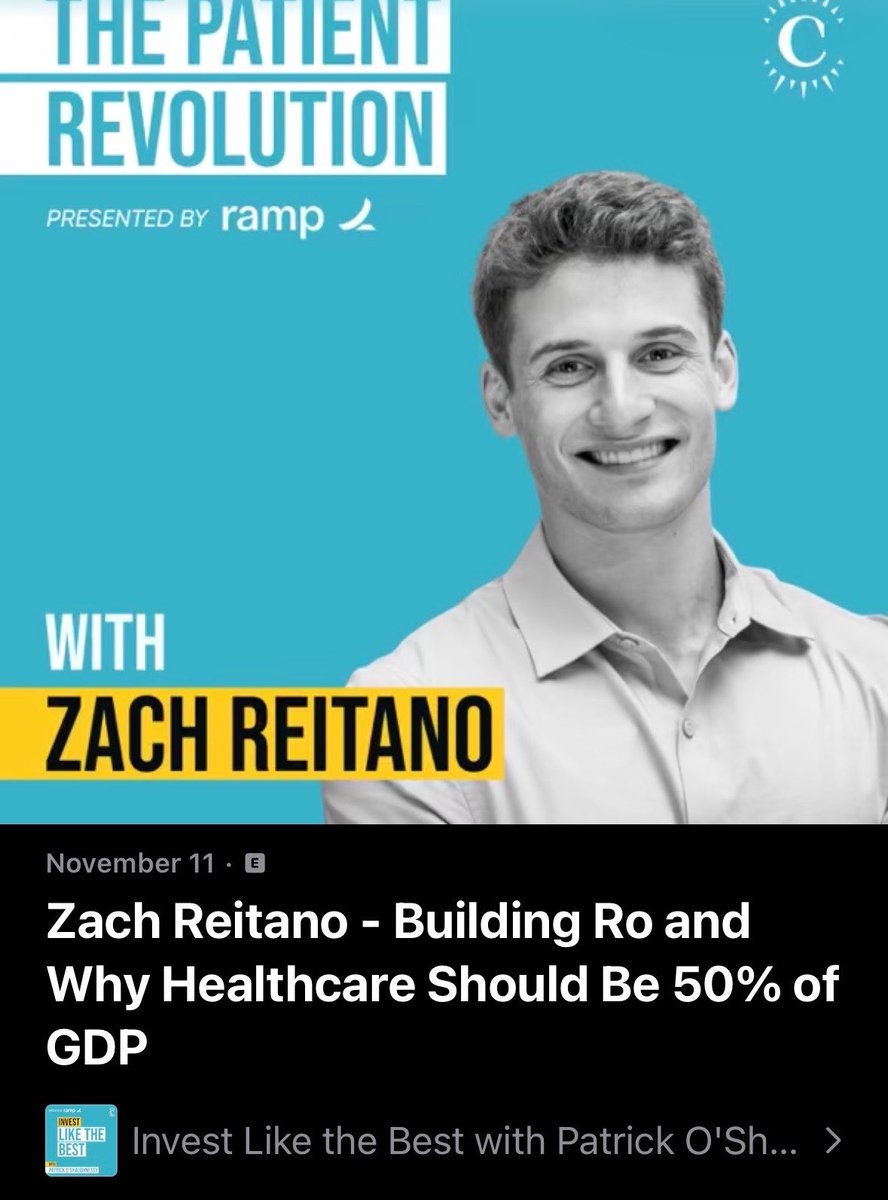
My conversation with Zach Reitano (@ZReitano), co-founder and CEO of Ro
In four years he took Ro from a $250M run rate to over $3B, with about a third fewer people
Zach rarely does long conversations like this, so it was fun to talk about the details of what that took and everything happening in healthcare
Plus, his answer to the closing question is amazing
We discuss:
- the state of the US healthcare system
- refounding Ro
- strong attract, strong repel culture
- the notion of jobs over lives
- the power of celebrities in marketing
- the importance of tailwinds (AI, GLP-1s)
- trying to recreate his dad in software
Enjoy!
TIMESTAMPS
0:34 How Much Should We Spend on Health
4:59 The Patient Is Not the Customer
10:24 Inside Ro's Business
18:28 The Future of GLP-1s
25:46 Jobs Over Lives
30:02 The Turnaround
47:43 Where Healthcare Goes Next
1:00:27 Recreating His Dad in Software
1:06:33 Marketing Into Stigma
1:19:06 Zach's Hottest Take
1:20:58 The Kindest Thing
Zach Reitano on why we shouldn't prioritize jobs over lives:
"About 40,000 people a year die from car accidents. That is almost the same exact number as the people who die from breast cancer every single year.
Driverless cars have proven to be 10, 20 times safer than a human driver. So we basically for certain types of cancer have a cure, and the conversation is not, how do we have Operation Warp Speed for this cure for cancer. It is more about job displacement.
It's not that I want to diminish job displacement. It's that we cannot prioritize jobs over lives.
We were talking about a cure for cancer and someone said, 'what about the people currently treating cancer patients without the cure? I don't even know that they would be able to.' It was the stupidest idea ever."
My conversation with Zach Reitano (@ZReitano), co-founder and CEO of Ro
In four years he took Ro from a $250M run rate to over $3B, with about a third fewer people
Zach rarely does long conversations like this, so it was fun to talk about the details of what that took and everything happening in healthcare
Plus, his answer to the closing question is amazing
We discuss:
- the state of the US healthcare system
- refounding Ro
- strong attract, strong repel culture
- the notion of jobs over lives
- the power of celebrities in marketing
- the importance of tailwinds (AI, GLP-1s)
- trying to recreate his dad in software
Enjoy!
TIMESTAMPS
0:34 How Much Should We Spend on Health
4:59 The Patient Is Not the Customer
10:24 Inside Ro's Business
18:28 The Future of GLP-1s
25:46 Jobs Over Lives
30:02 The Turnaround
47:43 Where Healthcare Goes Next
1:00:27 Recreating His Dad in Software
1:06:33 Marketing Into Stigma
1:19:06 Zach's Hottest Take
1:20:58 The Kindest Thing
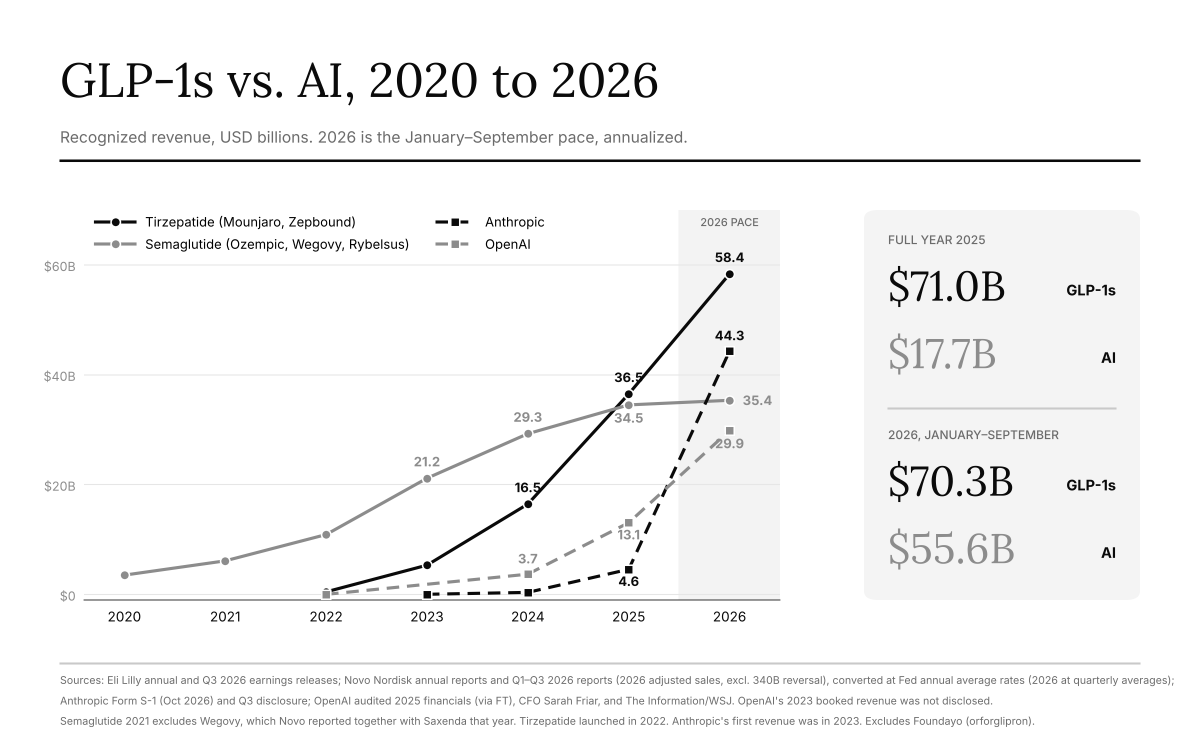
Both markets are still early relative to who could use them.
About 1 in 3 overweight adults qualify for a GLP-1 today. About 1 in 100 are taking one.
For AI, about 2% of people online pay for it.
GLP-1s still out-earn OpenAI and Anthropic combined
The two drugs behind Ozempic and Mounjaro did $71B in 2025 vs $18B for OpenAI + Anthropic
But through September this year it’s $70B vs $56B
My conversation with Zach Reitano (@ZReitano), co-founder and CEO of Ro
In four years he took Ro from a $250M run rate to over $3B, with about a third fewer people
Zach rarely does long conversations like this, so it was fun to talk about the details of what that took and everything happening in healthcare
Plus, his answer to the closing question is amazing
We discuss:
- the state of the US healthcare system
- refounding Ro
- strong attract, strong repel culture
- the notion of jobs over lives
- the power of celebrities in marketing
- the importance of tailwinds (AI, GLP-1s)
- trying to recreate his dad in software
Enjoy!
TIMESTAMPS
0:34 How Much Should We Spend on Health
4:59 The Patient Is Not the Customer
10:24 Inside Ro's Business
18:28 The Future of GLP-1s
25:46 Jobs Over Lives
30:02 The Turnaround
47:43 Where Healthcare Goes Next
1:00:27 Recreating His Dad in Software
1:06:33 Marketing Into Stigma
1:19:06 Zach's Hottest Take
1:20:58 The Kindest Thing
This kid was in my junior year intern class at Booz (a management consulting firm). He didn’t get a return offer; apparently he disagreed with his manager. This was a big deal for our intern class because almost every one got return offers, and Zach was one of the smartest and popular kids in our class.
But he went on to become an entrepreneur and build a multi billion $ healthcare biz instead.
Moral of the story - some people aren’t meant to become agreeable consultants and have bosses. Those are usually the entrepreneurs who refuse to accept the world as is, and who want to “put a ding in the universe.”
Tenacious, ambitious and incredibly principled… truly one of a kind founder. Proud of @ZReitano for telling the story that is really just beginning. Let’s go @ro!
Have listened and learned from @patrick_oshag and his guests for years. When I decided to do this conversation, I went straight to him. Hope you enjoy it.
Still just the beginning!
My conversation with Zach Reitano (@ZReitano), co-founder and CEO of Ro
In four years he took Ro from a $250M run rate to over $3B, with about a third fewer people
Zach rarely does long conversations like this, so it was fun to talk about the details of what that took and everything happening in healthcare
Plus, his answer to the closing question is amazing
We discuss:
- the state of the US healthcare system
- refounding Ro
- strong attract, strong repel culture
- the notion of jobs over lives
- the power of celebrities in marketing
- the importance of tailwinds (AI, GLP-1s)
- trying to recreate his dad in software
Enjoy!
TIMESTAMPS
0:34 How Much Should We Spend on Health
4:59 The Patient Is Not the Customer
10:24 Inside Ro's Business
18:28 The Future of GLP-1s
25:46 Jobs Over Lives
30:02 The Turnaround
47:43 Where Healthcare Goes Next
1:00:27 Recreating His Dad in Software
1:06:33 Marketing Into Stigma
1:19:06 Zach's Hottest Take
1:20:58 The Kindest Thing
The new https://t.co/A6zF5SN5hG is live!
We’re bringing @dagster, @fastmcp, and @PrefectIO together as an amazing platform for controlling what agents know, what agents can do, and what outcomes they’re achieving.
That’s everything you need for repeatable, reproducible, and reliable agent behavior.
More next week…
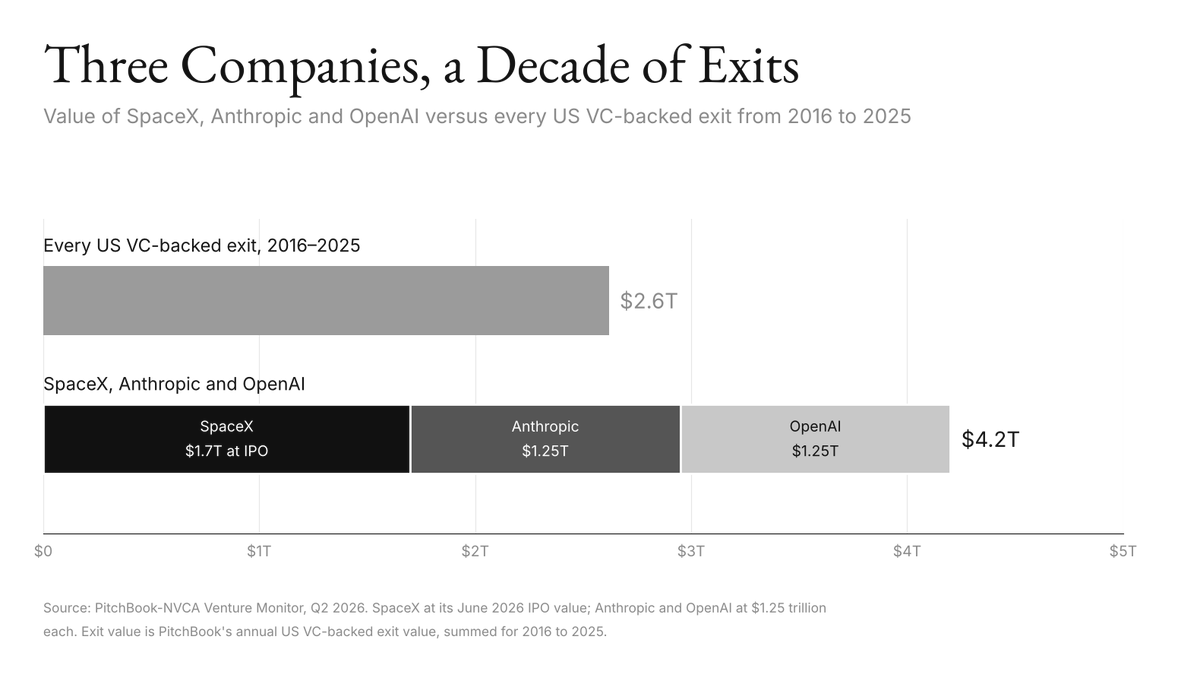
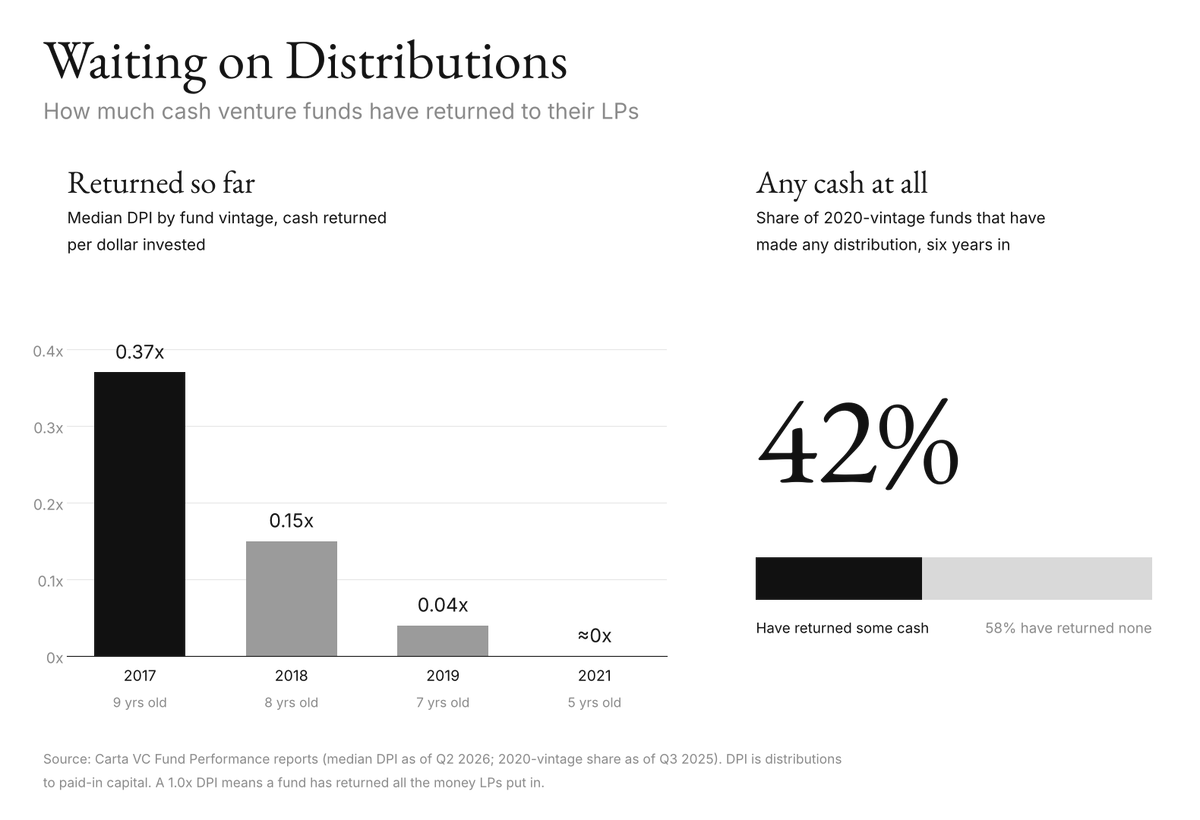
Most LPs haven't seen liquidity this cycle:
- SpaceX, Anthropic and OpenAI: $4.2T
- Every US VC-backed exit, 2016-2025: $2.6T
- SpaceX's $1.7T IPO alone is 65%
- Only 42% of 2020-vintage funds have returned any cash
"If you're an LP that wasn't in a fund that had a lot of exposure to SpaceX, you haven’t gotten any liquidity.
It's not 30-50% of LP AUM in venture capital. It's 30-50% of their AUM in three to four companies. It's SpaceX, Anthropic and OpenAI." –– @ramtinnaimi
I’ve seen examples of everything:
- lots of ops improvement
- idea generation that led to great results
- analysis better and faster
- portfolio construction / optimization that beat the actual portfolio in all ways on paper (makes sense that optimization tasks like portfolio construction work well)
The gap between investors who’ve embraced ai (especially in research + admin) and those who haven’t is staggering
One of the best I know said 90%+ of firms work is now Ai / automated
Another sole practitioner has a whole firm run by grok bots
Era of agentic investing is here
Mark, by @colossusjeremy.
This is a story about the head of history's largest nonterritorial empire, who nonetheless remains a prisoner of his rivals. Has he finally found a way out?
The profile has been nearly a year in the making. Stern interviewed three dozen people, including Zuckerberg, his MMA coach, and his critics and competitors at the frontier AI labs. He spoke with his parents, Karen and Ed, and watched their son get punched in the face.
The story spans Meta HQ in Menlo Park, the Zuckerbergs' homes in Palo Alto and Lake Tahoe, and a party in a Manhattan warehouse with Kylie Jenner and Timothée Chalamet. There is also a sneak peek of Aaron Sorkin's forthcoming sequel about Zuckerberg, sourced via a Hollywood fixer Stern first encountered in Russia.
The result is a profile unlike one you've read before.
https://t.co/uO3zL1HKDl
at thrive, we deeply believe that the best ideas can come from anyone.
our fellowship is one way we put it into practice. each year, we support a small group of college students as they pursue their own ideas alongside our team.
we have been fortunate to learn from those who have shared their time and experience with us. we do not have all the answers, but we hope that sharing what we have learned can help our fellows find their own.
https://t.co/hHqpmj8QFH
@JosephOnions I think so far it’s has mostly manifested as less hiring (or no hiring). Especially true at analyst level. Most pure analyst work is trending towards over. The creative work to ask unique questions, get unique info, form good judgement is alive and well.
@scammed_likely@bencasnocha I mean, like anything it’s a mixed bag. Point is, the amount of usage is skyrocketing after being close to nothing 9-15 months ago.
@bencasnocha No I’ve seen many of the systems I’m describing in detail.
Also, perhaps the best one is a family office with no incentive at all to be showy about it.
@JosephOnions 7 or 8 out of ten
I’m the laggard. My team has created incredible software for entire underwriting / research process and firm management stuff but it could be better.
I’m probably a 6 and need to get into better habits.