What if the biggest problem with AI in life sciences isn’t the model?
It’s the layer underneath it.
Biological systems are complex, relational, and governed by constraints. Yet much of today’s enterprise AI still works by retrieving fragments of text and asking a probabilistic model to make sense of them.
Ontology-as-a-Service (OaaS) takes a different approach: create a structured, machine-readable representation of the organization’s scientific and operational reality, then give AI a semantic foundation to reason over.
Our latest blog looks at how this can become a deterministic digital twin for life sciences, and why the ontology layer could be one of the most important pieces of enterprise AI infrastructure.
Read more: https://t.co/Asa42O0Gwk
AI answers are only as useful as the evidence behind them.
With Nextnet, every answer is connected to the underlying scientific literature, so you can inspect sources, review supporting excerpts, explore citation networks, and evaluate the researchers behind the work.
From answer → source → context → impact.
Go beyond answers. Explore the full research context behind them.
Try Nextnet for free: https://t.co/XHQrKTMm4h
AI alone isn’t enough to turn complex data into insight. What’s missing is structure that gives meaning and context.
Our latest post breaks down 5 ways Nextnet ontology can help organizations unlock the full value of their data:
🔸 Ground AI in real scientific meaning to reduce hallucinations
🔸 Connect siloed data into a shared semantic layer
🔸 Enable research-grade reasoning, not just text generation
🔸 Turn expert knowledge into reusable, extensible infrastructure
🔸 Build a durable AI moat your organization truly owns
👉 Read more about Nextnet ontology in our latest blog https://t.co/iJaOyngsBZ
Scientific knowledge is expanding faster than ever but the data behind it remains fragmented.
Genes, diseases, drugs, publications, datasets… all living in separate silos.
Nextnet Ontology brings these pieces together into a unified semantic framework that connects biological entities, relationships, and evidence across the life sciences landscape.
The result:
🔸 More meaningful discovery
🔸 Smarter AI reasoning
🔸 A deeper understanding of how knowledge truly connects
Read the full blog to see how ontology powers the foundation of the Nextnet platform 👉 https://t.co/iJaOynfUMr
How do you know if a scientific answer is actually trustworthy?
Nextnet Copilot is designed to make evidence visible, not hidden.
In this video, we show how Copilot transforms a single research question into a deeply connected view of scientific literature. Every answer is anchored in peer-reviewed sources, carefully selected for relevance, recency, and quality.
From there, Copilot lets you explore far beyond a static reference list.
Each paper unfolds into a dynamic citation network, revealing:
🟢 The papers it builds on
🟢 The studies citing it right now
🟢 How ideas spread, evolve, and influence the field
No more endless scrolling. No more dead-end PDFs. Copilot guides you straight to the research that’s shaping the conversation today and lets you follow the trail as far as your curiosity takes you.
Every citation is interactive. Open any paper to explore full details, metadata, and its own network of connections, all without breaking your flow.
With Nextnet Copilot, research isn’t a list of references.
It’s an experience.
🔍 Ask a question.
📚 Unlock 100x more trusted sources.
🚀 Explore the science behind the answer.
Mapping connections between research topics and publications is a time-consuming task.
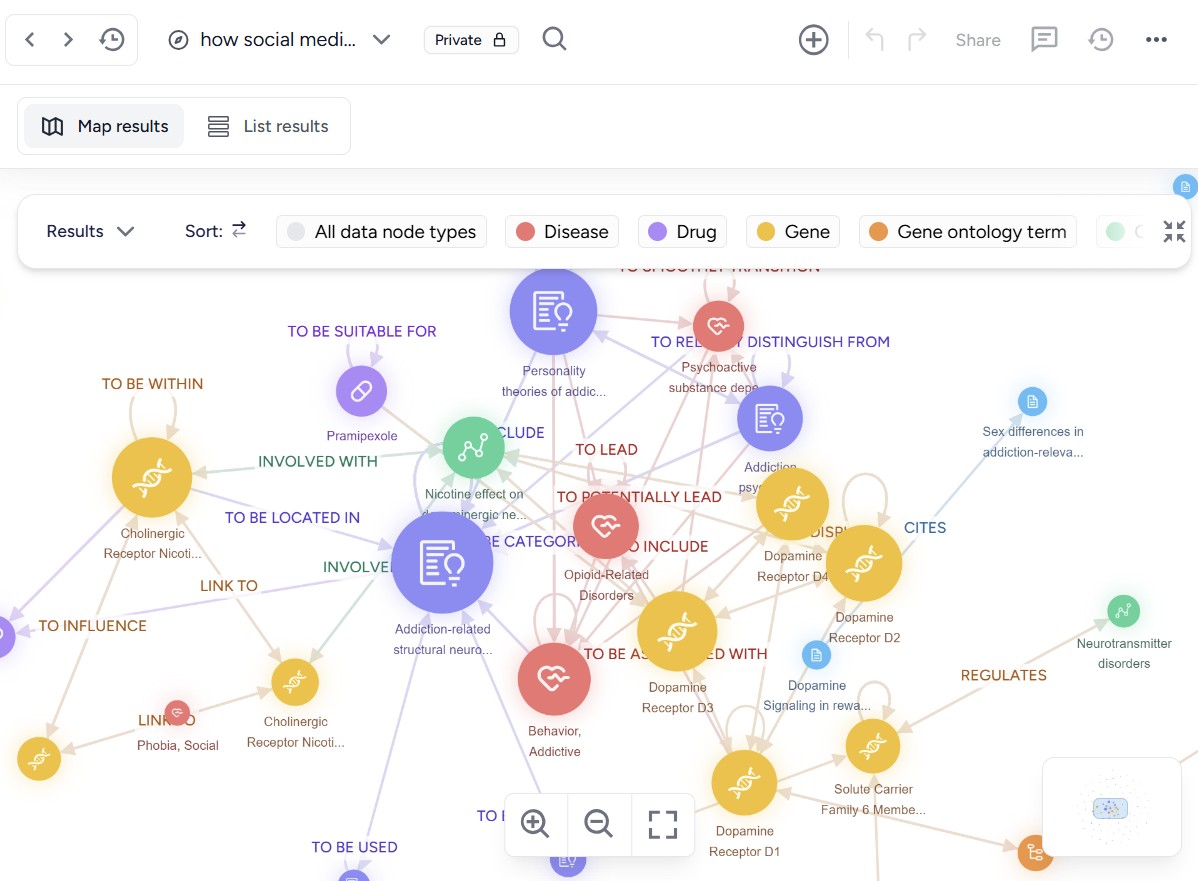
NextNet is an AI app that can help you with it. It lets you run visual searches for topics related to life sciences.
It's free and very easy to use:
AI provides a universal framework that leverages data and compute at scale to uncover higher-order patterns
Today, @arcinstitute in collaboration with @nvidia releases Evo 2—a fully open source biological foundation model trained on genomes spanning the entire tree of life 🧵
Inner view of the transmembrane domain of human VANGL1, as obtained from cryoEM experiments (PDB code: 9JK8) #scivis#sciart@dzine_ai@proteinimaging
https://t.co/ZjALCFPtWf
Imagine having your personalized biomedical knowledge assistant that can help you identify patterns hidden deep within tens of millions of scientific papers. So that you can generate insights and make decisions at the speed of thought. ⚡
“Have you been getting calls from Sweden?”
Victor Ambros’ son woke his up this morning with a surprising question. We speak to Ambros about his first reactions after being awarded the 2024 Nobel Prize in Physiology or Medicine.
Even the biggest blockbuster drugs can be dismissed as unworthy by smart and ambitious people in a #LifeSciences enterprise.
This can happen due to a variety of inadvertent reasons and human oversights. Some of which includes:
✅ There are 10,000 known rare diseases
✅ Only 5% have US FDA-approved treatments
❌ 95% of rare diseases lack approved medication, affecting
❌ 400 Million people globally.
💡 With Nextnet you can quickly find leads and fast-track drug discovery for rare diseases.
📣 Hey, fellow scientists, we have some great news! 🚀
We are now releasing an early preview of a new module, the Insights Copilot. If you would like to participate, please register your interest at 👉 https://t.co/aCUPyX7m9k.
Spots are limited, so make sure you sign up fast!
This has been a loooooong time coming.
I finally sat down to record a new tutorial. Not about rendering, but Blender is involved 😊
I hope I can finish editing by tomorrow, but I will let you know as soon as it's live 📣
Got some time to work on my personal project of folding epithelial cell layer!
This is related to my first postdoc work. Although I never got it to get as ideal as in the animation, we did obtain some epithelial folding ^_^
96% of all drugs fail in R&D and $100 Million is lost for each failed drug program. There is no other industry where product failure is so rampant due to inefficiencies and productivity challenges.
[What Instructors Say] "Smart biology is great for students to visualize the actual processes that occur in cells and biological systems. Awesome for teaching and learning!" Thank you @biggnotl for sharing. Grateful.
Learn more at https://t.co/rZjuFXgP1n
#biology#science#3D