Moving AI agents from generating insights to placing real trades changes the risk profile completely.
The interesting part is no longer just the model output - it’s how authorization, constraints, and responsibility are handled once capital is involved.
Will you be in the space tonight in two hours?
Data tells an agent what to do. Action is where accountability begins.
Tonight we're joining @AstarterDefiHub and @BOTChain_ai to talk about what happens when AI agents move from research to execution in onchain finance — who authorized the action, what rules it followed, and who answers when something goes wrong.
That's the gap PoHA is built for: human-accountable action, verified at entry, on the same ledger for humans, machines, and AI agents.
📅 Tonight, 20:00 UTC+8 (12:00 UTC) · English
🎙️ Set your reminder and bring your questions.
Once AI systems start taking real actions at scale, the ability to reconstruct exactly what happened becomes more important than the ability to generate new outputs.
Most teams still rely on system claims rather than independently checkable records.
How are you currently distinguishing between the two in your own environments? Drop down your thoughts in @Actum_AI's comment 👇
Most AI systems can tell you what they did. Almost none can prove it.
Actum's production network now covers 5,300+ endpoints, with 1,139,000+ verified behavioral events recorded — and roughly 5,800 new events added every day.
Over the past 30 days alone, 174,000+ on-chain attestations were written with zero failures, at 99.986% coverage.
Every one of those events passed the same checks: a pre-frozen codebook, six-dimension entry verification, and a human sign-off before anything counts as verified.
That is what PoHA (Proof of Human-Accountable Action) means in practice — not claims about AI behavior, but a record that can be checked, traced, and assigned to an accountable human.
Autonomy is easy to promise. Accountability has to be built.
Happy Thanksgiving! 🦃
Most teams treat logs as sufficient evidence until the moment something needs to be proven after the fact.
The gap between “we recorded it” and “anyone can independently verify it” is where most accountability disputes begin.
How are you currently handling that distinction in production systems? 🤔 Share it in @Actum_AI 's comment below!
𝗧𝗿𝗮𝗱𝗶𝘁𝗶𝗼𝗻𝗮𝗹 𝗟𝗼𝗴𝘀 𝘃𝘀. 𝗣𝗼𝗛𝗔: 𝗪𝗵𝘆 "𝗪𝗲 𝗛𝗮𝘃𝗲 𝗟𝗼𝗴𝘀" 𝗜𝘀 𝗡𝗼𝘁 𝗘𝗻𝗼𝘂𝗴𝗵
Every system keeps logs. But when something goes wrong — an AI agent moves funds, a machine executes the wrong step, a record gets disputed — the first question is always: can we trust the log itself?
Traditional logs have three structural weaknesses:
1. They can be edited after the fact. A log written by the same system it is supposed to audit proves very little.
2. They carry a single timestamp. When an event happened and when it was recorded are collapsed into one number — and the gap between them is exactly where disputes live.
3. They record actions, not accountability. A log line tells you what happened, but not who authorized it or who answers for it.
PoHA (Proof of Human-Accountable Action) was designed to close these gaps:
• Rules frozen before execution — the codebook is locked in advance, so the standard cannot be rewritten after an incident.
• Bi-temporal truth — occurrence time and ingestion time are recorded separately, so late, missing, or out-of-order entries are visible instead of hidden.
• 6D entry verification — every action is checked across time, space, personnel authorization, whitelisted actions, execution elements, and sequence before it enters the ledger.
• Signed attestations with human sign-off — every critical action ends with a specific, authorized human who is accountable for it.
The result is not a log you have to trust. It is a record anyone can independently verify.
Logs tell you what a system claims happened. PoHA proves what actually happened — and who stands behind it.
🎉 The results are in!
3 lucky winners have been selected, and rewards are now being distributed! 🎁
Thank you to everyone who participated. We appreciate your continued support and engagement with the ACTUM community.
See you again on the 25th of every month for another round of lucky draws! 👀✨
Wanna be next lucky person? Join us now: https://t.co/m8Jjg8Az32
Monthly Giveaway Time | Ends Nov 26, 7:01 AM UTC 🎉
$10 up for grabs, 3 winners. Just hop into the Actum Discord, head to the right destination and hit the button.
You'll need to earn 100+ Points this month to qualify.
https://t.co/dkOBrKk879
Tokenizing physical objects is becoming straightforward.
The harder part is making every use of those objects verifiable and attributable once they leave the controlled environment.
Tomorrow’s space with @Actum_AI looks at that gap. Will you be joining? 🎤
Tokenizing a power bank is easy. Knowing who used it, when, and under what rules — that's the hard part.
Consumer RWA lives or dies on one question: can every real-world action be verified, traced, and assigned to an accountable human? That is exactly what PoHA (Proof of Human-Accountable Action) was built for.
Join us tomorrow as we discuss what lies beyond traditional RWA — and why trust infrastructure has to come before scale.
📅 Nov 27, 1 PM UTC
Host: @ShareX_Network
Guests: @ocean6_ai@BOTChain_ai@freedaohome @plum_meme
Last round of the month for the weekly AI fail check, and only one winner this time. ✨
What’s the most expensive or chaotic agent mistake you’ve seen recently that a simple gate before execution could have prevented?
Drop your story in the comments section of @Actum_AI below 📝
🚨 Weekly AI Hallucination / Agent Fail Check — Round 4!
This is the last round of November, and this time we're picking ONE winner.
What's the wildest mistake you saw an AI agent or bot make this week? A trading bot that sold at the bottom? A support agent that hallucinated a refund policy? An automation that looped itself into chaos?
Reply with a screenshot or story + tag @Actum_AI, and tell us how a Circuit Breaker could have stopped it. The best entry wins 10 USDT! 🏆
As AI systems move from suggestion to execution, the ownership question becomes harder to ignore.
Some teams still separate “the model’s output” from “who is responsible for the result.” Others are starting to treat that separation as a risk in itself.
Where do you stand on this right now? Jump in @Actum_AI's comment below to pour your heart! ⤵️
Humans, machines, and AI agents — three kinds of actors, one ledger.
Most systems still treat AI actions as "the model's fault" and machine logs as "just data." Nobody owns the outcome.
PoHA flips that: Human, Machine, and AI Agent are modeled as peers on the same account book. Every action is attributable, every decision traceable — and accountability always lands on a human.
That's not a slogan. It's the architecture: 5,300+ endpoints, 1.139M+ verified field events, and a circuit breaker that can stop a bad action before it becomes a bad outcome.
The question isn't whether AI will act on its own. It already does. The question is: when it does, who answers for it?
Our answer: a human. Always.
What do you think — should an AI agent ever be allowed to act with no human accountable? 👇
Most AI systems still ask you to trust them on reputation or confidence scores.
Once agents start taking real actions, that standard starts to feel incomplete.
What’s the minimum proof you personally need before you’d let an AI system operate in a live environment? Share your take in @Actum_AI's comments 💭
If an AI can't show its work, it can't earn your trust. PoHA makes every action accountable — Human, Machine, and AI Agent, on the same record. Trust is not a claim. It's a receipt.
Most systems only show clean numbers in controlled environments.
Seeing the same level of consistency hold up once real machines, real operators, and real operational pressure are involved is a different test.
How do you currently judge whether an AI accountability layer is actually production-ready? Share your take in @Actum_AI's comments 👇
October, by the numbers:
📍 5,300+ endpoints live
📊 1.139M+ events recorded
⚡ ~5,800 events per day
✅ 99.986% on-chain attestation coverage — 174,000+ events, zero failures
Every action leaves a receipt. That's what PoHA is for.
Anyone can claim their AI is trustworthy. Fewer can point to filings you can actually look up.
Behind Actum’s PoHA and 4-layer stack sit 8 patent filings and 5 software copyrights - paired with a system already running in production across industrial environments.
The signal is less about the patents themselves and more about what they protect: a stack built to be audited, not just demonstrated.
Read the full post below and share your take in @Actum_AI's comments 👇
Real tech leaves a paper trail.
Anyone can claim their AI is "trustworthy." The question is what backs the claim — a pitch deck, or filings you can look up?
Behind @Actum_AI's PoHA framework and 4-layer behavioral stack stand 8 patent filings (across CN & HK) and 5 software copyrights — built from the ground up for verifiable industrial & enterprise AI.
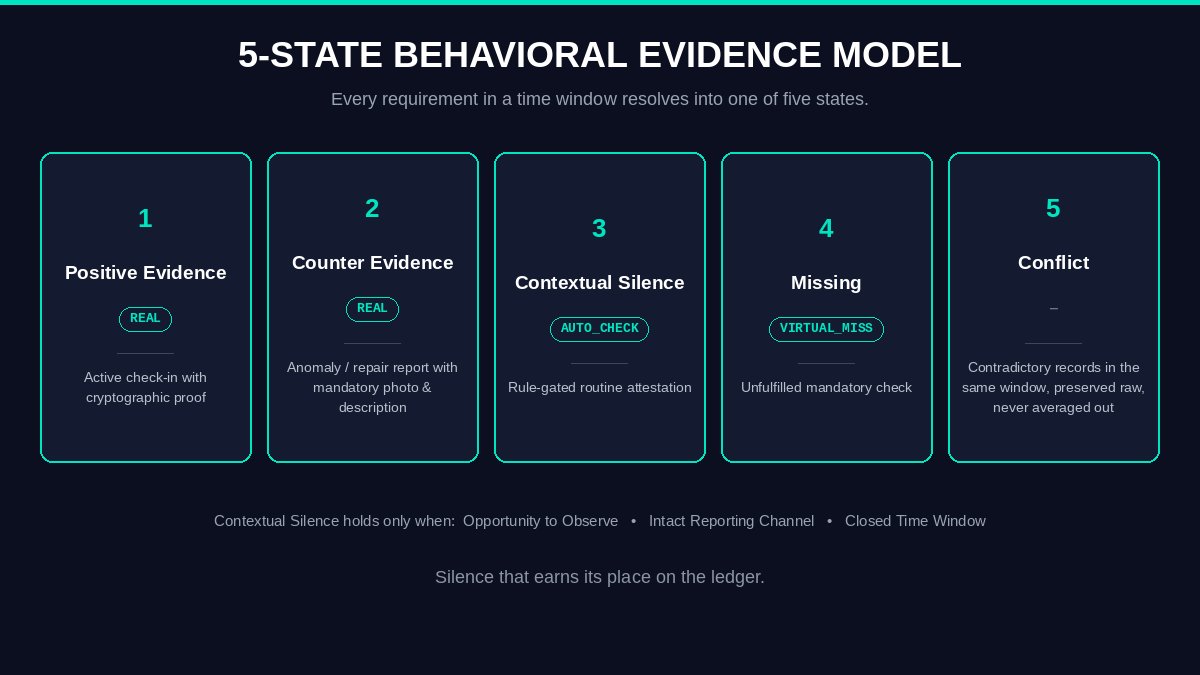
Behind that claim sits the actual machinery: the pre-frozen codebook that locks the rules before the game starts, the six-dimensional entry verification at the gate, the bi-temporal ledger that separates when an action happened from when it was recorded, and the five-state evidence model that treats silence as evidence only under strict conditions.
And it's already running in production — 5,300+ endpoints, 1.139M+ verified behavioral events, ~5,800 new events a day, 99.986% attestation coverage with zero failures in the past 30 days.
Patents don't make a product good. But 8 filings and 5 copyrights behind a system that's already verifying real industrial behavior every day is a signal worth reading: this wasn't built for a demo. It was built to be audited. 📜
Actum’s PoHA is already running in production across two very different industries - rail equipment manufacturing and commercial hospitality.
Different operational needs on the surface, same underlying problem underneath: when an action happens, who is accountable?
One shared ledger, same verification process. The real question is how far this model can travel beyond these two settings. 👇
One Ledger, Two Very Different Industries — How Does That Work?
Actum's PoHA runs in production in two completely different settings: a rail transit equipment manufacturer, with 5,000+ machines and operators doing hourly inspections; and a commercial hospitality setting, with guest data and service records flowing back and forth.
What the two settings need looks nothing alike — the factory needs every bolt's inspection tied to a person; the hotel needs every data access traceable. But underneath, the problem is the same: when an action happens, who was there, who authorized it, can you trace it afterward, can you hold someone accountable?
PoHA's answer is one shared ledger: Humans, Machines, and AI Agents, verified against the same standard, speaking through the same evidence. A pre-frozen codebook before the action, six-dimensional verification at the gate, signed attestation after — a factory inspection check-in and a hotel data access go through the same process.
The numbers: the ledger now produces ~5,800 verified events a day across 5,300+ endpoints, with 174,000+ on-chain attestations in the past 30 days, 0 failures, 99.986% coverage.
Different industries, same ledger. That's why PoHA can move from one setting to another: it doesn't solve one industry's business problem. It solves the problem every industry shares — who is accountable for what AI does.
In a factory with 5,000+ machines, you can’t photograph every normal bolt every hour.
Actum’s 5-State Behavioral Evidence Model including Contextual Silence, lets you capture full operational accountability without drowning people in paperwork.
Curious how others here think about handling “nothing abnormal happened” as valid evidence. Drop your view below 🔗
In a factory with 5,000+ machines, operators can't photograph every normal bolt every single https://t.co/sMkpTc8gvz how do you capture 100% operational accountability — without drowning humans in paperwork?Enter Actum's 5-State Behavioral Evidence Model — and the power of Contextual Silence. 🧵👇
Weekly AI Fail Check #3 is live. Actum is giving 10 USDT to the best 3 replies this week!
What AI agent fail did you see that looked small but could have been expensive in production?
Drop your story or screenshot below and explain whether an entry Circuit Breaker could have stopped it. 🛠️
🚨 Weekly AI Fail Check #3 is here!
What wild mistakes did you see an AI agent make this week? Auto-ordering the wrong thing, deleting the wrong file, sending test data to a real customer, or confidently talking nonsense in a group chat?
A fail itself isn't scary. What's scary is when nobody knows, nobody is accountable, and there's no way to trace it back. Most agent failures don't happen because the agent is "not smart enough" — they happen because there's no gate before it acts: no pre-frozen rules, no entry verification, no signed behavioral record. It fails, and you can't even investigate it properly.
So the same question as always this week: drop your AI fail screenshot or story in the replies, tag @Actum_AI, and tell us whether an entry "Circuit Breaker" could have stopped it.
The 3 best answers win 10 USDT each. 🏆
That's exactly what Actum's PoHA is for: a pre-frozen codebook before the action, six-dimensional verification at the gate, and signed attestation after — so every agent action has someone accountable for it.
Traditional logs tell you what the system says happened.
A PoHA ledger proves what happened, when it happened, and who is accountable for it.
That’s the gap Actum is closing. Curious how others here think about the difference between logs and verifiable records 🤔
Traditional Logs vs. Actum PoHA Ledger — why the difference matters more than it looks.
Traditional logs record what happened. That sounds enough, until something goes wrong. Then the questions start: who edited this entry? When did it actually happen — when the event occurred, or when it reached the log? And the investigation usually ends the same way: "system error." No one accountable, nothing to prove otherwise.
❌ Editable by admins — whoever holds the keys can rewrite history.
❌ Single timestamp — occurrence and ingestion collapse into one number, so you can never prove when something really happened.
❌ Blames "system error" — the log describes the machine, not the human behind it.
Actum's PoHA ledger is built the other way around:
✅ Signed at generation — every event is signed the moment it's created. Tamper-evident: any change after the fact is detectable.
✅ Bi-temporal truth — Occurrence Time and Ingestion Time are recorded separately, so the timeline is provable, not asserted.
✅ Anchors every AI and machine action to an accountable human — Humans, Machines, and AI Agents all write to the same ledger, under the same standard, and every entry traces back to a specific authorized person.
A log tells you what the system says happened. A PoHA ledger proves what happened, when, and who is responsible for it.
That's the difference between "we looked into it" and "here is the evidence."
Enterprise AI Agents are everywhere in demos, but far fewer make it into production.
The technical issues are real, but the bigger blocker for many teams is liability and auditability: when an agent acts, who is accountable?
Actum is built around that exact gap. What’s the biggest barrier you’re seeing right now? Comment your thoughts👇
Enterprise AI Agents are everywhere in demos — but far fewer are running in production. Why?
The usual answers sound technical: hallucinations, accuracy, integration cost. Those are real. But talk to the people actually signing off on deployments, and a different barrier comes up: when an Agent acts, who is liable? Can you audit what it did, prove what happened, and trace it back to a specific authorized person?
That's the gap Actum was built for. PoHA — Proof of Human-Accountable Action — puts three gates around every Agent behavior: a pre-frozen codebook that only allows whitelisted actions; six-dimensional entry verification — Time, Space, Personnel Authorization, Whitelisted Action, Required Elements, Sequence & Thresholds — that blocks anything failing even one check; and signed, dual-timestamped, on-chain attestation of every event, tamper-evident and accountable to a specific human.
It's already running in production: 5,300+ endpoints, 1.139M+ verified behavioral events, ~5,800 new events a day, 99.986% attestation coverage with zero failures in the last 30 days — across rail transit equipment manufacturing and commercial hospitality.
Accuracy will keep improving. Integration will keep getting cheaper. But liability and auditability aren't problems you wait out — they're problems you build for.
👇 Poll: What is the biggest barrier to enterprise AI Agent adoption right now?
By 2027, company workforces will include field engineers, robots, sensors, and AI copilots.
Today, only the human can be held accountable when something goes wrong.
Actum puts all three on the same ledger under the same rules. Curious how others here think about shared accountability across humans and AI. Drop your view below 📚
👤🤖🧠 In 2027, your company's workforce won't just be humans. It will be:
👤 Field Engineers
🤖 Industrial Robots & IoT Sensors
🧠 AI Copilots
Three kinds of workers. Three kinds of actions. But when something goes wrong, only one of them can be held accountable today — the human.
That is the gap Actum closes. Actum is the first behavioral ledger that models all three on the exact same accountability sheet.
The field engineer signs off on an inspection. The sensor records a reading. The AI copilot approves a step. Three different actors, three different kinds of evidence — but one ledger, one set of pre-frozen rules, one standard: every action recorded, every step attributable.
No separate books for humans and machines. No "the AI did it" as an excuse. When Human, Machine, and AI share the same ledger, accountability stops being a human-only burden — and starts being a property of the system itself.
When two trusted sources disagree in the same time window, most systems pick one or average them out.
Actum keeps both records and flags the conflict, because the discrepancy itself can be evidence.
How others here handle conflicting operational data? Drop your thoughts below ✍️
🔍 What happens when Sensor A says "Normal" and Inspector B reports "Broken" — in the same 15-minute window?
Most systems pick one. They overwrite the older record, or average the two into something that never actually happened. The discrepancy disappears. So does the truth.
Actum does the opposite. It flags a 𝐂𝐨𝐧𝐟𝐥𝐢𝐜𝐭 𝐒𝐭𝐚𝐭𝐞 and preserves both raw proofs on-chain — exactly as they were recorded, side by side.
Why? Because a disagreement between two trusted sources is itself evidence. It might mean a sensor is failing. It might mean the inspection caught something the sensor missed. It might mean someone is lying. You cannot know which — until you keep both records and let the facts speak.
Averaging two conflicting proofs does not give you the truth. It gives you a number nobody observed.
In Actum's ledger, facts are signed at generation and never overwritten. When evidence conflicts, the conflict itself is preserved — because truth lives in the discrepancy. ���
The agentic economy will be decided by one thing: whether enterprises can actually prove what their AI agents did.
Not confidence scores. Not demos. Real, attributable execution with a human accountable at the end.
That’s the bet Actum is making. What’s your view on this? 👀
�� As the agentic economy scales, one question will decide which AI systems enterprises actually trust:
Can you prove what your agents did?
Not "did the model sound confident." Not "did the demo look good." Prove it — step by step, action by action, with a human accountable at the end of the chain.
Models will become commoditized. Verifiable execution and human accountability will capture the value. That is the bet Actum is built on: every action recorded before execution, every step attributable to a human, machine, or AI agent — on one ledger, under one set of pre-frozen rules.
The AI that wins in production will not be the smartest one. It will be the one whose behavior you can verify. 🛡️