1/6
¿Vender $ASTS ahora? Para mí, es el error definitivo. Estamos ante el despliegue de una infraestructura crítica global. No estamos comprando una acción más, estamos comprando la columna vertebral de la conectividad del futuro.
Our May 2026 tear sheet is now available.
In May the fund returned +8.82% net of fees, bringing the YTD net return to +14.1% & since inception CAGR to +17.9%.
Accredited investors can sign up for updates here https://t.co/PfC7Cox8Cs
$ASTS - 🚨New episode featuring Crossroads Capital is live on the AST SpaceMobile Podcast!
🎙️ Crossroads Capital - AST SpaceMobile and the Final Bridge to Universal Human Connectivity
Welcome to a special edition of the AST SpaceMobile Podcast. In this episode, we are presenting an AI-narrated audio version of the deep-dive research report, "AST SpaceMobile: The final bridge to universal human connectivity."
Authored by Ryan O'Connor and Adam Brass of Crossroads Capital, this comprehensive piece breaks down the massive market opportunity, the technological milestones, and the underlying economics that position ASTS to revolutionize global telecommunications.
We know reading a full investment thesis isn't always practical on the go, so this AI-read edition brings Crossroads Capital's thorough analysis straight to your feed for hands-free listening.
----------
Ryan O'Connor and Adam Brass of Crossroads Capital present a deep dive into A.S.T SpaceMobile, framing it as the final bridge to universal human connectivity. The discussion explores how the company aims to eliminate coverage gaps for five billion smartphone users and bring broadband to the three billion people currently living without basic internet services. This mission is driven by a unique technological paradigm shift that moves the world toward a standard of ubiquitous cellular access.
The episode details the technical breakthrough enabled by SpaceMobile's massive phased array antennas. Unlike traditional satellite phones that require specialized hardware, these basketball-court-sized arrays allow unmodified, off-the-shelf smartphones to connect directly to 5G broadband from low Earth orbit. Ryan O'Connor explains why this technical achievement de-risks the investment and sets the stage for a new category of telecommunications infrastructure that works indoors, in cars, and across oceans.
A major segment focuses on the strategic 'Triple Convergence' of collapsing launch costs, space sector innovation, and the evolution of terrestrial wireless. Crossroads Capital analyzes why SpaceMobile possesses a superior business model compared to Starlink. While Starlink pursues a capital-intensive direct-to-consumer approach, SpaceMobile utilizes a wholesale model that leverages the licensed spectrum and marketing power of giants like AT&T, Verizon, and Vodafone, creating a symbiotic ecosystem that enhances rather than disrupts the industry.
The conversation shifts to the company's emerging role as a United States national security asset. By securing prime contractor status, SpaceMobile is positioned to benefit from the Golden Dome defense program. The analysis covers how these satellites provide resilient, jam-proof communications and electromagnetic monitoring, making the constellation a critical pillar for modern warfare and national sovereignty. Ryan O'Connor highlights the support from influential policymakers like Senator Ted Cruz and FCC Chairman Brendan Carr.
Finally, the episode examines the unique culture of the SpaceMob, a technically sophisticated community of investors and engineers who provide a distributed brain trust for due diligence. Ryan O'Connor concludes with a valuation analysis, arguing that SpaceMobile's current market cap reflects only a fraction of its potential as the largest subscription business in history. The episode outlines why this represents a rare generational investment opportunity with massive asymmetric upside, regardless of short-term market cycles.
https://t.co/an4F9fIBBd
Per previous posts on the game theory involved between $T $VZ and $TMUS & decision that lead to a US monopoly for $ASTS. Doesn't mention the act of seppuku $TMUS could have chosen to select. Will be interesting to see if $SPCX can make D2D math work while being cut off from US.
$ASTS
🧵 Let’s discuss the Prisoner’s Dilemma.
Three companies walk into a room. None of them can leave.
Picture three prisoners. Separate rooms. Same deal on the table.
Each one is told: “If you cooperate and the others don’t — you win and you go free. If you all cooperate — you all win a little, and serve a light sentence. But if you’re the only one who doesn’t cooperate… you lose everything.”
This is the Prisoner’s Dilemma. And it’s exactly what’s happening to MNOs right now.
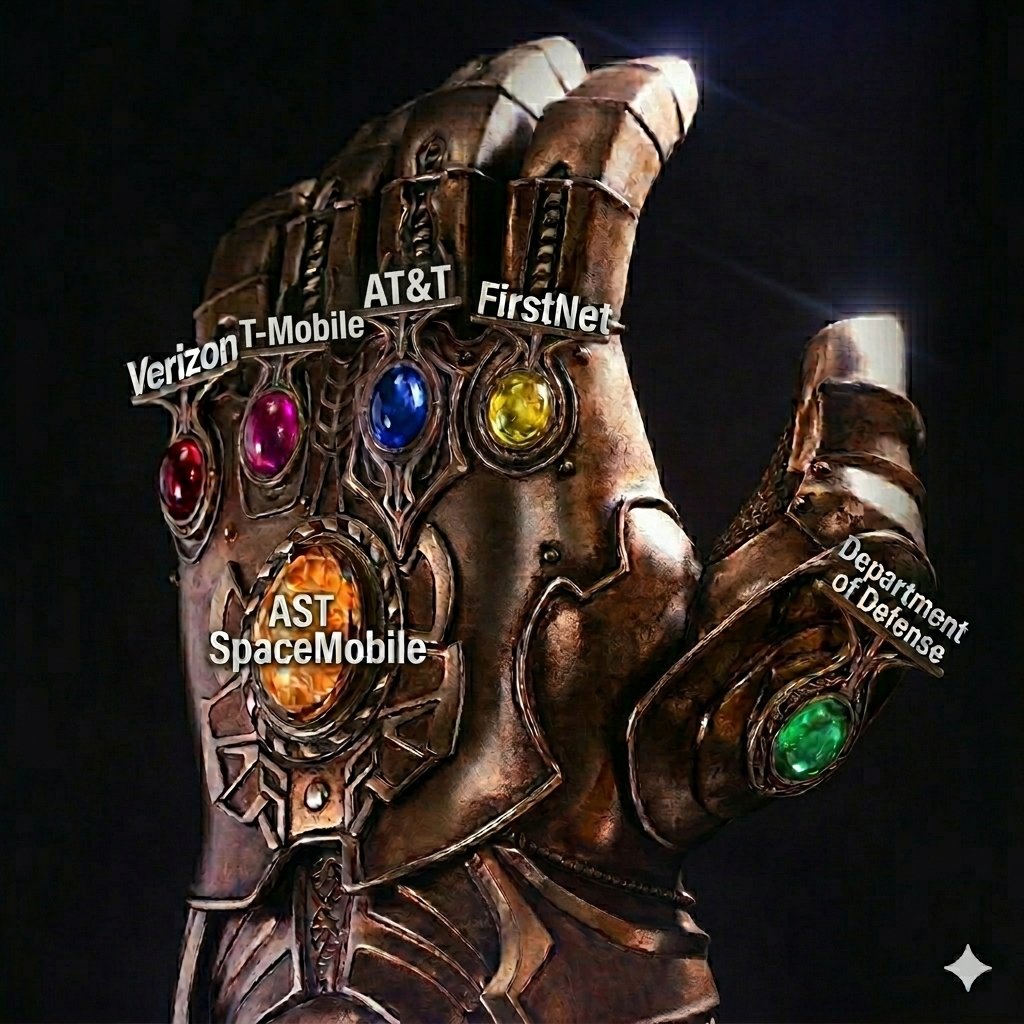
The three prisoners are Verizon, AT&T, & T-Mobile.
The deal on the table? Whether to partner with AST — the only company that can deliver broadband to their customers’ phones, who doesn’t want to compete with them directly.
Verizon already said yes. ✅
AT&T already said yes. ✅
T-Mobile is sitting in that room right now, and the clock is ticking.
But signing the deal is only step one - here’s where the dilemma gets even more brutal: it’s not enough to have ASTS. You have to deploy it aggressively, likely nto your biggest, most valuable customer tier. Because if your competitor does it first — they don’t just win a new product offering, they win a new coverage narrative.
We already have one blueprint - Bell Canada announced satellite connectivity would be included in ALL premium plans — pushing it to their entire premium customer base overnight. A full commercial deployment to their highest-value subscribers from day one.
Think about what that means at scale in the US. Verizon, AT&T, and T-Mobile together have roughly 250 million postpaid subscribers. Even conservatively, 125 million of them are on premium plans. 125 million Americans could wake up with satellite coverage — no new phone, no new SIM, no dish - overnight.
Now put that in the context of the Prisoner’s Dilemma. If AT&T bundles ASTS into every premium plan and runs a campaign: “No dead zones. Included in your plan. Starting now.” — What does Verizon do? What does T-Mobile do?
They don’t deliberate. They don’t form a committee. They call ASTS and ask how fast they can match it. Because they literally all have access to the exact same service offering without differentiation, you either offer it or you don’t.
Because what’s at stake? Premium plan subscribers are the most valuable customers in wireless. Highest revenue per user. Lowest churn. The ones every carrier fights hardest to keep. The carrier that locks in “the coverage carrier” brand with that segment first doesn’t just win Q3, they fundamentally change their trajectory for years.
So the competitive pressure isn’t just to adopt ASTS. It’s to adopt it fast, bundle it broadly, market it loudly, and make switching away feel like giving up coverage itself.
The prisoners aren’t just being forced to cooperate — they’re being forced to outbid each other on how enthusiastically they cooperate.
None of them can afford to say no. None of them can afford to go cheap. None of them can afford to wait. That’s not negotiating leverage for the carriers.
People wrongly assume three giant carriers vs. one small satellite company means the carriers dictate terms. But the Prisoner’s Dilemma doesn’t care about size. It cares about who needs whom more — and what happens to the one who blinks.
ASTS has one negotiating posture and it’s devastating: “We’ll reward whoever moves first, most aggressively, and at the best terms. The other two can watch.” First-mover gets the brand: “We’re the coverage carrier.” The other two spend years trying to claw that back.
So the prisoners cooperate. All three of them. They have to. And they don’t just cooperate — they race to cooperate loudest.
So all at once, overnight, 125 million accounts are creating what, $5, $8, $10 per subscriber per month? $7.5-$15B in revenue created in just the US. Now apply the dilemma to every market.
Three of the largest carriers in America. One satellite provider. Zero exit doors.
The vendor none of them could afford to say no to is about to get paid.
$ASTS
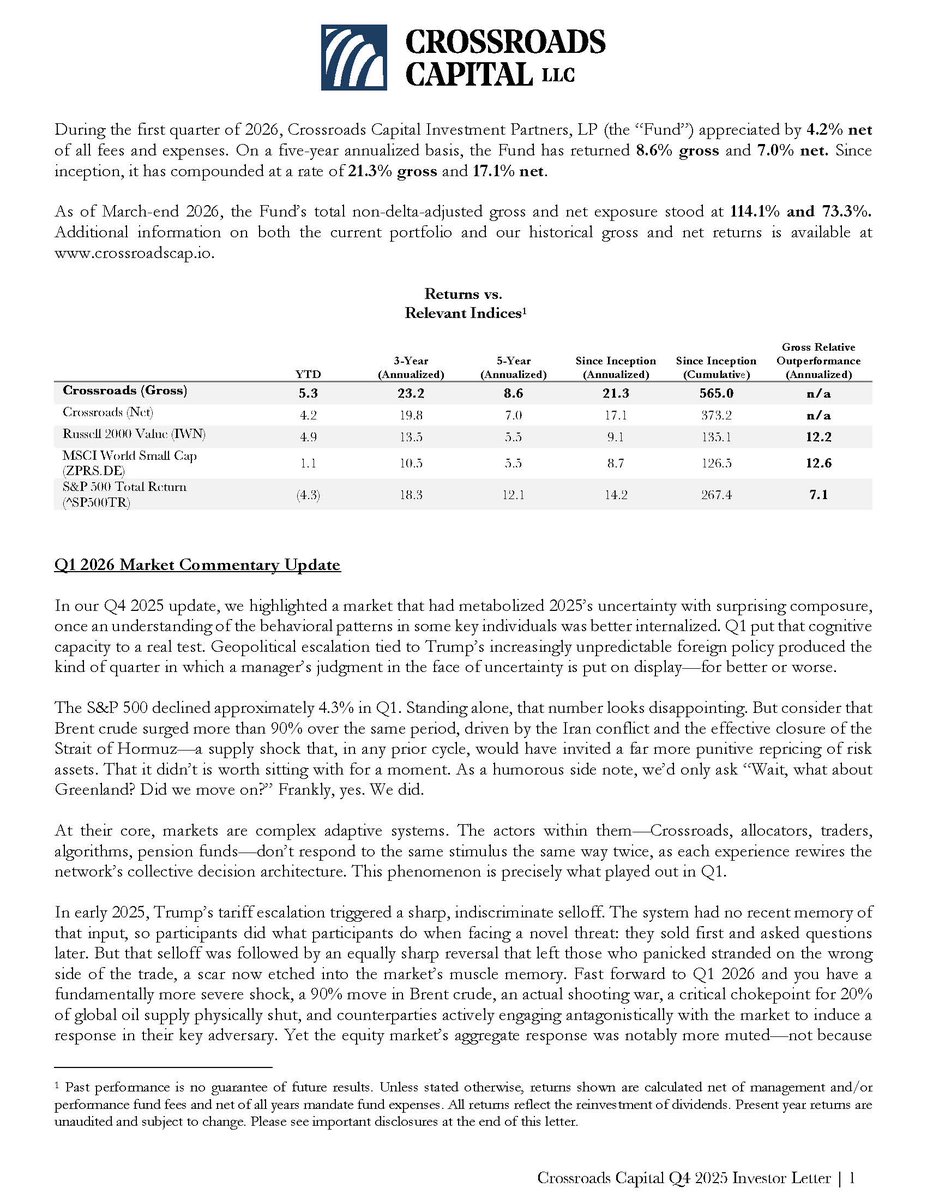
We described the Q1 market as "in a state of suspended animation" in which continual macro uncertainty and constant noise paralyzed the average investor. Our full commentary here: https://t.co/LKDKAd5anW
1/ Our Q1 2026 investor letter is now available: https://t.co/LKDKAd5anW
In Q1 the Fund returned +4.2% bringing the Fund's since inception CAGR to 17.1%.
Accredited investors can sign up to receive fund updates here: https://t.co/PfC7Cox8Cs
Follow us @CrossroadsOnX
Ignore retail investors at your own peril:
Across R3k, retail hasn't recorded a negative imbalance day since March 30th or a month w/ more than 5 negative retail flow days since July 2025. May MTD retail buy imbalances are averaging $1.8bn/day, the strongest since start of 2025.
$ASTS just secured a monopoly in the world's largest telco market?
$TMUS + Starlink contract ends this summer.
Elon is loud on his desire to become a carrier.
The enemy of my enemy is my friend.
$TMUS partners w/ $T & $VZ but why do they accept?
1/
https://t.co/AKUASudAri
Look at language in today's PR, $TMUS not even pretending anymore that they offer true broadband ahead of T-sat expiry, now just pooled its most valuable asset (spectrum) with its 2 biggest competitors, then $AST issues PR at the same time? "the game is afoot, my dear Watson."
Game theory. $TMUS threatens to act irrationally, offer low band spectrum to Starlink, its a race to the bottom but a credible threat for $T & $VZ. $TMUS has interal data; they know the service is BAD w/ poor revenue splits today (70-80% goes to Starlink) this adds to threat.
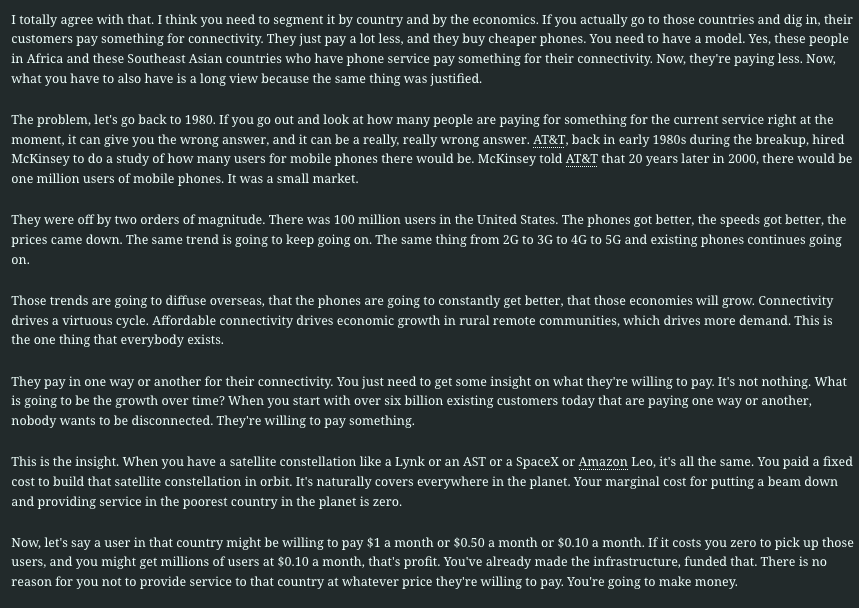
What Charles Miller (co-founder of Lynk, an $ASTS competitor) is saying here- is that if you squint hard enough to look a few years out.....$ASTS has a path towards becoming one of the greatest business models in the history of capitalism.
$ASTS The market needs to understand the basic marginal economics of direct-to-device. The TAM is very very large in scale because the marginal economics of serving 1 more customer is basically $0.
Its a pleasure being part of the $ASTS community. Institutional capital can continue to ignore retail at its own peril, even more so in the case of Spacemob which boasts satcom specialists, RF engineers, technologists +more performing unbelievable levels of ongoing due diligence
An obscure SpaceX rival has rallied 6,000%, powered by a group of zealots called SpaceMobbers and a stock guru known only as the Kook. https://t.co/IDsIxgvUIv