Are you looking for a postdoc? Interested in pushing the capabilities of ultra-high field MR and impacting mental health research? We have an exciting opportunity to join @SPMIC_UoN and develop tools to study brain function using 7 T fMRS. Apply below👇https://t.co/6vSL7gfFGt
Are you looking for a postdoc? Interested in pushing the capabilities of ultra-high field MR and impacting mental health research? We have an exciting opportunity to join @SPMIC_UoN and develop tools to study brain function using 7 T fMRS. Apply below👇https://t.co/6vSL7gfFGt
Interested in doing a PhD? An exciting opportunity to join a doctoral training programme (@Impact_Aim_Mrc) and develop new imaging techniques to measure metabolite changes in the brain! @SPMIC_UoN@UoN_Physics@CorrigoLab
https://t.co/1GJbbmyv3o
Deadline: 16th Jan!
My lab @PurdueHSCI@PurdueHHS@PurdueBME is hiring a postdoc on novel MRI/Imaging acquisition, reconstruction, or analysis methods for both preclinical and clinical scanners. The candidates should have a Ph.D. or MD in Medical Physics, Biomedical Engineering, Computer Science,
Excited to announce a PhD studentship opportunity at @SPMIC_UoN to develop methods for ultra-high field MR spectroscopy! Funding available for UK-based students.
https://t.co/dKZmUHL0eX
We are collecting info on the needs, wishes, and opinions of the #functionalMRS community to inform a submission for a member-initiated symposium @ISMRM 2022. If you currently do fMRS (or want to), please consider taking this survey: https://t.co/pIWeeAecNV
Thanks in advance!
'Ghosting' 👻 or spurious echo artifacts are common in MR spectroscopy.
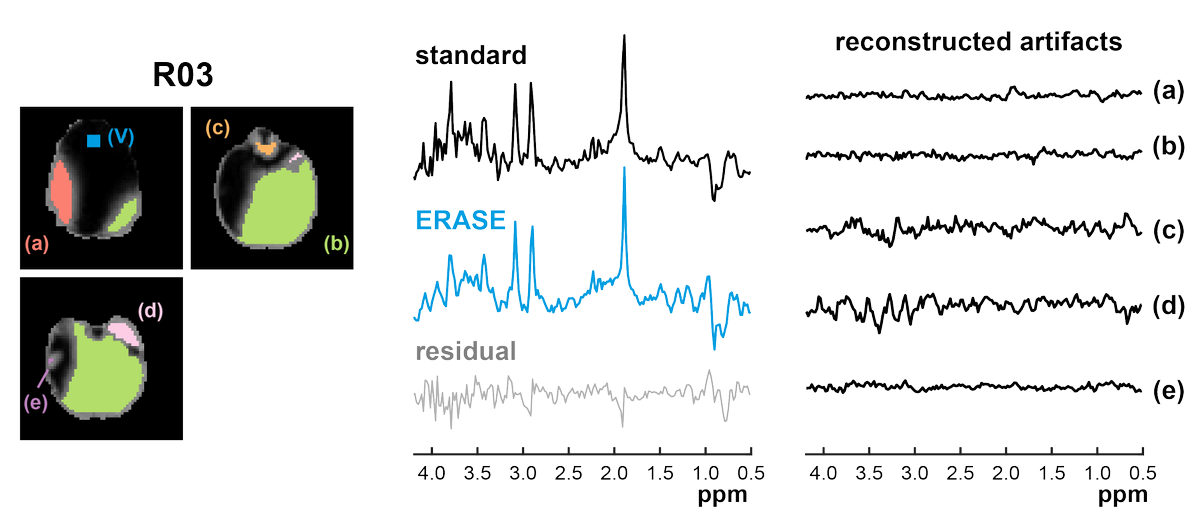
Our paper, published this week in MRM, proposes a new method (ERASE) to remove these artifacts using sensitivity encoding:
https://t.co/mQd43K5pzr
Check it out!
(P.S. This is my first tweet!)
Of course, nothing beats acquiring high quality data 😅, but we are often constrained by hardware.
ERASE is a reconstruction tool which may be applied post-hoc or added as a pre-scan in MRS.
Future work could explore adding prior knowledge into region estimation.
When applied in volunteer data sets containing spurious echo artifacts, we saw visible improvements in spectral quality (in particular 3-4 ppm) and lower CRLBs of major metabolites after fitting with ERASE.
This was despite the g-factor noise penalty of sensitivity encoding.