BREAKING: The BYU School of Medicine has received preliminary accreditation from the Liaison Committee on Medical Education (LCME), authorizing the school to recruit and admit students and launch its MD program.
@byumedschool will welcome its first students in July 2027 and will begin accepting applications in the coming weeks following activation of its listing on the American Medical College Application Service (AMCAS).
The BYU Board of Trustees has also approved plans for the school's future home, a 275,000-square-foot building on BYU's West Campus, just east of Intermountain Health's Utah Valley Hospital—the School of Medicine’s primary clinical affiliate. Construction is expected to begin in 2027.
Why Even the Best Clinicians Need Checklists
Medicine is practiced by humans—and humans are predictably biased.
Nobel laureate Daniel Kahneman showed that our brains rely on fast, intuitive thinking that works well under pressure—but systematically fails in complex, high-stakes decisions (Thinking, Fast and Slow).
In healthcare, those cognitive shortcuts show up as:
•Anchoring on early diagnoses
•Missing rare but critical conditions
•Inconsistent communication under stress
Checklists work not because clinicians lack knowledge—but because we’re human.
They:
•Slow us down when it matters
•Reduce reliance on memory under cognitive load
•Create shared mental models for teams
•Protect patients from predictable human error
This isn’t about control or bureaucracy.
It’s about designing systems that support good judgment when bias, fatigue, and time pressure are unavoidable.
High reliability care isn’t about heroics.
It’s about structure.
#checklistmanifesto #danielkahneman #healthcare #bias #healthsystemscience #improvement
🌍 Imagine a society where:
•Health care costs are dramatically reduced 💸
•People live longer, healthier lives ⏳
•Chronic illnesses like diabetes, heart disease, and obesity are no longer the norm but the exception ❤️🩹
This isn’t science fiction. It’s the predictable outcome if more of us made daily choices that science has already proven to work:
✅ Avoid harmful substances
✅ Exercise at least 30 minutes per day
✅ Prioritize quality sleep
✅ Eat a balanced, nutritious diet
The ripple effects would be profound:
•Economy: Trillions saved in preventable health care expenditures
•Families: More years spent with loved ones in good health
•Workforce: Increased productivity, creativity, and resilience
•Communities: Reduced strain on systems, greater equity in health outcomes
Small, consistent choices scale into generational impact. Each step, meal, night of rest, and workout is an investment not just in ourselves, but in the future of society.
We already know the “medicine.” The question is: will we collectively choose it?
💡 What’s one healthy decision you’ve committed to this year that’s making a difference?
🐾 The Science of Pets: Why They’re More Than Companions 🐾
Many of us know how good it feels to come home to a wagging tail or a gentle purr. But science is clear: owning a pet provides real, measurable health benefits—and different types of pets offer unique advantages.
🧠 Mental Health Benefits
Lower stress and anxiety (pets reduce cortisol, increase oxytocin)
Less loneliness and depression
Improved mood and emotional resilience
❤️ Physical Health Benefits
Dog owners are more active and have lower cardiovascular risk (American Heart Association).
Children exposed early to pets have lower rates of asthma and allergies.
Even watching fish swim has been shown to lower blood pressure and improve calm.
🐕🐈🐠 By Pet Type
Dogs → Activity, heart health, social connection
Cats → Comfort, companionship, stress reduction
Fish → Relaxation, blood pressure benefits
Small mammals/birds → Teach responsibility, provide interaction and cognitive stimulation
⚠️ Of course, pets also come with responsibilities and costs. But when cared for well, they can play a powerful role in supporting whole-person health.
👉 The takeaway: Owning a pet isn’t just about companionship—it can be a pathway to better mental, physical, and social well-being.
Do you notice certain health benefits from your pets? 🐶🐱🐟
#Wellness #MentalHealth #Health #Science #PetOwners #HealthyLiving
🌍 The Strength of Conviction + The Grace of Respect 🌍
One of the most important choices we face in life is how we live out our beliefs.
To live with passion, conviction, and integrity.
To stand firmly for the values that matter most.
But an equally important decision is to allow others the dignity of living their beliefs; even when they differ from ours.
True strength isn’t found in silencing disagreement. It’s found in creating space for others to follow their own path, so long as it doesn’t infringe on the rights and freedoms of others.
✨ This balance matters.
It allows us to live boldly without becoming intolerant.
It teaches us that unity doesn’t require uniformity.
And it helps build communities where diversity of thought and belief can thrive.
Live your beliefs passionately. Respect the right of others to do the same.
That’s not weakness, it’s wisdom. It’s how we honor both our convictions and our common humanity.
#Leadership #Respect #Conviction #Freedom #Community #Integrity
⚖️ Essential AND Enjoyable: The Path to Effortless Work
Too often, we separate our lives into two buckets:
Things we have to do (essential tasks)
Things we want to do (enjoyable activities)
But what if the most sustainable, impactful work is actually the overlap of both?
Greg McKeown, in his book Effortless, describes this intersection as the place where work feels natural—not because it isn’t important or challenging, but because it combines meaning with joy.
✨ When tasks are both essential and enjoyable, they don’t just get done… they energize us.
🧠 Why This Matters
Research in psychology supports this idea:
When we work in areas that are both valuable and enjoyable, we are more motivated, resilient, and creative.
Burnout is less likely when effort is paired with enjoyment.
We achieve more, not through sheer willpower, but by aligning with what feels intrinsically rewarding.
✅ Practical Takeaway
Ask yourself:
What’s essential in my work or life right now?
How can I make it enjoyable—or align it with what I already enjoy?
Examples:
Turn workouts into social time with a friend.
Pair deep work with your favorite music.
Align professional projects with causes that matter to you.
💡 The effortless state isn’t about avoiding hard things. It’s about building a life where the most important work also fuels your energy and joy.
Essential + Enjoyable = Effortless.
#Effortless #Essentialism #Leadership #Productivity #Mindset #Wellness #Growth
🌿 Wisdom for Resilience: Move the Body When the Mind is Weary, Move the Mind When the Body is Weary 🌿
We all face moments when our minds feel overloaded with stress, worry, or fatigue—or when our bodies feel tired after long hours of work or exertion.
Modern science affirms a timeless truth:
🧠 When the mind is weary, moving the body can restore focus, calm racing thoughts, and improve clarity. Exercise boosts blood flow to the brain, lowers stress hormones, and strengthens the “grit center” of the brain—the anterior midcingulate cortex (aMCC)—helping us persist through challenges.
💪 When the body is weary, engaging the mind through learning, creativity, or problem-solving can provide restoration. Cognitive work can distract from physical fatigue and build resilience by exercising neural pathways linked to memory, focus, and adaptability.
⚖️ This balance—switching between physical and mental effort—creates a rhythm that protects health, enhances performance, and sustains long-term well-being.
✅ Practical Takeaway:
Go for a walk, stretch, or lift weights when your brain feels foggy.
Read, journal, or engage in creative work when your body needs rest.
Small shifts can keep both body and mind resilient.
Ancient wisdom + modern neuroscience agree: wholeness comes from knowing when to move the body and when to move the mind.
#Resilience #Wellness #Neuroscience #MentalHealth #Leadership #HealthAndPerformance
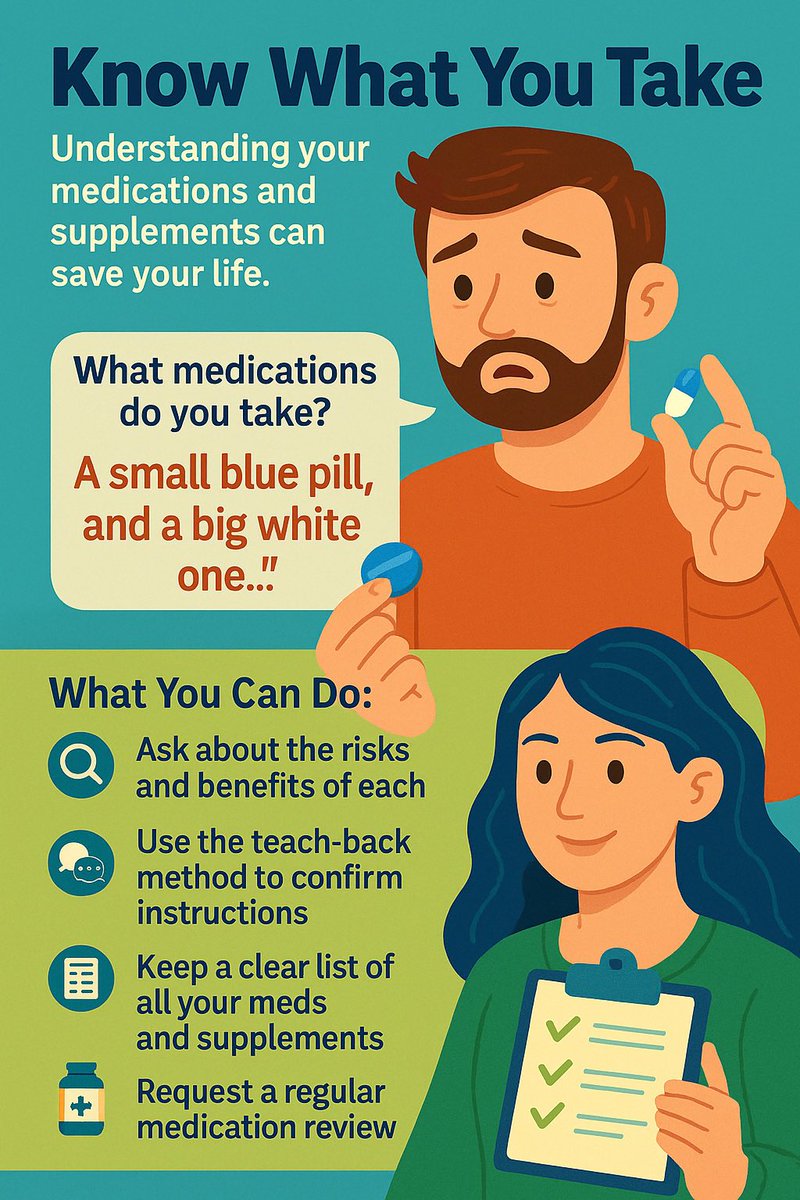
💊 Know Your Medications—Not Just Their Color
When asked, “What medications do you take?” the right answer isn’t:
👉 “A small blue pill and a big white one…”
That’s a dangerous lack of knowledge.
Science is clear: people who understand their medical conditions and treatments are more likely to:
✅ Take medications correctly
✅ Avoid harmful drug interactions
✅ Recognize side effects early
✅ Make informed decisions with their doctor
📖 Studies show that low health literacy is linked to:
⚠️ Higher hospitalization rates
⚠️ Poorer overall health outcomes
⚠️ Greater risk of medication errors
Knowledge is power. It’s not enough to just have a treatment—you need to understand it.
🔑 Practical steps:
Learn the name, dose, and purpose of each medication or supplement
Ask your doctor or pharmacist: “What are the benefits and what are the risks?”
Keep a written or digital list of your medications to share with your care team
Your health is too important to leave in the hands of “the blue one” and “the white one.”
👉 Own your knowledge. Own your health.
#HealthLiteracy #MedicationSafety #PatientEmpowerment #PreventiveHealth #InformedChoices #HealthcareCommunication
🌍 Understanding Hypertension: The Silent Risk 🌍
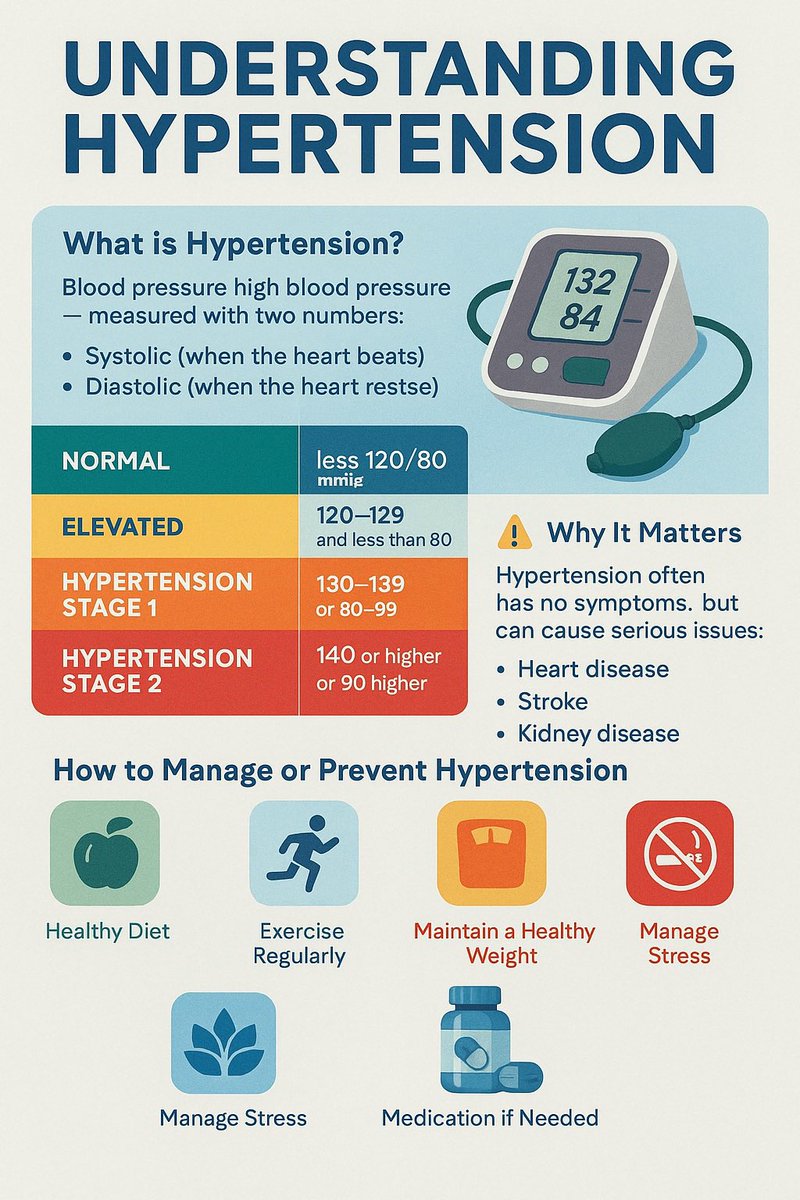
High blood pressure, or hypertension, is one of the most common—and dangerous—health conditions worldwide. Often called the “silent killer,” it usually has no symptoms but can cause life-threatening complications if left uncontrolled.
📏 How It’s Measured
Systolic (top number): Pressure when the heart beats
Diastolic (bottom number): Pressure when the heart rests
Normal: <120 / <80 mmHg
Hypertension: ≥130 / ≥80 mmHg
❗ Why It Matters
Increases risk of heart attack, stroke, kidney disease, and vision problems
Contributes to millions of preventable deaths worldwide each year
✅ Behavior Changes That Help
Reduce sodium intake (processed foods, restaurant meals)
Eat more fruits, vegetables, and whole grains
Maintain a healthy weight and body fat range
Exercise 30 minutes most days
Limit alcohol and avoid tobacco
Manage stress with sleep, relaxation, and mindfulness
Hypertension is preventable and manageable—but it requires awareness and consistent action.
💡 Small, daily choices build into long-term protection for your heart and brain.
You can take control.
#healtheducation #hypertension #behaviorchange #bloodpressure #hearthealth
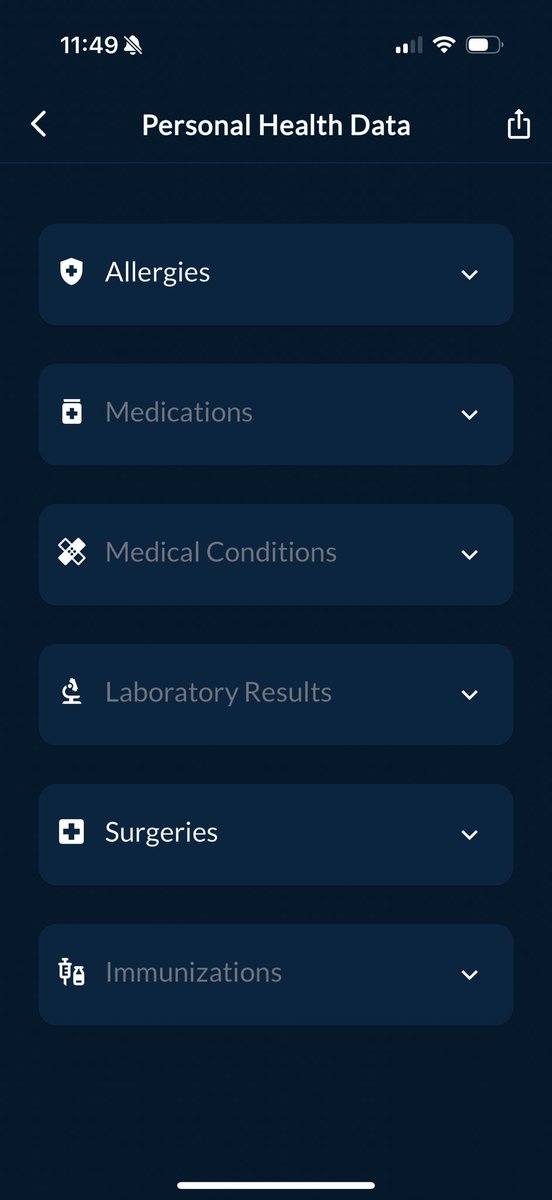
📂 Why Everyone Needs a Personal Health Record
Your health is your most valuable asset. But here’s the truth: most of us don’t have a complete, accessible record of our own medical history.
Research shows that people who maintain a personal health record (PHR) experience:
✅ Better engagement in their care
✅ Fewer medical errors
✅ Earlier detection of health issues
✅ Improved communication between doctors
✅ More confidence and peace of mind
Why does it matter?
Because when you can see, understand, and share your own health data, you become the most important member of your healthcare team.
💡 The bottom line:
A Personal Health Record isn’t just paperwork—it’s a tool for empowerment, prevention, and peace of mind.
When you own your data, you own your health story.
#PersonalHealthRecord #DigitalHealth #PatientEmpowerment #Wellness #HealthOwnership #PreventiveCare
🌱 Hardship Often Prepares an Ordinary Person for an Extraordinary Destiny — C.S. Lewis
When the road gets hard, it’s tempting to think the struggle is a detour. But science — and life — tell us otherwise.
Just like muscles grow stronger through resistance, our minds and bodies adapt, improve, and thrive when we push through challenge. In fact, studies show:
•Neuroplasticity: Learning new skills and persisting through challenges builds new neural pathways, improving memory, focus, and creativity.
•Hormesis: Exposure to manageable stress — like exercise, fasting, or cold exposure — strengthens the body’s resilience, reduces inflammation, and boosts immune function.
•Behavioral Consistency: Small, daily health habits (walking, healthy eating, sleep hygiene, mindfulness) compound over time, lowering risk for chronic disease and improving mental well-being.
•Psychological Growth: Overcoming obstacles fosters grit, self-efficacy, and optimism — all linked to higher life satisfaction and happiness.
The path to your best self isn’t smooth, but it is worth it.
Each day you choose actions within your control — to move, to learn, to connect, to rest — you are shaping your future health, happiness, and fulfillment.
So keep going. Not in spite of the hardship, but because of it. Your extraordinary destiny may be closer than you think.
#Motivation #PersonalGrowth #HealthAndWellness #Resilience #Neuroplasticity #Grit
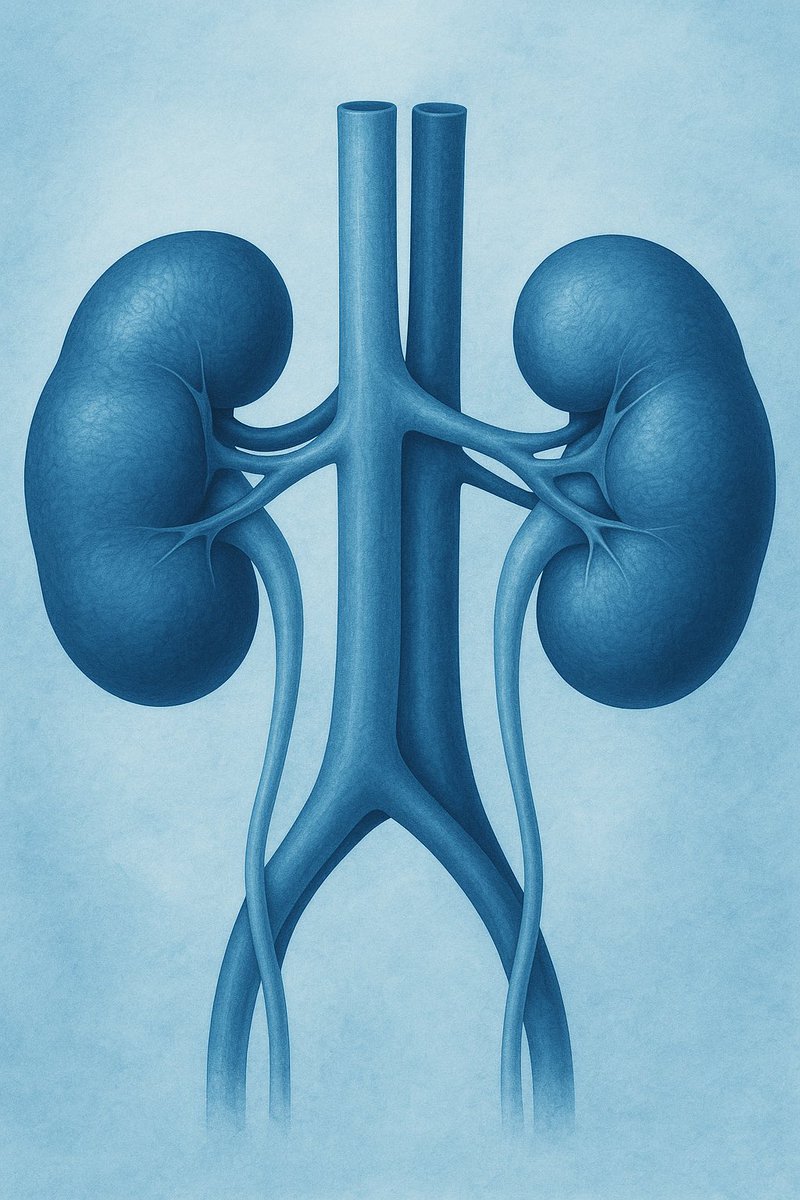
🩺 Your Kidneys: Small but Mighty Health Protectors
Every day, your kidneys quietly perform life-saving work—filtering about 50 gallons of blood daily to keep you healthy.
Why kidneys matter:
•Waste removal: They filter out toxins, excess water, and byproducts from food and metabolism.
•Blood pressure regulation: They balance salt, potassium, and other electrolytes.
•Red blood cell production: They release erythropoietin, a hormone that signals bone marrow to make red blood cells.
•Bone health: They help activate vitamin D so your body can absorb calcium.
•Fluid balance: They keep your hydration in check—too much or too little fluid can harm your body.
Creatinine Test – A Window Into Kidney Health
Creatinine is a waste product from muscle activity. Healthy kidneys filter it out efficiently, so a simple blood test measuring serum creatinine can reveal how well your kidneys are working.
•Low or normal levels: Usually mean your kidneys are filtering well.
•High levels: May indicate kidney stress or damage, prompting further evaluation like an estimated glomerular filtration rate (eGFR).
Kidney disease is more common than you think:
•Nearly 1 in 7 adults in the U.S. has chronic kidney disease (CKD)—many don’t know it.
•1 in 3 adults is at risk due to diabetes, high blood pressure, or a family history of kidney problems.
•Even healthy people can experience acute kidney injury from severe dehydration, gastrointestinal illness with vomiting/diarrhea, heat stroke, or certain medications.
Kidney-friendly habits:
✅ Stay hydrated – but don’t overdo it; drink mostly water.
✅ Manage blood pressure & blood sugar – high levels can damage kidney vessels.
✅ Limit excess salt – helps reduce strain on your kidneys.
✅ Maintain a healthy weight – obesity increases kidney disease risk.
✅ Avoid unnecessary NSAIDs – frequent high-dose painkillers can harm kidney function.
✅ Don’t smoke – smoking damages blood flow to the kidneys.
Bottom line: You only get two kidneys, and they’re quietly working for you 24/7. Knowing your risks and supporting kidney function through daily habits can protect you for life.
💬 Have you ever had a creatinine test?
#KidneyHealth #PublicHealth #PreventiveCare #LabTests #Wellness #Creatinine #HealthyHabits
🧬 What Do Crypto Wallets and Greek Gods Have in Common?
In blockchain, every token or wallet has an address—a long, complex string of characters like this:
0xf7e945FcE8F19302AaCc7E1418b0A0bdef89327B
Most people ignore these strings. But sometimes, embedded in them is a “vanity code”—a purposeful, human-readable fragment hidden in the randomness.
Take the IZE token address, for example.
🔍 It contains F7E945—the hex code for the color Apollo.
Not a coincidence.
Apollo wasn’t just the god of the sun. He was the mythical patron of:
🎯 Archery (precision)
🎵 Music and dance (rhythm)
🧠 Truth and prophecy (insight)
🌞 Light and healing (energy and renewal)
📝 Poetry and knowledge (expression)
In today’s language, we might simply call it: wellness.
That’s what the IZE token was designed to support.
💡 A modern blockchain token for a modern vision of health—physical, emotional, digital.
Vanity codes like these aren’t just easter eggs. They are intentional identity markers in a decentralized world. Proof that even in code, meaning matters.
Blockchain is more than math. It’s storytelling, too.
#CryptoEducation #VanityAddress #IZE #Apollo #Wellness #Web3Identity #BlockchainForGood #DigitalHealth #ColorTheory #DecentralizedMeaning #IZEtoken #gPlus
🧠 How to Help a Loved One with Anxiety: What to Do, What to Avoid, and Why It Matters
Anxiety affects 1 in 5 adults—but it doesn’t always look like panic. It shows up in irritability, fatigue, indecision, restlessness, or even silence. And when someone we love is struggling, it’s hard to know what to do.
Here’s what science tells us works ⤵
✅ What Helps:
Be calm and nonjudgmental
“I’m here. You’re not alone.”
Gently name what you observe
“It sounds like you might be feeling anxious—does that sound right?”
Try grounding tools together
→ Breathing, 5-4-3-2-1 grounding, a walk, music
Encourage structure and self-care
→ Sleep, hydration, movement, less caffeine
Support therapy, not stigma
“Lots of people go to therapy—it’s strong, not weak.”
🚫 What to Avoid:
“It’s not that bad.”
“You’re overreacting.”
Over-accommodating or trying to fix it too fast
Problem-solving before validating
🛠️ Want to go one step further? Use tools that listen. Literally.
💡 The g+ app uses AI voice recognition wellness checks to detect subtle shifts in tone and cadence that may indicate stress or anxiety—often before you even realize it.
It’s like a daily emotional check-in powered by science, with personalized recommendations to guide you toward better mental health.
Sometimes the most powerful support isn’t fixing—it’s listening, encouraging, and pointing toward real help.
#MentalHealthMatters #AnxietySupport #WellnessTech #VoiceRecognition #EmpathyInAction #SupportNotStigma #gPlus #HealthInnovation #ListenWithCare #Galvan
🧠 The Brain Science Behind Doing Hard Things
Tucked deep within your brain, the anterior midcingulate cortex (aMCC) is a small but mighty region that activates when you face difficult, effortful tasks—especially ones that test your endurance, willpower, and sense of purpose.
What’s fascinating?
The aMCC doesn’t just “light up” during struggle. It grows stronger the more we lean into challenges. Neuroscientists believe this region is key to:
✅ Sustained motivation
✅ Pain tolerance
✅ Decision-making under pressure
✅ Goal-directed behavior
In other words, every time you do something hard—run that extra mile, have that tough conversation, or persist through discomfort—you’re literally training your brain to become more resilient, focused, and capable.
💡 Growth doesn’t come from comfort. It comes from resistance.
Whether you’re chasing personal goals or leading a team, embrace the challenge. Not because it’s easy—but because it activates the part of your brain designed to help you become your best self.
Do hard things. Your brain—and your future self—will thank you.
#Neuroscience #Resilience #Leadership #PersonalGrowth #Neuroplasticity #MentalToughness #DoHardThings #BrainHealth #Wellness #Mindset
🧠💤 What’s the #1 performance enhancer for students, professionals, and humans in general?
SLEEP.
Too often we treat sleep like a luxury, when it’s actually a biological necessity — for focus, immunity, memory, mood, and recovery.
Here’s a science-backed crash course you can share with your teens, team, or even your tired self:
🧬 The Science of Sleep
⏰ Controlled by hormones:
🧠 Melatonin = Sleep signal
⚡ Cortisol = Wake-up energy
💤 Adenosine = Builds pressure to sleep
🌙 Sleep has 4 stages (and you cycle through them every 90 mins):
Light Sleep
Deeper Sleep
Deep (Slow-Wave) Sleep — repairs body
REM — where dreams + memory work happen
🛌 How Much Sleep Do You Need?
🧒 Kids: 9–12 hrs
🧑🎓 Teens: 8–10 hrs
🧑 Adults: 7–9 hrs
(Yes, teens really do need more sleep — it’s biology.)
📉 What Happens When You Don’t Sleep Enough?
Impaired focus & memory
Mood swings & anxiety
Weak immune system
Slower recovery
Poor decision-making
✅ Sleep Hygiene = Better Sleep
Same bedtime every night
Avoid screens before bed
Limit caffeine late in the day
Dark, cool, quiet room
Morning sunlight = circadian reset
💬 If you’re tired — mentally or physically — you might not need more hustle. You might need more sleep.
Let’s normalize sleeping smarter, not just working harder.
#SleepScience #Wellbeing #HealthEducation #BrainHealth #HighPerformance #SleepTips #YouthDevelopment #EmployeeWellness #MentalHealth #WorkplaceWellness #EducationMatters
Your back pain isn't from aging.
It's from sitting 8 hours a day at your comfy desk job.
It wrecks your posture and compresses your spine.
Here are 9 simple exercises to fix your back before the damage becomes permanent: 🧵
(From a Doctor of Physical Therapy)