The Christian worldview is the only worldview that can justify and will maintain the human rights and freedoms upon which our nation was founded 250 years ago today. Islam won’t (sharia law), Hinduism won’t (caste system), Atheism won’t (no one is higher than the dictator, which led to 100 million murdered by atheistic regimes in the 20th Century).
Those other worldviews do not believe,“that all men are created equal, that they are endowed by their Creator with certain unalienable Rights, that among these are Life, Liberty and the pursuit of Happiness.--That to secure these rights, Governments are instituted among Men, deriving their just powers from the consent of the governed.”
Our founders knew that rights can only come from God—not governments—but that good governments are supposed to secure those rights. That’s what Christianity teaches.
Reflecting back on the founding of our country, John Adams wrote to Thomas Jefferson in 1813, “The general Principles on which the Fathers achieved Independence, where the only Principles in which that beautiful Assembly of young Gentlemen could Unite. . . And what were these general Principles? I answer, the general Principles of Christianity. . . ”
So whether you are a Christian or not, you should appreciate the principles that come from Christianity, including inalienable rights, and that governments are temporary institutions that are to protect the lives and liberties of beings that are eternal and made in the image of God—you and me.
Here are 7 exercises that strengthen your heart and spiritual muscles:
1. Regular study of the Bible
2. Consistent godly fellowship
3. Looking for God's glory in creation every day
4. Sitting under preaching and teaching of Scripture
5. Spending quiet moments reflecting on the goodness of God
6. Reading solid Christian books
7. Spending ample time in prayer
USA. A Mexican restaurant. We had not yet ordered anything, and the food was already arriving.
Chips. Salsa. Unrequested. Free.
I stopped the waiter. "We have not earned these."
"They just come with the table, man."
They come with the TABLE. In my land, hospitality is a debt. Every gift creates an obligation, weighed carefully, returned in the proper season with interest of feeling. Here, the gift arrives before you have even proven you can pay for dinner.
This is not an appetizer. This is a declaration: we trust you. Eat.
I ate with the gravity the moment deserved. And then — I must report this calmly — the basket emptied, and a new one appeared.
"Did we…?"
"Refill," the waiter said. "It's bottomless."
Bottomless. They have wells of salsa. The supply lines of this nation are beyond anything my ancestors imagined.
My friend warned me. "Don't fill up on chips, dude."
Too late. I had accepted three baskets. Honor demanded each one be finished — an unfinished gift is an insult. By the time my actual food arrived, I was a ruined man.
I was not hungry. I was not comfortable. I had been defeated by a courtesy.
Generosity that arrives before the request cannot be repaid. It can only be survived.
I know the rule now. I have made my peace with the basket. One basket. Two at the most.
Who am I deceiving. There is no number of baskets I would refuse. The trust of a nation is in that salsa, and I intend to honor all of it.
Somewhere along the way, many of us picked up the quiet assumption that following Jesus would make life easier. Smoother. Happier. And when the road got steep instead, we wondered if we'd done something wrong. But what if comfort was never the point?
God's deepest goal for us isn't a pleasant life — it's a transformed one. He's shaping us, slowly and steadily, into the likeness of Christ. Sometimes that work happens in joy. Often it happens in the hard places we wouldn't have chosen.
When you look back, where do you see God using a hard season to shape you?
"If I told you there was one free thing you could do every Sunday that would make your kids happier, healthier, smarter, and closer to you, you'd think I was selling something."
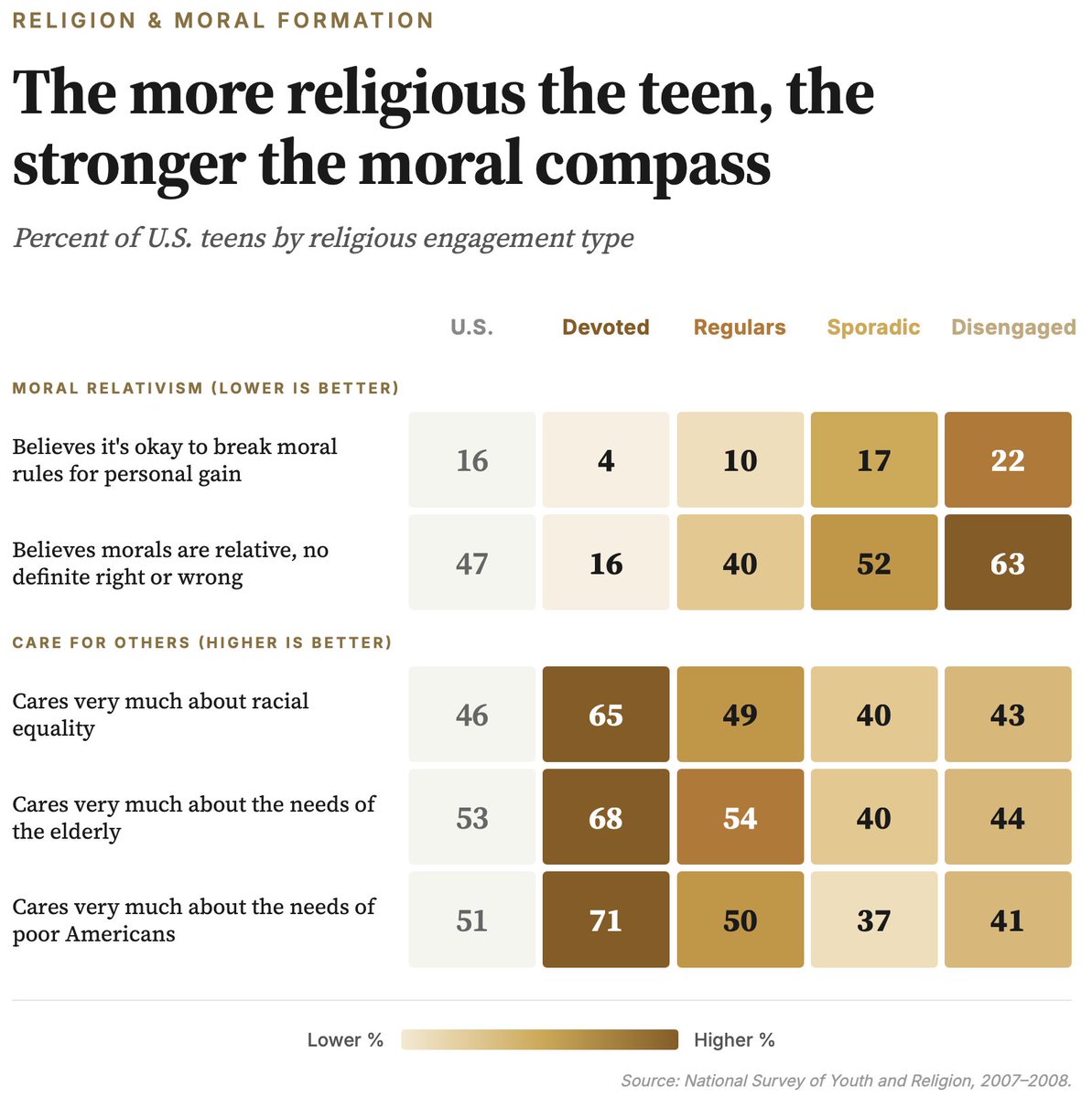
Take your kids to church regularly. I don't care if you believe. The data is so lopsided that skipping it is the parenting equivalent of refusing vegetables because you don't like the taste.
Grades. Religious teens get As at almost twice the rate of nonreligious teens. In a class of 100, that's 24 A-students instead of 14. Church gives a kid the same academic boost as being born rich instead of poor.
College. Working-class religious kids earn bachelor's degrees at double the rate of their nonreligious peers. Middle-class kids do it at 1.5x the rate. For families without a trust fund, this is one of the most powerful forms of upward mobility social scientists have measured.
Character. Religious teens are far less likely to lie, cheat, or do things they hope their parents never find out about. They're more likely to care about racial equality, the elderly, and the poor. They reject the idea that morality is whatever works for you in the moment. That kind of kid doesn't happen by accident. It's built.
Closeness. 60% of parents of religious teens say they feel "extremely close" to their kid, compared to 50% of nonreligious parents. The kids report the same thing back. They get along better with their parents, talk about hard stuff, and actually want to spend time with their family.
Despair. Religious teens are dramatically less likely to be depressed, anxious, lonely, or feel that life is meaningless. 90% of devoted religious teens never binge drink, compared to 41% of the disengaged. Economists named the modern epidemic "deaths of despair." Regular church attendance is one of the strongest known buffers against it. Parents are spending fortunes trying to solve teen mental health. The most evidence-backed intervention is free.
Purpose. Religious young adults report higher purpose, gratitude, life satisfaction, and resilience. These are the exact traits every parent says they want their kid to have.
Here's why it works. Affluent families already surround their kids with networks of stable, accomplished adults through neighborhoods, schools, and parents' colleagues. Working and middle-class families usually don't. A congregation is often the last institution in American life that puts your kid in weekly contact with dozens of stable, employed, sober adults who know their name. It used to be called "a village." Now it barely exists outside of churches.
"But I don't believe." Your kid doesn't need your theology. They need you to show up.
"But church is boring." So is sitting through a kindergarten music recital. Parenting is the deliberate choice to be bored on purpose for someone you love.
There's a church within 15 minutes of nearly every American home. You don't need money, connections, or credentials to walk in. Nothing else in this country will surround your kid with engaged adults, teach them moral seriousness, and give them a stable weekly rhythm at zero cost.
You already drive them to practices that produce far less. The free thing on Sunday produces more, on more dimensions, than almost anything else you do as a parent.
You don't have to believe anything. You just have to take them.