For most of human history, when a mother could not feed her baby, the baby went to a goat. Then a factory offered to do the goat's job, and you can guess which one is now sold as the scientific choice.
Goat milk is milk. Formula is skimmed milk powder with the fat removed and replaced by palm, rapeseed, coconut and sunflower oil.
Goat milk fat comes in globules smaller than a cow's, with more of the short and medium chain fats a baby burns easily. Formula fat comes out of a refinery.
Goat milk carries cholesterol, because an infant brain is built out of it. Formula carries next to none.
Goat milk carries oligosaccharides, the sugars that feed a baby's gut bacteria, and its profile sits closer to human milk than any other animal's. Formula manufacturers now synthesise a couple of them and print it on the tin as an innovation.
Goat milk is served warm, raw and alive, straight from the animal. Formula is spray dried, sealed, and brought back to life with the kitchen tap.
In 1816 a German physician published a book calling the goat the best wet nurse available. French foundling hospitals kept herds for the purpose and the infants suckled directly from the animal.
In 1816 nobody had a formula industry. Today it turns over about £40 billion a year, and the European Union only re-admitted goat milk as a base for infant formula in 2014, which means it had been banned.
Two centuries of goats and a two hundred million year track record on one side. Fifty years and a seed oil blend on the other.
The one with the seed oils is the one with the word science on the tin.
Eat a pound of beef a day, every day for a year, and one animal dies. One bullock, two years out on grass, a bolt to the forehead and gone before the sound reaches him.
Eat a pound of pork a day for a year and 3 pigs die. Most go down a lift into a pit of carbon dioxide. It burns the nose and throat, they fight to climb out, and it takes the best part of a minute to put them under.
Eat a pound of lamb a day for a year and 8 lambs die. Stunned, cut, done inside a second.
Eat a pound of salmon a day for a year and 55 fish die, plus the sardines they were fed. The lucky ones are clubbed. The rest have the gills cut while awake, or are gassed, and fight it for up to nine minutes.
Eat a pound of chicken a day for a year and 75 birds die. Hung upside down by the legs on a moving line, dragged head first through an electrified bath, then the blade. Some arch their necks, miss the water, and meet the blade awake.
Eat a pound of prawns a day for a year and 15,000 die. In the trawl they are crushed and left to asphyxiate on the deck. In the farm, their mother has her eyestalk cut off to make her lay.
Eat a pound of bread a day for a year and nobody can give you a number. Field mice, voles and nesting birds go through the combine in July. In Germany alone the mowers cut around 90,000 roe deer fawns in half every May. Round the grain store the rats take the poison and bleed to death inside for a week.
Eat a pound of rice a day for a year and the paddy is flooded, drained and sprayed, and everything in the water goes with it. Frogs, fish, snakes, the lot. Then the stubble is burned.
The bullock had a number on an ear tag and a man who checked on him every morning.
The field mouse had a combine.
The only animal on the list that was looked in the eye before it died is the one you have been told to feel guilty about.
Jailbroken PS5 console managed to make PlayStation 2 games run on PS5 from disc, without even importing digital files🚀
This means Sony were deliberately keeping players from running their games that can work just fine, just so they can sell the games again on PS Store / PS+
Modders are also working on making PS3 games run from disc on PS5, also after Sony telling us it’s “hard” to do so, due to “different infrastructure”
And now you see how far Sony’s greed has gotten. XBOX could always run games from all past generations, full backwards compatibility, yet Sony somehow pretended it was hard, and they once pretended to be shocked as to “why would anyone wanna play old games”?
And there you have it, it’s greed. The same reason they wanna convince you discs are a niche market and don’t sell when data proved them wrong💿
(Special thanks @Pirat_Nation for the research)
In 1999 climbers found George Mallory's body high on Everest, 75 years after he vanished, and the clothes he died in were still on him. They were wool, silk and cotton. In 2006 somebody put on an exact copy and climbed the mountain in it.
For decades the story had been that Mallory and Irvine were doomed by their kit. Tweed jackets and woolly jumpers at 28,000 feet. Brave amateurs, dressed for a grouse moor.
The body told a different story. Mallory was wearing 8 thin layers. Silk next to the skin, then fine wool, then more silk, more wool, a flannel shirt, and a windproof cotton outer woven so tightly it turned the snow.
Four British universities took fragments from the body and rebuilt the whole outfit, thread for thread. A mountaineer called Graham Hoyland wore it on Everest.
He reported that it was warm. It was also lighter than the modern down suit his companions were wearing. The silk layers slid over the wool, so he could move his arms freely, which a man in a padded plastic suit cannot. The wool held its warmth when damp with sweat. He said he would have been comfortable going for the summit in it.
The researchers concluded the clothing was fully up to the job.
So the gear of 1924 was not the weak point. A sheep and a silkworm had solved the problem of the coldest place on earth, at less weight, before anyone had invented nylon.
Then we spent a century replacing it with petroleum and told ourselves the men who came before were underdressed.
The Royal Navy switched its sailors from cotton to polyester two years before the Falklands, and the sea put the two fabrics to the test on the afternoon of 4 May 1982.
HMS Sheffield was hit by an Exocet 70 miles off the islands. The warhead did not go off. It did not need to: the rocket fuel did, and the ship filled with fire and black smoke in seconds. Twenty men died. Many more came out of her with burns, and the burns had a feature the surgeons at Ajax Bay and the Uganda had not been trained for.
The shirts had melted. The new working rig was polyester, lighter and cheaper and quicker to dry than the old cotton, and in a flash fire it did what polyester does at 250 degrees, which is turn to liquid and bond to whatever it is touching. Men were brought off with their uniform fused into their skin, and the first job in the burns tent was peeling plastic out of flesh. Nylon socks did the same thing to feet. Anti-flash hoods and gloves, the white cotton gear every sailor still wears at action stations, had saved the faces and hands they covered and left a line where the plastic began.
The lesson was learned at the Sir Galahad too, at Bluff Cove a month later, where the Welsh Guards were caught below decks and the burns ward at Ajax Bay found the same thing.
Afterwards the Navy went back to natural fibres. Cotton action working dress, cotton socks, the wool jumper that had never left. The US Navy took the same lesson from the Falklands and again from the USS Stark in 1987 and banned polyester and Corfam shoes aboard ship. Then, in 2012, it issued a new blue camouflage working uniform, tested it, and had to announce to its own sailors that it would burn robustly and melt into a sticky molten material. The uniform was nylon and cotton. It had been in service for four years.
Every navy that has ever had a fire has arrived at the same answer and then forgotten it as soon as the accountants came back.
Natural fibre does not melt. A sheep's wool will not catch at a temperature a ship fire reaches, and when it chars it stops. Cotton burns, but it burns off, it does not become part of you.
The shirt that went into a man's skin on the Sheffield is the same fabric as the school polo shirt, the fleece, the gym top, the sofa cover and the sheet on the bed.
The Navy had to be shown it once.
You are wearing it now.
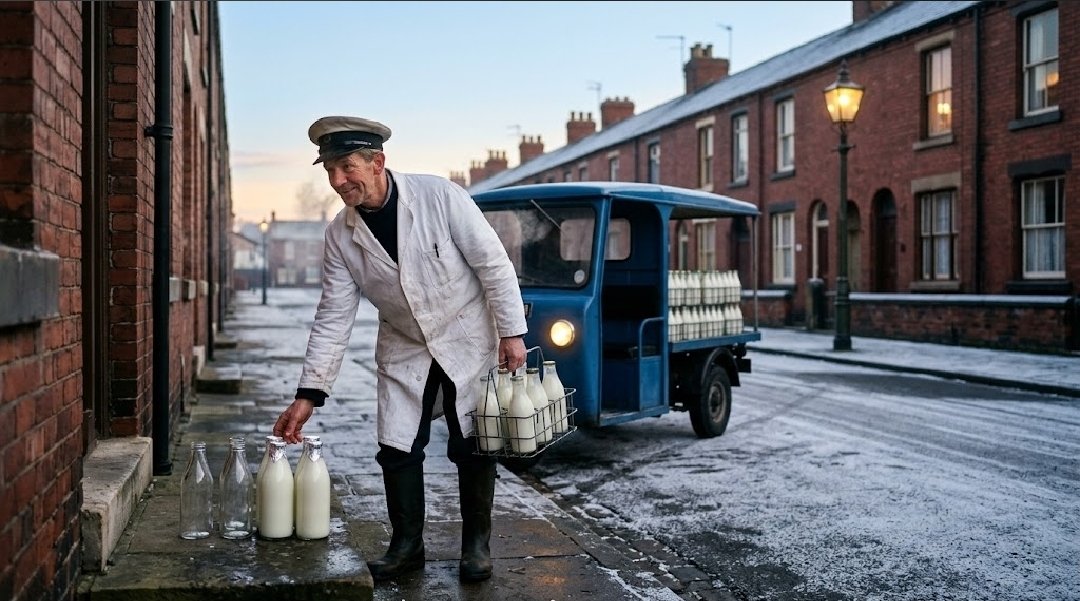
In 1967 Britain had more electric vehicles on its roads than every other country on earth put together, and they were all delivering milk.
There were tens of thousands of them. The milk float: open sided, battery under the floor, top speed of about 15 miles an hour, and a whine you could pick out in your sleep. It was charged overnight at the depot and was back there by lunchtime.
It carried glass bottles. Each one was collected from your step the next morning, washed and refilled. A bottle went round like that 20 or 30 times before it broke. The foil cap went for scrap. There was no other packaging.
The milk had come from farms within a few miles, through a local dairy, and was on the step before 7.
So here is what the country had. A zero-emission delivery fleet. Reusable containers with a return rate any modern scheme would kill for. No plastic. A supply chain you could cycle the length of. A man who noticed if an old lady's bottles were piling up, and knocked.
It was dismantled in about 15 years, because a supermarket could sell milk a few pence cheaper in a plastic jug as a way of getting you through the door.
Every piece of that system is now the subject of a government target for 2040.
It was running in 1967, silently, in the dark, and nobody thought it was worth a mention.
Three months ago today, Sony announced their predatory plan to end physical game media, leading to a global outrage that transcended gaming into all media, turning Sony into the subject of resentment and ridicule🚀
Here’s what all-digital future means:
❌No ownership
❌No preservation
❌No options
❌No second hand market or trading
❌Total reliance on internet/networks
❌Price increase on a whim w/o competition
❌Region locked “code in box” games
❌Being at the mercy or Sony’s terms
❌64% of the world lose access to games since they have no dedicated PlayStation Store to their countries
Here’s what Sony did after the outrage:
⬇️Double down, claiming that they’ve “carefully considered” the decision when they didn’t even bother informing their publishing partners according to reports
⬇️Sending players emails reminding them that the terms mean digital games aren’t owned by players
⬇️Ended partnership with Hideo Kojima suddenly mid June, on Metal Gear Solid’s spiritual successor type of action espionage called PHYSINT, which is now being published by XBOX
⬇️Argued in court that players don’t own digital games using a laughable argument pretending to be deliberately obtuse about ownership meaning
⬇️Insisted that players do not deserve any bit of the tariff refunds they received from the US
This has put Sony under such tough criticism due to their total disrespect for players and consumer’s rights:
👉Reports stated that the industry has an negative reaction from the industry causing great resentment towards Sony according ti studios and publishers who spoke with John Linneman or Digital Foundry
👉Reports came up stating that Sony is now surveying studios/publishers regarding how they feel about physical media giving a small hope that the decision could be overturned
Sony has based their entire decision on lies, greed, terrible management and total detachment from gamers and creators desires, and global markets:
✅Multiple games sold 40-50% physical in markets like UK, France, Japan and Australia
✅Per documents that surfaced, the industry calculates DLC, microtransactions, digital only and free to play games as “digital sales” which inflates their numbers
✅Various mainstream media outlets like NBC have reported on the matter, interviewing those speaking on the negatives of a digital only future, so this isn’t a niche internet outrage
✅Music, film, shows and books continue to be produced on physical media despite the existence of the digital alternative far more conveniently
✅Several industry legends have spoken in support of physical media, and expressed disappointment with ending it, including:
🫡Hideo Kojima
🫡Shuji Utsumi – SEGA President & COO
🫡Dan Houser – Rockstar Co-Founder
🫡Sohei Niikawa – Disgaea Creator
🫡Josh Fairhurst – Limited Run Co-Founder
🫡Yoko Taro
🫡Naoki Hamaguchi – FFVIIR Director
🫡Jean-Luc Mélenchon – French Politician
🫡GOG – spoke in support ownership of games as a must, digital and physical
Physical video game media must continue to be produced. We must speak out and never give up.
This is our most basic right as consumers to vote with our voices and wallets.
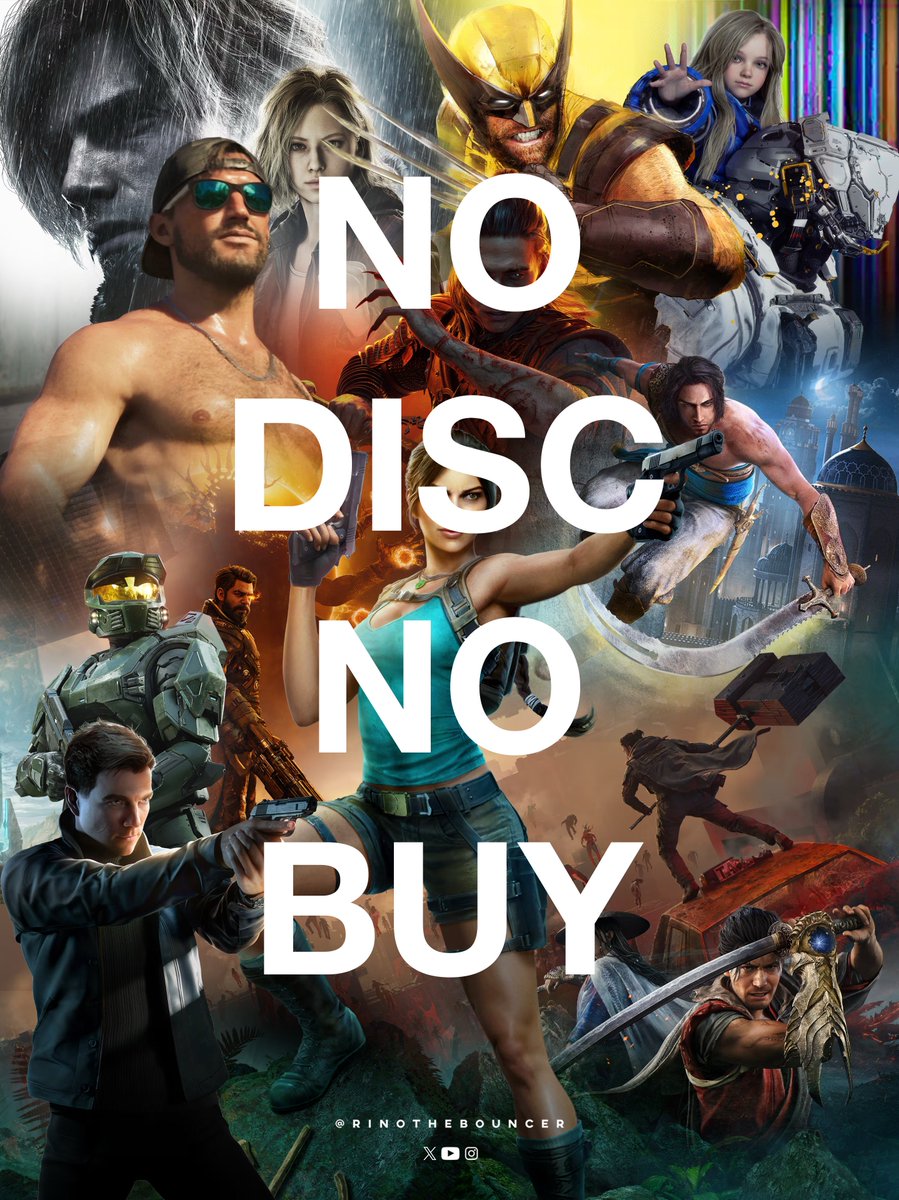
NO DISC 💿 NO BUY
Are you with me?💪🏼
At 220 degrees, nylon melts and runs. At 220 degrees, wool is a jumper.
At 250 degrees, polyester melts and sticks to the skin. At 250 degrees, wool is a jumper.
At 300 degrees, acrylic catches and drips burning plastic. At 300 degrees, wool is a jumper.
At 400 degrees, the fleece is a liquid. At 400 degrees, wool is a jumper.
At 500 degrees, the sofa is on fire. At 500 degrees, wool is a jumper.
At 570 degrees, wool finally chars, puts itself out, and stops.
That is why the seat under you on an aeroplane is wool.
That is why the Royal Navy stopped issuing nylon after 1982, when the men on the Sheffield found out what it does.
That is why a firefighter's station blanket was wool for a hundred years before anyone made an advert about it.
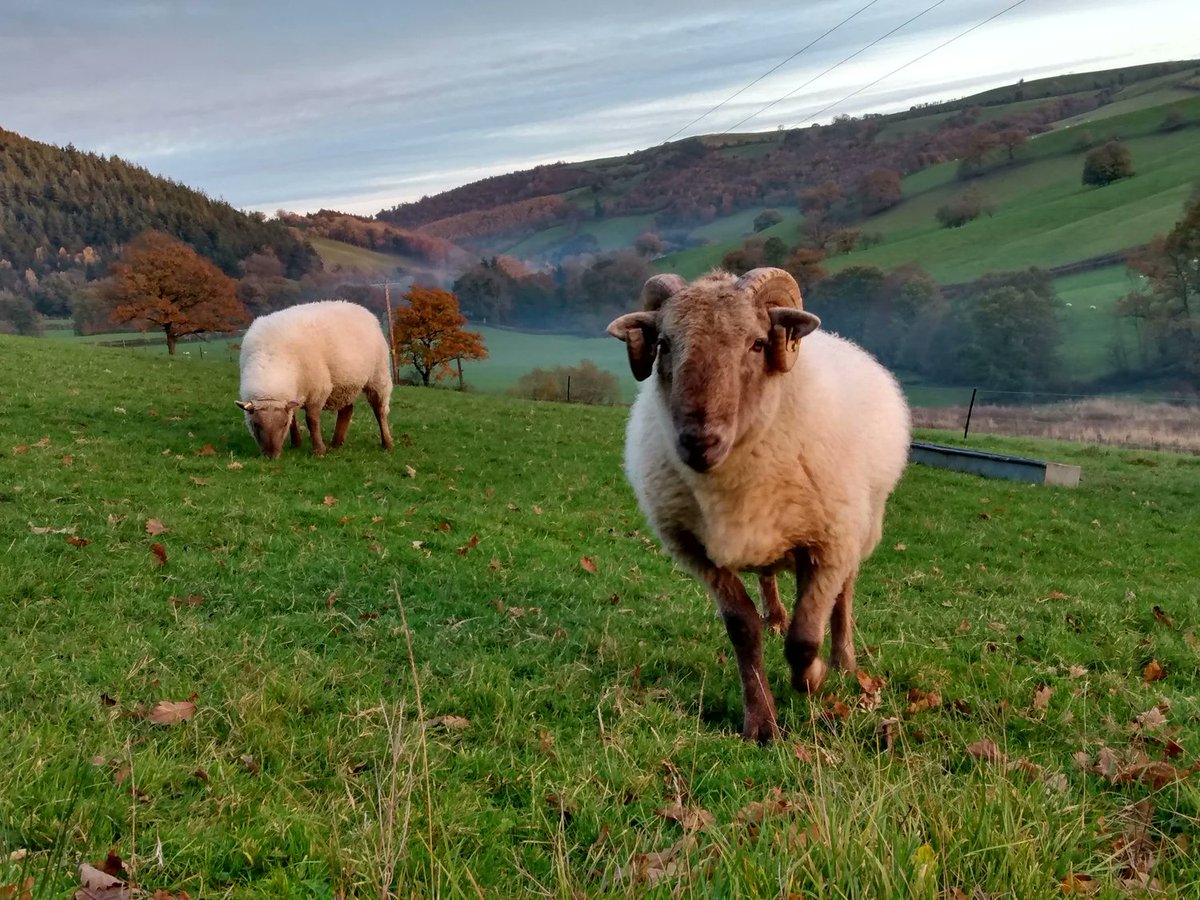
The sheep grows a fire-rated, self-extinguishing, water-shedding fabric on a hill in Wales for nothing.
The market price is below the cost of the haircut.
The replacement is petrol you can wear.
Lidl has put peas in the beef and written High Protein on the front.
The pea is hidden in a little black box, in a font you need a suspicious nature to read.
It isn't a pea. It's the beige powder left after yellow split peas are milled and soaked in alkali. Vegan shakes are made from it. It tastes of a wet cupboard and it costs a fraction of mince.
It's short of methionine. Beef isn't. So the 37g on the front is a bigger number doing a smaller job.
The cow spent 2 years turning plants into beef. Lidl has put the plants back in.
They took the fat out too. The flavour, the vitamins and the fullness left before the pea arrived. Food removed, crop added, and the word for that is High.
Nobody in a gym has ever read past High.
The reason isn't hidden. Lidl promised a quarter of its protein would be plant based by 2030. The meat-free aisle went grey. So the peas are going into the beef, where the customers are.
In Holland the same mince is already 40% pea. Britain hasn't been told its number.
Tesco printed Meat & Veg on the box in 2019. Dead in a year. Lidl moved the veg to the back.
Buy the ugly 20% mince with one ingredient. The animal already ate the peas.
RUMOR: Sony is said to have sent out a survey to developers asking them about how they feel regarding ending physical media, suggesting they are considering backtracking on the decision🚀
“There is a survey Sony sent out to developers that is, what I was told by my contacts, a bigger survey than they’ve sent almost ever before.
There was a question in it trying to ask in a not-direct way: Is there an issue with not selling games physically, asking developers for feedback on killing discs.
Wolverine is still selling plenty of physical copies and Sony is starting to ask devs if they are worried about killing physical, suggesting that if they got a bunch of feedback, maybe they would consider some sort of mea culpa.”
WE NEED TO KEEP THE PRESSURE!
BE LOUD 💪🏼 BE PERSISTENT
All of us together, PlayStation, Xbox’s, Nintendo, PC, Retro gamers!❤️💚💙🖤🤍
NO DISC 💿 NO BUY
Source: @mooreslawisdead
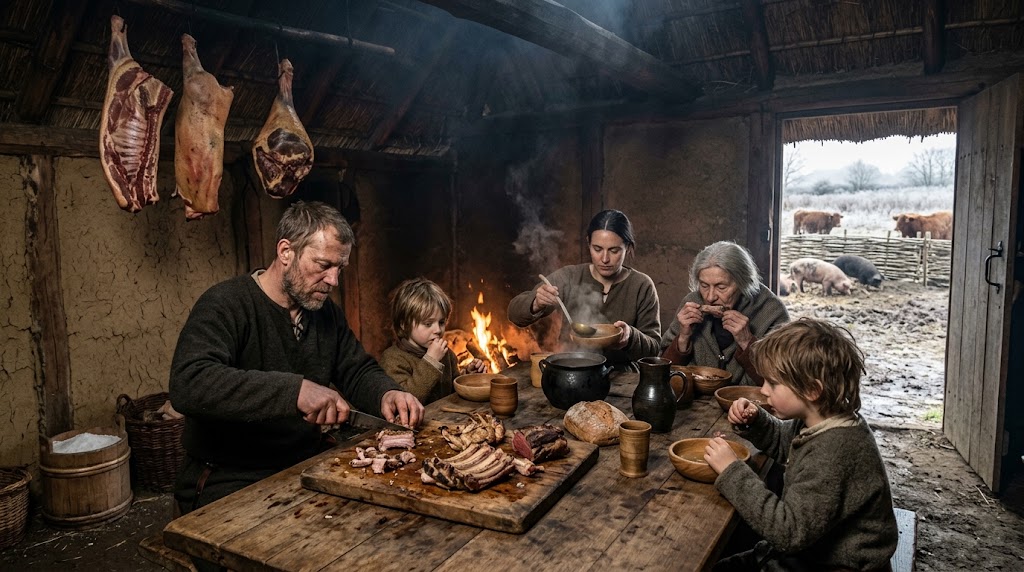
The Anglo-Saxon king and the Anglo-Saxon ploughman ate the same dinner. The hungry peasant watching his lord eat meat was brought to England by the Normans, and the bones prove it.
In 2022 a Cambridge team published the chemistry of 2,023 skeletons buried in England between the 5th and 11th centuries. Bone keeps a record of how much animal protein its owner ate. They sorted the dead by rank, the sword burials and the jewellery against the plain graves.
The bones matched. The thegn under his grave goods and the ceorl under nothing at all had eaten alike.
Anglo-Saxon England:
- Cnut's law: every free man may hunt on his own land.
- The king travelled to his farmers and ate with them.
- One feast list from Wessex, around 700: 300 guests, 1kg of meat a head.
- November was called Blotmonath, blood month, for the slaughter.
- Rich grave and poor grave, the same diet in the bone.
Then 1066, and about 8,000 Normans took possession of two million English.
Norman England:
- Every deer in the country became the king's.
- A third of England was put under forest law.
- The penalty for killing a hart was blinding.
- The rabbit and the dove belonged to the manor.
- By 1086 about 5% of the land was still in English hands.
- The cow, the sheep and the pig kept their English names in the field and took French ones at the table.
An English monk wrote the Conqueror's obituary in the Chronicle in 1087. He loved the stags, it says, as if he were their father.
In the later medieval graveyards the bones of rank and the bones of the village stop matching.
We picture the feasting lord and the starving peasant as the natural order of the old world. In England it came over on a boat, and it spoke French.
The first time ordinary English people could afford to eat meat, Parliament passed a law to stop them.
In 1256 the harvest workers on one Norfolk manor were fed a diet that was 4% meat by value. Most of the rest was bread. The deer belonged to the king, the rabbits to the lord, and the peasant to the pottage.
Then the Black Death killed half the country. Suddenly there were more fields than hands. The survivors could name their price, and they named it in beef.
1351: wages are frozen by law at their level before the plague. Asking for more is a crime, and every village is ordered to build a set of stocks for those who do.
1361: a labourer who leaves his lord for better pay is to be branded on the forehead with an F, for falsehood.
1363: a statute lays down what a servant may eat. Meat or fish once a day and no more.
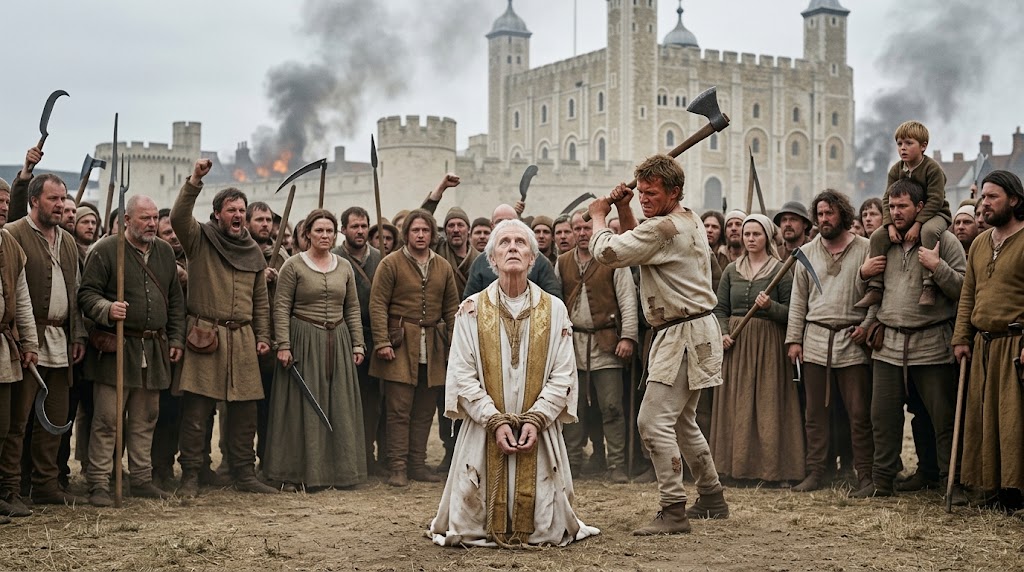
It held for 30 years. In June 1381 the ploughmen marched on London, took the Tower, and beheaded the Archbishop of Canterbury.
Wat Tyler put their demands to the king in person. An end to serfdom. And every park, warren, river and wood in England thrown open, so that a poor man might take game the same as a rich one.
At St Albans the rebels walked into the abbot's private warren, caught a rabbit, and tied it to the town pillory, as notice that the game was now theirs.
Tyler was stabbed at the meeting. The king, who was 14, took back every promise. Villeins you are, he told them, and villeins you shall remain.
9 years later came the reply to the rabbit.
1390: nobody worth under 40 shillings a year may keep a hunting dog, a ferret or a net, on pain of a year in prison. Parliament wrote its reasoning into the preamble. Labourers had been seen out hunting on holy days like gentlemen, and were using the hunts as cover to meet and plot another rising.
There were plenty of deer. What could not be tolerated was a ploughman with a haunch of venison, because a man who can feed himself can afford to say no.
The laws failed. Hands were too scarce, and by 1424 that same Norfolk manor was feeding its harvesters 28% meat.
The instinct behind the laws has never failed once. Whenever the poor get their hands on meat, somebody important discovers a reason they should not have it. The king's pleasure. The social order. Their cholesterol. The climate.
The reason is replaced every century. The people giving it have never once missed a steak.
Sony has been a mess of contradictions in every decision they made🚀
✅They want you to believe in an all-digital future, and in the same sentence, ended support for PS3/Vita digital store
✅They want you to believe the future is digital, meanwhile their digital library, especially for the PAID backwards compatibility on PS+ Premium, is abysmal, and has been that way for years
✅They cancelled a Hideo Kojima successor for Metal Gear and it’s been claimed it is due to high budget and long development time, meanwhile their studios shipped nothing of value, made overpriced games that hardly innovate, and some of them haven’t shipped a single game this generation
✅They proceeded to pay $4.7B to Bungie who released Marathon on PS5 and PC and sold 1 million less than Death Stranding 2, and funded Concord for reported figure of $400m and it lasted less than two weeks before it miserably shut down
✅They want you to trust them with you money, while assuring you nothing you buy is your own and they can take it at any time for any reason
✅They also emphasized on leveraging the word “harassment” as an excuse to cut off support, ban or even sue you, conveniently around the time everyone is outraged over their terrible policies and violating buyers rights, by redefining what “buy” means
✅They want you to spend like an adult while treating you like children, with little to respect or communication, and will vilify every criticism as “toxicity”
This is not the work of a competent leadership and Sony and PlayStation’s CEOs and execs must be fired and replaced with a competent team that actually values customers, trust and gaming as an art form, rather than rabidly pleasing their greed and that of their investors
NO KOJIMA 🫡 NO BUY
NO DISC 💿 NO BUY
Every three years in medieval England, the king's men went from cottage to cottage cutting the toes off the peasants' dogs.
It was called lawing. The dog's forefoot went on a block of wood, a chisel was set across three claws, and they came off with one blow of a mallet. The Charter of the Forest, 1217, records the correct method: three claws of the forefoot, but not the ball.
A dog with three toes missing cannot run down a deer. That was the entire purpose. A third of England was royal forest, every animal in it belonged to the king, and a poor man's dog was the one piece of hunting equipment he could not be stopped from owning. So they left him the dog and took its feet.
If the inspectors found yours intact, the fine was three shillings, about a month's wages. Before 1217 they simply took your ox.
No law ever told that man he could not eat meat. The law took his bow, his dog's toes and his right to the wood, then left him entirely free to work out the rest for himself. He worked it out. He ate oats and beans, and he raised children who ate oats and beans.
That is how it is always done. Meat is never banned for the poor. It just becomes, by one sensible regulation after another, impossible to get.
Count the sensible regulations being drafted for your dinner this year.
Procter & Gamble made soap. In 1911 they took an ingredient they had developed for soap, put it in a tin, and sold it to American women as food.
The ingredient was cottonseed oil. Cotton seed was what the mill threw away. It rotted in heaps by the roadside. The raw seed poisons pigs. The oil comes out red, bitter and stinking, and its other buyers made roofing tar and explosives.
P&G bought the mills, hardened the oil with hydrogen gas to make cheaper soap, and noticed that what came out of the vat looked exactly like lard.
So they called it Crisco, and they called it pure. Modern. Clean. Nothing like the dirty old butter and lard your mother used.
They gave away cookbooks with Crisco in every recipe. They found a rabbi to announce that the Hebrew race had been waiting 4,000 years for it.
Crisco launched in 1911. The first heart attack in the American medical literature was described in 1912.
Over the next 40 years Americans ate less and less butter, more and more of what was in P&G's tin, and heart disease became the biggest killer in the country.
Butter had an alibi. What P&G needed was somebody official to ignore it.
In 1948 the American Heart Association was a small club of doctors with no money. P&G's hit radio show ran a contest for them. Listeners posted in $1.75 million, and the club became the national authority on the human heart overnight.
In 1960 P&G launched Crisco Oil.
In 1961 the American Heart Association told the nation to swap butter for vegetable oil.
That advice is still on your doctor's wall.
Years later it came out that hardening the oil made trans fats, and trans fats were killing people. The industry pinned everything on that one word, changed the recipe, and declared margarine safe.
It was never only the trans fat. When doctors in Sydney moved heart patients off butter and onto plain safflower oil, more of them died. When Minnesota ran the biggest trial of all, on corn oil, the old people on the oil died faster. That result went into a basement for 40 years.
The problem is the oil. It is an industrial fat, washed out of seeds with a petrol solvent, bleached, and deodorised so you cannot smell what it is. It goes rancid in the bottle, in the fryer and in you, and it sits in your body fat for years. Americans now carry more than twice as much of it as their grandparents did.
P&G sold Crisco in 2002 and walked away.
The American Heart Association still sells its red tick to bottles of seed oil, for a fee.
Butter is cream, shaken. It has never once needed a radio show.
Every fibre a human being wore before 1935 came off an animal or out of a field.
Wool, linen, silk, leather, cotton, fur, hemp. Ten thousand years of it and nothing else.
Nylon arrived in 1935, from a DuPont laboratory, made out of coal and air.
Polyester followed in 1941, out of oil.
The fleece jacket arrived in 1979, spun from the same plastic as a fizzy drink bottle.
Polyester is now more than half of every fibre made on earth.
Every wash sends a few hundred thousand fragments of it down the drain.
In 2020 they found plastic in the human placenta.
In 2022 they found it in blood.
In 2024 they found it in the testicles of every man they tested.
In 2025 they weighed it in the brain and found the equivalent of a plastic spoon.
Meanwhile, in 2023, a Swaledale fleece off a Yorkshire hill fetched 5p a kilo.
Shearing her cost the farmer close to £2. He paid to have her wool taken away.
This year is the best wool year in a decade, and a fleece will just about cover the man who took it off.
The only fibre on earth that grows back every summer, insulates when wet, refuses to burn and rots quietly in a field when you are finished with it, is worth less than the labour of removing it.
The one they found in your blood is £200 a jacket.
The sheep has not been informed.
Former PlayStation executives Shuhei Yoshida and Adam Boyes recreated their iconic "how to share disc games on PS4" meme ... but this time with nothing in their hands after Sony's news on ending physical media
Activist: "Farmers won. The threshold's £2.5m now. Millionaires crying about tax."
Farmer: "What's this field worth?"
Activist: "I don't know. A lot."
Farmer: "About £10,000 an acre round here. I've got 400 acres. So, a millionaire. 4 times."
Activist: "Exactly."
Farmer: "It made £22,000 last year. My wife does the books and she didn't pay herself. That's about half a percent on the £4m you're looking at."
Activist: "Then sell some."
Farmer: "Sell 100 acres and I've got a farm too small to run and a bill on the rest. Sell the lot and I've got a house and no job. It's £4m the way your kidney is worth £100,000. True on paper. Try spending it."
Activist: "Other businesses pay inheritance tax."
Farmer: "Other businesses pay it out of what they make. Mine makes half a percent. The bill's 20% on everything over the line, so £300,000. That's 14 years of profit, if the weather holds for 14 years, which it has never once done."
Activist: "So you want a special exemption for being a farmer."
Farmer: "I want the tax to be on money. You've built one on soil. The man who buys my 100 acres to get out of paying it won't grow a thing on them, and the relief was there to stop him in the first place."
Activist: "You're crying poverty from a £4m farm."
Farmer: "I'm crying poverty from a £22,000 wage. The £4m is what a man in a suit will pay for my job. You keep confusing what he'll pay to take it with what I get for doing it."
1928, and a New York hospital agreed to try to kill a man with steak.
Vilhjalmur Stefansson had spent years in the Arctic living with the Inuit and eating what they ate, which was meat and fat and nothing that grew. He came home and said so, and every medical man in America told him he was either lying or lucky. Scurvy, they said. Kidneys. Blood pressure. Bowels. A man cannot live on meat alone, and any man who claims to has not tried it under supervision.
So he offered to try it under supervision. Bellevue Hospital, a research institute paying the bills, a ward, a nurse, and a doctor called Du Bois with every test in the building. Stefansson and a young Dane called Karsten Andersen moved in and ate nothing but meat for a year.
The doctors set the diet themselves to begin with. Lean meat, for science: the chops trimmed, the fat left off, protein and water.
Stefansson was ill inside 3 days. Sick, weak, his gut in revolt, the whole thing coming apart on the third morning. The men who had said meat would make him ill looked at each other.
He asked for the fat back.
Ribs, brisket, the fat left on, the bone marrow, the bacon, the trimmings. Within 2 days the sickness stopped and did not come back for the rest of the year. He had learned the rule in the Arctic, where a hunter with only lean meat starves with a full stomach, and the ward had just watched it happen to a man in a bed.
They ate about 2 pounds of meat a day each, the fat running at somewhere near 3 calories in 4. No fruit. No vegetable. No milk, even, for the whole 12 months. The nurse counted everything.
The scurvy never came. The kidneys were fine. The blood pressure was fine. The bowels, which everyone had been most excited about, were entirely uneventful. Both men lost a few pounds and finished the year in better condition than they started it, and the hospital had to sit down and write that up.
It was published in 1930. Nobody read it who could have used it. The next 50 years of dietary advice were written as if the ward had never existed, and the man who had lived a year on fat under a microscope was filed under explorer.
The fat was the finding. Take it off and the meat diet fails in 3 days. Leave it on and it runs for a year in a hospital bed with a nurse counting.
It is still in your fridge tonight, on the edge of the chop, waiting for you to stop trimming it.
This is Hiroki Totoki, Sony's current CEO, formally Sony's CFO.
He was appointed CEO on April 1st 2025. People are infuriated with Sony's recent decisions.
This is the person responsible for these decisions. His most famous quote is this.
"I'm very much obsessed with growth"