This also really surprised me.
Even at it's lowest point in the last decase (Covid), life expectancy for males in England has NEVER been lower than the HIGHEST it's ever been in Wales or Scotland...
In some very real sense, Ozempic was invented in 1990. Pfizer ran the human trials and just never published them.
They showed it lowered blood glucose in diabetics, slowed gastric emptying, and killed hunger; the same 3 things that make Ozempic work today.
The joint venture agreement said internal data stayed internal, and that was that. Pfizer killed the program in 1991. The reasoning, as far as I can tell, was that nobody would ever want an injectable diabetes drug besides insulin.
So, the license went back to the hospital in Boston that held the patents.
Novo picked it up in 1992 and spent the next two decades building liraglutide, then semaglutide.
It's insane that data sat in a filing cabinet for 30+ years.
I only know this because Jeffrey Flier, one of the Harvard scientists in the room, finally wrote it up. He's in his late 70s and didn't want the history to die with him.
This makes you wonder what else is in those filing cabinets.
Ozempic could've existed 27 years ago.
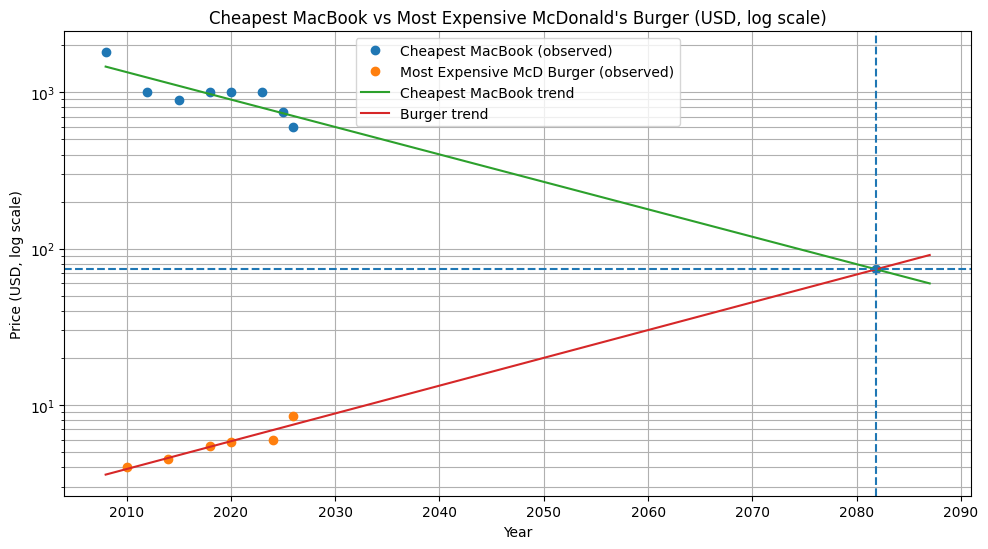
I've plotted the most expensive McDonald's burger and the least expensive MacBook over time. This analysis projects that the most expensive burger will be more expensive than the cheapest laptop as soon as 2081
In 20 years, vibe coders will look at the Linux kernel repo the way we look at the pyramids. In awe, unable to imagine how they managed to drag all those giant stones and pile them up in the middle of the desert.
What happens when a skill can be almost fully automated with AI? Do these jobs simply disappear?
Instead of purely speculating we can simply look at concrete examples. Take translators. Translation can be 100% automated with AI, and this capability has been around since 2023. So we have 2-3 years of data.
What we see so far:
- Stable FTE count, but slow hiring or no hiring
- Nature of the job switched from doing it yourself to supervising AI output (post-editing)
- Increased task volume
- Decreased hourly rates
- Freelancers getting cut
We are now starting to see the same pattern with software jobs.
Overall there's definitely some pressure on employment but we're very far from "the jobs just go away". In fact the number of full-time translators is still modestly increasing.
When the economy rebounds from the ongoing "stealth recession" and companies start hiring again, the world will have more professional software engineers than we did before GenAI.
The mass layoffs you're about to see in the tech sector won't be caused by job automation. They will be caused by fears about the economy, like in 2022. It won't be unrelated to AI, mind you, since it ties into big tech capex needs. But it won't be due to automation.
We hit a frontier in medicine this year.
This has been a concept since CRISPR was described. Today it's a reality.
You are probably living in the greatest age of human discovery.
You probably know the start of this Olympic story, but do you know how it finished?
This photo is of Eric Moussambani, aka 'Eric the Eel' from Equatorial Guinea, competing in the 100m Freestyle event at the Sydney 2000 Olympics, alone.
Why?
/1
Assembling and testing what will be Ghana's first patch clamp rig with @Tom_DAT as part of @wellcometrust and @IBROorg Neuroscience Capacity Accelerator for Mental Health scheme. Exited to ship and start using it in Accra soon.
@TheBARPod why don't you say that for every extra $5/month received from a generous donor, you give someone else ("in need") a freebie?
E.g. if I'm donating $10, you give 1 person "in need" a freebie...
Had the pleasure of writing about some of my ideas of how the African ML community can move from being consumers to creators of ML technology for the @DeepIndaba - https://t.co/Se05MrMo2o. 🌍