We tested leading video world models on their ability to predict simple physics and found that most fail within a few frames.
Today we're releasing MC-PhysBench, a new kind of benchmark that measures how long a model's output stays physically valid.
15+ models. 9 scenes. 6,000+ videos scored. 7 failure checks.
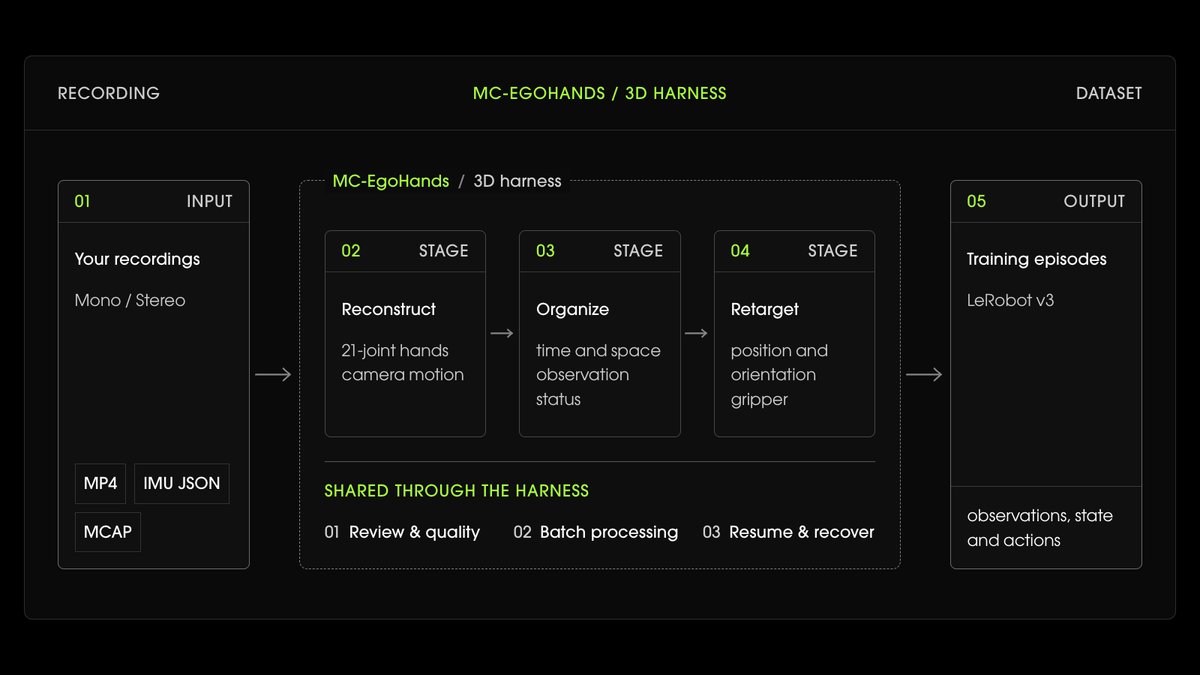
From any mono or stereo ego recording, MC-EgoHands:
1. Reconstructs both hands and the camera
2. Places them in a shared world frame
3. Smooths the motion over time
Frames where a hand wasn't seen are marked interpolated or missing. It then retargets each grasp's position, orientation, and hand opening to Panda/LIBERO or Yam.
How do you scale 2 million hours of ego data without sacrificing quality?
Earlier this week, we revealed the world’s largest egocentric dataset. Our frontier pipeline has also turned it into the most labeled, annotated, and human QA’ed robotics ego dataset in the world.
We’ve focused on some of the hardest problems in computer vision and ego data to ensure every clip contains SOTA action supervision directly helpful for training dexterous manipulation.
Excited to finally share what we’ve been building at @MidcenturyAI. We’re coming out of stealth with a $15M Series Seed to scale robotics beyond demos.
Physical AI is at an inflection point. EgoScale and Dyna have established a scaling law unlocked by human action data, and as pretraining scales, we’re seeing more generalist behavior and in-context learning emerge. Robotics is entering its scaling era and it’s time to embrace the bitter lesson.
But unlike LLMs, robotics can’t scrape the internet for pretraining data and real-world evaluation and RL don’t scale. That’s the gap we started Midcentury to close, and we’re already working with frontier labs on both sides of it.
Our thesis on data is simple: scale and enrichment are what matter. So we’ve built the world’s largest and most densely labeled egocentric dataset, with 2M+ hours across 20K+ tasks and SOTA action supervision.
On simulation, we’ve built Matrix, combining classical simulation, learned physics, and real-world data to close the sim-to-real gap and scale evaluation + RL.
We’ve brought together researchers and operators from the Stanford AI Lab, OpenAI, DeepMind, NVIDIA, Scale AI, and others who have built datasets, benchmarks, and models at the frontier of robotics and AI.
And we’re just getting started. We have a stacked slate of research releases coming, from SOTA 3D motion reconstruction from egocentric video to the first long-horizon physics-validity benchmark for world models.
Couldn’t be more excited to be building this with @dgmonsoon and a relentless team. Lots more coming soon!
We're ushering the era of ego data commoditization. Scale and quality of training corpus is the only thing that matters. If you're not aligned, you will get left behind
Finally able to share what we’ve been building at Midcentury.
I joined for the depth of the team and the pace and ambition of the research. I lead our robotics research, focused on how robots can learn from the work people already do.
There’s a lot between recording human skill and teaching a robot to use it. We’re working across that gap: selecting useful data, reconstructing 3D motion, studying how human and robot experience fit together in training, and building better ways to evaluate robot behavior.
What excites me is following that whole path, from the data to what a robot can actually do, with a team that can tackle each part.
Today, @MidcenturyAI is coming out of stealth with $15M in seed funding to advance robot learning through large-scale data and simulation.
Our team brings together researchers and engineers from Stanford AI Lab, OpenAI, DeepMind, NVIDIA, and more, with experience spanning RoboNet, GDPVal, and NVIDIA Cosmos 3.
Excited to finally share what we’ve been working on.
What makes robotics such a compelling research problem is the sheer variety of the physical world. A useful robot needs to generalize across objects, environments, and tasks, and recover when things don’t go as expected.
We believe scaling that capability requires both diverse human action data and environments where robot policies can be evaluated and improved through repeated experimentation.
At Midcentury, we’re building both:
> 2M+ hours of egocentric human activity across 50+ environments and 20,000+ tasks, paired with rich action supervision to help robots learn from human behavior.
> Matrix, a simulation platform combining classical simulation, learned physics, and real-world data for policy evaluation and post-training at scale.
We’re already supporting frontier labs working on these problems. What excites me most is the research this enables: understanding how robots can learn transferable skills from human experience and turn those skills into reliable physical work.
Proud to be building this with our team @ckxyz_@dgmonsoon@notnoahphan@sorozco0612@micholco@addeagupta@B_S_N_Y@robot_xyz_rpy
If you’re working on robot learning, simulation, or embodied intelligence, I’d love to connect. We’re hiring.
https://t.co/pJrVpFCv1d
Introducing Midcentury.
We’re building the data and simulation infra for physical AI.
Today, we’re coming out of stealth with a $15M Series Seed to scale robotics beyond polished demos.
We’re already supporting frontier labs with:
→ The world’s largest egocentric dataset: 2M+ hours, 50+ environments, 20,000+ tasks
→ Matrix: a frontier simulation platform scaled with our real-world data to evaluate and post-train policies at scale
We're out of stealth!! Data is the bottleneck for robotics, and the bet we're making is that human action data is how you break it. Not raw video, but millions of hours of real work enriched frame by frame with the pose, depth, and tactile signal that makes it something a robot can actually learn from. That's the machine I get to help run at Midcentury. The next era of physical AI gets built on top of it. Let's go 🚀
Introducing Midcentury.
We’re building the data and simulation infra for physical AI.
Today, we’re coming out of stealth with a $15M Series Seed to scale robotics beyond polished demos.
We’re already supporting frontier labs with:
→ The world’s largest egocentric dataset: 2M+ hours, 50+ environments, 20,000+ tasks
→ Matrix: a frontier simulation platform scaled with our real-world data to evaluate and post-train policies at scale
Today we’re introducing GDPval, a new evaluation that measures AI on real-world, economically valuable tasks.
Evals ground progress in evidence instead of speculation and help track how AI improves at the kind of work that matters most.
https://t.co/uKPPDldVNS
Our latest paper is out now in @jmirpub: https://t.co/7tJgZWkQrH.
Together with my co-first author @ColinMagdamo and our incredible team at @MassGenBrigham, we developed a semi-automated NLP-powered annotation tool (NAT) to facilitate phenotyping of cognitive status. 🧵 1/15