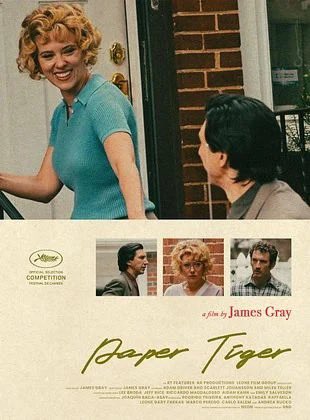
Dommage qu’il n’y avait personne dans le jury de #Cannes2026 pour rappeler que rejeter «Paper Tiger» de #JamesGray, ce n’était pas seulement rater un grand film. C’était insulter un des plus grands cinéastes de notre temps, jamais primé sur la Croisette en 7 participations
💼 L'Alliance Française de Nagoya recrute dans la communication, les relations publiques et le marketing !
⏰ Date limite de candidature : 31/05
🔗 https://t.co/319rcM1Yju
À 21h sur France 4 «Decision to Leave» est une leçon de cinéma de Park Chan-wok. Le président du jury de #Cannes2026 conjugue romance et enquête criminelle dans une intrigue hitchcockienne qui télescope manipulation et amour fou. Le travail sur la lumière et les cadrages éblouit
Dès aujourd'hui sur le site d'@ARTEfr : la #série "Ashes to Ashes", une savoureuse comédie policière au cœur des années 80, par les créateurs de la cultissime série "Life on Mars", également en ligne
https://t.co/WzHadmOIrs
He's reading a 1,353-year-old document that a Buddhist monk spent 25 years putting together, one character at a time.
Around 1,400 years ago, an emperor of China named Taizong wanted some text carved onto a stone tablet, written in the handwriting of Wang Xizhi, considered China's greatest calligrapher. Wang Xizhi had been dead for nearly 300 years.
So a Buddhist monk named Huairen, along with 40+ helpers, took on the project. They went through the emperor's archives, private collections, old letters, anywhere Wang had ever written something. They pulled out individual characters, traced them, and resized them. When a character couldn't be found anywhere, they took pieces from other characters and built new ones, like Lego. 1,903 characters in total. The emperor spent so much from the royal treasury hunting down missing characters that the finished tablet earned a nickname: the Thousand Gold Stele.
That stone tablet still stands today, in a museum in Xi'an. For 1,353 years, people have been pressing paper onto it and rubbing ink over the carved characters to make copies. The image on his iPad is a digital scan of one of those rubbings.
Wang Xizhi (303-361 AD) is called the Sage of Calligraphy, basically the Shakespeare of Chinese handwriting. Out of 100 famous calligraphers from his lifetime, 20 belonged to his family. His children all became calligraphers. He practiced so much that legend says the pond outside his house turned black from washing his brushes.
Yet not one original Wang Xizhi work survives. Everything is a copy, a tracing, or a stone rubbing.
His most famous piece, the Lantingji Xu (Orchid Pavilion Preface), was written drunk at a poetry party in 353 AD. 324 characters. The Chinese character 之 appears in it 20 times. Wang wrote each one differently. The next morning, sober, he tried to recreate the piece more than 100 times. He never matched the original.
Three centuries later, that scroll ended up with a monk named Biancai. Emperor Taizong got fixated on owning it. He sent messengers three times. Biancai lied each time. So Taizong sent a court official disguised as a wandering scholar, who spent months befriending Biancai, then stole the scroll and rode back to the capital.
When Taizong died in 649 AD, the original Lantingji Xu was buried with him. It has been lost ever since.
In 2010, a 41-character fragment from another Wang piece (Ping'an Tie) sold at a Beijing auction for 308 million yuan, or $46 million. That's roughly $1.13 million per character. And it was a copy.
So what's on his iPad is a digital scan of a paper rubbing of a stone tablet that monks built character by character because Wang Xizhi's actual handwriting was so coveted, one emperor stole it, another was buried with it, and every Chinese calligrapher since has been chasing its ghost.
Munching snacks on a train is the right energy for that.
🇪🇺🎞 Pour la Journée de l' #Europe le 9 mai, @ARTEfr met à l'honneur des jeunes cinéastes européens avec 7 courts métrages primés par les Académies européennes du #cinéma, sur https://t.co/H2Ijv8g0eq, YouTube ARTE Cinéma & YouTube Courts Toujours
Le CP ➡https://t.co/P9S3wok5FE
Les producteurs ont charcuté Lola Montès contre la volonté d’Ophüls. Truffaut et toute la Nouvelle Vague ont crié au scandale.
Ophüls, lui, est mort sans voir son film réhabilité.
Aujourd’hui, c’est un chef-d’œuvre. Avec Martine Carol, Peter Ustinov, Anton Walbrook
« Citizen Kane est l'un des rares films qui ont contribué à l'évolution de l'art cinématographique… #OrsonWelles a réconcilié le cinéma muet et le cinéma parlant. Le langage cinématographique a pu reprendre sa marche triomphale. »
Jean Douchet, critique et cinéaste
🎞 A l'occasion du 79ème Festival de Cannes (12 - 23.05), @ARTEfr propose à l'antenne et en ligne une riche programmation de films sélectionnés ou distingués lors des éditions précédentes.
Dès aujourd'hui : une soirée Pedro Almodóvar / Antonio Banderas.
#Cinéma#FestivalDeCannes
Si vous ne connaissez pas, je vous partage https://t.co/oOsOFZEGrL, un site qui centralise les catalogues des films dispos sur les plateformes de streaming légal 'arte, francetv ...)
Diffusion ce soir à 20h sur @franceculture. Avec Fausto Fasulo et Stephane Du Mesnildot autour de @frangeliers et notre invité Jean-François Rauger. En chronique «La Guerre des gangs» digibook @ArtusFilms la mort de Mario Adorf et @Reflet_Diamant en blu-ray chez @UFODISTRIBUTION
Pour ceux qui se posent la question, la magnifique chorégraphie est de Damien Jalet, chorégraphe belge.
Journée internationale de la danse aujourd’hui. Regardez ces 3 minutes
Cambiar la ubicación de la cámara al mostrar una misma acción repetida debería siempre guardar justificación de algún tipo. Fijaos como Michael Haneke en la magnífica Caché (2005) hace buen uso de ello en las 4 ocasiones en que Auteil visita la casa de Majid 1/4