Pages of the Glorius Qur'ān today, Tuesday 11/8/26, al-Naḥl (16): 119-128 & al-Isrā'i (17): 1-7, tafakkur verse 16: 119
Theme: the greatest of all sins is to despair in or give-up on the mercy and forgiveness of Allah
{ثُمَّ إِنَّ رَبَّكَ لِلَّذِینَ عَمِلُوا۟ ٱلسُّوۤءَ بِجَهَـٰلَةࣲ ثُمَّ تَابُوا۟ مِنۢ بَعۡدِ ذَ ٰلِكَ وَأَصۡلَحُوۤا۟ إِنَّ رَبَّكَ مِنۢ بَعۡدِهَا لَغَفُورࣱ رَّحِیمٌ}
"Then, indeed your Lord, to those who have done wrong out of ignorance and then repent after that and correct themselves - indeed, your Lord, thereafter, is Forgiving and Merciful".
LESSONS:
1. No sinner should despair of Allah’s mercy. Human beings make mistakes, sometimes through ignorance, weakness, passion or poor judgement. Yet Allah leaves the door of return open. A sinful past does not prevent a person from attaining righteousness when repentance is sincere.
2. Knowing something is wrong does not necessarily remove the element of jahālah (ignorant or foolish conduct). In Qurʾānic usage, ignorance can describe behaving foolishly under the influence of anger, desire or heedlessness, even when one possesses some knowledge. Sin itself reflects a moment in which knowledge fails to govern behaviour.
3. True repentance must produce change. The verse joins repentance with iṣlāḥ (reformation): “then repent afterwards and correct themselves.” Repentance is therefore more than verbal regret. The believer abandons the wrongdoing, regrets it, resolves not to return to it and, where the rights of others were violated, makes appropriate efforts to repair the harm.
4. People should be allowed to become better than their past. Islam does not encourage us to permanently define a person by an offence from which they have genuinely repented and reformed. If Allah accepts repentance, believers should be cautious about continually humiliating people with mistakes they have sincerely abandoned.
5. Allah ends the journey from sin with forgiveness and mercy. After mentioning wrongdoing, repentance and reform, the verse declares that Allah is Forgiving and Merciful. This teaches us that Islam is not merely concerned with identifying wrongdoing; it seeks the restoration of the wrongdoer. The lesson is therefore not that mistakes do not matter, but that mistakes need not have the final word: repentance, reform and the mercy of Allah can write a better ending.
O Allah, our Lord, You are the Most Forgiving, the Most Merciful. Forgive us for the wrongs we have committed knowingly and unknowingly, openly and secretly, deliberately and through weakness or ignorance. Āmīn.
Pages of the Glorius Qur'ān today, Monday 10/8/26, al-Naḥl (16): 103-118, tafakkur verse 16: 115
Theme: Allah’s Law Combines Firm Principles with Mercy in Necessity
{إِنَّمَا حَرَّمَ عَلَیۡكُمُ ٱلۡمَیۡتَةَ وَٱلدَّمَ وَلَحۡمَ ٱلۡخِنزِیرِ وَمَاۤ أُهِلَّ لِغَیۡرِ ٱللَّهِ بِهِۦۖ فَمَنِ ٱضۡطُرَّ غَیۡرَ بَاغࣲ وَلَا عَادࣲ فَإِنَّ ٱللَّهَ غَفُورࣱ رَّحِیمࣱ}
"He has only forbidden to you dead animals, blood, the flesh of swine, and that which has been dedicated to other than Allāh. But whoever is forced [by necessity], neither desiring [it] nor transgressing [its limit] - then indeed, Allāh is Forgiving and Merciful".
LESSONS:
1. Allah alone determines what is lawful and unlawful. The verse identifies prohibited foods, carrion, blood, swine, and what has been dedicated to other than Allah. A believer therefore submits dietary choices to divine guidance rather than merely personal preference or prevailing culture.
2. Tawḥīd extends even to what we eat. The prohibition of an animal dedicated to other than Allah demonstrates that worship and everyday life cannot be completely separated in Islam. A Muslim's food, earnings, relationships, and conduct are all connected to devotion to Allah.
3. Necessity changes the application of the ruling, not the ruling itself. Allah says, “But whoever is forced by necessity…” What is ordinarily forbidden may become permissible when genuinely necessary to preserve life or prevent serious harm. This is reflected in the juristic maxim al-ḍarūrāt tubīḥ al-maḥẓūrāt, necessities permit what would otherwise be prohibited.
4. Concessions themselves have limits. The words “neither desiring it nor transgressing its limit” prevent necessity from becoming an excuse for indulgence. One takes only what the genuine necessity requires. This illustrates another important principle: concessions in the Sharīʿah are disciplined by their purposes and circumstances.
5. Allah's legislation is inseparable from His mercy. The verse ends, “Indeed, Allah is Forgiving and Merciful.” The Sharīʿah does not demand that a person destroy himself merely to observe an ordinary prohibition. When genuine hardship threatens essential human welfare, Allah provides lawful relief. Thus, obedience and mercy are not opposites: the concession itself is part of obedience to the Merciful Lawgiver.
O Allah, provide us with what is lawful and wholesome, and keep us away from what is forbidden and impure. Grant us excellence in following Your commands and observing Your limits. O Allah, grant us understanding of Your religion and teach us the wisdom of Your law. Do not burden us with what we cannot bear. When necessity befalls us, grant us insight and moderation, and do not allow us to turn Your concessions into excuses for following our desires. Forgive us and have mercy upon us. Indeed, You are the All-Forgiving, the Most Merciful. Āmīn.
Pages of the Glorius Qur'ān today, Sunday 9/8/26, al-Naḥl (16): 88-102 tafakkur verse 16: 97
Theme: Righteousness is not measured by gender or subjective to gender bias, both men and women are required to be good believers and righteous in deeds
{مَنۡ عَمِلَ صَـٰلِحࣰا مِّن ذَكَرٍ أَوۡ أُنثَىٰ وَهُوَ مُؤۡمِنࣱ فَلَنُحۡیِیَنَّهُۥ حَیَوٰةࣰ طَیِّبَةࣰۖ وَلَنَجۡزِیَنَّهُمۡ أَجۡرَهُم بِأَحۡسَنِ مَا كَانُوا۟ یَعۡمَلُونَ}
"Whoever does righteousness, whether male or female, while he is a believer - We will surely cause him to live a good life, and We will surely give them their reward [in the Hereafter] according to the best of what they used to do".
LESSONS:
1. Righteousness is open to both men and women. Allah makes no distinction between male and female in access to spiritual excellence and divine reward. What ultimately gives a person worth before Allah is sincere faith expressed through righteous conduct.
2. Faith and good deeds belong together. The verse connects īmān with righteous action. Faith is not merely something professed by the tongue; its fruits should appear in our worship, character, family relationships, work, honesty, compassion, and dealings with others.
3. The “good life” is greater than material wealth. Allah promises the believer who acts righteously a ḥayāh ṭayyibah, a wholesome and blessed life. It may include lawful provision and worldly comfort, but more importantly, it includes contentment, tranquillity, dignity, gratitude, and a heart that remains connected to Allah even during hardship.
4. True success combines this world and the Hereafter. Islam does not teach us to abandon this life in pursuit of the next. Righteousness brings meaning and goodness to our present existence while preparing us for an infinitely greater reward after death. The believer therefore builds the worldly life without sacrificing the eternal one.
5. No righteous deed is wasted with Allah. Acts of worship, kindness to one's family, honest labour, helping the needy, serving society, forgiving others, and resisting what Allah has forbidden may sometimes go unnoticed by people, but never by Allah. He promises to reward His servants according to the best of what they used to do. Therefore, live righteously even when nobody is watching or applauding, Allah sees, records, and rewards.
May Allah grant us sincere faith and righteous deeds, bless us with a good, peaceful, dignified, and wholesome life, place contentment in our hearts and barakah in our provisions, families, health, knowledge, and endeavours. May He make us steadfast in obedience in ease and hardship, accept the best of our deeds, forgive our shortcomings, and grant us a reward far greater than what we deserve. May our lives be pleasing to Him, our deaths be upon faith, and our final abode be al-Firdaws. Āmīn.
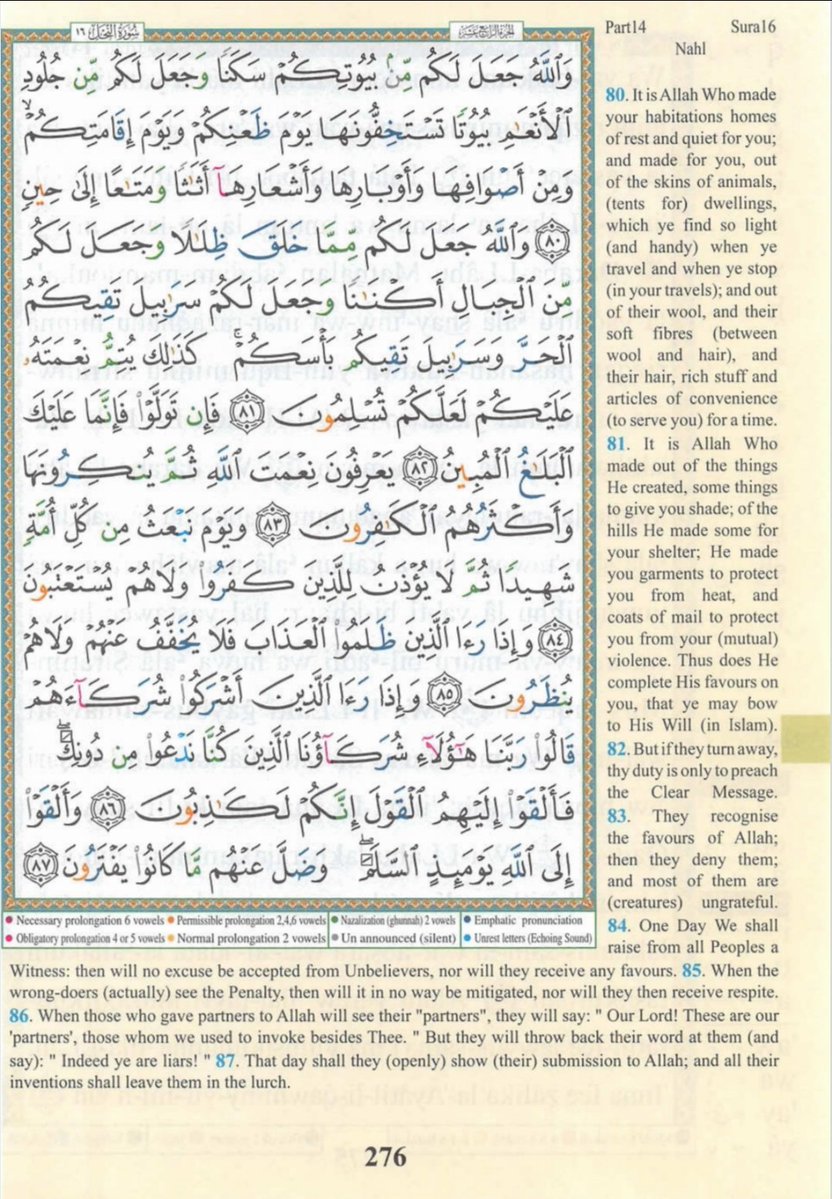
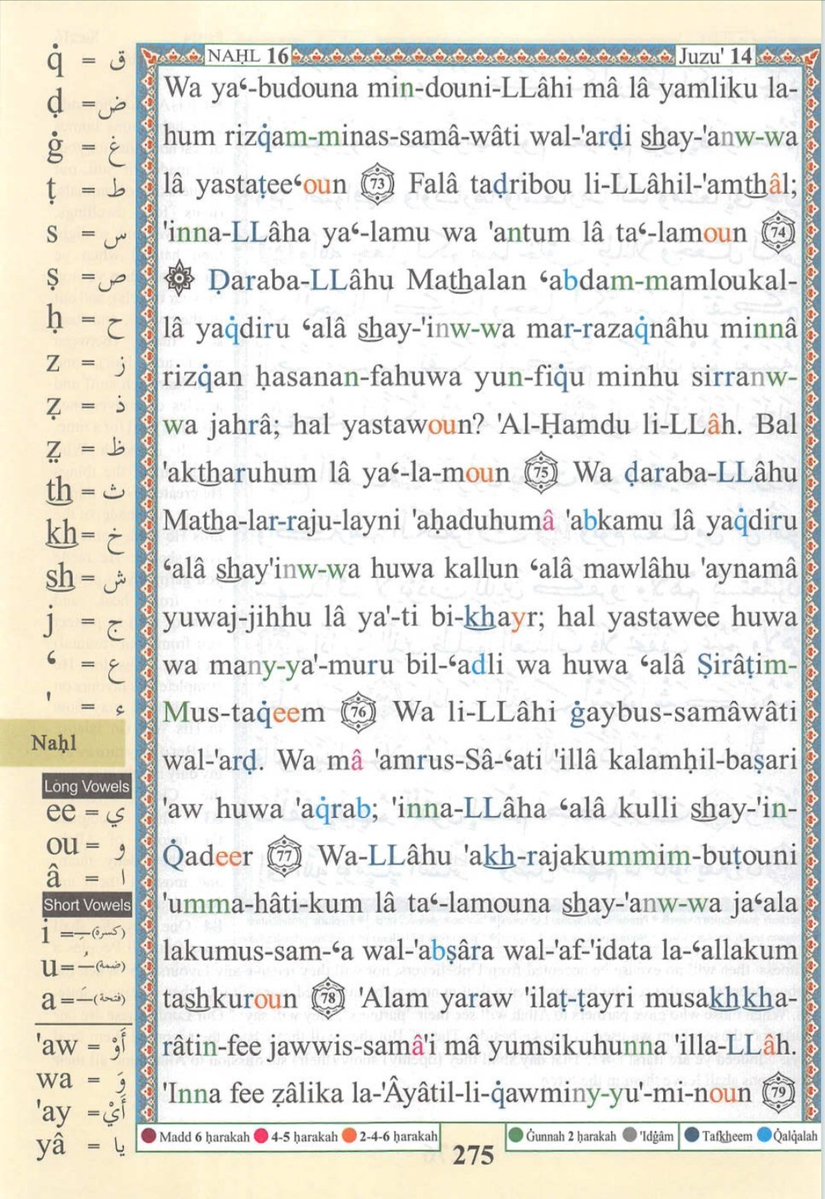
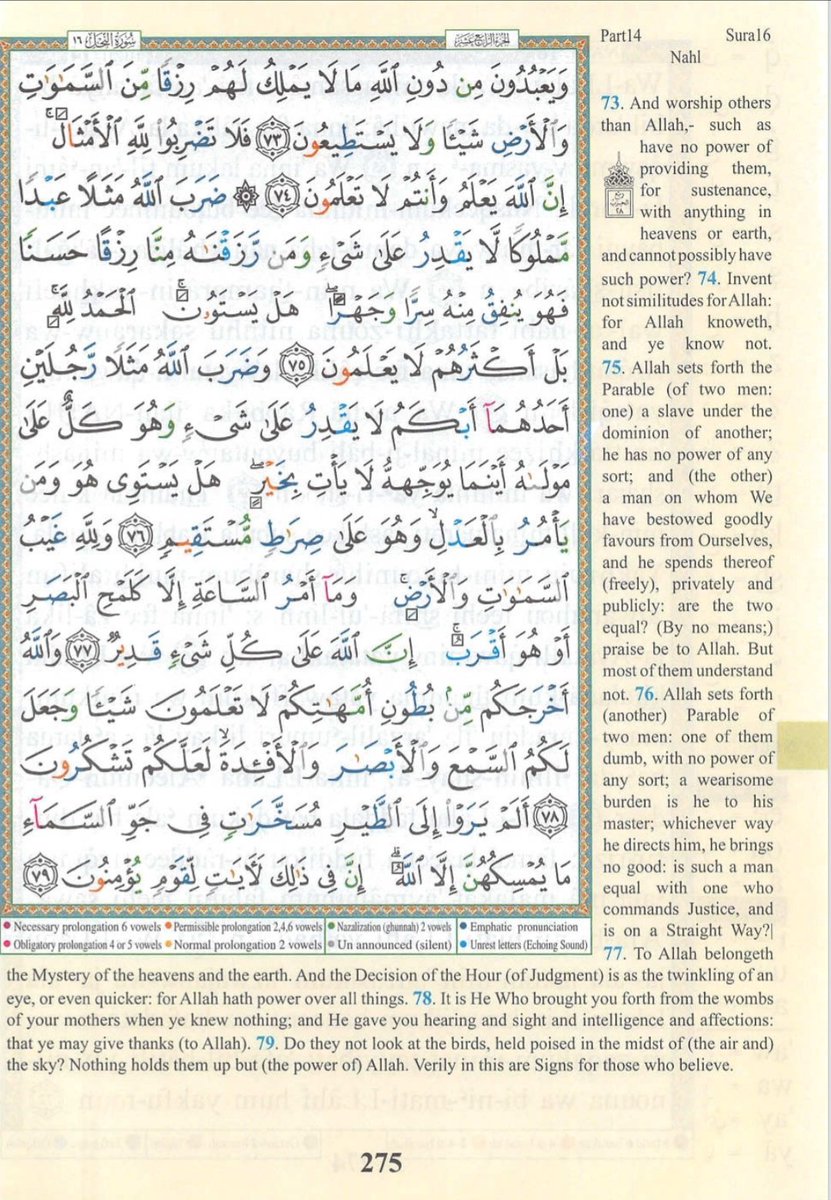
Pages of the Glorius Qur'ān today, Saturday 8/8/26, al-Naḥl (16): 73-87, tafakkur verse 16: 79
Theme: Birds are Signs of Allah
{أَلَمۡ یَرَوۡا۟ إِلَى ٱلطَّیۡرِ مُسَخَّرَ ٰتࣲ فِی جَوِّ ٱلسَّمَاۤءِ مَا یُمۡسِكُهُنَّ إِلَّا ٱللَّهُۚ إِنَّ فِی ذَ ٰلِكَ لَـَٔایَـٰتࣲ لِّقَوۡمࣲ یُؤۡمِنُونَ}
"Do they not see the birds controlled in the atmosphere of the sky? None holds them up except Allāh. Indeed in that are signs for a people who believe*.
LESSONS:
1. The Qur’an invites us to observe nature thoughtfully. Allah says: “Do they not see the birds controlled in the atmosphere of the sky? None holds them up except Allah. Indeed in that are signs for a people who believe” (Qur’an 16:79). A bird in flight is therefore more than a beautiful sight; it is a sign pointing to the wisdom and power of its Creator.
2. The science of flight makes this sign even more remarkable. A bird’s wings generate lift and thrust while its feathers control airflow, balance and direction. Gravity continues to act, yet the bird remains airborne through an extraordinary harmony of wings, air, movement and physical laws. Allah’s sustaining power does not exclude these natural mechanisms; He created them.
3. The bird’s body is wonderfully suited for flight. Its lightweight but strong skeleton, powerful muscles, efficient respiratory system and specialised feathers work together with remarkable precision. Even a simple turn or landing requires the coordinated activity of the brain, eyes, nerves, muscles, wings and tail.
4. Bird migration reveals another astonishing dimension. Some birds travel thousands of kilometres across oceans, deserts and continents. They navigate using combinations of the sun, stars, landmarks, smell and even Earth’s magnetic field. Some young birds undertake long migrations without having travelled the route before. Science explains aspects of how this happens; faith asks who endowed them with these extraordinary abilities.
5. The miracle is not the absence of natural laws, but their astonishing harmony. Gravity, air, wings, feathers, muscles, lungs, senses and instinct all work together to make flight possible. Science helps us understand how birds fly; the Qur’an teaches us to reflect on what that magnificent order signifies. The deeper we study creation, the more reasons we discover to marvel at the wisdom, knowledge and power of Allah.
O Allah, Creator of the heavens and the earth, just as You hold the birds in the sky and guide them across vast distances, guide us upon the straight path and sustain us through every journey of life. Open our eyes to Your signs, increase us in beneficial knowledge, strengthen our faith through reflection upon Your creation, provide for us from where we do not expect, and never leave us to ourselves. Grant us hearts that recognise Your greatness and tongues that remain grateful to You. Āmīn.
Pages of the Glorius Qur'ān today, Friday 7/8/26, al-Naḥl (16): 55-72, tafakkur verse 16: 70
Theme: Alah is the Creator and the Perfect Planner of all affairs
{وَٱللَّهُ خَلَقَكُمۡ ثُمَّ یَتَوَفَّىٰكُمۡۚ وَمِنكُم مَّن یُرَدُّ إِلَىٰۤ أَرۡذَلِ ٱلۡعُمُرِ لِكَیۡ لَا یَعۡلَمَ بَعۡدَ عِلۡمࣲ شَیۡـًٔاۚ إِنَّ ٱللَّهَ عَلِیمࣱ قَدِیرࣱ}
"And Allāh created you; then He will take you in death. And among you is he who is reversed to the most decrepit [old] age so that he will not know, after [having had] knowledge, a thing. Indeed, Allāh is Knowing and Competent".
LESSONS:
1. Allah alone controls the stages of human life. From creation to death, every phase of our existence is under His complete knowledge and power.
2. Old age is a reminder of human weakness. Some people live long enough to experience a decline in memory, reasoning, and physical ability, becoming almost like children again. This humbles those who rely on their own strength or intellect.
3. Knowledge is a gift from Allah. Just as He grants knowledge, He can also remove it. Therefore, no one should become arrogant because of learning or intellectual ability.
4. The verse encourages gratitude and compassion. We should thank Allah for our mental and physical faculties while they remain and show patience, kindness, and respect to the elderly whose abilities have diminished.
5. An eschatological reflection. The gradual loss of strength and knowledge reminds us that this worldly life is temporary. Human power inevitably fades, directing the believer to prepare for the everlasting life of the Hereafter, where neither old age nor decay exists for the people of Paradise.
The closing words, "Indeed, Allah is All-Knowing, All-Powerful" (إِنَّ اللَّهَ عَلِيمٌ قَدِيرٌ), contrast human frailty with Allah's perfect and eternal knowledge. While human beings may gain knowledge and later lose it, Allah's knowledge never diminishes, and His power is never weakened. This contrast calls the believer to humility, reliance upon Allah, and constant preparation for the meeting with Him.
O Allah, You created us and to You is our return. Bless us with lives spent in obedience to You and grant us a good ending. Do not let our knowledge become a proof against us, but make it beneficial for us and for others. Preserve our minds, our memory, our faith, and our dignity for as long as You keep us alive. If You decree old age for us, make it an age filled with patience, remembrance of You, and acceptance of Your decree. Protect us from being returned to a state that causes us to forget You or neglect our duties. Forgive our sins, have mercy on our parents and elders, grant ease to those weakened by age or illness, and admit us into Your everlasting Paradise, where there is no weakness, no forgetfulness, and no death. Indeed, You are the All-Knowing, the All-Powerful. Āmīn.
Pages of the Glorius Qur'ān today, Thurday 6/8/26, al-Naḥl (16): 35-54, tafakkur verse 16: 36
Theme: The Universal Call to Tawḥīd and the Rejection of Ṭāghūt
{وَلَقَدۡ بَعَثۡنَا فِی كُلِّ أُمَّةࣲ رَّسُولًا أَنِ ٱعۡبُدُوا۟ ٱللَّهَ وَٱجۡتَنِبُوا۟ ٱلطَّـٰغُوتَۖ فَمِنۡهُم مَّنۡ هَدَى ٱللَّهُ وَمِنۡهُم مَّنۡ حَقَّتۡ عَلَیۡهِ ٱلضَّلَـٰلَةُۚ فَسِیرُوا۟ فِی ٱلۡأَرۡضِ فَٱنظُرُوا۟ كَیۡفَ كَانَ عَـٰقِبَةُ ٱلۡمُكَذِّبِینَ}
"And We certainly sent into every nation a messenger, [saying], Worship Allāh and avoid ṭāghūt. And among them were those whom Allāh guided, and among them were those upon whom error was [deservedly] decreed. So proceed [i.e., travel] through the earth and observe how was the end of the deniers".
LESSONS:
First, it establishes the unity of the message of all Prophets. From Ādam to Muḥammad (ṣallallāhu ʿalayhi wa sallam), every Messenger called his people to two inseparable foundations: the worship of Allah alone (tawḥīd) and the rejection of ṭāghūt, everything that is worshipped, obeyed, or followed in defiance of Allah. Thus, Islam is not a new religion but the continuation and perfection of the same divine message delivered to every nation.
Second, the verse affirms both divine guidance and human responsibility. Allah sent Messengers, clarified the truth, and established the proof (ḥujjah). Those who accepted the message were guided by Allah, while those who knowingly rejected it deserved to be left in their misguidance. This demonstrates that guidance is a blessing from Allah, but it comes after people are given the opportunity to recognise and accept the truth.
Third, Allah commands us to study history: "Travel through the earth and observe..." The Qur'ān repeatedly invites believers to reflect on the ruins and stories of past civilizations. Their destruction was not because they lacked wealth, power, or knowledge, but because they denied Allah's Messengers after the truth had become clear. History, therefore, is not merely a record of the past, it is a source of moral and spiritual lessons for every generation.
Every ideology, political system, personality cult, or material obsession that competes with Allah's right to be worshipped and obeyed is a form of ṭāghūt. The believer's duty remains exactly as it was for every nation before us: to worship Allah alone, reject all false objects of devotion and authority, learn from the rise and fall of previous peoples, and remain steadfast upon the truth until meeting Allah.
Allāhumma ihdinā li-tawḥīdika wa thabbitnā ʿalā ʿibādatika, wa jannibnā al-ṭāghūta wa kulla mā yubʿidunā ʿanka, wajʿalnā mina alladhīna yastamiʿūna al-ḥaqqa fayattabiʿūnah, wa lā tajʿalnā mina al-mukadhdhibīn, warzuqnā al-iʿtibāra bi-āyātika wa bi-ʿibari al-umami al-sābiqīn, wakhtim lanā bil-hudā wa al-thabāt wa ḥusni al-khātimah. Āmīn.
O Allah, guide us to Your pure Oneness and keep us steadfast in worshipping You alone. Keep us away from ṭāghūt and everything that distances us from You. Make us among those who hear the truth and follow it, and do not make us among those who deny it. Grant us the ability to take lessons from Your signs and from the history of the nations before us. Bless us with steadfast guidance and grant us a beautiful ending. Āmīn.
Pages of the Glorius Qur'ān today, Wednesday 5/8/26, al-Naḥl (16): 15-34, tafakkur verse 16: 23
Theme: Tawḥīd
{إِلَـٰهُكُمۡ إِلَـٰهࣱ وَ ٰحِدࣱۚ فَٱلَّذِینَ لَا یُؤۡمِنُونَ بِٱلۡـَٔاخِرَةِ قُلُوبُهُم مُّنكِرَةࣱ وَهُم مُّسۡتَكۡبِرُونَ}
"Your god is one God. But those who do not believe in the Hereafter - their hearts are disapproving, and they are arrogant".
LESSONS
1. Tawḥīd is the foundation of every aspect of life.
The verse begins by declaring that God is One, reminding believers that every act of worship, every moral decision, and every aspiration should be directed to Him alone. Tawḥīd is not merely a theological statement; it is a complete worldview. A Muslim who truly believes in the Oneness of Allah cannot divide his loyalty between Allah and worldly desires, wealth, power, or personalities. This conviction gives purpose to life and protects the believer from all forms of idolatry, whether they are spiritual, ideological, or material.
2. Belief in the Hereafter strengthens faith in Tawḥīd.
The verse links disbelief in the Hereafter with rejection of the truth. A person who does not believe that he will stand before Allah for judgment finds little reason to submit sincerely to His commands. For Muslims today, belief in the Hereafter is what transforms Tawḥīd from a verbal declaration into a lived reality. It motivates honesty when no one is watching, patience during hardship, justice in dealing with others, and steadfastness when obedience to Allah comes at a personal cost.
3. The greatest barrier to guidance is arrogance, not lack of evidence.
Allah describes the rejecters as arrogant, indicating that many people turn away from the truth not because they lack proof but because they refuse to humble themselves before it. This lesson is equally relevant to Muslims. Arrogance can manifest in refusing correction, dismissing authentic evidence because it challenges one's preferences, or elevating personal opinions above divine guidance. Tawḥīd requires humility, the willingness to submit wholeheartedly to Allah regardless of one's status, knowledge, or influence.
4. The condition of the heart determines the direction of life.
The verse points to hearts that inwardly reject the truth. Islam consistently teaches that reform begins with the heart. A heart filled with sincerity, remembrance of Allah, gratitude, and fear of accountability naturally inclines toward Tawḥīd and righteous action. Conversely, a heart consumed by pride, envy, and attachment to worldly life gradually distances itself from Allah. Muslims must therefore give as much attention to purifying their hearts as they do to increasing their knowledge and outward acts of worship.
5. Tawḥīd demands exclusive devotion and complete reliance upon Allah.
Affirming that God is One means recognizing Him as the sole Creator, Sustainer, Lawgiver, and ultimate source of hope and fear. A Muslim should therefore seek help from Allah before all others, place trust in Him above every worldly means, and measure success by His pleasure rather than public approval. In an age of celebrity culture, materialism, and ideological confusion, Tawḥīd calls Muslims back to a life centred on Allah alone. It liberates the believer from the slavery of human opinions and worldly ambitions, replacing them with dignity, purpose, and unwavering trust in the Lord of the worlds.
O Allah, make our hearts firm upon Your Oneness and keep us steadfast upon sincere faith. Āmīn.
Pages of the Glorius Qur'ān today, Tuesday 4/8/26, al-Ḥijr (15): 91-99 & al-Naḥl (16): 1-14, tafakkur verse 16: 14
Theme: Recognizing Allah's blessings through the miracles of the body of waters and the endless provisions provided in them
{وَهُوَ ٱلَّذِی سَخَّرَ ٱلۡبَحۡرَ لِتَأۡكُلُوا۟ مِنۡهُ لَحۡمࣰا طَرِیࣰّا وَتَسۡتَخۡرِجُوا۟ مِنۡهُ حِلۡیَةࣰ تَلۡبَسُونَهَاۖ وَتَرَى ٱلۡفُلۡكَ مَوَاخِرَ فِیهِ وَلِتَبۡتَغُوا۟ مِن فَضۡلِهِۦ وَلَعَلَّكُمۡ تَشۡكُرُونَ}
"And it is He who subjected the sea for you to eat from it tender meat and to extract from it ornaments which you wear. And you see the ships plowing through it, and [He subjected it] that you may seek of His bounty; and perhaps you will be grateful".
LESSONS:
1. Every provision is ultimately from Allah.
The sea, with all its resources, is not a product of human ingenuity but a blessing placed at our service by Allah. Fish, other seafood, and countless marine resources are divine provisions that should deepen our awareness of the Giver rather than merely the gift.
2. Islam encourages the lawful enjoyment of Allah's blessings.
The verse mentions both necessities ("tender meat") and adornments ("ornaments which you wear"). This demonstrates that Islam does not prohibit beauty or lawful enjoyment of worldly blessings, provided they are acquired and used within the limits of the Sharīʿah.
3. Human progress is built upon Allah's favour.
Ships crossing the seas symbolize commerce, travel, exploration, and civilization. While people design and build vessels, their success depends on the natural laws, oceans, and winds that Allah has created and subjected for humanity. Every scientific and technological achievement should therefore inspire humility before the Creator.
4. Seeking wealth through lawful means is an act of worship.
Allah explicitly mentions that people travel the seas "to seek of His bounty." Earning a living through lawful trade, industry, and honest labour is not contrary to spirituality; it is a noble pursuit when accompanied by sincerity, integrity, and gratitude to Allah.
5. Gratitude is the proper response to divine blessings.
The verse concludes by reminding us that all these favours are meant to produce gratitude. True gratitude is not merely saying al-ḥamdu lillāh; it is recognizing Allah as the source of every blessing, obeying Him, and using His gifts in ways that please Him.
Allāhumma ijʿalnā min ʿibādika al-shākirīn, warzuqnā rizqan ḥalālan ṭayyiban, wa bārik lanā fīmā razaqtanā, wa lā tajʿal niʿamaka sababan lighaflatinā ʿanka. Āmīn.
O Allah, make us among Your grateful servants. Grant us lawful and wholesome provision, bless what You have provided for us, and do not let Your blessings become a cause of heedlessness toward You. Āmīn.
Pages of the Glorius Qur'ān today, Monday 3/8/26, al-Ḥijr (15): 52-90, tafakkur verse 15: 54-56
Theme: Never despair of the mercy and limitless power of Allah
{قَالَ أَبَشَّرۡتُمُونِی عَلَىٰۤ أَن مَّسَّنِیَ ٱلۡكِبَرُ فَبِمَ تُبَشِّرُونَ (54) قَالُوا۟ بَشَّرۡنَـٰكَ بِٱلۡحَقِّ فَلَا تَكُن مِّنَ ٱلۡقَـٰنِطِینَ (55) قَالَ وَمَن یَقۡنَطُ مِن رَّحۡمَةِ رَبِّهِۦۤ إِلَّا ٱلضَّاۤلُّونَ (56)}
"He (Ibrāhīm) said, "Do you give me glad tidings despite old age having overtaken me? Then of what do you give me glad tidings?"
They said, "We have given you glad tidings in truth, so do not be among those who despair."
He said, "And who despairs of the mercy of his Lord except those who are astray?"
LESSONS
1. Allah's power transcends human limitations.
Prophet Ibrāhīm (ʿalayhi al-salām) was astonished because he and his wife had reached old age, when having children seemed naturally impossible. Yet Allah's decree is never constrained by what appears impossible to human beings.
2. Genuine faith never gives way to despair.
The angels reminded Ibrāhīm not to be among those who despair, reaffirming that Allah's promises are always true, regardless of how improbable they may seem.
3. Despair of Allah's mercy is a sign of misguidance.
Ibrāhīm's response establishes a profound principle: "Who despairs of the mercy of his Lord except those who are astray?" A believer may feel pain, grief, or uncertainty, but should never lose hope in Allah's mercy and ability to change any situation.
4. Human reasoning has limits, but Allah's decree has none.
What appears impossible according to worldly standards may be effortless for Allah. The believer therefore combines practical effort with complete trust (tawakkul) in Allah.
5. Allah fulfils His promises at the most appropriate time.
The birth of Isḥāq (Isaac) to elderly parents demonstrates that Allah's timing is always perfect. Delays are not denials; they are often part of His wisdom and a means of strengthening faith.
اللَّهُمَّ لَا تَجْعَلْنِي مِنَ الْقَانِطِينَ مِنْ رَحْمَتِكَ، وَارْزُقْنِي حُسْنَ الظَّنِّ بِكَ، وَثِقَةً بِوَعْدِكَ، وَاجْعَلْ لِي مِنْ كُلِّ هَمٍّ فَرَجًا، وَمِنْ كُلِّ ضِيقٍ مَخْرَجًا، إِنَّكَ عَلَىٰ كُلِّ شَيْءٍ قَدِيرٌ.
Allāhumma lā tajʿalnī mina al-qāniṭīna min raḥmatika, warzuqnī ḥusna al-ẓanni bika, wa thiqatan bi-waʿdika, wajʿal lī min kulli hammin farajan, wa min kulli ḍīqin makhrajan, innaka ʿalā kulli shayʾin qadīr.
"O Allah, do not make me among those who despair of Your mercy. Grant me good expectations of You, confidence in Your promise, and make for me a way out of every worry and every hardship. Indeed, You are Powerful over all things."
Āmīn.
Pages of the Glorius Qur'ān today, Sunday 2/8/26, al-Ḥijr (15): 16-51, tafakkur verse 15: 49-50
Theme: A Muslim should understand the balancing of hope in Allah's mercy with fear of His punishment
{۞ نَبِّئۡ عِبَادِیۤ أَنِّیۤ أَنَا ٱلۡغَفُورُ ٱلرَّحِیمُ (49) وَأَنَّ عَذَابِی هُوَ ٱلۡعَذَابُ ٱلۡأَلِیمُ (50)}
"[O Muḥammad], inform My servants that it is I who am the Forgiving, the Merciful,
And that it is My punishment which is the painful punishment".
LESSONS:
1. Allah's mercy is vast and always open to the repentant.
Allah begins by introducing Himself as al-Ghafūr (the All-Forgiving) and al-Raḥīm (the Most Merciful), reminding believers that no sin is too great to be forgiven when one sincerely repents and returns to Him.
2. A believer must balance hope and fear.
These two verses teach that faith should neither be based solely on hope nor solely on fear. Hope without fear may lead to complacency, while fear without hope may lead to despair. The true believer walks the middle path.
3. Allah's punishment is real and should never be taken lightly.
Just as Allah's mercy is real, so is His punishment. Persisting in disbelief, arrogance, oppression, and unrepented sins exposes a person to a painful punishment. This serves as a powerful deterrent against disobedience.
4. Effective daʿwah combines glad tidings with warning.
Allah commanded the Prophet ﷺ to inform people of both His mercy and His punishment. Islamic preaching should therefore inspire people with hope while also warning them of the consequences of rejecting Allah's guidance.
5. A sound relationship with Allah is built on both love and reverence.
These verses cultivate a balanced spirituality in which the believer loves Allah for His boundless mercy, hopes for His forgiveness, and reveres Him enough to avoid actions that incur His punishment. Such balance produces sincerity, humility, and steadfast obedience.
O Allah, O All-Forgiving, O Most Merciful, forgive us all our sins, the small and the great, the first and the last, the hidden and the public.
O Allah, make us among Your servants who hope for Your mercy and fear Your punishment, and do not make us among the heedless.
O Allah, keep our hearts firm upon obedience to You, grant us a good ending, admit us into Paradise through Your mercy, and protect us from the Fire through Your grace. Indeed, You are the All-Forgiving, the Most Merciful. Āmīn.
Pages of the Glorius Qur'ān today, Saturday 1/8/26, Ibrāhīm (14): 43-52 & al-Ḥijr (15): 1-15, tafakkur verse 15: 9
Theme: the Preservation of the Qur'ān is divine, no amount of effort could corrupt it
{إِنَّا نَحۡنُ نَزَّلۡنَا ٱلذِّكۡرَ وَإِنَّا لَهُۥ لَحَـٰفِظُونَ}
"Indeed, it is We who sent down the message [i.e., the Qur’ān], and indeed, We will be its guardian".
LESSONS:
1. The Qur'ān is a Divine Revelation.
Allah emphatically declares that He Himself revealed the Qur'ān. It is not the product of human thought, philosophy, or imagination. Its origin is divine, making it the ultimate and final source of guidance for humanity.
2. Allah Himself Guarantees Its Preservation.
Unlike previous scriptures, whose preservation was entrusted to human communities, Allah personally undertook the responsibility of safeguarding the Qur'ān. Throughout more than fourteen centuries, it has remained intact in both its written form and in the hearts of millions of memorizers across generations.
3. The Integrity of Islam Rests Upon the Preservation of the Qur'ān.
Since the Qur'ān is the primary source of Islamic belief, law, ethics, and spirituality, its preservation ensures that the authentic message of Islam remains accessible to every generation until the Day of Resurrection.
4. The Verse Strengthens the Believer's Confidence.
This divine promise assures Muslims that no conspiracy, distortion, or hostility can extinguish Allah's guidance. While attempts to alter or suppress the Qur'ān have occurred throughout history, Allah's promise has consistently been fulfilled.
5. Preserving the Qur'ān Includes Living by It.
Although Allah has guaranteed the preservation of the Qur'ānic text, believers are honoured with the responsibility of preserving its teachings through recitation, memorisation, study, implementation, teaching, and conveying its message to others with wisdom and sincerity.
Allāhumma ijʿal al-Qur'āna rabīʿa qulūbinā, wa nūra ṣudūrinā, wa jalā'a aḥzāninā, wa dhahāba humūminā, wajʿalnā min ahlihi alladhīna hum ahluka wa khāṣṣatuk.
O Allah, make the Qur'ān the spring of our hearts, the light of our chests, the remover of our sorrows, and the reliever of our anxieties. Make us among the people of the Qur'ān, Your chosen and beloved servants. (Qur'ān 15:9). Āmīn.
Pages of the Glorius Qur'ān today, Friday 31/7/26, Ibrāhīm (14): 25-42, tafakkur verse 14: 40-41
Theme: Show your children the path to Allah, walk it with them, they would pray for you when you are no more
{رَبِّ ٱجۡعَلۡنِی مُقِیمَ ٱلصَّلَوٰةِ وَمِن ذُرِّیَّتِیۚ رَبَّنَا وَتَقَبَّلۡ دُعَاۤءِ (40) رَبَّنَا ٱغۡفِرۡ لِی وَلِوَ ٰلِدَیَّ وَلِلۡمُؤۡمِنِینَ یَوۡمَ یَقُومُ ٱلۡحِسَابُ (41)}
"My Lord, make me an establisher of prayer, and [many] from my descendants. Our Lord, and accept my supplication.
Our Lord, forgive me and my parents and the believers the Day the account is established".
LESSONS:
1. The greatest inheritance a parent can leave is not wealth or status but unwavering faith. Prophet Ibrāhīm (ʿalayhi al-salām) prayed first that he and his descendants would remain devoted to ṣalāh, teaching us to prioritize spiritual legacy over material inheritance.
2. Children learn more from what they see than from what they hear. When parents consistently walk the path of obedience to Allah, they become living examples whose faith naturally inspires the next generation.
3. Righteous upbringing bears fruit long after a parent's death. Children nurtured upon faith and righteousness become a continuous source of duʿāʾ, asking Allah to forgive and elevate their parents, just as Prophet Ibrāhīm prayed for his own.
4. Raising children upon Islam is an investment for the Hereafter. Every prayer they perform, every act of righteousness they do, and every sincere supplication they make for their parents continues to benefit them even after they have left this world.
5. The verses remind us that a successful family is one united by worship, supplication, and hope in Allah's mercy. Show your children the path to Allah, walk it faithfully with them, and they will remember you before Allah when you are no more.
O Allah, make us and our descendants among those who establish prayer and remain steadfast in obedience to You. Instill in the hearts of our sons and daughters love for You and love for Your Messenger ﷺ, and enable us to be righteous role models for them. O Allah, make them the comfort of our eyes in this world, and make them among those who continue to pray for our mercy and forgiveness after our death. Gather us together with them in the Highest Paradise through Your infinite mercy, O Most Merciful of those who show mercy. Āmīn.
Pages of the Glorius Qur'ān today, Wednesday 29/7/26, Sūrah Ra'd (13): 43 and Ibrāhīm (14): 1-10, tafakkur verse 14: 7
Theme: Gratitude is the key to unlocking more blessings
{وَإِذۡ تَأَذَّنَ رَبُّكُمۡ لَىِٕن شَكَرۡتُمۡ لَأَزِیدَنَّكُمۡۖ وَلَىِٕن كَفَرۡتُمۡ إِنَّ عَذَابِی لَشَدِیدࣱ}
"And [remember] when your Lord proclaimed, 'If you are grateful, I will surely increase you [in favor]; but if you deny, indeed, My punishment is severe".
LESSONS:
1. Gratitude is a divine command and a pathway to increase
Allah does not merely encourage gratitude; He promises an increase for those who practise it. The increase is not limited to wealth. It includes increase in faith, wisdom, peace of mind, health, relationships, opportunities, blessings, and closeness to Allah. A grateful heart sees abundance even in what appears small, and Allah expands the value of what it possesses.
2. Gratitude transforms what we have into blessings
Many people possess countless blessings but fail to experience their sweetness because they overlook them. Gratitude turns ordinary gifts into sources of joy and contentment. The grateful person does not constantly measure life by what is missing but recognizes the countless favours already bestowed by Allah.
3. Ingratitude is a form of spiritual blindness
The opposite of gratitude (shukr) is kufrān al-niʿmah, denying or neglecting Allah’s blessings. It is not merely refusing to believe; it also includes failing to acknowledge the One who granted every favour. When people attribute their success entirely to themselves and forget the Giver, they risk losing the spiritual awareness that protects them from arrogance.
4. Allah’s promise of increase is certain
The verse uses a strong oath-like expression: “I will surely increase you” (la-azīdannakum). Allah’s promises never fail. The servant who sincerely thanks Him may not always receive exactly what he expects, but Allah increases him in ways that are ultimately better and more beneficial.
5. Gratitude is a daily act of worship
True gratitude is not only words of praise; it consists of three dimensions:
Gratitude of the heart: recognizing that every blessing comes from Allah;
Gratitude of the tongue: praising Allah and acknowledging His favours;
Gratitude of action: using Allah’s blessings in ways that please Him.
A person who is grateful for knowledge shares it, one grateful for wealth gives charity, one grateful for authority serves people, and one grateful for life uses it in obedience to Allah.
The question is not only: “How many blessings do I have?” but also: “How much gratitude do I show for the blessings I already possess?” Many people wait for more before they become grateful, while Allah teaches that gratitude is itself the door through which more blessings enter.
May Allah make us among those who recognize His favours, praise Him for them, and use them in obedience to Him. May He increase us in faith, goodness, and blessings, and protect us from the blindness of ingratitude. Āmīn.
Pages of the Glorius Qur'ān today, Tuesday 28/7/26, Sūrah Ra'd (13): 29-42, tafakkur verse 13: 31
Theme: The Qur'ān is the greatest miracle on Earth
{وَلَوۡ أَنَّ قُرۡءَانࣰا سُیِّرَتۡ بِهِ ٱلۡجِبَالُ أَوۡ قُطِّعَتۡ بِهِ ٱلۡأَرۡضُ أَوۡ كُلِّمَ بِهِ ٱلۡمَوۡتَىٰۗ بَل لِّلَّهِ ٱلۡأَمۡرُ جَمِیعًاۗ أَفَلَمۡ یَا۟یۡـَٔسِ ٱلَّذِینَ ءَامَنُوۤا۟ أَن لَّوۡ یَشَاۤءُ ٱللَّهُ لَهَدَى ٱلنَّاسَ جَمِیعࣰاۗ وَلَا یَزَالُ ٱلَّذِینَ كَفَرُوا۟ تُصِیبُهُم بِمَا صَنَعُوا۟ قَارِعَةٌ أَوۡ تَحُلُّ قَرِیبࣰا مِّن دَارِهِمۡ حَتَّىٰ یَأۡتِیَ وَعۡدُ ٱللَّهِۚ إِنَّ ٱللَّهَ لَا یُخۡلِفُ ٱلۡمِیعَادَ}
"And if there was any Qur’ān [i.e., recitation] by which the mountains would be removed or the earth would be broken apart or the dead would be made to speak, [it would be this Qur’ān], but to Allāh belongs the affair entirely. Then have those who believed not accepted that had Allāh willed, He would have guided the people, all of them? And those who disbelieve do not cease to be struck, for what they have done, by calamity - or it will descend near their home - until there comes the promise of Allāh. Indeed, Allāh does not fail in [His] promise".
LESSONS:
1. The Qur'ān is the greatest miracle ever revealed.
Allah declares that if any revelation could physically move mountains, split the earth apart, or make the dead speak, it would have been this Qur'ān. This rhetorical expression highlights that the Qur'ān possesses the greatest possible authority and transformative power. Its primary purpose, however, is not to amaze people with spectacular physical miracles but to transform hearts, minds, and souls. A heart awakened by the Qur'ān is a greater miracle than a mountain being moved.
2. Guidance belongs to Allah alone.
The verse reminds believers that even the clearest evidence cannot compel faith. Had Allah willed, every human being would have believed. This teaches that while people are commanded to convey the truth with wisdom and compassion, only Allah opens hearts to guidance. The duty of the prophets and their followers is to communicate the message faithfully, not to force acceptance.
3. Persistent disbelief has consequences.
Those who knowingly reject Allah's guidance continue to experience the consequences of their own choices. These may come as personal hardships, societal upheavals, or calamities approaching their communities. Such events serve as reminders and opportunities for reflection before the final accountability in the Hereafter. They are not random but occur within Allah's perfect wisdom and justice.
4. The promise of Allah is certain.
Whether it is the victory of truth, the fulfillment of divine justice, or the coming of the Last Day, Allah's promise never fails. Human beings may perceive delays, but divine timing is always perfect. This certainty strengthens the believer's patience, resilience, and unwavering trust in Allah during periods of hardship and uncertainty.
5. Believers should place their confidence in Allah, not merely in miracles.
Faith is sustained by sincere reflection, humility, and submission to Allah rather than by a constant demand for extraordinary signs. The Qur'ān itself is the enduring miracle available to every generation. Those who engage with it sincerely find guidance, wisdom, and spiritual renewal that no physical miracle could surpass.
O Allah, make the Qur'ān the spring of our hearts, the light of our chests, the remover of our sorrows, and the reliever of our anxieties. Grant us true guidance and steadfastness upon Your religion. Make us among those who place their complete trust in You, and fulfill for us Your promise of goodness in this world and the Hereafter. Āmīn.
Pages of the Glorius Qur'ān today, Monday 27/7/26, Sūrah Ra'd (13): 14-28, tafakkur verse 13: 16
Theme: The Absolute Oneness and Sovereignty of Allāh over Creation is the truest of all truths
{قُلۡ مَن رَّبُّ ٱلسَّمَـٰوَ ٰتِ وَٱلۡأَرۡضِ قُلِ ٱللَّهُۚ قُلۡ أَفَٱتَّخَذۡتُم مِّن دُونِهِۦۤ أَوۡلِیَاۤءَ لَا یَمۡلِكُونَ لِأَنفُسِهِمۡ نَفۡعࣰا وَلَا ضَرࣰّاۚ قُلۡ هَلۡ یَسۡتَوِی ٱلۡأَعۡمَىٰ وَٱلۡبَصِیرُ أَمۡ هَلۡ تَسۡتَوِی ٱلظُّلُمَـٰتُ وَٱلنُّورُۗ أَمۡ جَعَلُوا۟ لِلَّهِ شُرَكَاۤءَ خَلَقُوا۟ كَخَلۡقِهِۦ فَتَشَـٰبَهَ ٱلۡخَلۡقُ عَلَیۡهِمۡۚ قُلِ ٱللَّهُ خَـٰلِقُ كُلِّ شَیۡءࣲ وَهُوَ ٱلۡوَ ٰحِدُ ٱلۡقَهَّـٰرُ}
"Say, Who is Lord of the heavens and earth? Say, Allāh. Say, Have you then taken besides Him allies not possessing [even] for themselves any benefit or any harm? Say, Is the blind equivalent to the seeing? Or is darkness equivalent to light? Or have they attributed to Allāh partners who created like His creation so that the creation [of each] seemed similar to them? Say, Allāh is the Creator of all things, and He is the One, the Prevailing".
LESSONS:
1. Tawḥīd begins with recognizing Allāh as the sole Creator and Sustainer. The Qur'ān directs the Prophet ﷺ to ask who owns and governs the heavens and the earth, leaving no room for any answer other than Allāh. Since He alone creates, sustains, and controls the universe, He alone deserves worship, absolute obedience, and complete reliance.
2. No created being possesses independent power to benefit or harm. The verse challenges the futility of taking protectors besides Allāh, for even those beings cannot control their own affairs without His permission. This teaches the believer to place ultimate trust in Allāh alone while recognizing that all means and causes operate only by His will.
3. Truth and falsehood can never be equal. Just as sight is superior to blindness and light is distinct from darkness, faith cannot be equated with disbelief, nor guidance with misguidance. The believer should therefore seek knowledge, embrace revelation, and avoid moral and spiritual confusion that blurs the distinction between truth and falsehood.
4. Creation is the clearest proof of Allāh's exclusive divinity. The Qur'ān asks whether the alleged partners of Allāh have created anything comparable to His creation. Since none shares in His creative power, none deserves any share of worship. Every sign in the universe points to the uniqueness, majesty, and absolute authority of the Creator.
5. Allāh alone is al-Wāḥid and al-Qahhār. The verse concludes by affirming two magnificent Divine Names: al-Wāḥid (The One), signifying His absolute uniqueness without partner or rival, and al-Qahhār (The Irresistible, the Supreme Dominator), affirming that every creature is under His complete power and authority. This certainty fills the believer's heart with humility, confidence, and unwavering devotion to Allāh alone.
O Allāh, O the One, O the Irresistible, keep our hearts firm upon Your Oneness. Make us among Your sincere servants. Show us the truth as truth and grant us the ability to follow it; show us falsehood as falsehood and grant us the ability to avoid it. Do not allow our hearts to become attached to anything besides You. Indeed, You are over all things All-Powerful. Āmīn.


![IdrisAOni1's tweet photo. Pages of the Glorius Qur'ān today, Monday 10/8/26, al-Naḥl (16): 103-118, tafakkur verse 16: 115
Theme: Allah’s Law Combines Firm Principles with Mercy in Necessity
{إِنَّمَا حَرَّمَ عَلَیۡكُمُ ٱلۡمَیۡتَةَ وَٱلدَّمَ وَلَحۡمَ ٱلۡخِنزِیرِ وَمَاۤ أُهِلَّ لِغَیۡرِ ٱللَّهِ بِهِۦۖ فَمَنِ ٱضۡطُرَّ غَیۡرَ بَاغࣲ وَلَا عَادࣲ فَإِنَّ ٱللَّهَ غَفُورࣱ رَّحِیمࣱ}
"He has only forbidden to you dead animals, blood, the flesh of swine, and that which has been dedicated to other than Allāh. But whoever is forced [by necessity], neither desiring [it] nor transgressing [its limit] - then indeed, Allāh is Forgiving and Merciful".
LESSONS:
1. Allah alone determines what is lawful and unlawful. The verse identifies prohibited foods, carrion, blood, swine, and what has been dedicated to other than Allah. A believer therefore submits dietary choices to divine guidance rather than merely personal preference or prevailing culture.
2. Tawḥīd extends even to what we eat. The prohibition of an animal dedicated to other than Allah demonstrates that worship and everyday life cannot be completely separated in Islam. A Muslim's food, earnings, relationships, and conduct are all connected to devotion to Allah.
3. Necessity changes the application of the ruling, not the ruling itself. Allah says, “But whoever is forced by necessity…” What is ordinarily forbidden may become permissible when genuinely necessary to preserve life or prevent serious harm. This is reflected in the juristic maxim al-ḍarūrāt tubīḥ al-maḥẓūrāt, necessities permit what would otherwise be prohibited.
4. Concessions themselves have limits. The words “neither desiring it nor transgressing its limit” prevent necessity from becoming an excuse for indulgence. One takes only what the genuine necessity requires. This illustrates another important principle: concessions in the Sharīʿah are disciplined by their purposes and circumstances.
5. Allah's legislation is inseparable from His mercy. The verse ends, “Indeed, Allah is Forgiving and Merciful.” The Sharīʿah does not demand that a person destroy himself merely to observe an ordinary prohibition. When genuine hardship threatens essential human welfare, Allah provides lawful relief. Thus, obedience and mercy are not opposites: the concession itself is part of obedience to the Merciful Lawgiver.
O Allah, provide us with what is lawful and wholesome, and keep us away from what is forbidden and impure. Grant us excellence in following Your commands and observing Your limits. O Allah, grant us understanding of Your religion and teach us the wisdom of Your law. Do not burden us with what we cannot bear. When necessity befalls us, grant us insight and moderation, and do not allow us to turn Your concessions into excuses for following our desires. Forgive us and have mercy upon us. Indeed, You are the All-Forgiving, the Most Merciful. Āmīn.](https://pbs.twimg.com/media/HPVi2mrXcAAUuyh.jpg)
![IdrisAOni1's tweet photo. Pages of the Glorius Qur'ān today, Monday 10/8/26, al-Naḥl (16): 103-118, tafakkur verse 16: 115
Theme: Allah’s Law Combines Firm Principles with Mercy in Necessity
{إِنَّمَا حَرَّمَ عَلَیۡكُمُ ٱلۡمَیۡتَةَ وَٱلدَّمَ وَلَحۡمَ ٱلۡخِنزِیرِ وَمَاۤ أُهِلَّ لِغَیۡرِ ٱللَّهِ بِهِۦۖ فَمَنِ ٱضۡطُرَّ غَیۡرَ بَاغࣲ وَلَا عَادࣲ فَإِنَّ ٱللَّهَ غَفُورࣱ رَّحِیمࣱ}
"He has only forbidden to you dead animals, blood, the flesh of swine, and that which has been dedicated to other than Allāh. But whoever is forced [by necessity], neither desiring [it] nor transgressing [its limit] - then indeed, Allāh is Forgiving and Merciful".
LESSONS:
1. Allah alone determines what is lawful and unlawful. The verse identifies prohibited foods, carrion, blood, swine, and what has been dedicated to other than Allah. A believer therefore submits dietary choices to divine guidance rather than merely personal preference or prevailing culture.
2. Tawḥīd extends even to what we eat. The prohibition of an animal dedicated to other than Allah demonstrates that worship and everyday life cannot be completely separated in Islam. A Muslim's food, earnings, relationships, and conduct are all connected to devotion to Allah.
3. Necessity changes the application of the ruling, not the ruling itself. Allah says, “But whoever is forced by necessity…” What is ordinarily forbidden may become permissible when genuinely necessary to preserve life or prevent serious harm. This is reflected in the juristic maxim al-ḍarūrāt tubīḥ al-maḥẓūrāt, necessities permit what would otherwise be prohibited.
4. Concessions themselves have limits. The words “neither desiring it nor transgressing its limit” prevent necessity from becoming an excuse for indulgence. One takes only what the genuine necessity requires. This illustrates another important principle: concessions in the Sharīʿah are disciplined by their purposes and circumstances.
5. Allah's legislation is inseparable from His mercy. The verse ends, “Indeed, Allah is Forgiving and Merciful.” The Sharīʿah does not demand that a person destroy himself merely to observe an ordinary prohibition. When genuine hardship threatens essential human welfare, Allah provides lawful relief. Thus, obedience and mercy are not opposites: the concession itself is part of obedience to the Merciful Lawgiver.
O Allah, provide us with what is lawful and wholesome, and keep us away from what is forbidden and impure. Grant us excellence in following Your commands and observing Your limits. O Allah, grant us understanding of Your religion and teach us the wisdom of Your law. Do not burden us with what we cannot bear. When necessity befalls us, grant us insight and moderation, and do not allow us to turn Your concessions into excuses for following our desires. Forgive us and have mercy upon us. Indeed, You are the All-Forgiving, the Most Merciful. Āmīn.](https://pbs.twimg.com/media/HPVi1bOWMAA8oQE.jpg)
![IdrisAOni1's tweet photo. Pages of the Glorius Qur'ān today, Monday 10/8/26, al-Naḥl (16): 103-118, tafakkur verse 16: 115
Theme: Allah’s Law Combines Firm Principles with Mercy in Necessity
{إِنَّمَا حَرَّمَ عَلَیۡكُمُ ٱلۡمَیۡتَةَ وَٱلدَّمَ وَلَحۡمَ ٱلۡخِنزِیرِ وَمَاۤ أُهِلَّ لِغَیۡرِ ٱللَّهِ بِهِۦۖ فَمَنِ ٱضۡطُرَّ غَیۡرَ بَاغࣲ وَلَا عَادࣲ فَإِنَّ ٱللَّهَ غَفُورࣱ رَّحِیمࣱ}
"He has only forbidden to you dead animals, blood, the flesh of swine, and that which has been dedicated to other than Allāh. But whoever is forced [by necessity], neither desiring [it] nor transgressing [its limit] - then indeed, Allāh is Forgiving and Merciful".
LESSONS:
1. Allah alone determines what is lawful and unlawful. The verse identifies prohibited foods, carrion, blood, swine, and what has been dedicated to other than Allah. A believer therefore submits dietary choices to divine guidance rather than merely personal preference or prevailing culture.
2. Tawḥīd extends even to what we eat. The prohibition of an animal dedicated to other than Allah demonstrates that worship and everyday life cannot be completely separated in Islam. A Muslim's food, earnings, relationships, and conduct are all connected to devotion to Allah.
3. Necessity changes the application of the ruling, not the ruling itself. Allah says, “But whoever is forced by necessity…” What is ordinarily forbidden may become permissible when genuinely necessary to preserve life or prevent serious harm. This is reflected in the juristic maxim al-ḍarūrāt tubīḥ al-maḥẓūrāt, necessities permit what would otherwise be prohibited.
4. Concessions themselves have limits. The words “neither desiring it nor transgressing its limit” prevent necessity from becoming an excuse for indulgence. One takes only what the genuine necessity requires. This illustrates another important principle: concessions in the Sharīʿah are disciplined by their purposes and circumstances.
5. Allah's legislation is inseparable from His mercy. The verse ends, “Indeed, Allah is Forgiving and Merciful.” The Sharīʿah does not demand that a person destroy himself merely to observe an ordinary prohibition. When genuine hardship threatens essential human welfare, Allah provides lawful relief. Thus, obedience and mercy are not opposites: the concession itself is part of obedience to the Merciful Lawgiver.
O Allah, provide us with what is lawful and wholesome, and keep us away from what is forbidden and impure. Grant us excellence in following Your commands and observing Your limits. O Allah, grant us understanding of Your religion and teach us the wisdom of Your law. Do not burden us with what we cannot bear. When necessity befalls us, grant us insight and moderation, and do not allow us to turn Your concessions into excuses for following our desires. Forgive us and have mercy upon us. Indeed, You are the All-Forgiving, the Most Merciful. Āmīn.](https://pbs.twimg.com/media/HPVi0AyXoAAj8l_.jpg)


![IdrisAOni1's tweet photo. Pages of the Glorius Qur'ān today, Sunday 9/8/26, al-Naḥl (16): 88-102 tafakkur verse 16: 97
Theme: Righteousness is not measured by gender or subjective to gender bias, both men and women are required to be good believers and righteous in deeds
{مَنۡ عَمِلَ صَـٰلِحࣰا مِّن ذَكَرٍ أَوۡ أُنثَىٰ وَهُوَ مُؤۡمِنࣱ فَلَنُحۡیِیَنَّهُۥ حَیَوٰةࣰ طَیِّبَةࣰۖ وَلَنَجۡزِیَنَّهُمۡ أَجۡرَهُم بِأَحۡسَنِ مَا كَانُوا۟ یَعۡمَلُونَ}
"Whoever does righteousness, whether male or female, while he is a believer - We will surely cause him to live a good life, and We will surely give them their reward [in the Hereafter] according to the best of what they used to do".
LESSONS:
1. Righteousness is open to both men and women. Allah makes no distinction between male and female in access to spiritual excellence and divine reward. What ultimately gives a person worth before Allah is sincere faith expressed through righteous conduct.
2. Faith and good deeds belong together. The verse connects īmān with righteous action. Faith is not merely something professed by the tongue; its fruits should appear in our worship, character, family relationships, work, honesty, compassion, and dealings with others.
3. The “good life” is greater than material wealth. Allah promises the believer who acts righteously a ḥayāh ṭayyibah, a wholesome and blessed life. It may include lawful provision and worldly comfort, but more importantly, it includes contentment, tranquillity, dignity, gratitude, and a heart that remains connected to Allah even during hardship.
4. True success combines this world and the Hereafter. Islam does not teach us to abandon this life in pursuit of the next. Righteousness brings meaning and goodness to our present existence while preparing us for an infinitely greater reward after death. The believer therefore builds the worldly life without sacrificing the eternal one.
5. No righteous deed is wasted with Allah. Acts of worship, kindness to one's family, honest labour, helping the needy, serving society, forgiving others, and resisting what Allah has forbidden may sometimes go unnoticed by people, but never by Allah. He promises to reward His servants according to the best of what they used to do. Therefore, live righteously even when nobody is watching or applauding, Allah sees, records, and rewards.
May Allah grant us sincere faith and righteous deeds, bless us with a good, peaceful, dignified, and wholesome life, place contentment in our hearts and barakah in our provisions, families, health, knowledge, and endeavours. May He make us steadfast in obedience in ease and hardship, accept the best of our deeds, forgive our shortcomings, and grant us a reward far greater than what we deserve. May our lives be pleasing to Him, our deaths be upon faith, and our final abode be al-Firdaws. Āmīn.](https://pbs.twimg.com/media/HPQYa0GW8AEwrJs.jpg)
![IdrisAOni1's tweet photo. Pages of the Glorius Qur'ān today, Sunday 9/8/26, al-Naḥl (16): 88-102 tafakkur verse 16: 97
Theme: Righteousness is not measured by gender or subjective to gender bias, both men and women are required to be good believers and righteous in deeds
{مَنۡ عَمِلَ صَـٰلِحࣰا مِّن ذَكَرٍ أَوۡ أُنثَىٰ وَهُوَ مُؤۡمِنࣱ فَلَنُحۡیِیَنَّهُۥ حَیَوٰةࣰ طَیِّبَةࣰۖ وَلَنَجۡزِیَنَّهُمۡ أَجۡرَهُم بِأَحۡسَنِ مَا كَانُوا۟ یَعۡمَلُونَ}
"Whoever does righteousness, whether male or female, while he is a believer - We will surely cause him to live a good life, and We will surely give them their reward [in the Hereafter] according to the best of what they used to do".
LESSONS:
1. Righteousness is open to both men and women. Allah makes no distinction between male and female in access to spiritual excellence and divine reward. What ultimately gives a person worth before Allah is sincere faith expressed through righteous conduct.
2. Faith and good deeds belong together. The verse connects īmān with righteous action. Faith is not merely something professed by the tongue; its fruits should appear in our worship, character, family relationships, work, honesty, compassion, and dealings with others.
3. The “good life” is greater than material wealth. Allah promises the believer who acts righteously a ḥayāh ṭayyibah, a wholesome and blessed life. It may include lawful provision and worldly comfort, but more importantly, it includes contentment, tranquillity, dignity, gratitude, and a heart that remains connected to Allah even during hardship.
4. True success combines this world and the Hereafter. Islam does not teach us to abandon this life in pursuit of the next. Righteousness brings meaning and goodness to our present existence while preparing us for an infinitely greater reward after death. The believer therefore builds the worldly life without sacrificing the eternal one.
5. No righteous deed is wasted with Allah. Acts of worship, kindness to one's family, honest labour, helping the needy, serving society, forgiving others, and resisting what Allah has forbidden may sometimes go unnoticed by people, but never by Allah. He promises to reward His servants according to the best of what they used to do. Therefore, live righteously even when nobody is watching or applauding, Allah sees, records, and rewards.
May Allah grant us sincere faith and righteous deeds, bless us with a good, peaceful, dignified, and wholesome life, place contentment in our hearts and barakah in our provisions, families, health, knowledge, and endeavours. May He make us steadfast in obedience in ease and hardship, accept the best of our deeds, forgive our shortcomings, and grant us a reward far greater than what we deserve. May our lives be pleasing to Him, our deaths be upon faith, and our final abode be al-Firdaws. Āmīn.](https://pbs.twimg.com/media/HPQYZ9zWcAA-QPM.jpg)
![IdrisAOni1's tweet photo. Pages of the Glorius Qur'ān today, Sunday 9/8/26, al-Naḥl (16): 88-102 tafakkur verse 16: 97
Theme: Righteousness is not measured by gender or subjective to gender bias, both men and women are required to be good believers and righteous in deeds
{مَنۡ عَمِلَ صَـٰلِحࣰا مِّن ذَكَرٍ أَوۡ أُنثَىٰ وَهُوَ مُؤۡمِنࣱ فَلَنُحۡیِیَنَّهُۥ حَیَوٰةࣰ طَیِّبَةࣰۖ وَلَنَجۡزِیَنَّهُمۡ أَجۡرَهُم بِأَحۡسَنِ مَا كَانُوا۟ یَعۡمَلُونَ}
"Whoever does righteousness, whether male or female, while he is a believer - We will surely cause him to live a good life, and We will surely give them their reward [in the Hereafter] according to the best of what they used to do".
LESSONS:
1. Righteousness is open to both men and women. Allah makes no distinction between male and female in access to spiritual excellence and divine reward. What ultimately gives a person worth before Allah is sincere faith expressed through righteous conduct.
2. Faith and good deeds belong together. The verse connects īmān with righteous action. Faith is not merely something professed by the tongue; its fruits should appear in our worship, character, family relationships, work, honesty, compassion, and dealings with others.
3. The “good life” is greater than material wealth. Allah promises the believer who acts righteously a ḥayāh ṭayyibah, a wholesome and blessed life. It may include lawful provision and worldly comfort, but more importantly, it includes contentment, tranquillity, dignity, gratitude, and a heart that remains connected to Allah even during hardship.
4. True success combines this world and the Hereafter. Islam does not teach us to abandon this life in pursuit of the next. Righteousness brings meaning and goodness to our present existence while preparing us for an infinitely greater reward after death. The believer therefore builds the worldly life without sacrificing the eternal one.
5. No righteous deed is wasted with Allah. Acts of worship, kindness to one's family, honest labour, helping the needy, serving society, forgiving others, and resisting what Allah has forbidden may sometimes go unnoticed by people, but never by Allah. He promises to reward His servants according to the best of what they used to do. Therefore, live righteously even when nobody is watching or applauding, Allah sees, records, and rewards.
May Allah grant us sincere faith and righteous deeds, bless us with a good, peaceful, dignified, and wholesome life, place contentment in our hearts and barakah in our provisions, families, health, knowledge, and endeavours. May He make us steadfast in obedience in ease and hardship, accept the best of our deeds, forgive our shortcomings, and grant us a reward far greater than what we deserve. May our lives be pleasing to Him, our deaths be upon faith, and our final abode be al-Firdaws. Āmīn.](https://pbs.twimg.com/media/HPQYY-NWoAEm5DQ.jpg)
![IdrisAOni1's tweet photo. Pages of the Glorius Qur'ān today, Friday 7/8/26, al-Naḥl (16): 55-72, tafakkur verse 16: 70
Theme: Alah is the Creator and the Perfect Planner of all affairs
{وَٱللَّهُ خَلَقَكُمۡ ثُمَّ یَتَوَفَّىٰكُمۡۚ وَمِنكُم مَّن یُرَدُّ إِلَىٰۤ أَرۡذَلِ ٱلۡعُمُرِ لِكَیۡ لَا یَعۡلَمَ بَعۡدَ عِلۡمࣲ شَیۡـًٔاۚ إِنَّ ٱللَّهَ عَلِیمࣱ قَدِیرࣱ}
"And Allāh created you; then He will take you in death. And among you is he who is reversed to the most decrepit [old] age so that he will not know, after [having had] knowledge, a thing. Indeed, Allāh is Knowing and Competent".
LESSONS:
1. Allah alone controls the stages of human life. From creation to death, every phase of our existence is under His complete knowledge and power.
2. Old age is a reminder of human weakness. Some people live long enough to experience a decline in memory, reasoning, and physical ability, becoming almost like children again. This humbles those who rely on their own strength or intellect.
3. Knowledge is a gift from Allah. Just as He grants knowledge, He can also remove it. Therefore, no one should become arrogant because of learning or intellectual ability.
4. The verse encourages gratitude and compassion. We should thank Allah for our mental and physical faculties while they remain and show patience, kindness, and respect to the elderly whose abilities have diminished.
5. An eschatological reflection. The gradual loss of strength and knowledge reminds us that this worldly life is temporary. Human power inevitably fades, directing the believer to prepare for the everlasting life of the Hereafter, where neither old age nor decay exists for the people of Paradise.
The closing words, "Indeed, Allah is All-Knowing, All-Powerful" (إِنَّ اللَّهَ عَلِيمٌ قَدِيرٌ), contrast human frailty with Allah's perfect and eternal knowledge. While human beings may gain knowledge and later lose it, Allah's knowledge never diminishes, and His power is never weakened. This contrast calls the believer to humility, reliance upon Allah, and constant preparation for the meeting with Him.
O Allah, You created us and to You is our return. Bless us with lives spent in obedience to You and grant us a good ending. Do not let our knowledge become a proof against us, but make it beneficial for us and for others. Preserve our minds, our memory, our faith, and our dignity for as long as You keep us alive. If You decree old age for us, make it an age filled with patience, remembrance of You, and acceptance of Your decree. Protect us from being returned to a state that causes us to forget You or neglect our duties. Forgive our sins, have mercy on our parents and elders, grant ease to those weakened by age or illness, and admit us into Your everlasting Paradise, where there is no weakness, no forgetfulness, and no death. Indeed, You are the All-Knowing, the All-Powerful. Āmīn.](https://pbs.twimg.com/media/HPGHfZsWAAA4wKx.jpg)
![IdrisAOni1's tweet photo. Pages of the Glorius Qur'ān today, Friday 7/8/26, al-Naḥl (16): 55-72, tafakkur verse 16: 70
Theme: Alah is the Creator and the Perfect Planner of all affairs
{وَٱللَّهُ خَلَقَكُمۡ ثُمَّ یَتَوَفَّىٰكُمۡۚ وَمِنكُم مَّن یُرَدُّ إِلَىٰۤ أَرۡذَلِ ٱلۡعُمُرِ لِكَیۡ لَا یَعۡلَمَ بَعۡدَ عِلۡمࣲ شَیۡـًٔاۚ إِنَّ ٱللَّهَ عَلِیمࣱ قَدِیرࣱ}
"And Allāh created you; then He will take you in death. And among you is he who is reversed to the most decrepit [old] age so that he will not know, after [having had] knowledge, a thing. Indeed, Allāh is Knowing and Competent".
LESSONS:
1. Allah alone controls the stages of human life. From creation to death, every phase of our existence is under His complete knowledge and power.
2. Old age is a reminder of human weakness. Some people live long enough to experience a decline in memory, reasoning, and physical ability, becoming almost like children again. This humbles those who rely on their own strength or intellect.
3. Knowledge is a gift from Allah. Just as He grants knowledge, He can also remove it. Therefore, no one should become arrogant because of learning or intellectual ability.
4. The verse encourages gratitude and compassion. We should thank Allah for our mental and physical faculties while they remain and show patience, kindness, and respect to the elderly whose abilities have diminished.
5. An eschatological reflection. The gradual loss of strength and knowledge reminds us that this worldly life is temporary. Human power inevitably fades, directing the believer to prepare for the everlasting life of the Hereafter, where neither old age nor decay exists for the people of Paradise.
The closing words, "Indeed, Allah is All-Knowing, All-Powerful" (إِنَّ اللَّهَ عَلِيمٌ قَدِيرٌ), contrast human frailty with Allah's perfect and eternal knowledge. While human beings may gain knowledge and later lose it, Allah's knowledge never diminishes, and His power is never weakened. This contrast calls the believer to humility, reliance upon Allah, and constant preparation for the meeting with Him.
O Allah, You created us and to You is our return. Bless us with lives spent in obedience to You and grant us a good ending. Do not let our knowledge become a proof against us, but make it beneficial for us and for others. Preserve our minds, our memory, our faith, and our dignity for as long as You keep us alive. If You decree old age for us, make it an age filled with patience, remembrance of You, and acceptance of Your decree. Protect us from being returned to a state that causes us to forget You or neglect our duties. Forgive our sins, have mercy on our parents and elders, grant ease to those weakened by age or illness, and admit us into Your everlasting Paradise, where there is no weakness, no forgetfulness, and no death. Indeed, You are the All-Knowing, the All-Powerful. Āmīn.](https://pbs.twimg.com/media/HPGHehdWwAAv7O4.jpg)
![IdrisAOni1's tweet photo. Pages of the Glorius Qur'ān today, Friday 7/8/26, al-Naḥl (16): 55-72, tafakkur verse 16: 70
Theme: Alah is the Creator and the Perfect Planner of all affairs
{وَٱللَّهُ خَلَقَكُمۡ ثُمَّ یَتَوَفَّىٰكُمۡۚ وَمِنكُم مَّن یُرَدُّ إِلَىٰۤ أَرۡذَلِ ٱلۡعُمُرِ لِكَیۡ لَا یَعۡلَمَ بَعۡدَ عِلۡمࣲ شَیۡـًٔاۚ إِنَّ ٱللَّهَ عَلِیمࣱ قَدِیرࣱ}
"And Allāh created you; then He will take you in death. And among you is he who is reversed to the most decrepit [old] age so that he will not know, after [having had] knowledge, a thing. Indeed, Allāh is Knowing and Competent".
LESSONS:
1. Allah alone controls the stages of human life. From creation to death, every phase of our existence is under His complete knowledge and power.
2. Old age is a reminder of human weakness. Some people live long enough to experience a decline in memory, reasoning, and physical ability, becoming almost like children again. This humbles those who rely on their own strength or intellect.
3. Knowledge is a gift from Allah. Just as He grants knowledge, He can also remove it. Therefore, no one should become arrogant because of learning or intellectual ability.
4. The verse encourages gratitude and compassion. We should thank Allah for our mental and physical faculties while they remain and show patience, kindness, and respect to the elderly whose abilities have diminished.
5. An eschatological reflection. The gradual loss of strength and knowledge reminds us that this worldly life is temporary. Human power inevitably fades, directing the believer to prepare for the everlasting life of the Hereafter, where neither old age nor decay exists for the people of Paradise.
The closing words, "Indeed, Allah is All-Knowing, All-Powerful" (إِنَّ اللَّهَ عَلِيمٌ قَدِيرٌ), contrast human frailty with Allah's perfect and eternal knowledge. While human beings may gain knowledge and later lose it, Allah's knowledge never diminishes, and His power is never weakened. This contrast calls the believer to humility, reliance upon Allah, and constant preparation for the meeting with Him.
O Allah, You created us and to You is our return. Bless us with lives spent in obedience to You and grant us a good ending. Do not let our knowledge become a proof against us, but make it beneficial for us and for others. Preserve our minds, our memory, our faith, and our dignity for as long as You keep us alive. If You decree old age for us, make it an age filled with patience, remembrance of You, and acceptance of Your decree. Protect us from being returned to a state that causes us to forget You or neglect our duties. Forgive our sins, have mercy on our parents and elders, grant ease to those weakened by age or illness, and admit us into Your everlasting Paradise, where there is no weakness, no forgetfulness, and no death. Indeed, You are the All-Knowing, the All-Powerful. Āmīn.](https://pbs.twimg.com/media/HPGHdeyWEAAmBp1.jpg)
![IdrisAOni1's tweet photo. Pages of the Glorius Qur'ān today, Thurday 6/8/26, al-Naḥl (16): 35-54, tafakkur verse 16: 36
Theme: The Universal Call to Tawḥīd and the Rejection of Ṭāghūt
{وَلَقَدۡ بَعَثۡنَا فِی كُلِّ أُمَّةࣲ رَّسُولًا أَنِ ٱعۡبُدُوا۟ ٱللَّهَ وَٱجۡتَنِبُوا۟ ٱلطَّـٰغُوتَۖ فَمِنۡهُم مَّنۡ هَدَى ٱللَّهُ وَمِنۡهُم مَّنۡ حَقَّتۡ عَلَیۡهِ ٱلضَّلَـٰلَةُۚ فَسِیرُوا۟ فِی ٱلۡأَرۡضِ فَٱنظُرُوا۟ كَیۡفَ كَانَ عَـٰقِبَةُ ٱلۡمُكَذِّبِینَ}
"And We certainly sent into every nation a messenger, [saying], Worship Allāh and avoid ṭāghūt. And among them were those whom Allāh guided, and among them were those upon whom error was [deservedly] decreed. So proceed [i.e., travel] through the earth and observe how was the end of the deniers".
LESSONS:
First, it establishes the unity of the message of all Prophets. From Ādam to Muḥammad (ṣallallāhu ʿalayhi wa sallam), every Messenger called his people to two inseparable foundations: the worship of Allah alone (tawḥīd) and the rejection of ṭāghūt, everything that is worshipped, obeyed, or followed in defiance of Allah. Thus, Islam is not a new religion but the continuation and perfection of the same divine message delivered to every nation.
Second, the verse affirms both divine guidance and human responsibility. Allah sent Messengers, clarified the truth, and established the proof (ḥujjah). Those who accepted the message were guided by Allah, while those who knowingly rejected it deserved to be left in their misguidance. This demonstrates that guidance is a blessing from Allah, but it comes after people are given the opportunity to recognise and accept the truth.
Third, Allah commands us to study history: "Travel through the earth and observe..." The Qur'ān repeatedly invites believers to reflect on the ruins and stories of past civilizations. Their destruction was not because they lacked wealth, power, or knowledge, but because they denied Allah's Messengers after the truth had become clear. History, therefore, is not merely a record of the past, it is a source of moral and spiritual lessons for every generation.
Every ideology, political system, personality cult, or material obsession that competes with Allah's right to be worshipped and obeyed is a form of ṭāghūt. The believer's duty remains exactly as it was for every nation before us: to worship Allah alone, reject all false objects of devotion and authority, learn from the rise and fall of previous peoples, and remain steadfast upon the truth until meeting Allah.
Allāhumma ihdinā li-tawḥīdika wa thabbitnā ʿalā ʿibādatika, wa jannibnā al-ṭāghūta wa kulla mā yubʿidunā ʿanka, wajʿalnā mina alladhīna yastamiʿūna al-ḥaqqa fayattabiʿūnah, wa lā tajʿalnā mina al-mukadhdhibīn, warzuqnā al-iʿtibāra bi-āyātika wa bi-ʿibari al-umami al-sābiqīn, wakhtim lanā bil-hudā wa al-thabāt wa ḥusni al-khātimah. Āmīn.
O Allah, guide us to Your pure Oneness and keep us steadfast in worshipping You alone. Keep us away from ṭāghūt and everything that distances us from You. Make us among those who hear the truth and follow it, and do not make us among those who deny it. Grant us the ability to take lessons from Your signs and from the history of the nations before us. Bless us with steadfast guidance and grant us a beautiful ending. Āmīn.](https://pbs.twimg.com/media/HPA9hwsW4AAhpq3.jpg)
![IdrisAOni1's tweet photo. Pages of the Glorius Qur'ān today, Thurday 6/8/26, al-Naḥl (16): 35-54, tafakkur verse 16: 36
Theme: The Universal Call to Tawḥīd and the Rejection of Ṭāghūt
{وَلَقَدۡ بَعَثۡنَا فِی كُلِّ أُمَّةࣲ رَّسُولًا أَنِ ٱعۡبُدُوا۟ ٱللَّهَ وَٱجۡتَنِبُوا۟ ٱلطَّـٰغُوتَۖ فَمِنۡهُم مَّنۡ هَدَى ٱللَّهُ وَمِنۡهُم مَّنۡ حَقَّتۡ عَلَیۡهِ ٱلضَّلَـٰلَةُۚ فَسِیرُوا۟ فِی ٱلۡأَرۡضِ فَٱنظُرُوا۟ كَیۡفَ كَانَ عَـٰقِبَةُ ٱلۡمُكَذِّبِینَ}
"And We certainly sent into every nation a messenger, [saying], Worship Allāh and avoid ṭāghūt. And among them were those whom Allāh guided, and among them were those upon whom error was [deservedly] decreed. So proceed [i.e., travel] through the earth and observe how was the end of the deniers".
LESSONS:
First, it establishes the unity of the message of all Prophets. From Ādam to Muḥammad (ṣallallāhu ʿalayhi wa sallam), every Messenger called his people to two inseparable foundations: the worship of Allah alone (tawḥīd) and the rejection of ṭāghūt, everything that is worshipped, obeyed, or followed in defiance of Allah. Thus, Islam is not a new religion but the continuation and perfection of the same divine message delivered to every nation.
Second, the verse affirms both divine guidance and human responsibility. Allah sent Messengers, clarified the truth, and established the proof (ḥujjah). Those who accepted the message were guided by Allah, while those who knowingly rejected it deserved to be left in their misguidance. This demonstrates that guidance is a blessing from Allah, but it comes after people are given the opportunity to recognise and accept the truth.
Third, Allah commands us to study history: "Travel through the earth and observe..." The Qur'ān repeatedly invites believers to reflect on the ruins and stories of past civilizations. Their destruction was not because they lacked wealth, power, or knowledge, but because they denied Allah's Messengers after the truth had become clear. History, therefore, is not merely a record of the past, it is a source of moral and spiritual lessons for every generation.
Every ideology, political system, personality cult, or material obsession that competes with Allah's right to be worshipped and obeyed is a form of ṭāghūt. The believer's duty remains exactly as it was for every nation before us: to worship Allah alone, reject all false objects of devotion and authority, learn from the rise and fall of previous peoples, and remain steadfast upon the truth until meeting Allah.
Allāhumma ihdinā li-tawḥīdika wa thabbitnā ʿalā ʿibādatika, wa jannibnā al-ṭāghūta wa kulla mā yubʿidunā ʿanka, wajʿalnā mina alladhīna yastamiʿūna al-ḥaqqa fayattabiʿūnah, wa lā tajʿalnā mina al-mukadhdhibīn, warzuqnā al-iʿtibāra bi-āyātika wa bi-ʿibari al-umami al-sābiqīn, wakhtim lanā bil-hudā wa al-thabāt wa ḥusni al-khātimah. Āmīn.
O Allah, guide us to Your pure Oneness and keep us steadfast in worshipping You alone. Keep us away from ṭāghūt and everything that distances us from You. Make us among those who hear the truth and follow it, and do not make us among those who deny it. Grant us the ability to take lessons from Your signs and from the history of the nations before us. Bless us with steadfast guidance and grant us a beautiful ending. Āmīn.](https://pbs.twimg.com/media/HPA9gxmXwAAzPMr.jpg)
![IdrisAOni1's tweet photo. Pages of the Glorius Qur'ān today, Thurday 6/8/26, al-Naḥl (16): 35-54, tafakkur verse 16: 36
Theme: The Universal Call to Tawḥīd and the Rejection of Ṭāghūt
{وَلَقَدۡ بَعَثۡنَا فِی كُلِّ أُمَّةࣲ رَّسُولًا أَنِ ٱعۡبُدُوا۟ ٱللَّهَ وَٱجۡتَنِبُوا۟ ٱلطَّـٰغُوتَۖ فَمِنۡهُم مَّنۡ هَدَى ٱللَّهُ وَمِنۡهُم مَّنۡ حَقَّتۡ عَلَیۡهِ ٱلضَّلَـٰلَةُۚ فَسِیرُوا۟ فِی ٱلۡأَرۡضِ فَٱنظُرُوا۟ كَیۡفَ كَانَ عَـٰقِبَةُ ٱلۡمُكَذِّبِینَ}
"And We certainly sent into every nation a messenger, [saying], Worship Allāh and avoid ṭāghūt. And among them were those whom Allāh guided, and among them were those upon whom error was [deservedly] decreed. So proceed [i.e., travel] through the earth and observe how was the end of the deniers".
LESSONS:
First, it establishes the unity of the message of all Prophets. From Ādam to Muḥammad (ṣallallāhu ʿalayhi wa sallam), every Messenger called his people to two inseparable foundations: the worship of Allah alone (tawḥīd) and the rejection of ṭāghūt, everything that is worshipped, obeyed, or followed in defiance of Allah. Thus, Islam is not a new religion but the continuation and perfection of the same divine message delivered to every nation.
Second, the verse affirms both divine guidance and human responsibility. Allah sent Messengers, clarified the truth, and established the proof (ḥujjah). Those who accepted the message were guided by Allah, while those who knowingly rejected it deserved to be left in their misguidance. This demonstrates that guidance is a blessing from Allah, but it comes after people are given the opportunity to recognise and accept the truth.
Third, Allah commands us to study history: "Travel through the earth and observe..." The Qur'ān repeatedly invites believers to reflect on the ruins and stories of past civilizations. Their destruction was not because they lacked wealth, power, or knowledge, but because they denied Allah's Messengers after the truth had become clear. History, therefore, is not merely a record of the past, it is a source of moral and spiritual lessons for every generation.
Every ideology, political system, personality cult, or material obsession that competes with Allah's right to be worshipped and obeyed is a form of ṭāghūt. The believer's duty remains exactly as it was for every nation before us: to worship Allah alone, reject all false objects of devotion and authority, learn from the rise and fall of previous peoples, and remain steadfast upon the truth until meeting Allah.
Allāhumma ihdinā li-tawḥīdika wa thabbitnā ʿalā ʿibādatika, wa jannibnā al-ṭāghūta wa kulla mā yubʿidunā ʿanka, wajʿalnā mina alladhīna yastamiʿūna al-ḥaqqa fayattabiʿūnah, wa lā tajʿalnā mina al-mukadhdhibīn, warzuqnā al-iʿtibāra bi-āyātika wa bi-ʿibari al-umami al-sābiqīn, wakhtim lanā bil-hudā wa al-thabāt wa ḥusni al-khātimah. Āmīn.
O Allah, guide us to Your pure Oneness and keep us steadfast in worshipping You alone. Keep us away from ṭāghūt and everything that distances us from You. Make us among those who hear the truth and follow it, and do not make us among those who deny it. Grant us the ability to take lessons from Your signs and from the history of the nations before us. Bless us with steadfast guidance and grant us a beautiful ending. Āmīn.](https://pbs.twimg.com/media/HPA9fz_XwAAhyxP.jpg)

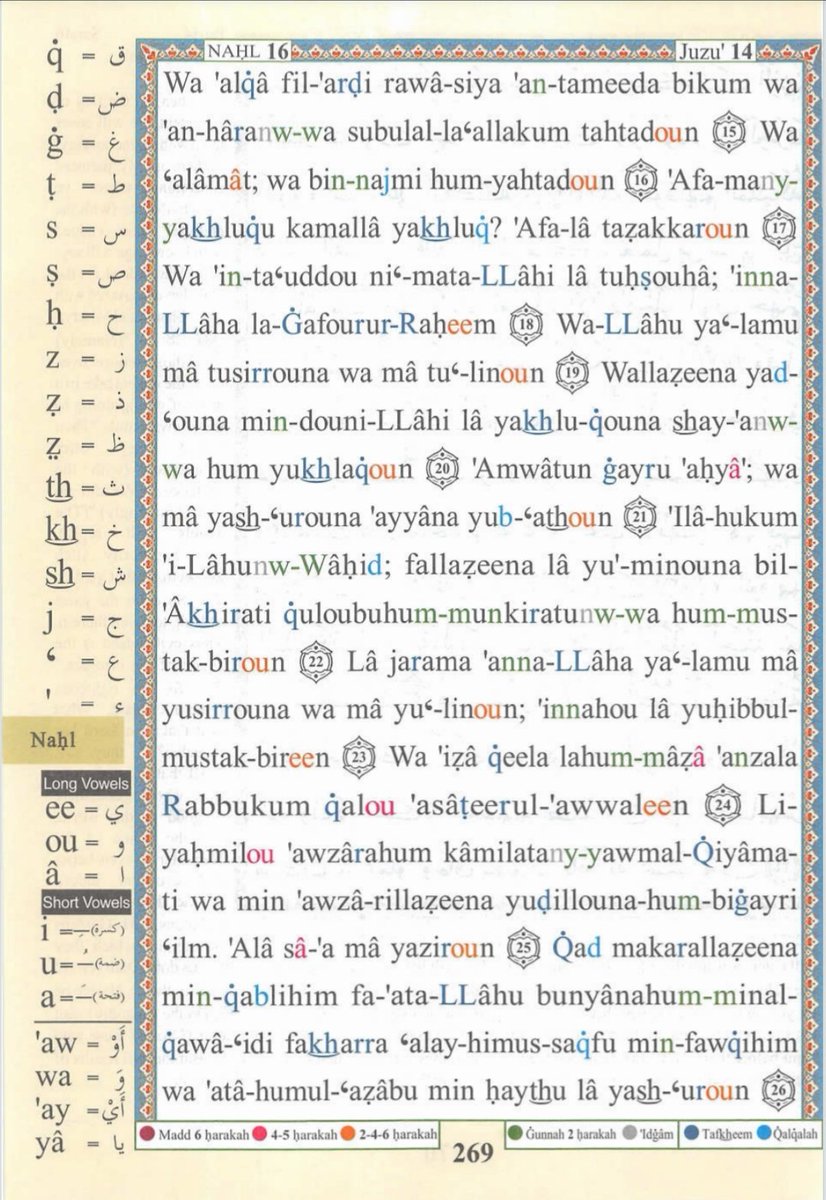

![IdrisAOni1's tweet photo. Pages of the Glorius Qur'ān today, Tuesday 4/8/26, al-Ḥijr (15): 91-99 & al-Naḥl (16): 1-14, tafakkur verse 16: 14
Theme: Recognizing Allah's blessings through the miracles of the body of waters and the endless provisions provided in them
{وَهُوَ ٱلَّذِی سَخَّرَ ٱلۡبَحۡرَ لِتَأۡكُلُوا۟ مِنۡهُ لَحۡمࣰا طَرِیࣰّا وَتَسۡتَخۡرِجُوا۟ مِنۡهُ حِلۡیَةࣰ تَلۡبَسُونَهَاۖ وَتَرَى ٱلۡفُلۡكَ مَوَاخِرَ فِیهِ وَلِتَبۡتَغُوا۟ مِن فَضۡلِهِۦ وَلَعَلَّكُمۡ تَشۡكُرُونَ}
"And it is He who subjected the sea for you to eat from it tender meat and to extract from it ornaments which you wear. And you see the ships plowing through it, and [He subjected it] that you may seek of His bounty; and perhaps you will be grateful".
LESSONS:
1. Every provision is ultimately from Allah.
The sea, with all its resources, is not a product of human ingenuity but a blessing placed at our service by Allah. Fish, other seafood, and countless marine resources are divine provisions that should deepen our awareness of the Giver rather than merely the gift.
2. Islam encourages the lawful enjoyment of Allah's blessings.
The verse mentions both necessities ("tender meat") and adornments ("ornaments which you wear"). This demonstrates that Islam does not prohibit beauty or lawful enjoyment of worldly blessings, provided they are acquired and used within the limits of the Sharīʿah.
3. Human progress is built upon Allah's favour.
Ships crossing the seas symbolize commerce, travel, exploration, and civilization. While people design and build vessels, their success depends on the natural laws, oceans, and winds that Allah has created and subjected for humanity. Every scientific and technological achievement should therefore inspire humility before the Creator.
4. Seeking wealth through lawful means is an act of worship.
Allah explicitly mentions that people travel the seas "to seek of His bounty." Earning a living through lawful trade, industry, and honest labour is not contrary to spirituality; it is a noble pursuit when accompanied by sincerity, integrity, and gratitude to Allah.
5. Gratitude is the proper response to divine blessings.
The verse concludes by reminding us that all these favours are meant to produce gratitude. True gratitude is not merely saying al-ḥamdu lillāh; it is recognizing Allah as the source of every blessing, obeying Him, and using His gifts in ways that please Him.
Allāhumma ijʿalnā min ʿibādika al-shākirīn, warzuqnā rizqan ḥalālan ṭayyiban, wa bārik lanā fīmā razaqtanā, wa lā tajʿal niʿamaka sababan lighaflatinā ʿanka. Āmīn.
O Allah, make us among Your grateful servants. Grant us lawful and wholesome provision, bless what You have provided for us, and do not let Your blessings become a cause of heedlessness toward You. Āmīn.](https://pbs.twimg.com/media/HO2pNDHXQAAUA4Y.jpg)
![IdrisAOni1's tweet photo. Pages of the Glorius Qur'ān today, Tuesday 4/8/26, al-Ḥijr (15): 91-99 & al-Naḥl (16): 1-14, tafakkur verse 16: 14
Theme: Recognizing Allah's blessings through the miracles of the body of waters and the endless provisions provided in them
{وَهُوَ ٱلَّذِی سَخَّرَ ٱلۡبَحۡرَ لِتَأۡكُلُوا۟ مِنۡهُ لَحۡمࣰا طَرِیࣰّا وَتَسۡتَخۡرِجُوا۟ مِنۡهُ حِلۡیَةࣰ تَلۡبَسُونَهَاۖ وَتَرَى ٱلۡفُلۡكَ مَوَاخِرَ فِیهِ وَلِتَبۡتَغُوا۟ مِن فَضۡلِهِۦ وَلَعَلَّكُمۡ تَشۡكُرُونَ}
"And it is He who subjected the sea for you to eat from it tender meat and to extract from it ornaments which you wear. And you see the ships plowing through it, and [He subjected it] that you may seek of His bounty; and perhaps you will be grateful".
LESSONS:
1. Every provision is ultimately from Allah.
The sea, with all its resources, is not a product of human ingenuity but a blessing placed at our service by Allah. Fish, other seafood, and countless marine resources are divine provisions that should deepen our awareness of the Giver rather than merely the gift.
2. Islam encourages the lawful enjoyment of Allah's blessings.
The verse mentions both necessities ("tender meat") and adornments ("ornaments which you wear"). This demonstrates that Islam does not prohibit beauty or lawful enjoyment of worldly blessings, provided they are acquired and used within the limits of the Sharīʿah.
3. Human progress is built upon Allah's favour.
Ships crossing the seas symbolize commerce, travel, exploration, and civilization. While people design and build vessels, their success depends on the natural laws, oceans, and winds that Allah has created and subjected for humanity. Every scientific and technological achievement should therefore inspire humility before the Creator.
4. Seeking wealth through lawful means is an act of worship.
Allah explicitly mentions that people travel the seas "to seek of His bounty." Earning a living through lawful trade, industry, and honest labour is not contrary to spirituality; it is a noble pursuit when accompanied by sincerity, integrity, and gratitude to Allah.
5. Gratitude is the proper response to divine blessings.
The verse concludes by reminding us that all these favours are meant to produce gratitude. True gratitude is not merely saying al-ḥamdu lillāh; it is recognizing Allah as the source of every blessing, obeying Him, and using His gifts in ways that please Him.
Allāhumma ijʿalnā min ʿibādika al-shākirīn, warzuqnā rizqan ḥalālan ṭayyiban, wa bārik lanā fīmā razaqtanā, wa lā tajʿal niʿamaka sababan lighaflatinā ʿanka. Āmīn.
O Allah, make us among Your grateful servants. Grant us lawful and wholesome provision, bless what You have provided for us, and do not let Your blessings become a cause of heedlessness toward You. Āmīn.](https://pbs.twimg.com/media/HO2pMOPW0AAjdmN.jpg)
![IdrisAOni1's tweet photo. Pages of the Glorius Qur'ān today, Tuesday 4/8/26, al-Ḥijr (15): 91-99 & al-Naḥl (16): 1-14, tafakkur verse 16: 14
Theme: Recognizing Allah's blessings through the miracles of the body of waters and the endless provisions provided in them
{وَهُوَ ٱلَّذِی سَخَّرَ ٱلۡبَحۡرَ لِتَأۡكُلُوا۟ مِنۡهُ لَحۡمࣰا طَرِیࣰّا وَتَسۡتَخۡرِجُوا۟ مِنۡهُ حِلۡیَةࣰ تَلۡبَسُونَهَاۖ وَتَرَى ٱلۡفُلۡكَ مَوَاخِرَ فِیهِ وَلِتَبۡتَغُوا۟ مِن فَضۡلِهِۦ وَلَعَلَّكُمۡ تَشۡكُرُونَ}
"And it is He who subjected the sea for you to eat from it tender meat and to extract from it ornaments which you wear. And you see the ships plowing through it, and [He subjected it] that you may seek of His bounty; and perhaps you will be grateful".
LESSONS:
1. Every provision is ultimately from Allah.
The sea, with all its resources, is not a product of human ingenuity but a blessing placed at our service by Allah. Fish, other seafood, and countless marine resources are divine provisions that should deepen our awareness of the Giver rather than merely the gift.
2. Islam encourages the lawful enjoyment of Allah's blessings.
The verse mentions both necessities ("tender meat") and adornments ("ornaments which you wear"). This demonstrates that Islam does not prohibit beauty or lawful enjoyment of worldly blessings, provided they are acquired and used within the limits of the Sharīʿah.
3. Human progress is built upon Allah's favour.
Ships crossing the seas symbolize commerce, travel, exploration, and civilization. While people design and build vessels, their success depends on the natural laws, oceans, and winds that Allah has created and subjected for humanity. Every scientific and technological achievement should therefore inspire humility before the Creator.
4. Seeking wealth through lawful means is an act of worship.
Allah explicitly mentions that people travel the seas "to seek of His bounty." Earning a living through lawful trade, industry, and honest labour is not contrary to spirituality; it is a noble pursuit when accompanied by sincerity, integrity, and gratitude to Allah.
5. Gratitude is the proper response to divine blessings.
The verse concludes by reminding us that all these favours are meant to produce gratitude. True gratitude is not merely saying al-ḥamdu lillāh; it is recognizing Allah as the source of every blessing, obeying Him, and using His gifts in ways that please Him.
Allāhumma ijʿalnā min ʿibādika al-shākirīn, warzuqnā rizqan ḥalālan ṭayyiban, wa bārik lanā fīmā razaqtanā, wa lā tajʿal niʿamaka sababan lighaflatinā ʿanka. Āmīn.
O Allah, make us among Your grateful servants. Grant us lawful and wholesome provision, bless what You have provided for us, and do not let Your blessings become a cause of heedlessness toward You. Āmīn.](https://pbs.twimg.com/media/HO2pLWCXkAAD4cz.jpg)
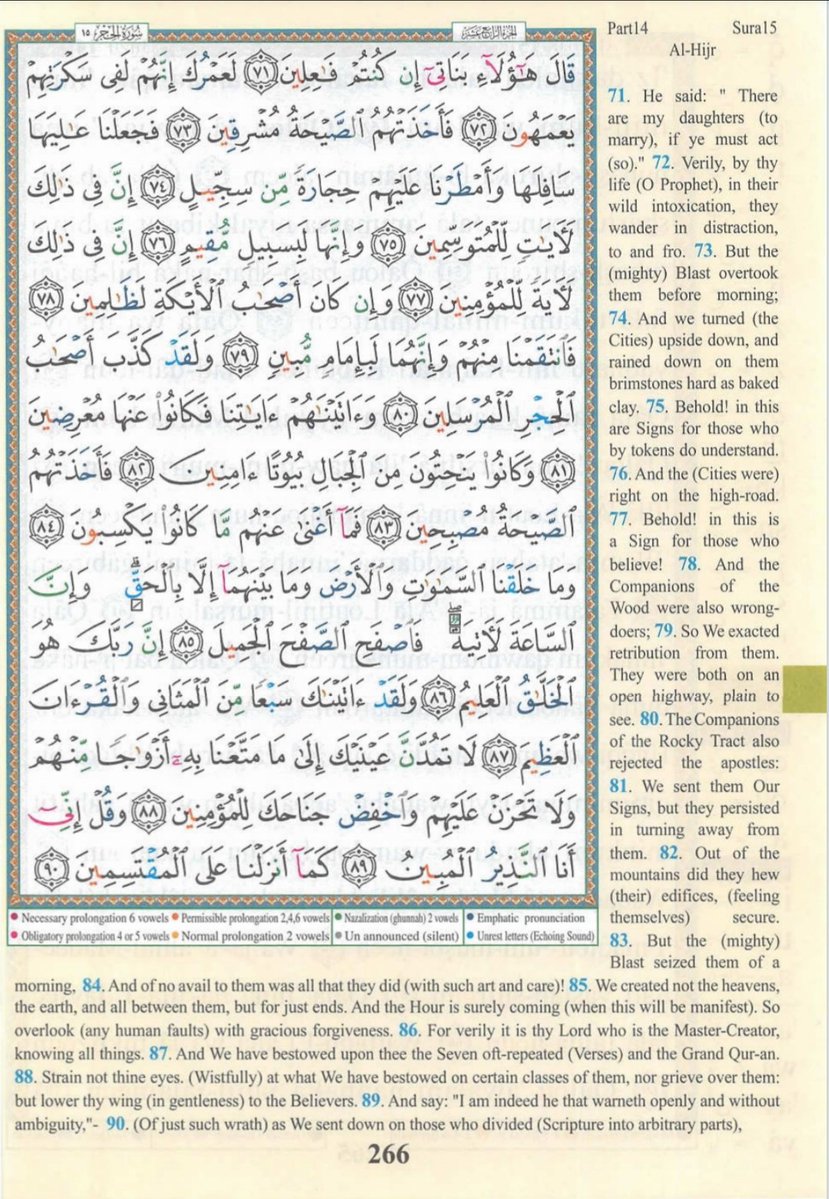


![IdrisAOni1's tweet photo. Pages of the Glorius Qur'ān today, Sunday 2/8/26, al-Ḥijr (15): 16-51, tafakkur verse 15: 49-50
Theme: A Muslim should understand the balancing of hope in Allah's mercy with fear of His punishment
{۞ نَبِّئۡ عِبَادِیۤ أَنِّیۤ أَنَا ٱلۡغَفُورُ ٱلرَّحِیمُ (49) وَأَنَّ عَذَابِی هُوَ ٱلۡعَذَابُ ٱلۡأَلِیمُ (50)}
"[O Muḥammad], inform My servants that it is I who am the Forgiving, the Merciful,
And that it is My punishment which is the painful punishment".
LESSONS:
1. Allah's mercy is vast and always open to the repentant.
Allah begins by introducing Himself as al-Ghafūr (the All-Forgiving) and al-Raḥīm (the Most Merciful), reminding believers that no sin is too great to be forgiven when one sincerely repents and returns to Him.
2. A believer must balance hope and fear.
These two verses teach that faith should neither be based solely on hope nor solely on fear. Hope without fear may lead to complacency, while fear without hope may lead to despair. The true believer walks the middle path.
3. Allah's punishment is real and should never be taken lightly.
Just as Allah's mercy is real, so is His punishment. Persisting in disbelief, arrogance, oppression, and unrepented sins exposes a person to a painful punishment. This serves as a powerful deterrent against disobedience.
4. Effective daʿwah combines glad tidings with warning.
Allah commanded the Prophet ﷺ to inform people of both His mercy and His punishment. Islamic preaching should therefore inspire people with hope while also warning them of the consequences of rejecting Allah's guidance.
5. A sound relationship with Allah is built on both love and reverence.
These verses cultivate a balanced spirituality in which the believer loves Allah for His boundless mercy, hopes for His forgiveness, and reveres Him enough to avoid actions that incur His punishment. Such balance produces sincerity, humility, and steadfast obedience.
O Allah, O All-Forgiving, O Most Merciful, forgive us all our sins, the small and the great, the first and the last, the hidden and the public.
O Allah, make us among Your servants who hope for Your mercy and fear Your punishment, and do not make us among the heedless.
O Allah, keep our hearts firm upon obedience to You, grant us a good ending, admit us into Paradise through Your mercy, and protect us from the Fire through Your grace. Indeed, You are the All-Forgiving, the Most Merciful. Āmīn.](https://pbs.twimg.com/media/HOsWD18XoAAX3uT.jpg)
![IdrisAOni1's tweet photo. Pages of the Glorius Qur'ān today, Sunday 2/8/26, al-Ḥijr (15): 16-51, tafakkur verse 15: 49-50
Theme: A Muslim should understand the balancing of hope in Allah's mercy with fear of His punishment
{۞ نَبِّئۡ عِبَادِیۤ أَنِّیۤ أَنَا ٱلۡغَفُورُ ٱلرَّحِیمُ (49) وَأَنَّ عَذَابِی هُوَ ٱلۡعَذَابُ ٱلۡأَلِیمُ (50)}
"[O Muḥammad], inform My servants that it is I who am the Forgiving, the Merciful,
And that it is My punishment which is the painful punishment".
LESSONS:
1. Allah's mercy is vast and always open to the repentant.
Allah begins by introducing Himself as al-Ghafūr (the All-Forgiving) and al-Raḥīm (the Most Merciful), reminding believers that no sin is too great to be forgiven when one sincerely repents and returns to Him.
2. A believer must balance hope and fear.
These two verses teach that faith should neither be based solely on hope nor solely on fear. Hope without fear may lead to complacency, while fear without hope may lead to despair. The true believer walks the middle path.
3. Allah's punishment is real and should never be taken lightly.
Just as Allah's mercy is real, so is His punishment. Persisting in disbelief, arrogance, oppression, and unrepented sins exposes a person to a painful punishment. This serves as a powerful deterrent against disobedience.
4. Effective daʿwah combines glad tidings with warning.
Allah commanded the Prophet ﷺ to inform people of both His mercy and His punishment. Islamic preaching should therefore inspire people with hope while also warning them of the consequences of rejecting Allah's guidance.
5. A sound relationship with Allah is built on both love and reverence.
These verses cultivate a balanced spirituality in which the believer loves Allah for His boundless mercy, hopes for His forgiveness, and reveres Him enough to avoid actions that incur His punishment. Such balance produces sincerity, humility, and steadfast obedience.
O Allah, O All-Forgiving, O Most Merciful, forgive us all our sins, the small and the great, the first and the last, the hidden and the public.
O Allah, make us among Your servants who hope for Your mercy and fear Your punishment, and do not make us among the heedless.
O Allah, keep our hearts firm upon obedience to You, grant us a good ending, admit us into Paradise through Your mercy, and protect us from the Fire through Your grace. Indeed, You are the All-Forgiving, the Most Merciful. Āmīn.](https://pbs.twimg.com/media/HOsWB-CXcAADbwL.jpg)
![IdrisAOni1's tweet photo. Pages of the Glorius Qur'ān today, Sunday 2/8/26, al-Ḥijr (15): 16-51, tafakkur verse 15: 49-50
Theme: A Muslim should understand the balancing of hope in Allah's mercy with fear of His punishment
{۞ نَبِّئۡ عِبَادِیۤ أَنِّیۤ أَنَا ٱلۡغَفُورُ ٱلرَّحِیمُ (49) وَأَنَّ عَذَابِی هُوَ ٱلۡعَذَابُ ٱلۡأَلِیمُ (50)}
"[O Muḥammad], inform My servants that it is I who am the Forgiving, the Merciful,
And that it is My punishment which is the painful punishment".
LESSONS:
1. Allah's mercy is vast and always open to the repentant.
Allah begins by introducing Himself as al-Ghafūr (the All-Forgiving) and al-Raḥīm (the Most Merciful), reminding believers that no sin is too great to be forgiven when one sincerely repents and returns to Him.
2. A believer must balance hope and fear.
These two verses teach that faith should neither be based solely on hope nor solely on fear. Hope without fear may lead to complacency, while fear without hope may lead to despair. The true believer walks the middle path.
3. Allah's punishment is real and should never be taken lightly.
Just as Allah's mercy is real, so is His punishment. Persisting in disbelief, arrogance, oppression, and unrepented sins exposes a person to a painful punishment. This serves as a powerful deterrent against disobedience.
4. Effective daʿwah combines glad tidings with warning.
Allah commanded the Prophet ﷺ to inform people of both His mercy and His punishment. Islamic preaching should therefore inspire people with hope while also warning them of the consequences of rejecting Allah's guidance.
5. A sound relationship with Allah is built on both love and reverence.
These verses cultivate a balanced spirituality in which the believer loves Allah for His boundless mercy, hopes for His forgiveness, and reveres Him enough to avoid actions that incur His punishment. Such balance produces sincerity, humility, and steadfast obedience.
O Allah, O All-Forgiving, O Most Merciful, forgive us all our sins, the small and the great, the first and the last, the hidden and the public.
O Allah, make us among Your servants who hope for Your mercy and fear Your punishment, and do not make us among the heedless.
O Allah, keep our hearts firm upon obedience to You, grant us a good ending, admit us into Paradise through Your mercy, and protect us from the Fire through Your grace. Indeed, You are the All-Forgiving, the Most Merciful. Āmīn.](https://pbs.twimg.com/media/HOsV_REXYAA20al.jpg)
![IdrisAOni1's tweet photo. Pages of the Glorius Qur'ān today, Saturday 1/8/26, Ibrāhīm (14): 43-52 & al-Ḥijr (15): 1-15, tafakkur verse 15: 9
Theme: the Preservation of the Qur'ān is divine, no amount of effort could corrupt it
{إِنَّا نَحۡنُ نَزَّلۡنَا ٱلذِّكۡرَ وَإِنَّا لَهُۥ لَحَـٰفِظُونَ}
"Indeed, it is We who sent down the message [i.e., the Qur’ān], and indeed, We will be its guardian".
LESSONS:
1. The Qur'ān is a Divine Revelation.
Allah emphatically declares that He Himself revealed the Qur'ān. It is not the product of human thought, philosophy, or imagination. Its origin is divine, making it the ultimate and final source of guidance for humanity.
2. Allah Himself Guarantees Its Preservation.
Unlike previous scriptures, whose preservation was entrusted to human communities, Allah personally undertook the responsibility of safeguarding the Qur'ān. Throughout more than fourteen centuries, it has remained intact in both its written form and in the hearts of millions of memorizers across generations.
3. The Integrity of Islam Rests Upon the Preservation of the Qur'ān.
Since the Qur'ān is the primary source of Islamic belief, law, ethics, and spirituality, its preservation ensures that the authentic message of Islam remains accessible to every generation until the Day of Resurrection.
4. The Verse Strengthens the Believer's Confidence.
This divine promise assures Muslims that no conspiracy, distortion, or hostility can extinguish Allah's guidance. While attempts to alter or suppress the Qur'ān have occurred throughout history, Allah's promise has consistently been fulfilled.
5. Preserving the Qur'ān Includes Living by It.
Although Allah has guaranteed the preservation of the Qur'ānic text, believers are honoured with the responsibility of preserving its teachings through recitation, memorisation, study, implementation, teaching, and conveying its message to others with wisdom and sincerity.
Allāhumma ijʿal al-Qur'āna rabīʿa qulūbinā, wa nūra ṣudūrinā, wa jalā'a aḥzāninā, wa dhahāba humūminā, wajʿalnā min ahlihi alladhīna hum ahluka wa khāṣṣatuk.
O Allah, make the Qur'ān the spring of our hearts, the light of our chests, the remover of our sorrows, and the reliever of our anxieties. Make us among the people of the Qur'ān, Your chosen and beloved servants. (Qur'ān 15:9). Āmīn.](https://pbs.twimg.com/media/HOnNmoWWMAA86Lx.jpg)
![IdrisAOni1's tweet photo. Pages of the Glorius Qur'ān today, Saturday 1/8/26, Ibrāhīm (14): 43-52 & al-Ḥijr (15): 1-15, tafakkur verse 15: 9
Theme: the Preservation of the Qur'ān is divine, no amount of effort could corrupt it
{إِنَّا نَحۡنُ نَزَّلۡنَا ٱلذِّكۡرَ وَإِنَّا لَهُۥ لَحَـٰفِظُونَ}
"Indeed, it is We who sent down the message [i.e., the Qur’ān], and indeed, We will be its guardian".
LESSONS:
1. The Qur'ān is a Divine Revelation.
Allah emphatically declares that He Himself revealed the Qur'ān. It is not the product of human thought, philosophy, or imagination. Its origin is divine, making it the ultimate and final source of guidance for humanity.
2. Allah Himself Guarantees Its Preservation.
Unlike previous scriptures, whose preservation was entrusted to human communities, Allah personally undertook the responsibility of safeguarding the Qur'ān. Throughout more than fourteen centuries, it has remained intact in both its written form and in the hearts of millions of memorizers across generations.
3. The Integrity of Islam Rests Upon the Preservation of the Qur'ān.
Since the Qur'ān is the primary source of Islamic belief, law, ethics, and spirituality, its preservation ensures that the authentic message of Islam remains accessible to every generation until the Day of Resurrection.
4. The Verse Strengthens the Believer's Confidence.
This divine promise assures Muslims that no conspiracy, distortion, or hostility can extinguish Allah's guidance. While attempts to alter or suppress the Qur'ān have occurred throughout history, Allah's promise has consistently been fulfilled.
5. Preserving the Qur'ān Includes Living by It.
Although Allah has guaranteed the preservation of the Qur'ānic text, believers are honoured with the responsibility of preserving its teachings through recitation, memorisation, study, implementation, teaching, and conveying its message to others with wisdom and sincerity.
Allāhumma ijʿal al-Qur'āna rabīʿa qulūbinā, wa nūra ṣudūrinā, wa jalā'a aḥzāninā, wa dhahāba humūminā, wajʿalnā min ahlihi alladhīna hum ahluka wa khāṣṣatuk.
O Allah, make the Qur'ān the spring of our hearts, the light of our chests, the remover of our sorrows, and the reliever of our anxieties. Make us among the people of the Qur'ān, Your chosen and beloved servants. (Qur'ān 15:9). Āmīn.](https://pbs.twimg.com/media/HOnNlu-WUAAJkdJ.jpg)
![IdrisAOni1's tweet photo. Pages of the Glorius Qur'ān today, Saturday 1/8/26, Ibrāhīm (14): 43-52 & al-Ḥijr (15): 1-15, tafakkur verse 15: 9
Theme: the Preservation of the Qur'ān is divine, no amount of effort could corrupt it
{إِنَّا نَحۡنُ نَزَّلۡنَا ٱلذِّكۡرَ وَإِنَّا لَهُۥ لَحَـٰفِظُونَ}
"Indeed, it is We who sent down the message [i.e., the Qur’ān], and indeed, We will be its guardian".
LESSONS:
1. The Qur'ān is a Divine Revelation.
Allah emphatically declares that He Himself revealed the Qur'ān. It is not the product of human thought, philosophy, or imagination. Its origin is divine, making it the ultimate and final source of guidance for humanity.
2. Allah Himself Guarantees Its Preservation.
Unlike previous scriptures, whose preservation was entrusted to human communities, Allah personally undertook the responsibility of safeguarding the Qur'ān. Throughout more than fourteen centuries, it has remained intact in both its written form and in the hearts of millions of memorizers across generations.
3. The Integrity of Islam Rests Upon the Preservation of the Qur'ān.
Since the Qur'ān is the primary source of Islamic belief, law, ethics, and spirituality, its preservation ensures that the authentic message of Islam remains accessible to every generation until the Day of Resurrection.
4. The Verse Strengthens the Believer's Confidence.
This divine promise assures Muslims that no conspiracy, distortion, or hostility can extinguish Allah's guidance. While attempts to alter or suppress the Qur'ān have occurred throughout history, Allah's promise has consistently been fulfilled.
5. Preserving the Qur'ān Includes Living by It.
Although Allah has guaranteed the preservation of the Qur'ānic text, believers are honoured with the responsibility of preserving its teachings through recitation, memorisation, study, implementation, teaching, and conveying its message to others with wisdom and sincerity.
Allāhumma ijʿal al-Qur'āna rabīʿa qulūbinā, wa nūra ṣudūrinā, wa jalā'a aḥzāninā, wa dhahāba humūminā, wajʿalnā min ahlihi alladhīna hum ahluka wa khāṣṣatuk.
O Allah, make the Qur'ān the spring of our hearts, the light of our chests, the remover of our sorrows, and the reliever of our anxieties. Make us among the people of the Qur'ān, Your chosen and beloved servants. (Qur'ān 15:9). Āmīn.](https://pbs.twimg.com/media/HOnNkldWgAAaroQ.jpg)
![IdrisAOni1's tweet photo. Pages of the Glorius Qur'ān today, Friday 31/7/26, Ibrāhīm (14): 25-42, tafakkur verse 14: 40-41
Theme: Show your children the path to Allah, walk it with them, they would pray for you when you are no more
{رَبِّ ٱجۡعَلۡنِی مُقِیمَ ٱلصَّلَوٰةِ وَمِن ذُرِّیَّتِیۚ رَبَّنَا وَتَقَبَّلۡ دُعَاۤءِ (40) رَبَّنَا ٱغۡفِرۡ لِی وَلِوَ ٰلِدَیَّ وَلِلۡمُؤۡمِنِینَ یَوۡمَ یَقُومُ ٱلۡحِسَابُ (41)}
"My Lord, make me an establisher of prayer, and [many] from my descendants. Our Lord, and accept my supplication.
Our Lord, forgive me and my parents and the believers the Day the account is established".
LESSONS:
1. The greatest inheritance a parent can leave is not wealth or status but unwavering faith. Prophet Ibrāhīm (ʿalayhi al-salām) prayed first that he and his descendants would remain devoted to ṣalāh, teaching us to prioritize spiritual legacy over material inheritance.
2. Children learn more from what they see than from what they hear. When parents consistently walk the path of obedience to Allah, they become living examples whose faith naturally inspires the next generation.
3. Righteous upbringing bears fruit long after a parent's death. Children nurtured upon faith and righteousness become a continuous source of duʿāʾ, asking Allah to forgive and elevate their parents, just as Prophet Ibrāhīm prayed for his own.
4. Raising children upon Islam is an investment for the Hereafter. Every prayer they perform, every act of righteousness they do, and every sincere supplication they make for their parents continues to benefit them even after they have left this world.
5. The verses remind us that a successful family is one united by worship, supplication, and hope in Allah's mercy. Show your children the path to Allah, walk it faithfully with them, and they will remember you before Allah when you are no more.
O Allah, make us and our descendants among those who establish prayer and remain steadfast in obedience to You. Instill in the hearts of our sons and daughters love for You and love for Your Messenger ﷺ, and enable us to be righteous role models for them. O Allah, make them the comfort of our eyes in this world, and make them among those who continue to pray for our mercy and forgiveness after our death. Gather us together with them in the Highest Paradise through Your infinite mercy, O Most Merciful of those who show mercy. Āmīn.](https://pbs.twimg.com/media/HOiDt1yWsAARaRd.jpg)
![IdrisAOni1's tweet photo. Pages of the Glorius Qur'ān today, Friday 31/7/26, Ibrāhīm (14): 25-42, tafakkur verse 14: 40-41
Theme: Show your children the path to Allah, walk it with them, they would pray for you when you are no more
{رَبِّ ٱجۡعَلۡنِی مُقِیمَ ٱلصَّلَوٰةِ وَمِن ذُرِّیَّتِیۚ رَبَّنَا وَتَقَبَّلۡ دُعَاۤءِ (40) رَبَّنَا ٱغۡفِرۡ لِی وَلِوَ ٰلِدَیَّ وَلِلۡمُؤۡمِنِینَ یَوۡمَ یَقُومُ ٱلۡحِسَابُ (41)}
"My Lord, make me an establisher of prayer, and [many] from my descendants. Our Lord, and accept my supplication.
Our Lord, forgive me and my parents and the believers the Day the account is established".
LESSONS:
1. The greatest inheritance a parent can leave is not wealth or status but unwavering faith. Prophet Ibrāhīm (ʿalayhi al-salām) prayed first that he and his descendants would remain devoted to ṣalāh, teaching us to prioritize spiritual legacy over material inheritance.
2. Children learn more from what they see than from what they hear. When parents consistently walk the path of obedience to Allah, they become living examples whose faith naturally inspires the next generation.
3. Righteous upbringing bears fruit long after a parent's death. Children nurtured upon faith and righteousness become a continuous source of duʿāʾ, asking Allah to forgive and elevate their parents, just as Prophet Ibrāhīm prayed for his own.
4. Raising children upon Islam is an investment for the Hereafter. Every prayer they perform, every act of righteousness they do, and every sincere supplication they make for their parents continues to benefit them even after they have left this world.
5. The verses remind us that a successful family is one united by worship, supplication, and hope in Allah's mercy. Show your children the path to Allah, walk it faithfully with them, and they will remember you before Allah when you are no more.
O Allah, make us and our descendants among those who establish prayer and remain steadfast in obedience to You. Instill in the hearts of our sons and daughters love for You and love for Your Messenger ﷺ, and enable us to be righteous role models for them. O Allah, make them the comfort of our eyes in this world, and make them among those who continue to pray for our mercy and forgiveness after our death. Gather us together with them in the Highest Paradise through Your infinite mercy, O Most Merciful of those who show mercy. Āmīn.](https://pbs.twimg.com/media/HOiDq8pWIAARtI0.jpg)
![IdrisAOni1's tweet photo. Pages of the Glorius Qur'ān today, Friday 31/7/26, Ibrāhīm (14): 25-42, tafakkur verse 14: 40-41
Theme: Show your children the path to Allah, walk it with them, they would pray for you when you are no more
{رَبِّ ٱجۡعَلۡنِی مُقِیمَ ٱلصَّلَوٰةِ وَمِن ذُرِّیَّتِیۚ رَبَّنَا وَتَقَبَّلۡ دُعَاۤءِ (40) رَبَّنَا ٱغۡفِرۡ لِی وَلِوَ ٰلِدَیَّ وَلِلۡمُؤۡمِنِینَ یَوۡمَ یَقُومُ ٱلۡحِسَابُ (41)}
"My Lord, make me an establisher of prayer, and [many] from my descendants. Our Lord, and accept my supplication.
Our Lord, forgive me and my parents and the believers the Day the account is established".
LESSONS:
1. The greatest inheritance a parent can leave is not wealth or status but unwavering faith. Prophet Ibrāhīm (ʿalayhi al-salām) prayed first that he and his descendants would remain devoted to ṣalāh, teaching us to prioritize spiritual legacy over material inheritance.
2. Children learn more from what they see than from what they hear. When parents consistently walk the path of obedience to Allah, they become living examples whose faith naturally inspires the next generation.
3. Righteous upbringing bears fruit long after a parent's death. Children nurtured upon faith and righteousness become a continuous source of duʿāʾ, asking Allah to forgive and elevate their parents, just as Prophet Ibrāhīm prayed for his own.
4. Raising children upon Islam is an investment for the Hereafter. Every prayer they perform, every act of righteousness they do, and every sincere supplication they make for their parents continues to benefit them even after they have left this world.
5. The verses remind us that a successful family is one united by worship, supplication, and hope in Allah's mercy. Show your children the path to Allah, walk it faithfully with them, and they will remember you before Allah when you are no more.
O Allah, make us and our descendants among those who establish prayer and remain steadfast in obedience to You. Instill in the hearts of our sons and daughters love for You and love for Your Messenger ﷺ, and enable us to be righteous role models for them. O Allah, make them the comfort of our eyes in this world, and make them among those who continue to pray for our mercy and forgiveness after our death. Gather us together with them in the Highest Paradise through Your infinite mercy, O Most Merciful of those who show mercy. Āmīn.](https://pbs.twimg.com/media/HOiDmxwWQAArzo1.jpg)
![IdrisAOni1's tweet photo. Pages of the Glorius Qur'ān today, Wednesday 29/7/26, Sūrah Ra'd (13): 43 and Ibrāhīm (14): 1-10, tafakkur verse 14: 7
Theme: Gratitude is the key to unlocking more blessings
{وَإِذۡ تَأَذَّنَ رَبُّكُمۡ لَىِٕن شَكَرۡتُمۡ لَأَزِیدَنَّكُمۡۖ وَلَىِٕن كَفَرۡتُمۡ إِنَّ عَذَابِی لَشَدِیدࣱ}
"And [remember] when your Lord proclaimed, 'If you are grateful, I will surely increase you [in favor]; but if you deny, indeed, My punishment is severe".
LESSONS:
1. Gratitude is a divine command and a pathway to increase
Allah does not merely encourage gratitude; He promises an increase for those who practise it. The increase is not limited to wealth. It includes increase in faith, wisdom, peace of mind, health, relationships, opportunities, blessings, and closeness to Allah. A grateful heart sees abundance even in what appears small, and Allah expands the value of what it possesses.
2. Gratitude transforms what we have into blessings
Many people possess countless blessings but fail to experience their sweetness because they overlook them. Gratitude turns ordinary gifts into sources of joy and contentment. The grateful person does not constantly measure life by what is missing but recognizes the countless favours already bestowed by Allah.
3. Ingratitude is a form of spiritual blindness
The opposite of gratitude (shukr) is kufrān al-niʿmah, denying or neglecting Allah’s blessings. It is not merely refusing to believe; it also includes failing to acknowledge the One who granted every favour. When people attribute their success entirely to themselves and forget the Giver, they risk losing the spiritual awareness that protects them from arrogance.
4. Allah’s promise of increase is certain
The verse uses a strong oath-like expression: “I will surely increase you” (la-azīdannakum). Allah’s promises never fail. The servant who sincerely thanks Him may not always receive exactly what he expects, but Allah increases him in ways that are ultimately better and more beneficial.
5. Gratitude is a daily act of worship
True gratitude is not only words of praise; it consists of three dimensions:
Gratitude of the heart: recognizing that every blessing comes from Allah;
Gratitude of the tongue: praising Allah and acknowledging His favours;
Gratitude of action: using Allah’s blessings in ways that please Him.
A person who is grateful for knowledge shares it, one grateful for wealth gives charity, one grateful for authority serves people, and one grateful for life uses it in obedience to Allah.
The question is not only: “How many blessings do I have?” but also: “How much gratitude do I show for the blessings I already possess?” Many people wait for more before they become grateful, while Allah teaches that gratitude is itself the door through which more blessings enter.
May Allah make us among those who recognize His favours, praise Him for them, and use them in obedience to Him. May He increase us in faith, goodness, and blessings, and protect us from the blindness of ingratitude. Āmīn.](https://pbs.twimg.com/media/HOXvfS-XgAInwH2.jpg)
![IdrisAOni1's tweet photo. Pages of the Glorius Qur'ān today, Wednesday 29/7/26, Sūrah Ra'd (13): 43 and Ibrāhīm (14): 1-10, tafakkur verse 14: 7
Theme: Gratitude is the key to unlocking more blessings
{وَإِذۡ تَأَذَّنَ رَبُّكُمۡ لَىِٕن شَكَرۡتُمۡ لَأَزِیدَنَّكُمۡۖ وَلَىِٕن كَفَرۡتُمۡ إِنَّ عَذَابِی لَشَدِیدࣱ}
"And [remember] when your Lord proclaimed, 'If you are grateful, I will surely increase you [in favor]; but if you deny, indeed, My punishment is severe".
LESSONS:
1. Gratitude is a divine command and a pathway to increase
Allah does not merely encourage gratitude; He promises an increase for those who practise it. The increase is not limited to wealth. It includes increase in faith, wisdom, peace of mind, health, relationships, opportunities, blessings, and closeness to Allah. A grateful heart sees abundance even in what appears small, and Allah expands the value of what it possesses.
2. Gratitude transforms what we have into blessings
Many people possess countless blessings but fail to experience their sweetness because they overlook them. Gratitude turns ordinary gifts into sources of joy and contentment. The grateful person does not constantly measure life by what is missing but recognizes the countless favours already bestowed by Allah.
3. Ingratitude is a form of spiritual blindness
The opposite of gratitude (shukr) is kufrān al-niʿmah, denying or neglecting Allah’s blessings. It is not merely refusing to believe; it also includes failing to acknowledge the One who granted every favour. When people attribute their success entirely to themselves and forget the Giver, they risk losing the spiritual awareness that protects them from arrogance.
4. Allah’s promise of increase is certain
The verse uses a strong oath-like expression: “I will surely increase you” (la-azīdannakum). Allah’s promises never fail. The servant who sincerely thanks Him may not always receive exactly what he expects, but Allah increases him in ways that are ultimately better and more beneficial.
5. Gratitude is a daily act of worship
True gratitude is not only words of praise; it consists of three dimensions:
Gratitude of the heart: recognizing that every blessing comes from Allah;
Gratitude of the tongue: praising Allah and acknowledging His favours;
Gratitude of action: using Allah’s blessings in ways that please Him.
A person who is grateful for knowledge shares it, one grateful for wealth gives charity, one grateful for authority serves people, and one grateful for life uses it in obedience to Allah.
The question is not only: “How many blessings do I have?” but also: “How much gratitude do I show for the blessings I already possess?” Many people wait for more before they become grateful, while Allah teaches that gratitude is itself the door through which more blessings enter.
May Allah make us among those who recognize His favours, praise Him for them, and use them in obedience to Him. May He increase us in faith, goodness, and blessings, and protect us from the blindness of ingratitude. Āmīn.](https://pbs.twimg.com/media/HOXveqeXIAA0Ywq.jpg)
![IdrisAOni1's tweet photo. Pages of the Glorius Qur'ān today, Wednesday 29/7/26, Sūrah Ra'd (13): 43 and Ibrāhīm (14): 1-10, tafakkur verse 14: 7
Theme: Gratitude is the key to unlocking more blessings
{وَإِذۡ تَأَذَّنَ رَبُّكُمۡ لَىِٕن شَكَرۡتُمۡ لَأَزِیدَنَّكُمۡۖ وَلَىِٕن كَفَرۡتُمۡ إِنَّ عَذَابِی لَشَدِیدࣱ}
"And [remember] when your Lord proclaimed, 'If you are grateful, I will surely increase you [in favor]; but if you deny, indeed, My punishment is severe".
LESSONS:
1. Gratitude is a divine command and a pathway to increase
Allah does not merely encourage gratitude; He promises an increase for those who practise it. The increase is not limited to wealth. It includes increase in faith, wisdom, peace of mind, health, relationships, opportunities, blessings, and closeness to Allah. A grateful heart sees abundance even in what appears small, and Allah expands the value of what it possesses.
2. Gratitude transforms what we have into blessings
Many people possess countless blessings but fail to experience their sweetness because they overlook them. Gratitude turns ordinary gifts into sources of joy and contentment. The grateful person does not constantly measure life by what is missing but recognizes the countless favours already bestowed by Allah.
3. Ingratitude is a form of spiritual blindness
The opposite of gratitude (shukr) is kufrān al-niʿmah, denying or neglecting Allah’s blessings. It is not merely refusing to believe; it also includes failing to acknowledge the One who granted every favour. When people attribute their success entirely to themselves and forget the Giver, they risk losing the spiritual awareness that protects them from arrogance.
4. Allah’s promise of increase is certain
The verse uses a strong oath-like expression: “I will surely increase you” (la-azīdannakum). Allah’s promises never fail. The servant who sincerely thanks Him may not always receive exactly what he expects, but Allah increases him in ways that are ultimately better and more beneficial.
5. Gratitude is a daily act of worship
True gratitude is not only words of praise; it consists of three dimensions:
Gratitude of the heart: recognizing that every blessing comes from Allah;
Gratitude of the tongue: praising Allah and acknowledging His favours;
Gratitude of action: using Allah’s blessings in ways that please Him.
A person who is grateful for knowledge shares it, one grateful for wealth gives charity, one grateful for authority serves people, and one grateful for life uses it in obedience to Allah.
The question is not only: “How many blessings do I have?” but also: “How much gratitude do I show for the blessings I already possess?” Many people wait for more before they become grateful, while Allah teaches that gratitude is itself the door through which more blessings enter.
May Allah make us among those who recognize His favours, praise Him for them, and use them in obedience to Him. May He increase us in faith, goodness, and blessings, and protect us from the blindness of ingratitude. Āmīn.](https://pbs.twimg.com/media/HOXvd6iWYAAfE28.jpg)
![IdrisAOni1's tweet photo. Pages of the Glorius Qur'ān today, Tuesday 28/7/26, Sūrah Ra'd (13): 29-42, tafakkur verse 13: 31
Theme: The Qur'ān is the greatest miracle on Earth
{وَلَوۡ أَنَّ قُرۡءَانࣰا سُیِّرَتۡ بِهِ ٱلۡجِبَالُ أَوۡ قُطِّعَتۡ بِهِ ٱلۡأَرۡضُ أَوۡ كُلِّمَ بِهِ ٱلۡمَوۡتَىٰۗ بَل لِّلَّهِ ٱلۡأَمۡرُ جَمِیعًاۗ أَفَلَمۡ یَا۟یۡـَٔسِ ٱلَّذِینَ ءَامَنُوۤا۟ أَن لَّوۡ یَشَاۤءُ ٱللَّهُ لَهَدَى ٱلنَّاسَ جَمِیعࣰاۗ وَلَا یَزَالُ ٱلَّذِینَ كَفَرُوا۟ تُصِیبُهُم بِمَا صَنَعُوا۟ قَارِعَةٌ أَوۡ تَحُلُّ قَرِیبࣰا مِّن دَارِهِمۡ حَتَّىٰ یَأۡتِیَ وَعۡدُ ٱللَّهِۚ إِنَّ ٱللَّهَ لَا یُخۡلِفُ ٱلۡمِیعَادَ}
"And if there was any Qur’ān [i.e., recitation] by which the mountains would be removed or the earth would be broken apart or the dead would be made to speak, [it would be this Qur’ān], but to Allāh belongs the affair entirely. Then have those who believed not accepted that had Allāh willed, He would have guided the people, all of them? And those who disbelieve do not cease to be struck, for what they have done, by calamity - or it will descend near their home - until there comes the promise of Allāh. Indeed, Allāh does not fail in [His] promise".
LESSONS:
1. The Qur'ān is the greatest miracle ever revealed.
Allah declares that if any revelation could physically move mountains, split the earth apart, or make the dead speak, it would have been this Qur'ān. This rhetorical expression highlights that the Qur'ān possesses the greatest possible authority and transformative power. Its primary purpose, however, is not to amaze people with spectacular physical miracles but to transform hearts, minds, and souls. A heart awakened by the Qur'ān is a greater miracle than a mountain being moved.
2. Guidance belongs to Allah alone.
The verse reminds believers that even the clearest evidence cannot compel faith. Had Allah willed, every human being would have believed. This teaches that while people are commanded to convey the truth with wisdom and compassion, only Allah opens hearts to guidance. The duty of the prophets and their followers is to communicate the message faithfully, not to force acceptance.
3. Persistent disbelief has consequences.
Those who knowingly reject Allah's guidance continue to experience the consequences of their own choices. These may come as personal hardships, societal upheavals, or calamities approaching their communities. Such events serve as reminders and opportunities for reflection before the final accountability in the Hereafter. They are not random but occur within Allah's perfect wisdom and justice.
4. The promise of Allah is certain.
Whether it is the victory of truth, the fulfillment of divine justice, or the coming of the Last Day, Allah's promise never fails. Human beings may perceive delays, but divine timing is always perfect. This certainty strengthens the believer's patience, resilience, and unwavering trust in Allah during periods of hardship and uncertainty.
5. Believers should place their confidence in Allah, not merely in miracles.
Faith is sustained by sincere reflection, humility, and submission to Allah rather than by a constant demand for extraordinary signs. The Qur'ān itself is the enduring miracle available to every generation. Those who engage with it sincerely find guidance, wisdom, and spiritual renewal that no physical miracle could surpass.
O Allah, make the Qur'ān the spring of our hearts, the light of our chests, the remover of our sorrows, and the reliever of our anxieties. Grant us true guidance and steadfastness upon Your religion. Make us among those who place their complete trust in You, and fulfill for us Your promise of goodness in this world and the Hereafter. Āmīn.](https://pbs.twimg.com/media/HOSnpYAWsAArLXE.jpg)
![IdrisAOni1's tweet photo. Pages of the Glorius Qur'ān today, Tuesday 28/7/26, Sūrah Ra'd (13): 29-42, tafakkur verse 13: 31
Theme: The Qur'ān is the greatest miracle on Earth
{وَلَوۡ أَنَّ قُرۡءَانࣰا سُیِّرَتۡ بِهِ ٱلۡجِبَالُ أَوۡ قُطِّعَتۡ بِهِ ٱلۡأَرۡضُ أَوۡ كُلِّمَ بِهِ ٱلۡمَوۡتَىٰۗ بَل لِّلَّهِ ٱلۡأَمۡرُ جَمِیعًاۗ أَفَلَمۡ یَا۟یۡـَٔسِ ٱلَّذِینَ ءَامَنُوۤا۟ أَن لَّوۡ یَشَاۤءُ ٱللَّهُ لَهَدَى ٱلنَّاسَ جَمِیعࣰاۗ وَلَا یَزَالُ ٱلَّذِینَ كَفَرُوا۟ تُصِیبُهُم بِمَا صَنَعُوا۟ قَارِعَةٌ أَوۡ تَحُلُّ قَرِیبࣰا مِّن دَارِهِمۡ حَتَّىٰ یَأۡتِیَ وَعۡدُ ٱللَّهِۚ إِنَّ ٱللَّهَ لَا یُخۡلِفُ ٱلۡمِیعَادَ}
"And if there was any Qur’ān [i.e., recitation] by which the mountains would be removed or the earth would be broken apart or the dead would be made to speak, [it would be this Qur’ān], but to Allāh belongs the affair entirely. Then have those who believed not accepted that had Allāh willed, He would have guided the people, all of them? And those who disbelieve do not cease to be struck, for what they have done, by calamity - or it will descend near their home - until there comes the promise of Allāh. Indeed, Allāh does not fail in [His] promise".
LESSONS:
1. The Qur'ān is the greatest miracle ever revealed.
Allah declares that if any revelation could physically move mountains, split the earth apart, or make the dead speak, it would have been this Qur'ān. This rhetorical expression highlights that the Qur'ān possesses the greatest possible authority and transformative power. Its primary purpose, however, is not to amaze people with spectacular physical miracles but to transform hearts, minds, and souls. A heart awakened by the Qur'ān is a greater miracle than a mountain being moved.
2. Guidance belongs to Allah alone.
The verse reminds believers that even the clearest evidence cannot compel faith. Had Allah willed, every human being would have believed. This teaches that while people are commanded to convey the truth with wisdom and compassion, only Allah opens hearts to guidance. The duty of the prophets and their followers is to communicate the message faithfully, not to force acceptance.
3. Persistent disbelief has consequences.
Those who knowingly reject Allah's guidance continue to experience the consequences of their own choices. These may come as personal hardships, societal upheavals, or calamities approaching their communities. Such events serve as reminders and opportunities for reflection before the final accountability in the Hereafter. They are not random but occur within Allah's perfect wisdom and justice.
4. The promise of Allah is certain.
Whether it is the victory of truth, the fulfillment of divine justice, or the coming of the Last Day, Allah's promise never fails. Human beings may perceive delays, but divine timing is always perfect. This certainty strengthens the believer's patience, resilience, and unwavering trust in Allah during periods of hardship and uncertainty.
5. Believers should place their confidence in Allah, not merely in miracles.
Faith is sustained by sincere reflection, humility, and submission to Allah rather than by a constant demand for extraordinary signs. The Qur'ān itself is the enduring miracle available to every generation. Those who engage with it sincerely find guidance, wisdom, and spiritual renewal that no physical miracle could surpass.
O Allah, make the Qur'ān the spring of our hearts, the light of our chests, the remover of our sorrows, and the reliever of our anxieties. Grant us true guidance and steadfastness upon Your religion. Make us among those who place their complete trust in You, and fulfill for us Your promise of goodness in this world and the Hereafter. Āmīn.](https://pbs.twimg.com/media/HOSnoKnWgAAjahq.jpg)
![IdrisAOni1's tweet photo. Pages of the Glorius Qur'ān today, Tuesday 28/7/26, Sūrah Ra'd (13): 29-42, tafakkur verse 13: 31
Theme: The Qur'ān is the greatest miracle on Earth
{وَلَوۡ أَنَّ قُرۡءَانࣰا سُیِّرَتۡ بِهِ ٱلۡجِبَالُ أَوۡ قُطِّعَتۡ بِهِ ٱلۡأَرۡضُ أَوۡ كُلِّمَ بِهِ ٱلۡمَوۡتَىٰۗ بَل لِّلَّهِ ٱلۡأَمۡرُ جَمِیعًاۗ أَفَلَمۡ یَا۟یۡـَٔسِ ٱلَّذِینَ ءَامَنُوۤا۟ أَن لَّوۡ یَشَاۤءُ ٱللَّهُ لَهَدَى ٱلنَّاسَ جَمِیعࣰاۗ وَلَا یَزَالُ ٱلَّذِینَ كَفَرُوا۟ تُصِیبُهُم بِمَا صَنَعُوا۟ قَارِعَةٌ أَوۡ تَحُلُّ قَرِیبࣰا مِّن دَارِهِمۡ حَتَّىٰ یَأۡتِیَ وَعۡدُ ٱللَّهِۚ إِنَّ ٱللَّهَ لَا یُخۡلِفُ ٱلۡمِیعَادَ}
"And if there was any Qur’ān [i.e., recitation] by which the mountains would be removed or the earth would be broken apart or the dead would be made to speak, [it would be this Qur’ān], but to Allāh belongs the affair entirely. Then have those who believed not accepted that had Allāh willed, He would have guided the people, all of them? And those who disbelieve do not cease to be struck, for what they have done, by calamity - or it will descend near their home - until there comes the promise of Allāh. Indeed, Allāh does not fail in [His] promise".
LESSONS:
1. The Qur'ān is the greatest miracle ever revealed.
Allah declares that if any revelation could physically move mountains, split the earth apart, or make the dead speak, it would have been this Qur'ān. This rhetorical expression highlights that the Qur'ān possesses the greatest possible authority and transformative power. Its primary purpose, however, is not to amaze people with spectacular physical miracles but to transform hearts, minds, and souls. A heart awakened by the Qur'ān is a greater miracle than a mountain being moved.
2. Guidance belongs to Allah alone.
The verse reminds believers that even the clearest evidence cannot compel faith. Had Allah willed, every human being would have believed. This teaches that while people are commanded to convey the truth with wisdom and compassion, only Allah opens hearts to guidance. The duty of the prophets and their followers is to communicate the message faithfully, not to force acceptance.
3. Persistent disbelief has consequences.
Those who knowingly reject Allah's guidance continue to experience the consequences of their own choices. These may come as personal hardships, societal upheavals, or calamities approaching their communities. Such events serve as reminders and opportunities for reflection before the final accountability in the Hereafter. They are not random but occur within Allah's perfect wisdom and justice.
4. The promise of Allah is certain.
Whether it is the victory of truth, the fulfillment of divine justice, or the coming of the Last Day, Allah's promise never fails. Human beings may perceive delays, but divine timing is always perfect. This certainty strengthens the believer's patience, resilience, and unwavering trust in Allah during periods of hardship and uncertainty.
5. Believers should place their confidence in Allah, not merely in miracles.
Faith is sustained by sincere reflection, humility, and submission to Allah rather than by a constant demand for extraordinary signs. The Qur'ān itself is the enduring miracle available to every generation. Those who engage with it sincerely find guidance, wisdom, and spiritual renewal that no physical miracle could surpass.
O Allah, make the Qur'ān the spring of our hearts, the light of our chests, the remover of our sorrows, and the reliever of our anxieties. Grant us true guidance and steadfastness upon Your religion. Make us among those who place their complete trust in You, and fulfill for us Your promise of goodness in this world and the Hereafter. Āmīn.](https://pbs.twimg.com/media/HOSnmw7WkAACxgl.jpg)
![IdrisAOni1's tweet photo. Pages of the Glorius Qur'ān today, Monday 27/7/26, Sūrah Ra'd (13): 14-28, tafakkur verse 13: 16
Theme: The Absolute Oneness and Sovereignty of Allāh over Creation is the truest of all truths
{قُلۡ مَن رَّبُّ ٱلسَّمَـٰوَ ٰتِ وَٱلۡأَرۡضِ قُلِ ٱللَّهُۚ قُلۡ أَفَٱتَّخَذۡتُم مِّن دُونِهِۦۤ أَوۡلِیَاۤءَ لَا یَمۡلِكُونَ لِأَنفُسِهِمۡ نَفۡعࣰا وَلَا ضَرࣰّاۚ قُلۡ هَلۡ یَسۡتَوِی ٱلۡأَعۡمَىٰ وَٱلۡبَصِیرُ أَمۡ هَلۡ تَسۡتَوِی ٱلظُّلُمَـٰتُ وَٱلنُّورُۗ أَمۡ جَعَلُوا۟ لِلَّهِ شُرَكَاۤءَ خَلَقُوا۟ كَخَلۡقِهِۦ فَتَشَـٰبَهَ ٱلۡخَلۡقُ عَلَیۡهِمۡۚ قُلِ ٱللَّهُ خَـٰلِقُ كُلِّ شَیۡءࣲ وَهُوَ ٱلۡوَ ٰحِدُ ٱلۡقَهَّـٰرُ}
"Say, Who is Lord of the heavens and earth? Say, Allāh. Say, Have you then taken besides Him allies not possessing [even] for themselves any benefit or any harm? Say, Is the blind equivalent to the seeing? Or is darkness equivalent to light? Or have they attributed to Allāh partners who created like His creation so that the creation [of each] seemed similar to them? Say, Allāh is the Creator of all things, and He is the One, the Prevailing".
LESSONS:
1. Tawḥīd begins with recognizing Allāh as the sole Creator and Sustainer. The Qur'ān directs the Prophet ﷺ to ask who owns and governs the heavens and the earth, leaving no room for any answer other than Allāh. Since He alone creates, sustains, and controls the universe, He alone deserves worship, absolute obedience, and complete reliance.
2. No created being possesses independent power to benefit or harm. The verse challenges the futility of taking protectors besides Allāh, for even those beings cannot control their own affairs without His permission. This teaches the believer to place ultimate trust in Allāh alone while recognizing that all means and causes operate only by His will.
3. Truth and falsehood can never be equal. Just as sight is superior to blindness and light is distinct from darkness, faith cannot be equated with disbelief, nor guidance with misguidance. The believer should therefore seek knowledge, embrace revelation, and avoid moral and spiritual confusion that blurs the distinction between truth and falsehood.
4. Creation is the clearest proof of Allāh's exclusive divinity. The Qur'ān asks whether the alleged partners of Allāh have created anything comparable to His creation. Since none shares in His creative power, none deserves any share of worship. Every sign in the universe points to the uniqueness, majesty, and absolute authority of the Creator.
5. Allāh alone is al-Wāḥid and al-Qahhār. The verse concludes by affirming two magnificent Divine Names: al-Wāḥid (The One), signifying His absolute uniqueness without partner or rival, and al-Qahhār (The Irresistible, the Supreme Dominator), affirming that every creature is under His complete power and authority. This certainty fills the believer's heart with humility, confidence, and unwavering devotion to Allāh alone.
O Allāh, O the One, O the Irresistible, keep our hearts firm upon Your Oneness. Make us among Your sincere servants. Show us the truth as truth and grant us the ability to follow it; show us falsehood as falsehood and grant us the ability to avoid it. Do not allow our hearts to become attached to anything besides You. Indeed, You are over all things All-Powerful. Āmīn.](https://pbs.twimg.com/media/HONdxWqXwAEI5ZM.jpg)
![IdrisAOni1's tweet photo. Pages of the Glorius Qur'ān today, Monday 27/7/26, Sūrah Ra'd (13): 14-28, tafakkur verse 13: 16
Theme: The Absolute Oneness and Sovereignty of Allāh over Creation is the truest of all truths
{قُلۡ مَن رَّبُّ ٱلسَّمَـٰوَ ٰتِ وَٱلۡأَرۡضِ قُلِ ٱللَّهُۚ قُلۡ أَفَٱتَّخَذۡتُم مِّن دُونِهِۦۤ أَوۡلِیَاۤءَ لَا یَمۡلِكُونَ لِأَنفُسِهِمۡ نَفۡعࣰا وَلَا ضَرࣰّاۚ قُلۡ هَلۡ یَسۡتَوِی ٱلۡأَعۡمَىٰ وَٱلۡبَصِیرُ أَمۡ هَلۡ تَسۡتَوِی ٱلظُّلُمَـٰتُ وَٱلنُّورُۗ أَمۡ جَعَلُوا۟ لِلَّهِ شُرَكَاۤءَ خَلَقُوا۟ كَخَلۡقِهِۦ فَتَشَـٰبَهَ ٱلۡخَلۡقُ عَلَیۡهِمۡۚ قُلِ ٱللَّهُ خَـٰلِقُ كُلِّ شَیۡءࣲ وَهُوَ ٱلۡوَ ٰحِدُ ٱلۡقَهَّـٰرُ}
"Say, Who is Lord of the heavens and earth? Say, Allāh. Say, Have you then taken besides Him allies not possessing [even] for themselves any benefit or any harm? Say, Is the blind equivalent to the seeing? Or is darkness equivalent to light? Or have they attributed to Allāh partners who created like His creation so that the creation [of each] seemed similar to them? Say, Allāh is the Creator of all things, and He is the One, the Prevailing".
LESSONS:
1. Tawḥīd begins with recognizing Allāh as the sole Creator and Sustainer. The Qur'ān directs the Prophet ﷺ to ask who owns and governs the heavens and the earth, leaving no room for any answer other than Allāh. Since He alone creates, sustains, and controls the universe, He alone deserves worship, absolute obedience, and complete reliance.
2. No created being possesses independent power to benefit or harm. The verse challenges the futility of taking protectors besides Allāh, for even those beings cannot control their own affairs without His permission. This teaches the believer to place ultimate trust in Allāh alone while recognizing that all means and causes operate only by His will.
3. Truth and falsehood can never be equal. Just as sight is superior to blindness and light is distinct from darkness, faith cannot be equated with disbelief, nor guidance with misguidance. The believer should therefore seek knowledge, embrace revelation, and avoid moral and spiritual confusion that blurs the distinction between truth and falsehood.
4. Creation is the clearest proof of Allāh's exclusive divinity. The Qur'ān asks whether the alleged partners of Allāh have created anything comparable to His creation. Since none shares in His creative power, none deserves any share of worship. Every sign in the universe points to the uniqueness, majesty, and absolute authority of the Creator.
5. Allāh alone is al-Wāḥid and al-Qahhār. The verse concludes by affirming two magnificent Divine Names: al-Wāḥid (The One), signifying His absolute uniqueness without partner or rival, and al-Qahhār (The Irresistible, the Supreme Dominator), affirming that every creature is under His complete power and authority. This certainty fills the believer's heart with humility, confidence, and unwavering devotion to Allāh alone.
O Allāh, O the One, O the Irresistible, keep our hearts firm upon Your Oneness. Make us among Your sincere servants. Show us the truth as truth and grant us the ability to follow it; show us falsehood as falsehood and grant us the ability to avoid it. Do not allow our hearts to become attached to anything besides You. Indeed, You are over all things All-Powerful. Āmīn.](https://pbs.twimg.com/media/HONdwg_WwAAhx9J.jpg)
![IdrisAOni1's tweet photo. Pages of the Glorius Qur'ān today, Monday 27/7/26, Sūrah Ra'd (13): 14-28, tafakkur verse 13: 16
Theme: The Absolute Oneness and Sovereignty of Allāh over Creation is the truest of all truths
{قُلۡ مَن رَّبُّ ٱلسَّمَـٰوَ ٰتِ وَٱلۡأَرۡضِ قُلِ ٱللَّهُۚ قُلۡ أَفَٱتَّخَذۡتُم مِّن دُونِهِۦۤ أَوۡلِیَاۤءَ لَا یَمۡلِكُونَ لِأَنفُسِهِمۡ نَفۡعࣰا وَلَا ضَرࣰّاۚ قُلۡ هَلۡ یَسۡتَوِی ٱلۡأَعۡمَىٰ وَٱلۡبَصِیرُ أَمۡ هَلۡ تَسۡتَوِی ٱلظُّلُمَـٰتُ وَٱلنُّورُۗ أَمۡ جَعَلُوا۟ لِلَّهِ شُرَكَاۤءَ خَلَقُوا۟ كَخَلۡقِهِۦ فَتَشَـٰبَهَ ٱلۡخَلۡقُ عَلَیۡهِمۡۚ قُلِ ٱللَّهُ خَـٰلِقُ كُلِّ شَیۡءࣲ وَهُوَ ٱلۡوَ ٰحِدُ ٱلۡقَهَّـٰرُ}
"Say, Who is Lord of the heavens and earth? Say, Allāh. Say, Have you then taken besides Him allies not possessing [even] for themselves any benefit or any harm? Say, Is the blind equivalent to the seeing? Or is darkness equivalent to light? Or have they attributed to Allāh partners who created like His creation so that the creation [of each] seemed similar to them? Say, Allāh is the Creator of all things, and He is the One, the Prevailing".
LESSONS:
1. Tawḥīd begins with recognizing Allāh as the sole Creator and Sustainer. The Qur'ān directs the Prophet ﷺ to ask who owns and governs the heavens and the earth, leaving no room for any answer other than Allāh. Since He alone creates, sustains, and controls the universe, He alone deserves worship, absolute obedience, and complete reliance.
2. No created being possesses independent power to benefit or harm. The verse challenges the futility of taking protectors besides Allāh, for even those beings cannot control their own affairs without His permission. This teaches the believer to place ultimate trust in Allāh alone while recognizing that all means and causes operate only by His will.
3. Truth and falsehood can never be equal. Just as sight is superior to blindness and light is distinct from darkness, faith cannot be equated with disbelief, nor guidance with misguidance. The believer should therefore seek knowledge, embrace revelation, and avoid moral and spiritual confusion that blurs the distinction between truth and falsehood.
4. Creation is the clearest proof of Allāh's exclusive divinity. The Qur'ān asks whether the alleged partners of Allāh have created anything comparable to His creation. Since none shares in His creative power, none deserves any share of worship. Every sign in the universe points to the uniqueness, majesty, and absolute authority of the Creator.
5. Allāh alone is al-Wāḥid and al-Qahhār. The verse concludes by affirming two magnificent Divine Names: al-Wāḥid (The One), signifying His absolute uniqueness without partner or rival, and al-Qahhār (The Irresistible, the Supreme Dominator), affirming that every creature is under His complete power and authority. This certainty fills the believer's heart with humility, confidence, and unwavering devotion to Allāh alone.
O Allāh, O the One, O the Irresistible, keep our hearts firm upon Your Oneness. Make us among Your sincere servants. Show us the truth as truth and grant us the ability to follow it; show us falsehood as falsehood and grant us the ability to avoid it. Do not allow our hearts to become attached to anything besides You. Indeed, You are over all things All-Powerful. Āmīn.](https://pbs.twimg.com/media/HONdvjMXkAACP4r.jpg)


![IdrisAOni1's tweet photo. Pages of the Glorius Qur'ān today, Monday 10/8/26, al-Naḥl (16): 103-118, tafakkur verse 16: 115
Theme: Allah’s Law Combines Firm Principles with Mercy in Necessity
{إِنَّمَا حَرَّمَ عَلَیۡكُمُ ٱلۡمَیۡتَةَ وَٱلدَّمَ وَلَحۡمَ ٱلۡخِنزِیرِ وَمَاۤ أُهِلَّ لِغَیۡرِ ٱللَّهِ بِهِۦۖ فَمَنِ ٱضۡطُرَّ غَیۡرَ بَاغࣲ وَلَا عَادࣲ فَإِنَّ ٱللَّهَ غَفُورࣱ رَّحِیمࣱ}
"He has only forbidden to you dead animals, blood, the flesh of swine, and that which has been dedicated to other than Allāh. But whoever is forced [by necessity], neither desiring [it] nor transgressing [its limit] - then indeed, Allāh is Forgiving and Merciful".
LESSONS:
1. Allah alone determines what is lawful and unlawful. The verse identifies prohibited foods, carrion, blood, swine, and what has been dedicated to other than Allah. A believer therefore submits dietary choices to divine guidance rather than merely personal preference or prevailing culture.
2. Tawḥīd extends even to what we eat. The prohibition of an animal dedicated to other than Allah demonstrates that worship and everyday life cannot be completely separated in Islam. A Muslim's food, earnings, relationships, and conduct are all connected to devotion to Allah.
3. Necessity changes the application of the ruling, not the ruling itself. Allah says, “But whoever is forced by necessity…” What is ordinarily forbidden may become permissible when genuinely necessary to preserve life or prevent serious harm. This is reflected in the juristic maxim al-ḍarūrāt tubīḥ al-maḥẓūrāt, necessities permit what would otherwise be prohibited.
4. Concessions themselves have limits. The words “neither desiring it nor transgressing its limit” prevent necessity from becoming an excuse for indulgence. One takes only what the genuine necessity requires. This illustrates another important principle: concessions in the Sharīʿah are disciplined by their purposes and circumstances.
5. Allah's legislation is inseparable from His mercy. The verse ends, “Indeed, Allah is Forgiving and Merciful.” The Sharīʿah does not demand that a person destroy himself merely to observe an ordinary prohibition. When genuine hardship threatens essential human welfare, Allah provides lawful relief. Thus, obedience and mercy are not opposites: the concession itself is part of obedience to the Merciful Lawgiver.
O Allah, provide us with what is lawful and wholesome, and keep us away from what is forbidden and impure. Grant us excellence in following Your commands and observing Your limits. O Allah, grant us understanding of Your religion and teach us the wisdom of Your law. Do not burden us with what we cannot bear. When necessity befalls us, grant us insight and moderation, and do not allow us to turn Your concessions into excuses for following our desires. Forgive us and have mercy upon us. Indeed, You are the All-Forgiving, the Most Merciful. Āmīn.](https://pbs.twimg.com/media/HPVi3lUXwAAFpDZ.jpg)
![IdrisAOni1's tweet photo. Pages of the Glorius Qur'ān today, Sunday 9/8/26, al-Naḥl (16): 88-102 tafakkur verse 16: 97
Theme: Righteousness is not measured by gender or subjective to gender bias, both men and women are required to be good believers and righteous in deeds
{مَنۡ عَمِلَ صَـٰلِحࣰا مِّن ذَكَرٍ أَوۡ أُنثَىٰ وَهُوَ مُؤۡمِنࣱ فَلَنُحۡیِیَنَّهُۥ حَیَوٰةࣰ طَیِّبَةࣰۖ وَلَنَجۡزِیَنَّهُمۡ أَجۡرَهُم بِأَحۡسَنِ مَا كَانُوا۟ یَعۡمَلُونَ}
"Whoever does righteousness, whether male or female, while he is a believer - We will surely cause him to live a good life, and We will surely give them their reward [in the Hereafter] according to the best of what they used to do".
LESSONS:
1. Righteousness is open to both men and women. Allah makes no distinction between male and female in access to spiritual excellence and divine reward. What ultimately gives a person worth before Allah is sincere faith expressed through righteous conduct.
2. Faith and good deeds belong together. The verse connects īmān with righteous action. Faith is not merely something professed by the tongue; its fruits should appear in our worship, character, family relationships, work, honesty, compassion, and dealings with others.
3. The “good life” is greater than material wealth. Allah promises the believer who acts righteously a ḥayāh ṭayyibah, a wholesome and blessed life. It may include lawful provision and worldly comfort, but more importantly, it includes contentment, tranquillity, dignity, gratitude, and a heart that remains connected to Allah even during hardship.
4. True success combines this world and the Hereafter. Islam does not teach us to abandon this life in pursuit of the next. Righteousness brings meaning and goodness to our present existence while preparing us for an infinitely greater reward after death. The believer therefore builds the worldly life without sacrificing the eternal one.
5. No righteous deed is wasted with Allah. Acts of worship, kindness to one's family, honest labour, helping the needy, serving society, forgiving others, and resisting what Allah has forbidden may sometimes go unnoticed by people, but never by Allah. He promises to reward His servants according to the best of what they used to do. Therefore, live righteously even when nobody is watching or applauding, Allah sees, records, and rewards.
May Allah grant us sincere faith and righteous deeds, bless us with a good, peaceful, dignified, and wholesome life, place contentment in our hearts and barakah in our provisions, families, health, knowledge, and endeavours. May He make us steadfast in obedience in ease and hardship, accept the best of our deeds, forgive our shortcomings, and grant us a reward far greater than what we deserve. May our lives be pleasing to Him, our deaths be upon faith, and our final abode be al-Firdaws. Āmīn.](https://pbs.twimg.com/media/HPQYlNyWwAAh2jF.jpg)
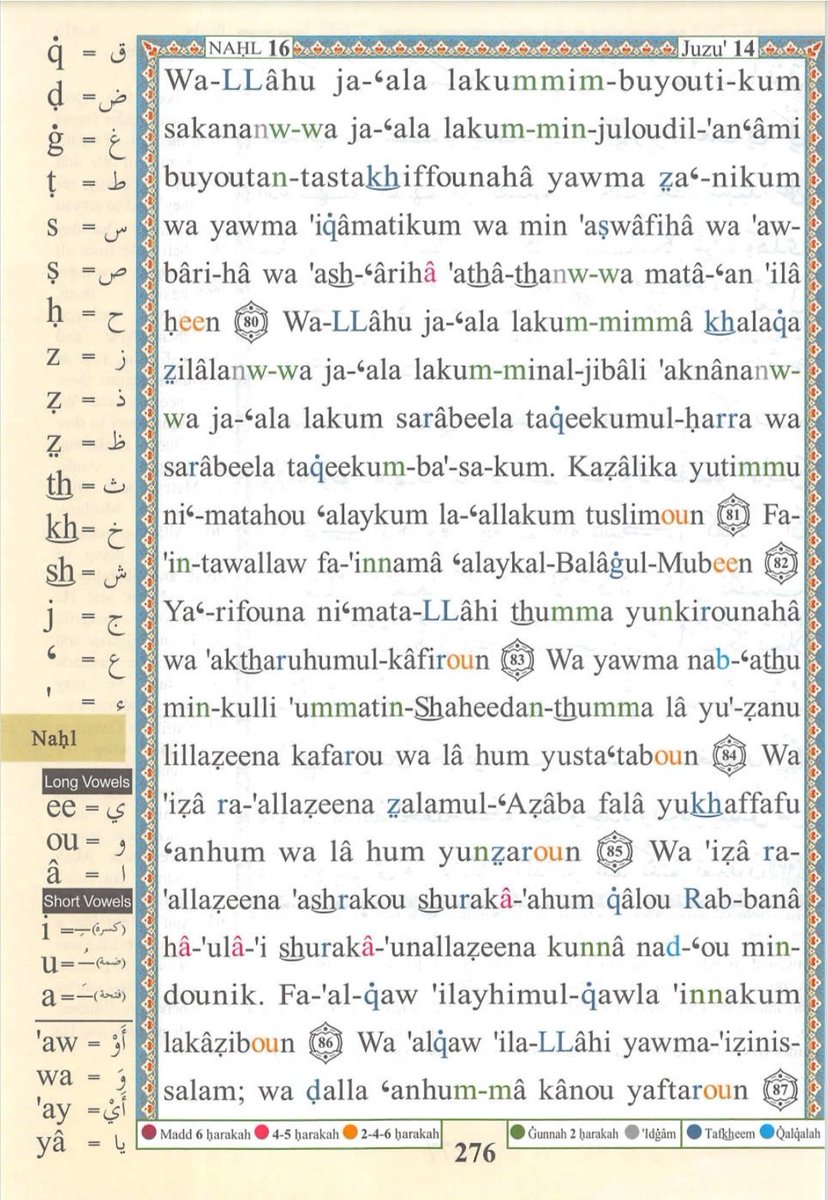
![IdrisAOni1's tweet photo. Pages of the Glorius Qur'ān today, Friday 7/8/26, al-Naḥl (16): 55-72, tafakkur verse 16: 70
Theme: Alah is the Creator and the Perfect Planner of all affairs
{وَٱللَّهُ خَلَقَكُمۡ ثُمَّ یَتَوَفَّىٰكُمۡۚ وَمِنكُم مَّن یُرَدُّ إِلَىٰۤ أَرۡذَلِ ٱلۡعُمُرِ لِكَیۡ لَا یَعۡلَمَ بَعۡدَ عِلۡمࣲ شَیۡـًٔاۚ إِنَّ ٱللَّهَ عَلِیمࣱ قَدِیرࣱ}
"And Allāh created you; then He will take you in death. And among you is he who is reversed to the most decrepit [old] age so that he will not know, after [having had] knowledge, a thing. Indeed, Allāh is Knowing and Competent".
LESSONS:
1. Allah alone controls the stages of human life. From creation to death, every phase of our existence is under His complete knowledge and power.
2. Old age is a reminder of human weakness. Some people live long enough to experience a decline in memory, reasoning, and physical ability, becoming almost like children again. This humbles those who rely on their own strength or intellect.
3. Knowledge is a gift from Allah. Just as He grants knowledge, He can also remove it. Therefore, no one should become arrogant because of learning or intellectual ability.
4. The verse encourages gratitude and compassion. We should thank Allah for our mental and physical faculties while they remain and show patience, kindness, and respect to the elderly whose abilities have diminished.
5. An eschatological reflection. The gradual loss of strength and knowledge reminds us that this worldly life is temporary. Human power inevitably fades, directing the believer to prepare for the everlasting life of the Hereafter, where neither old age nor decay exists for the people of Paradise.
The closing words, "Indeed, Allah is All-Knowing, All-Powerful" (إِنَّ اللَّهَ عَلِيمٌ قَدِيرٌ), contrast human frailty with Allah's perfect and eternal knowledge. While human beings may gain knowledge and later lose it, Allah's knowledge never diminishes, and His power is never weakened. This contrast calls the believer to humility, reliance upon Allah, and constant preparation for the meeting with Him.
O Allah, You created us and to You is our return. Bless us with lives spent in obedience to You and grant us a good ending. Do not let our knowledge become a proof against us, but make it beneficial for us and for others. Preserve our minds, our memory, our faith, and our dignity for as long as You keep us alive. If You decree old age for us, make it an age filled with patience, remembrance of You, and acceptance of Your decree. Protect us from being returned to a state that causes us to forget You or neglect our duties. Forgive our sins, have mercy on our parents and elders, grant ease to those weakened by age or illness, and admit us into Your everlasting Paradise, where there is no weakness, no forgetfulness, and no death. Indeed, You are the All-Knowing, the All-Powerful. Āmīn.](https://pbs.twimg.com/media/HPGHgJqXQAAWuHh.jpg)
![IdrisAOni1's tweet photo. Pages of the Glorius Qur'ān today, Thurday 6/8/26, al-Naḥl (16): 35-54, tafakkur verse 16: 36
Theme: The Universal Call to Tawḥīd and the Rejection of Ṭāghūt
{وَلَقَدۡ بَعَثۡنَا فِی كُلِّ أُمَّةࣲ رَّسُولًا أَنِ ٱعۡبُدُوا۟ ٱللَّهَ وَٱجۡتَنِبُوا۟ ٱلطَّـٰغُوتَۖ فَمِنۡهُم مَّنۡ هَدَى ٱللَّهُ وَمِنۡهُم مَّنۡ حَقَّتۡ عَلَیۡهِ ٱلضَّلَـٰلَةُۚ فَسِیرُوا۟ فِی ٱلۡأَرۡضِ فَٱنظُرُوا۟ كَیۡفَ كَانَ عَـٰقِبَةُ ٱلۡمُكَذِّبِینَ}
"And We certainly sent into every nation a messenger, [saying], Worship Allāh and avoid ṭāghūt. And among them were those whom Allāh guided, and among them were those upon whom error was [deservedly] decreed. So proceed [i.e., travel] through the earth and observe how was the end of the deniers".
LESSONS:
First, it establishes the unity of the message of all Prophets. From Ādam to Muḥammad (ṣallallāhu ʿalayhi wa sallam), every Messenger called his people to two inseparable foundations: the worship of Allah alone (tawḥīd) and the rejection of ṭāghūt, everything that is worshipped, obeyed, or followed in defiance of Allah. Thus, Islam is not a new religion but the continuation and perfection of the same divine message delivered to every nation.
Second, the verse affirms both divine guidance and human responsibility. Allah sent Messengers, clarified the truth, and established the proof (ḥujjah). Those who accepted the message were guided by Allah, while those who knowingly rejected it deserved to be left in their misguidance. This demonstrates that guidance is a blessing from Allah, but it comes after people are given the opportunity to recognise and accept the truth.
Third, Allah commands us to study history: "Travel through the earth and observe..." The Qur'ān repeatedly invites believers to reflect on the ruins and stories of past civilizations. Their destruction was not because they lacked wealth, power, or knowledge, but because they denied Allah's Messengers after the truth had become clear. History, therefore, is not merely a record of the past, it is a source of moral and spiritual lessons for every generation.
Every ideology, political system, personality cult, or material obsession that competes with Allah's right to be worshipped and obeyed is a form of ṭāghūt. The believer's duty remains exactly as it was for every nation before us: to worship Allah alone, reject all false objects of devotion and authority, learn from the rise and fall of previous peoples, and remain steadfast upon the truth until meeting Allah.
Allāhumma ihdinā li-tawḥīdika wa thabbitnā ʿalā ʿibādatika, wa jannibnā al-ṭāghūta wa kulla mā yubʿidunā ʿanka, wajʿalnā mina alladhīna yastamiʿūna al-ḥaqqa fayattabiʿūnah, wa lā tajʿalnā mina al-mukadhdhibīn, warzuqnā al-iʿtibāra bi-āyātika wa bi-ʿibari al-umami al-sābiqīn, wakhtim lanā bil-hudā wa al-thabāt wa ḥusni al-khātimah. Āmīn.
O Allah, guide us to Your pure Oneness and keep us steadfast in worshipping You alone. Keep us away from ṭāghūt and everything that distances us from You. Make us among those who hear the truth and follow it, and do not make us among those who deny it. Grant us the ability to take lessons from Your signs and from the history of the nations before us. Bless us with steadfast guidance and grant us a beautiful ending. Āmīn.](https://pbs.twimg.com/media/HPA9ipQWoAA2Pii.jpg)

![IdrisAOni1's tweet photo. Pages of the Glorius Qur'ān today, Tuesday 4/8/26, al-Ḥijr (15): 91-99 & al-Naḥl (16): 1-14, tafakkur verse 16: 14
Theme: Recognizing Allah's blessings through the miracles of the body of waters and the endless provisions provided in them
{وَهُوَ ٱلَّذِی سَخَّرَ ٱلۡبَحۡرَ لِتَأۡكُلُوا۟ مِنۡهُ لَحۡمࣰا طَرِیࣰّا وَتَسۡتَخۡرِجُوا۟ مِنۡهُ حِلۡیَةࣰ تَلۡبَسُونَهَاۖ وَتَرَى ٱلۡفُلۡكَ مَوَاخِرَ فِیهِ وَلِتَبۡتَغُوا۟ مِن فَضۡلِهِۦ وَلَعَلَّكُمۡ تَشۡكُرُونَ}
"And it is He who subjected the sea for you to eat from it tender meat and to extract from it ornaments which you wear. And you see the ships plowing through it, and [He subjected it] that you may seek of His bounty; and perhaps you will be grateful".
LESSONS:
1. Every provision is ultimately from Allah.
The sea, with all its resources, is not a product of human ingenuity but a blessing placed at our service by Allah. Fish, other seafood, and countless marine resources are divine provisions that should deepen our awareness of the Giver rather than merely the gift.
2. Islam encourages the lawful enjoyment of Allah's blessings.
The verse mentions both necessities ("tender meat") and adornments ("ornaments which you wear"). This demonstrates that Islam does not prohibit beauty or lawful enjoyment of worldly blessings, provided they are acquired and used within the limits of the Sharīʿah.
3. Human progress is built upon Allah's favour.
Ships crossing the seas symbolize commerce, travel, exploration, and civilization. While people design and build vessels, their success depends on the natural laws, oceans, and winds that Allah has created and subjected for humanity. Every scientific and technological achievement should therefore inspire humility before the Creator.
4. Seeking wealth through lawful means is an act of worship.
Allah explicitly mentions that people travel the seas "to seek of His bounty." Earning a living through lawful trade, industry, and honest labour is not contrary to spirituality; it is a noble pursuit when accompanied by sincerity, integrity, and gratitude to Allah.
5. Gratitude is the proper response to divine blessings.
The verse concludes by reminding us that all these favours are meant to produce gratitude. True gratitude is not merely saying al-ḥamdu lillāh; it is recognizing Allah as the source of every blessing, obeying Him, and using His gifts in ways that please Him.
Allāhumma ijʿalnā min ʿibādika al-shākirīn, warzuqnā rizqan ḥalālan ṭayyiban, wa bārik lanā fīmā razaqtanā, wa lā tajʿal niʿamaka sababan lighaflatinā ʿanka. Āmīn.
O Allah, make us among Your grateful servants. Grant us lawful and wholesome provision, bless what You have provided for us, and do not let Your blessings become a cause of heedlessness toward You. Āmīn.](https://pbs.twimg.com/media/HO2pN8gXAAEAXJS.jpg)
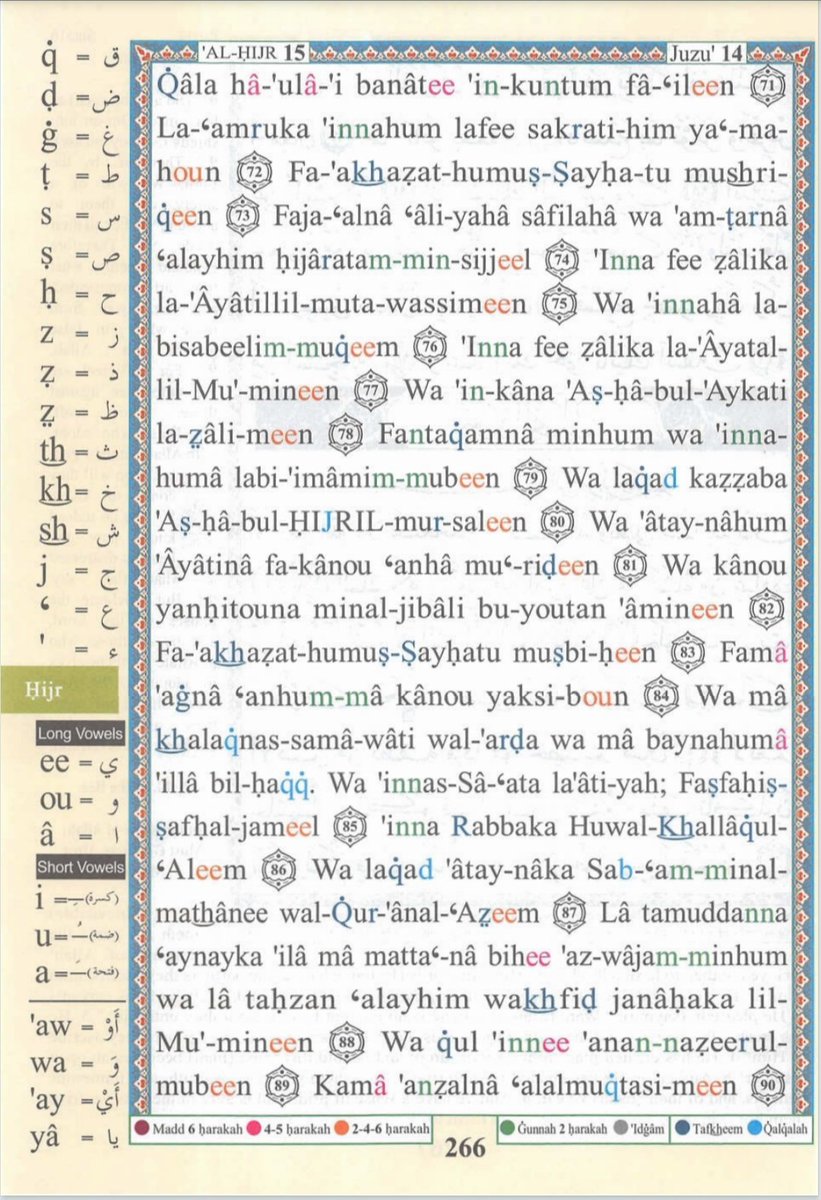
![IdrisAOni1's tweet photo. Pages of the Glorius Qur'ān today, Sunday 2/8/26, al-Ḥijr (15): 16-51, tafakkur verse 15: 49-50
Theme: A Muslim should understand the balancing of hope in Allah's mercy with fear of His punishment
{۞ نَبِّئۡ عِبَادِیۤ أَنِّیۤ أَنَا ٱلۡغَفُورُ ٱلرَّحِیمُ (49) وَأَنَّ عَذَابِی هُوَ ٱلۡعَذَابُ ٱلۡأَلِیمُ (50)}
"[O Muḥammad], inform My servants that it is I who am the Forgiving, the Merciful,
And that it is My punishment which is the painful punishment".
LESSONS:
1. Allah's mercy is vast and always open to the repentant.
Allah begins by introducing Himself as al-Ghafūr (the All-Forgiving) and al-Raḥīm (the Most Merciful), reminding believers that no sin is too great to be forgiven when one sincerely repents and returns to Him.
2. A believer must balance hope and fear.
These two verses teach that faith should neither be based solely on hope nor solely on fear. Hope without fear may lead to complacency, while fear without hope may lead to despair. The true believer walks the middle path.
3. Allah's punishment is real and should never be taken lightly.
Just as Allah's mercy is real, so is His punishment. Persisting in disbelief, arrogance, oppression, and unrepented sins exposes a person to a painful punishment. This serves as a powerful deterrent against disobedience.
4. Effective daʿwah combines glad tidings with warning.
Allah commanded the Prophet ﷺ to inform people of both His mercy and His punishment. Islamic preaching should therefore inspire people with hope while also warning them of the consequences of rejecting Allah's guidance.
5. A sound relationship with Allah is built on both love and reverence.
These verses cultivate a balanced spirituality in which the believer loves Allah for His boundless mercy, hopes for His forgiveness, and reveres Him enough to avoid actions that incur His punishment. Such balance produces sincerity, humility, and steadfast obedience.
O Allah, O All-Forgiving, O Most Merciful, forgive us all our sins, the small and the great, the first and the last, the hidden and the public.
O Allah, make us among Your servants who hope for Your mercy and fear Your punishment, and do not make us among the heedless.
O Allah, keep our hearts firm upon obedience to You, grant us a good ending, admit us into Paradise through Your mercy, and protect us from the Fire through Your grace. Indeed, You are the All-Forgiving, the Most Merciful. Āmīn.](https://pbs.twimg.com/media/HOsWGhZWAAEh11C.jpg)
![IdrisAOni1's tweet photo. Pages of the Glorius Qur'ān today, Saturday 1/8/26, Ibrāhīm (14): 43-52 & al-Ḥijr (15): 1-15, tafakkur verse 15: 9
Theme: the Preservation of the Qur'ān is divine, no amount of effort could corrupt it
{إِنَّا نَحۡنُ نَزَّلۡنَا ٱلذِّكۡرَ وَإِنَّا لَهُۥ لَحَـٰفِظُونَ}
"Indeed, it is We who sent down the message [i.e., the Qur’ān], and indeed, We will be its guardian".
LESSONS:
1. The Qur'ān is a Divine Revelation.
Allah emphatically declares that He Himself revealed the Qur'ān. It is not the product of human thought, philosophy, or imagination. Its origin is divine, making it the ultimate and final source of guidance for humanity.
2. Allah Himself Guarantees Its Preservation.
Unlike previous scriptures, whose preservation was entrusted to human communities, Allah personally undertook the responsibility of safeguarding the Qur'ān. Throughout more than fourteen centuries, it has remained intact in both its written form and in the hearts of millions of memorizers across generations.
3. The Integrity of Islam Rests Upon the Preservation of the Qur'ān.
Since the Qur'ān is the primary source of Islamic belief, law, ethics, and spirituality, its preservation ensures that the authentic message of Islam remains accessible to every generation until the Day of Resurrection.
4. The Verse Strengthens the Believer's Confidence.
This divine promise assures Muslims that no conspiracy, distortion, or hostility can extinguish Allah's guidance. While attempts to alter or suppress the Qur'ān have occurred throughout history, Allah's promise has consistently been fulfilled.
5. Preserving the Qur'ān Includes Living by It.
Although Allah has guaranteed the preservation of the Qur'ānic text, believers are honoured with the responsibility of preserving its teachings through recitation, memorisation, study, implementation, teaching, and conveying its message to others with wisdom and sincerity.
Allāhumma ijʿal al-Qur'āna rabīʿa qulūbinā, wa nūra ṣudūrinā, wa jalā'a aḥzāninā, wa dhahāba humūminā, wajʿalnā min ahlihi alladhīna hum ahluka wa khāṣṣatuk.
O Allah, make the Qur'ān the spring of our hearts, the light of our chests, the remover of our sorrows, and the reliever of our anxieties. Make us among the people of the Qur'ān, Your chosen and beloved servants. (Qur'ān 15:9). Āmīn.](https://pbs.twimg.com/media/HOnNoPDWgAAJGLH.jpg)
![IdrisAOni1's tweet photo. Pages of the Glorius Qur'ān today, Friday 31/7/26, Ibrāhīm (14): 25-42, tafakkur verse 14: 40-41
Theme: Show your children the path to Allah, walk it with them, they would pray for you when you are no more
{رَبِّ ٱجۡعَلۡنِی مُقِیمَ ٱلصَّلَوٰةِ وَمِن ذُرِّیَّتِیۚ رَبَّنَا وَتَقَبَّلۡ دُعَاۤءِ (40) رَبَّنَا ٱغۡفِرۡ لِی وَلِوَ ٰلِدَیَّ وَلِلۡمُؤۡمِنِینَ یَوۡمَ یَقُومُ ٱلۡحِسَابُ (41)}
"My Lord, make me an establisher of prayer, and [many] from my descendants. Our Lord, and accept my supplication.
Our Lord, forgive me and my parents and the believers the Day the account is established".
LESSONS:
1. The greatest inheritance a parent can leave is not wealth or status but unwavering faith. Prophet Ibrāhīm (ʿalayhi al-salām) prayed first that he and his descendants would remain devoted to ṣalāh, teaching us to prioritize spiritual legacy over material inheritance.
2. Children learn more from what they see than from what they hear. When parents consistently walk the path of obedience to Allah, they become living examples whose faith naturally inspires the next generation.
3. Righteous upbringing bears fruit long after a parent's death. Children nurtured upon faith and righteousness become a continuous source of duʿāʾ, asking Allah to forgive and elevate their parents, just as Prophet Ibrāhīm prayed for his own.
4. Raising children upon Islam is an investment for the Hereafter. Every prayer they perform, every act of righteousness they do, and every sincere supplication they make for their parents continues to benefit them even after they have left this world.
5. The verses remind us that a successful family is one united by worship, supplication, and hope in Allah's mercy. Show your children the path to Allah, walk it faithfully with them, and they will remember you before Allah when you are no more.
O Allah, make us and our descendants among those who establish prayer and remain steadfast in obedience to You. Instill in the hearts of our sons and daughters love for You and love for Your Messenger ﷺ, and enable us to be righteous role models for them. O Allah, make them the comfort of our eyes in this world, and make them among those who continue to pray for our mercy and forgiveness after our death. Gather us together with them in the Highest Paradise through Your infinite mercy, O Most Merciful of those who show mercy. Āmīn.](https://pbs.twimg.com/media/HOiDxdlWgAAOmSP.jpg)
![IdrisAOni1's tweet photo. Pages of the Glorius Qur'ān today, Wednesday 29/7/26, Sūrah Ra'd (13): 43 and Ibrāhīm (14): 1-10, tafakkur verse 14: 7
Theme: Gratitude is the key to unlocking more blessings
{وَإِذۡ تَأَذَّنَ رَبُّكُمۡ لَىِٕن شَكَرۡتُمۡ لَأَزِیدَنَّكُمۡۖ وَلَىِٕن كَفَرۡتُمۡ إِنَّ عَذَابِی لَشَدِیدࣱ}
"And [remember] when your Lord proclaimed, 'If you are grateful, I will surely increase you [in favor]; but if you deny, indeed, My punishment is severe".
LESSONS:
1. Gratitude is a divine command and a pathway to increase
Allah does not merely encourage gratitude; He promises an increase for those who practise it. The increase is not limited to wealth. It includes increase in faith, wisdom, peace of mind, health, relationships, opportunities, blessings, and closeness to Allah. A grateful heart sees abundance even in what appears small, and Allah expands the value of what it possesses.
2. Gratitude transforms what we have into blessings
Many people possess countless blessings but fail to experience their sweetness because they overlook them. Gratitude turns ordinary gifts into sources of joy and contentment. The grateful person does not constantly measure life by what is missing but recognizes the countless favours already bestowed by Allah.
3. Ingratitude is a form of spiritual blindness
The opposite of gratitude (shukr) is kufrān al-niʿmah, denying or neglecting Allah’s blessings. It is not merely refusing to believe; it also includes failing to acknowledge the One who granted every favour. When people attribute their success entirely to themselves and forget the Giver, they risk losing the spiritual awareness that protects them from arrogance.
4. Allah’s promise of increase is certain
The verse uses a strong oath-like expression: “I will surely increase you” (la-azīdannakum). Allah’s promises never fail. The servant who sincerely thanks Him may not always receive exactly what he expects, but Allah increases him in ways that are ultimately better and more beneficial.
5. Gratitude is a daily act of worship
True gratitude is not only words of praise; it consists of three dimensions:
Gratitude of the heart: recognizing that every blessing comes from Allah;
Gratitude of the tongue: praising Allah and acknowledging His favours;
Gratitude of action: using Allah’s blessings in ways that please Him.
A person who is grateful for knowledge shares it, one grateful for wealth gives charity, one grateful for authority serves people, and one grateful for life uses it in obedience to Allah.
The question is not only: “How many blessings do I have?” but also: “How much gratitude do I show for the blessings I already possess?” Many people wait for more before they become grateful, while Allah teaches that gratitude is itself the door through which more blessings enter.
May Allah make us among those who recognize His favours, praise Him for them, and use them in obedience to Him. May He increase us in faith, goodness, and blessings, and protect us from the blindness of ingratitude. Āmīn.](https://pbs.twimg.com/media/HOXvf_rW0AAm-pu.jpg)
![IdrisAOni1's tweet photo. Pages of the Glorius Qur'ān today, Tuesday 28/7/26, Sūrah Ra'd (13): 29-42, tafakkur verse 13: 31
Theme: The Qur'ān is the greatest miracle on Earth
{وَلَوۡ أَنَّ قُرۡءَانࣰا سُیِّرَتۡ بِهِ ٱلۡجِبَالُ أَوۡ قُطِّعَتۡ بِهِ ٱلۡأَرۡضُ أَوۡ كُلِّمَ بِهِ ٱلۡمَوۡتَىٰۗ بَل لِّلَّهِ ٱلۡأَمۡرُ جَمِیعًاۗ أَفَلَمۡ یَا۟یۡـَٔسِ ٱلَّذِینَ ءَامَنُوۤا۟ أَن لَّوۡ یَشَاۤءُ ٱللَّهُ لَهَدَى ٱلنَّاسَ جَمِیعࣰاۗ وَلَا یَزَالُ ٱلَّذِینَ كَفَرُوا۟ تُصِیبُهُم بِمَا صَنَعُوا۟ قَارِعَةٌ أَوۡ تَحُلُّ قَرِیبࣰا مِّن دَارِهِمۡ حَتَّىٰ یَأۡتِیَ وَعۡدُ ٱللَّهِۚ إِنَّ ٱللَّهَ لَا یُخۡلِفُ ٱلۡمِیعَادَ}
"And if there was any Qur’ān [i.e., recitation] by which the mountains would be removed or the earth would be broken apart or the dead would be made to speak, [it would be this Qur’ān], but to Allāh belongs the affair entirely. Then have those who believed not accepted that had Allāh willed, He would have guided the people, all of them? And those who disbelieve do not cease to be struck, for what they have done, by calamity - or it will descend near their home - until there comes the promise of Allāh. Indeed, Allāh does not fail in [His] promise".
LESSONS:
1. The Qur'ān is the greatest miracle ever revealed.
Allah declares that if any revelation could physically move mountains, split the earth apart, or make the dead speak, it would have been this Qur'ān. This rhetorical expression highlights that the Qur'ān possesses the greatest possible authority and transformative power. Its primary purpose, however, is not to amaze people with spectacular physical miracles but to transform hearts, minds, and souls. A heart awakened by the Qur'ān is a greater miracle than a mountain being moved.
2. Guidance belongs to Allah alone.
The verse reminds believers that even the clearest evidence cannot compel faith. Had Allah willed, every human being would have believed. This teaches that while people are commanded to convey the truth with wisdom and compassion, only Allah opens hearts to guidance. The duty of the prophets and their followers is to communicate the message faithfully, not to force acceptance.
3. Persistent disbelief has consequences.
Those who knowingly reject Allah's guidance continue to experience the consequences of their own choices. These may come as personal hardships, societal upheavals, or calamities approaching their communities. Such events serve as reminders and opportunities for reflection before the final accountability in the Hereafter. They are not random but occur within Allah's perfect wisdom and justice.
4. The promise of Allah is certain.
Whether it is the victory of truth, the fulfillment of divine justice, or the coming of the Last Day, Allah's promise never fails. Human beings may perceive delays, but divine timing is always perfect. This certainty strengthens the believer's patience, resilience, and unwavering trust in Allah during periods of hardship and uncertainty.
5. Believers should place their confidence in Allah, not merely in miracles.
Faith is sustained by sincere reflection, humility, and submission to Allah rather than by a constant demand for extraordinary signs. The Qur'ān itself is the enduring miracle available to every generation. Those who engage with it sincerely find guidance, wisdom, and spiritual renewal that no physical miracle could surpass.
O Allah, make the Qur'ān the spring of our hearts, the light of our chests, the remover of our sorrows, and the reliever of our anxieties. Grant us true guidance and steadfastness upon Your religion. Make us among those who place their complete trust in You, and fulfill for us Your promise of goodness in this world and the Hereafter. Āmīn.](https://pbs.twimg.com/media/HOSnq2JW8AAnW44.jpg)
![IdrisAOni1's tweet photo. Pages of the Glorius Qur'ān today, Monday 27/7/26, Sūrah Ra'd (13): 14-28, tafakkur verse 13: 16
Theme: The Absolute Oneness and Sovereignty of Allāh over Creation is the truest of all truths
{قُلۡ مَن رَّبُّ ٱلسَّمَـٰوَ ٰتِ وَٱلۡأَرۡضِ قُلِ ٱللَّهُۚ قُلۡ أَفَٱتَّخَذۡتُم مِّن دُونِهِۦۤ أَوۡلِیَاۤءَ لَا یَمۡلِكُونَ لِأَنفُسِهِمۡ نَفۡعࣰا وَلَا ضَرࣰّاۚ قُلۡ هَلۡ یَسۡتَوِی ٱلۡأَعۡمَىٰ وَٱلۡبَصِیرُ أَمۡ هَلۡ تَسۡتَوِی ٱلظُّلُمَـٰتُ وَٱلنُّورُۗ أَمۡ جَعَلُوا۟ لِلَّهِ شُرَكَاۤءَ خَلَقُوا۟ كَخَلۡقِهِۦ فَتَشَـٰبَهَ ٱلۡخَلۡقُ عَلَیۡهِمۡۚ قُلِ ٱللَّهُ خَـٰلِقُ كُلِّ شَیۡءࣲ وَهُوَ ٱلۡوَ ٰحِدُ ٱلۡقَهَّـٰرُ}
"Say, Who is Lord of the heavens and earth? Say, Allāh. Say, Have you then taken besides Him allies not possessing [even] for themselves any benefit or any harm? Say, Is the blind equivalent to the seeing? Or is darkness equivalent to light? Or have they attributed to Allāh partners who created like His creation so that the creation [of each] seemed similar to them? Say, Allāh is the Creator of all things, and He is the One, the Prevailing".
LESSONS:
1. Tawḥīd begins with recognizing Allāh as the sole Creator and Sustainer. The Qur'ān directs the Prophet ﷺ to ask who owns and governs the heavens and the earth, leaving no room for any answer other than Allāh. Since He alone creates, sustains, and controls the universe, He alone deserves worship, absolute obedience, and complete reliance.
2. No created being possesses independent power to benefit or harm. The verse challenges the futility of taking protectors besides Allāh, for even those beings cannot control their own affairs without His permission. This teaches the believer to place ultimate trust in Allāh alone while recognizing that all means and causes operate only by His will.
3. Truth and falsehood can never be equal. Just as sight is superior to blindness and light is distinct from darkness, faith cannot be equated with disbelief, nor guidance with misguidance. The believer should therefore seek knowledge, embrace revelation, and avoid moral and spiritual confusion that blurs the distinction between truth and falsehood.
4. Creation is the clearest proof of Allāh's exclusive divinity. The Qur'ān asks whether the alleged partners of Allāh have created anything comparable to His creation. Since none shares in His creative power, none deserves any share of worship. Every sign in the universe points to the uniqueness, majesty, and absolute authority of the Creator.
5. Allāh alone is al-Wāḥid and al-Qahhār. The verse concludes by affirming two magnificent Divine Names: al-Wāḥid (The One), signifying His absolute uniqueness without partner or rival, and al-Qahhār (The Irresistible, the Supreme Dominator), affirming that every creature is under His complete power and authority. This certainty fills the believer's heart with humility, confidence, and unwavering devotion to Allāh alone.
O Allāh, O the One, O the Irresistible, keep our hearts firm upon Your Oneness. Make us among Your sincere servants. Show us the truth as truth and grant us the ability to follow it; show us falsehood as falsehood and grant us the ability to avoid it. Do not allow our hearts to become attached to anything besides You. Indeed, You are over all things All-Powerful. Āmīn.](https://pbs.twimg.com/media/HONdyWIXAAAg45O.jpg)


