Gender studies is so ideological that a basic change it needs to make is to “signal…that disagreement…is not just OK, it is expected.”
From a sociologist who has taken critique seriously for years:
“I no longer use biological theories as a foil. Instead, I acknowledge that there are biological differences between women and men and that these are exaggerated and emphasized through social mechanisms. In the past few years, I have incorporated political-viewpoint diversity by adding Richard Reeves’s book, Of Boys and Men: Why the Modern Male is Struggling, Why It Matters, and What to Do About It, and short opinion pieces by political conservatives to my syllabus. By assigning authors who disagree with each other, I signal to my students that disagreement — with the readings, with each other, and with the professor — is not just OK, it is expected.”
"Tradition means giving votes to the most obscure of all classes, our ancestors. It is the democracy of the dead. Tradition refuses to submit to the small and arrogant oligarchy of those who merely happen to be walking about."
G. K. Chesterton
Director: “well, I’d say that the final cut!”
Disney Exec: “not so fast- first we have to run it by Pazuzu, the Demon that Eats Colors”
Pazuzu, the Demon that Eats Colors: “Delicious reds and greens! A feast for Pazuzu!”
“Empathy” directed towards intangible abstractions (“refugees,” “all living beings”) is indistinguishable from vanity. It’s just energy being recycled within the self. This is why hippies and bleeding hearts are often the worst narcissists you’ll come across
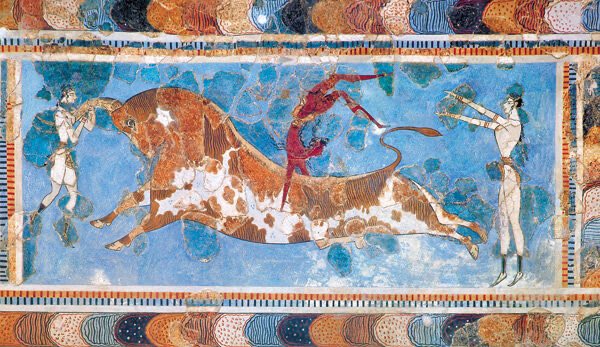
I am (still) reserving judgment on Nolan’s Odyssey, but just in general I do think it’s a modern mistake to imagine that “realistic” has to mean muted, grayscale, drab. We don’t bring these stories to life by stripping them down. It’s aesthetically deflationary and anti-mythic. If anything the Homeric world is super-saturated, heightened, bursting with life.
One gets the impression that *real life*, to the impassioned warriors and lovers of antiquity’s glittering Mediterranean shores, often felt super-saturated too. If it no longer feels that way to us it’s our own problem, a function of ennui and a failure of imagination, the sign of an exhausted age. That’s our style, our concern. It’s not Homer’s.
We don’t make these stories truer to life by making them darker. Our obsession with shadow and grayscale is an aesthetic pretending not to be one, pretending to be “reality.” That conceit will seem as silly in a few generations as the rococo affectations of the French gentry seem to us now. Why get caught up in passing fads? Why not swing for the fences, imagine in technicolor, fill the world of the mind with life? That’s what makes the Odyssey endure.
@zaydenam@pitdesi There is a false saying: 'How can someone who can't save himself save others?' Supposing I have the key to your chains, why should your lock and my lock be the same?
The modern world finally reveals itself when you see the vast majority of people, even relatively smart ones, are seasonal farm hands play-acting as administrators and magistrates. Their wills stretched to monstrous and deformed proportions through hydrocarbons and free global telecommunications.
Polyamory is interesting insofar that it demonstrates how useful invoking
therapeutic self entitlement can be in avoiding basic adult moral obligations.
Joan Didion in her famous essay, On Self Respect, composed at age 27(!) wrote:
‘Like Jordan Baker, people with self-respect have the courage of their mistakes. They know the price of things. If they choose to commit adultery, they do not then go running, in an access of bad conscience, to receive absolution from the wronged parties; nor do they complain unduly of the unfairness, the undeserved embarrassment, of being named corespondent.’
A big social/ cultural innovation since Didion’s essay is therapeutic storytelling that allows adults to feign ignorance of basic trade-offs in life (you can have your cake and eat it too) and permits adolescent recklessness without being held accountable for the consequences. This sort of rationalizing is an acid bath for the notions of self-respect and personal responsibility that Didion had in mind.
Transgenderism must revert to being a form of private eccentricity. Recognition as one's preferred gender can be privately negotiated but with no coercion by any entity private or public. We all have an absolute right to affirm or not affirm, believe or not believe, that gender identity exists, that no one can infringe.
Sex segregated spaces and activities remain segregated by sex, not "gender identity."
Adults are free to inflict bodily self-harm on themselves in pursuit of an appearance they like but outside of any pretense of a medical protocol -- these are cosmetic procedures that come with no promises to relieve dysphoria or unlock an authentic self and the cost is borne solely by the person seeking them. Any such promises constitute consumer fraud. Children are of course unable to consent to such procedures.
The state has no role in affirming any aspect of cross-gender ideation, avoids proselytizing to children in schools or to anyone else in any interface it has with the public. The person who has inflicted bodily self-harm on his sex traits is no more a distinct class of person to whom special privileges or protections can be conferred than a person who has covered his face in tattoos. The person who believes with all his heart that he is a woman at heart and would die if others don't recognize him as such imposes no duty on any other person to share in that belief or to pretend to share in it. That person must develop resiliency about living in a pluralistic, liberal, democratic society where every person has a right to belief and a corollary right to unbelief that no one may legitimately infringe.
Any and all deviations from this resolution are morally illegitimate and practically untenable.
The attempt to turn a private eccentricity into a social cause that justified the remaking of society was a ghastly and destructive mistake. It was made inevitable by certain facets of the culture and certain aspects of our politics. We must learn the lesson that experience has now taught us.
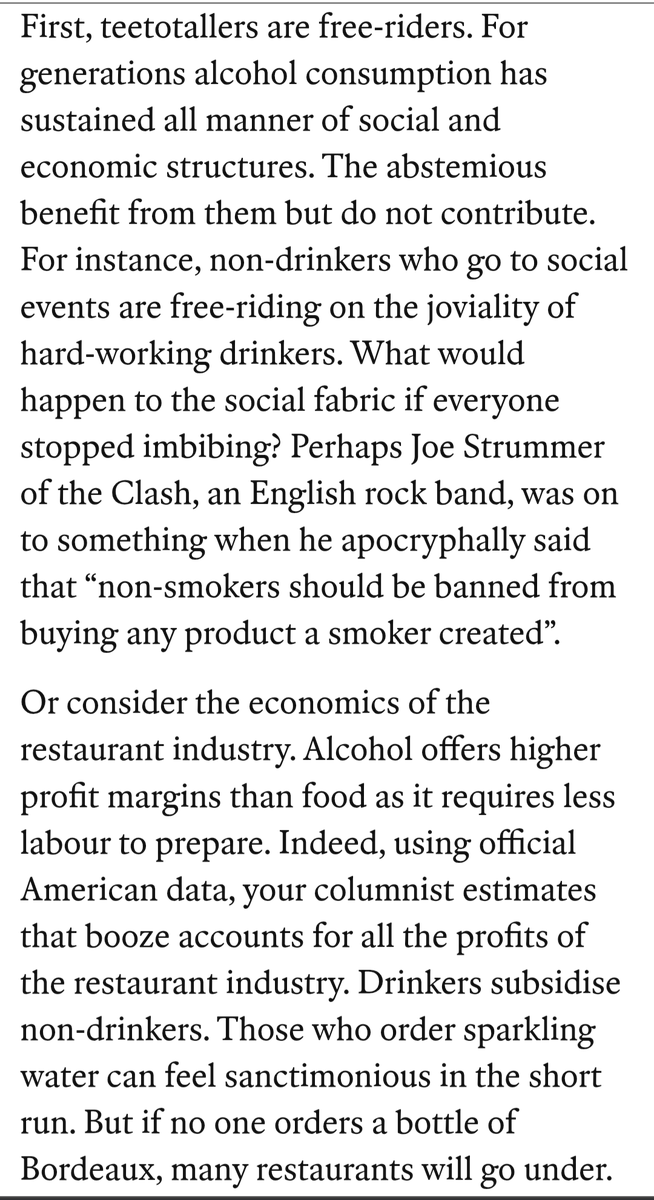
This @TheEconomist piece may be the most explicit endorsement of drinking that any major mainstream publication has run in a long time. Quite something, link below.
A uniting characteristic of a great deal of junk science is that it paints a picture of human beings as plastic bags in a tornado - moved by inexorable forces, lacking agency and rationality. They walk slower if incidentally exposed to words associated with old age, perceive their relationships as less stable if they sit on a wobbly stool, are willing to pay five times as much for an item if shown a large number. They are healed by placebos, but harmed by discount placebos. Even judges become predictably irrational if they are hungry, or if they are reminded of their own death.
Perhaps you could even say that humans are, in this worldview, lumps of meat in a piranha tank, taking liberties with Gelman's "piranha problem" formulation. They are irrational beings at the mercy of thousands of tiny manipulations (manipulations whose effects are, somehow, entirely predictable, despite being so numerous and so large).
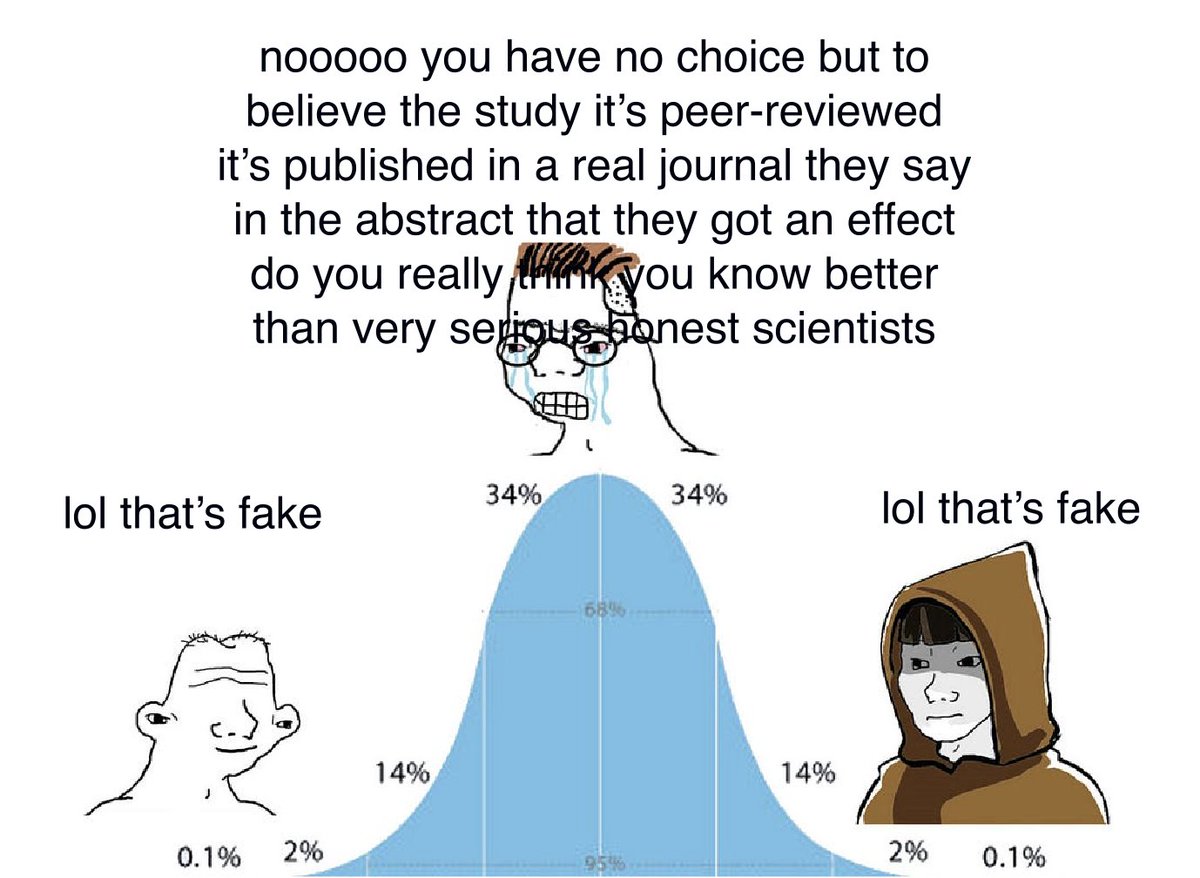
Only a tiny bubble of people now believe that this is false. But what does it say about people that so many believed, and continue to believe, in nudge, priming, hungry judges, seeing a few words printed in red makes people do worse on tests, etc.? Does it actually prove the underlying worldview correct - that people are stupid and irrational and have no agency?
I think I've flippantly drawn that conclusion in the past, but now I think it's actually backwards. Believing bullshit research in the face of the evidence of your own lying eyes and facial ridiculousness is very much a System 2/rational process. To unbelieve it requires even more deliberation - wading through the studies to find out how the junk science is produced by flexibility, fraud, and innumerable kinds of fuckery - but even the first step, from belief in rationality and agency to belief in plastic-bag-in-a-tornado theory, is a deliberative process.
That is to say, even the mistaken, widespread belief in automaticity based on junk science is in fact evidence against automaticity!
@SpencerKlavan Anyone utterly convinced that we "know" that human consciousness/subjectivity is "just like a computer program" is like another species to me. What a hollow existence. And they always state it that way (consciousness=software), surrendering the hierarchy off the bat.