BOOOM 🚨 If you're one of the hundreds of millions of people dealing with neck or back pain, @elonmusk just dropped some great news 🔥
He says Neuralink will one day end neck and back pain, and that promise comes from someone who's lived with that pain since 2013 🐰
It sounds challenging, but Neuralink has already built a big chunk of the hardware it needs 💪
🧠 Why Neuralink would go after the pain signal instead of the spine
Elon blew out the C5-C6 disc in his neck when he threw a 350-pound sumo champion at his 42nd birthday party, and years of surgeries followed. In April 2024, he said a disc replacement brought his pain down from a 7 to 9 out of 10 to a 1 to 4.
Surgery can repair a disc, but the feeling of pain is created in the brain. Nerves send warning signals up the spinal cord, and the brain decides how much it hurts. People with phantom limb pain feel pain in an arm or leg that's no longer there, because the brain keeps generating it.
That turns pain into a signal problem, and signals are Neuralink's specialty. A Neuralink pain implant could work as a closed loop: it reads the activity, recognizes the pain pattern, and sends gentle pulses back to dial it down.
If you drive a Tesla, you already know the idea. Traffic-Aware Cruise Control keeps adjusting to the car ahead instead of locking in one speed. Spine implants that adjust like this have already outperformed fixed-setting ones over three years in a clinical trial.
👂 How Neuralink's chips could read a person's pain pattern around the clock
Reading comes first, and a pain implant would have to do it nonstop for years inside a skull, where extra heat can harm tissue. Neuralink has designed a custom chip for exactly that job.
It samples each electrode up to 20,000 times a second and checks every sample in about one microsecond, a millionth of a second.
Instead of beaming all that raw data out, it spots neural spikes and sorts them by shape right on the chip, shrinking the stream to a few hundred kilobits per second. Less data to send means less heat and longer battery life.
The body is electrically noisy, so the chip runs a noise tracker that keeps recalibrating each channel as conditions change. Another Neuralink design uses quantum tunneling to build a tiny filter that blocks the body's slow electrical drift while taking up almost no chip space.
Neuralink's chip network can also send local field potential readings, the broad rhythm of whole groups of neurons. UCSF researchers used this kind of signal to predict when someone's chronic pain was running high.
Everyone's pain pattern looks a little different, so the implant would also need to learn its owner. That's something Neuralink already does every day in its Telepathy trials, where decoders are tuned to each participant's brain so people with paralysis can control computers with their thoughts.
By January 2026, 21 participants had enrolled, and the company reported zero serious device-related adverse events.
⚡ Two places Neuralink could turn the pain down
Neuralink says everything it has built since day one can both read and write, meaning it can stimulate neurons as well as record them.
One of its electrode designs packs 3,072 electrodes that do both, all inserted through a single small opening. Its designs put tiny pulses to work, too, like a faint tingle that confirms a device has securely paired with the implant.
The first place to turn pain down is the brain itself, where the implant could quiet the activity that creates the feeling of pain.
The second is closer to where the pain starts. Neuralink's sealed-electronics design names the spinal cord and peripheral nerves as target sites alongside the brain.
Back in 2022, the company showed electrodes in a pig's spinal cord controlling different leg movements. Elon has also described Neuralink bridging signals from the brain to damaged areas of the neck and spine.
A crushed disc will still need a surgeon. Neuralink would take on the pain that sticks around afterward, like the 1 to 4 Elon was left with.
🛡️ Hardware sealed to survive years inside the body
Chronic pain can last for years, so the implant has to be built to last as well. The inside of the body is basically warm salt water that eats away at electronics, and Neuralink has engineered its hardware to handle it.
Its seals are made from melted glass instead of drilled holes. A tough plastic shell called PCTFE stays airtight around thousands of tiny wires, and bare chips sit right inside a sealed crystal base instead of a bulky titanium can. Before surgery, the implant can soak in a fake liquid brain that tests its wires.
The threads are thinner than a human hair and flexible, which helps them avoid the scar tissue that slowly muffles signals from stiff implants.
Neuralink's newest granted design takes it even further: a living layer of lab-grown neurons that sits on the brain's surface and wires itself in without a single probe.
🚀 Three milestones Neuralink is racing toward next
The big one is writing into the human brain, and Blindsight, Neuralink's vision implant, is lined up to show it. Elon said on October 30 that it's ready from an engineering standpoint and just waiting on regulatory approval.
Next up is reach. The brain regions tied to chronic pain sit deeper than the patch of motor cortex Neuralink reads today. Neuralink's 2028 roadmap is built around that goal, aiming for more than 25,000 channels per implant and access to any part of the brain, with pain named as a target.
Then comes scale. Neuralink's surgical robot is designed to pull threads from a cartridge, dodge blood vessels with computer vision, and clean its needle between insertions.
Elon said Neuralink would move to high-volume production and an almost fully automated procedure in 2026.
Together, those steps could take a pain implant from a small group of trial volunteers to everyday patients.
🌅 What everyday life could look like with a Neuralink pain implant
Once Neuralink clears those milestones, a pain implant wouldn't have to wait for the pain to hit or for someone to reach for a pill.
A chip that checks every sample in about a microsecond and knows its owner's pain pattern could spot a flare-up while it's still building and calm it down before it ever peaks.
Elon has spent 13 years chasing relief from one bad throw in a sumo ring. If Neuralink pulls this off, people living with chronic pain could finally get relief that shows up before the pain does.
Even some of Tesla's biggest skeptics are starting to change their minds about Robotaxi
Wall Street analyst Ron Jewsikow, who previously had a SELL rating on Tesla, has now initiated coverage at Seaport Global with a BUY rating and a $475 price target
And the reason behind this change is Tesla's progress in autonomous driving
Robotaxi is now a "legitimate multitrillion-dollar opportunity" that has become "impossible to ignore"
Here's what Seaport is projecting:
• Tesla Robotaxi could reach $3–4 BILLION in annual recurring revenue by the end of 2027
• Tesla's autonomous driving mileage is growing faster than Waymo's in Texas
• Tesla's vision-only approach offers the potential to expand much faster without relying on expensive additional sensors
• FSD is becoming a major product differentiator across Western automotive markets
• Tesla's automotive business is expected to return to growth and improve margins in 2027
What's interesting is that this is coming from someone who spent years being skeptical of Tesla's autonomous driving approach
Now the real-world progress is changing his outlook
Tesla is still in the early stages of building out its Robotaxi network, and the scale of the opportunity is becoming harder for even its former critics to dismiss
BREAKING: Tesla Robotaxi has passed 6 million miles driven autonomously.
Tesla's safety report shows, to date:
- zero people injured
- zero airbag deployments
- zero pedestrians or cyclists hit across the fleet
The fleet reached 3.1 million autonomous miles on October 18 and has now passed 6 million.
- Austin leads all markets with ~2.1 million miles
- followed by Dallas at ~608,000
- Houston at ~226,000
Logged conditions include:
- ~862,000 miles after dark
- ~113,000 in the rain
- ~575,000 in rush hour
Source: Tesla
🇻🇪🚨ÚLTIMA HORA: El gobierno comunista de Venezuela revela que tiene una deuda de 237.500 millones de dólares. Venezuela tiene la mayor reserva de petróleo del mundo y aun así el comunismo y socialismo ha destruido toda la economía del país.
El comunismo es un CÁNCER maligno.
GOOD NEWS 🚨 A pre-refresh HW4 Model Y without a front bumper camera just got FSD v15.0.1 in software update 2026.38.6.11, and that settles a question plenty of older HW4 owners have been asking 🔥
It's the same build, with the same release notes, that the first wave of 2025 and newer Model Ys got, so legacy owners are getting the full release.
This car is the proof that V15 doesn't need the bumper camera. That puts older Model 3s, Model Ss, and Model Xs without one in line for V15 too, even though it has only shown up on Model Y so far.
So what does that camera actually do?
Tesla says it's there to help you see ahead when parking at low speed or off-roading. It covers the area right in front of the bumper, so a newer Model Y may still have the edge when nosing into a really tight spot.
On the road, that legacy Model Y's first hour on V15 went great. It drives just like the Robotaxis in Dallas and Austin, and parking, a weak spot on V14, is finally better.
And that's on a car with no bumper camera at all.
Reality View runs about half a second behind on that car, the same delay first-wave owners noticed, and it sometimes slips into frames that look more like an oil painting than a street. Tesla already has fixes planned, including about 35% less Reality View latency and a fix for a purple haze that shows up at night.
There's no point refreshing the app yet, though. For now, V15 is going to specific cars, and no new wave has started. Elon says it goes wide in December with the Holiday Update, and that's when it reaches most HW4 owners.
When it does, an older HW4 Tesla gets the same V15 as a Model Y fresh off the line, plus the Reality View fixes already on the way. That's a lot of new car for owners who didn't have to buy one.
Elon Musk foi friamente dispensado pelo seu ídolo Steve Jobs lol
Jornalista: "Você admira o Jobs?"
Elon: "Ele é uma das pessoas que eu admiro."
Jornalista: "Você já o encontrou pessoalmente?"
Elon: "Só uma vez, em uma festa."
Jornalista: "O que vocês conversaram?"
Elon: "Eu tentei falar com ele, mas ele me tratou de forma rude."
Jornalista: "O Jobs é louco, né? lol"
Elon: "Ele foi bem desagradável."
Jornalista: "Mesmo assim, você o admira?"
Elon: "As conquistas dele são incríveis."
Jornalista: "Então, o caráter é outra história?"
Elon: "Exatamente isso."
My last post was six years ago as @NASA Administrator.
Today, I’m returning to announce @QuantumSpace_US, is now public on the @NYSE as $QSPC.
We’re building satellites that can move, refuel and be refueled to help ensure America’s leadership in space.
Let’s get to work!
A TRUE Friend
When you are down and out
And everyone is turning against you
Only your true friends will be there for you
Elon Musk proved that
By standing right by Jensen’s side
Elon Musk even brought his kids
To Nvidia’s headquarters
Find a friend, like Elon
They are once in a lifetime friends
🚨 BREAKING: The USAID FILES are LIVE and they prove EXACTLY why President Trump, DOGE and Marco Rubio were right to shutter it — IT WAS ENGAGED IN BIG TECH CENSORSHIP and MANIPULATION
DOGE's "Big Balls" Edward Coristine confirmed the files are up and Elon Musk boosted it 🔥
Among the files, located on the LANDING PAGE of USAID:
- "Injunction and Content Moderation Talking points"
- A "Harmful Speech Monitoring and Tracking Methodology"
- "Talking Points and Asks for Google and YouTube"
- "Partnership Language for Facebook" draft
- A "Big Tech Engagement Plan"
- Concept notes and calls with the Global Disinformation Index
- A COVID vaccine information concept note through Facebook and WhatsApp
- A 92-page USAID "Disinformation Primer"
- A Summit for Democracy social media influencer campaign
- A request for a meeting between YouTube CEO Susan Wojcicki and USAID chief Samantha Power
- A Davos meeting request and a dinner invite for Power with YouTube CEO Neal Mohan
- A meeting request between Power and Meta's Nick Clegg
OUR tax dollars were used to pressure the platforms that control what Americans see!
DOGE was RIGHT to shut it down. Thank you, @as400495@elonmusk! 🇺🇸
Lucid, Nuro and Uber have announced the start of fully driverless Robotaxi testing on public roads in the San Francisco Bay Area, with no safety driver behind the wheel.
• Driverless employee rides will begin soon.
• Public launch is expected in Q1 2027.
• Testing will expand to additional Bay Area cities in 2027.
Uber has committed to purchasing at least 35,000 Lucid vehicles equipped with Nuro’s autonomous driving technology, with plans to expand the Robotaxi service across dozens of global markets over the coming years.
The vehicles will be owned and operated by Uber and its fleet partners and available exclusively through the Uber app.
Elon: "done without AI/SI, but we will be using a lot of SI in the future."
Mars is where that pays off. Perseverance hit the atmosphere near 20,000 km/h and had ~7 minutes to land itself. Earth couldn't help: signals took 11+ minutes.
That's a job for SI.
A Starship can survive reentry and still be unsafe to fly again. 🚀
How do engineers know whether a recovered Starship is structurally sound—or hiding permanent damage beneath its stainless-steel skin?
From microscopic cracks and weld defects to permanent deformation and structural fatigue, post-flight inspection goes far beyond checking whether the vehicle looks intact.
The real question isn't whether Starship survived its last flight.
It's whether its structure can safely survive the next one.
What would you inspect first: the welds, tank domes, or structural joints?
#Starship #SpaceX #RocketEngineering #AerospaceEngineering #ReusableRockets
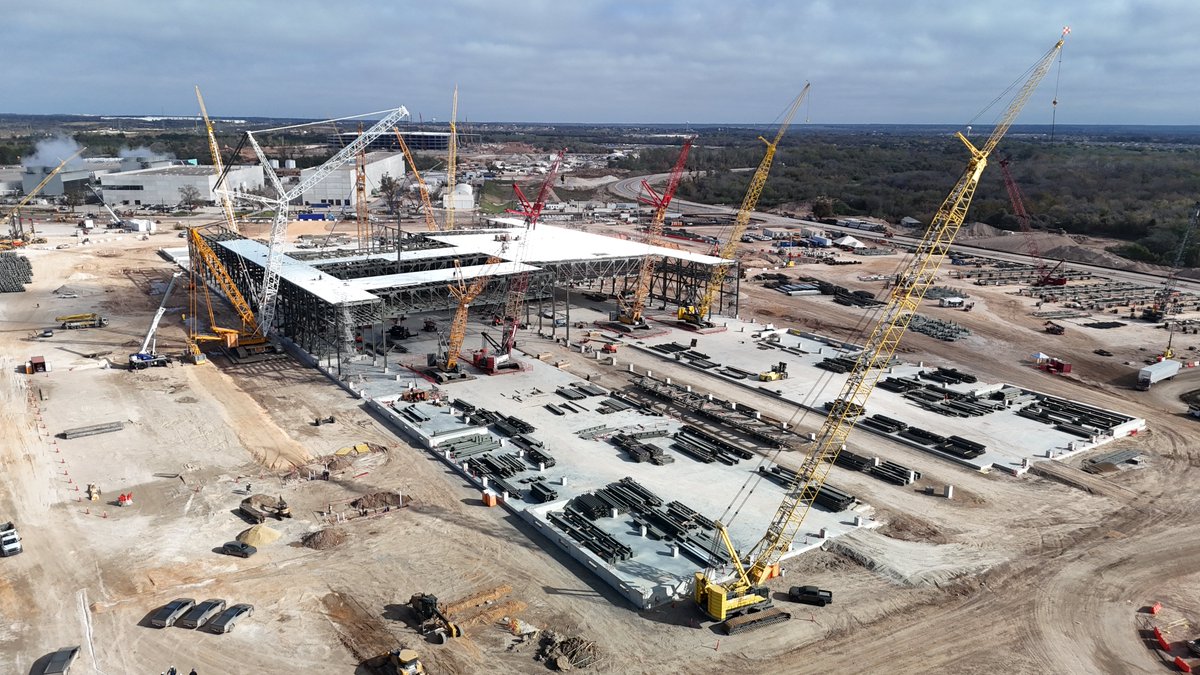
2026 Giga Texas Advanced Technology Chip Fab update (@Tesla / @SpaceX joint venture)
Busy site with multiple fronts moving at once:
• Huge equipment deliveries underway
• Electrical conduit trenching + concrete vault work continuing
• More large steel truss assembly progressing
• GeoPier equipment staged and idle for now
• New rebar footing cages being fabricated on the east side
This ~$3B R&D research fab on the North Campus is the precursor to the much larger Terafab in Grimes County. It combines logic, memory, packaging, and test under one roof so process recipes can be developed and qualified at a few-thousand-wafers-per-month scale for rapid iteration.
First experimental/test chips (including SRAM-style circuits) are targeted for roughly May–June 2027 here.
Proven processes then transfer to volume production at Terafab (aimed for late 2028 / Q3 2028 range, with the usual aggressive-timeline caveats).
This setup lets Tesla and SpaceX close the design-to-silicon loop close to vehicle, Optimus, and Cortex work before scaling at the megafab.
Vertical and foundation progress continues to accelerate. 🚀
NASA is in a new and interesting situation with SpaceX. For most of the commercial space era, our government agency was the "indispensable" customer, and private companies competed for its money. Now the dominant private player SpaceX has appeared to have "outgrown the customer" that once saved it. The SpaceX announcement that it will no longer book services on the Crew Dragon or Falcon 9 rocket, coupled with stopping new commercial reservations after 2028, presents scenarios not previously envisioned. Founder Elon Musk has described working with the government as "wearing lead shoes and walking through molasses." As a former government employee, I must say he isn't wrong - but how will this change the landscape of human spaceflight? Personally, I love his aggressive approach, as long as safety of crew, spacecraft, and mission remain at the forefront. #NeverBetAgainstElonMusk
For human spaceflight, this potentially creates a near-term capacity and redundancy problem in low-Earth orbit. Boeing’s Starliner remains the other Commercial Crew option, but it is still recovering from the 2024 crew flight test vavle/thruster issues and isn't ready to take people safely and reliably, to space…, yet. Are we in for another gap like the end of the shuttle program or is there another path we can take? Only time will tell.
🔥Elon Musk says he's tempted by a 500-ton Raptor 4 for Super Heavy's outer ring!
• Raptor 1 to 3 thrust increase: 185 to 280 tonnes
• Mass reduction: 3,630 to 1,720 kg
• Raptor 4 target: 300 tonnes at roughly the same mass
📸 SpaceX
TESLA E SPACEX PODEM SE TORNAR UMA SÓ GIGANTESCA EMPRESA!
SpaceX e Tesla, ambas comandadas por Elon Musk, já nomearam cinco diretores, três da Tesla e dois da SpaceX, para formar comitês que vão conduzir as negociações de uma possível fusão entre as duas empresas, segundo a imprensa americana.
Hoje a SpaceX vale cerca de US$ 1,9 trilhão na bolsa, e a Tesla, cerca de US$ 1,5 trilhão. Juntas, formariam uma empresa de aproximadamente US$ 3,5 trilhões, uma das mais valiosas do mundo. Segundo a Bloomberg, o acordo pode ser anunciado já em dezembro.
BREAKING: Starlink connects a remote health centre in South Sudan, helping WHO bring better care to isolated communities. ♥️
WHO has equipped Warrap Primary Health Care Centre in Tonj North with Starlink internet, a computer and a digital care system.
• Health workers can now get advice and support remotely, even far from the nearest hospital.
• Reliable internet helps them access updated medical information and send reports faster.
• Digital patient records make it easier to track treatments, referrals and follow-up visits.
• In three months, the digital system recorded 847 consultations for 785 patients.
• Treatment guidance appeared during 96% of consultations, helping staff make decisions while caring for patients.
Starlink is helping ensure that a remote location does not leave frontline health workers cut off from vital support.
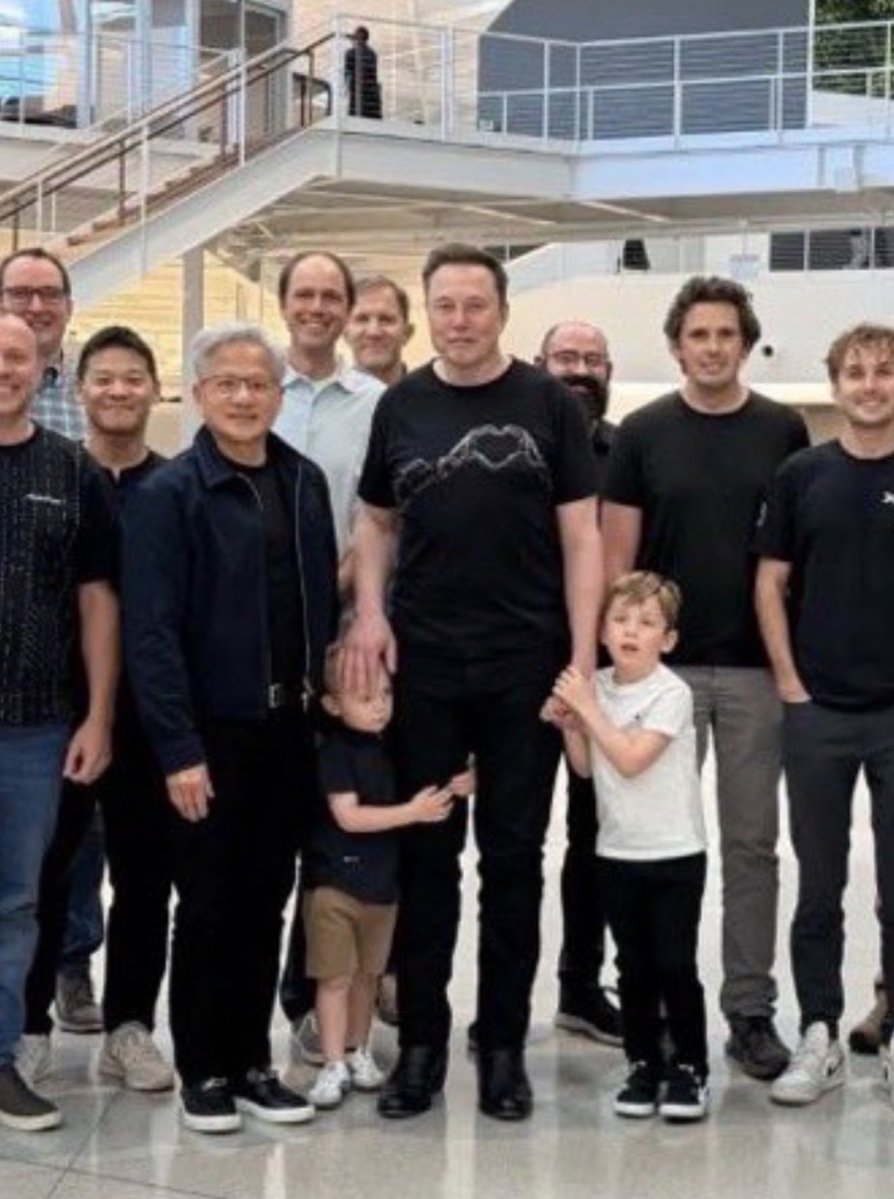
REAL FRIENDS SPOTTED 🚨 @elonmusk just dropped by Nvidia's headquarters to see Jensen Huang in person, and it caps off two wild weeks for Jensen 🔥
A newly surfaced photo shows Elon in a black tee right next to Jensen in the middle of Nvidia's Santa Clara lobby, with two little kids by his side and a big crowd posing around them.
A week ago, a scene like that looked like it might never happen.
Jensen stepped down as CEO on November 12, and five days later, Nvidia's board said it had no plans to bring him back.
Elon had his back the whole way. He said hiring Jensen "would be an honor," signed the petition for his return, and compared letting him go to kicking Michael Jordan off a team on a winning streak.
Hours after the board reversed course on Monday, Elon summed it all up in one post: "Everyone is your friend when the chips are up, but those who support you when the chips are down are your real friends. Fair-weather friends are worthless."
Then he went and backed those words up in person.
Jensen was there for Elon first, though. Ten years ago, he personally delivered Nvidia's very first DGX-1 AI supercomputer to him. As Jensen put it, "Nobody wanted to be part of it, except for Elon."
Ten years later, the numbers look a little different. SpaceXAI is racing to bring about 1.44 million Nvidia GPUs online at Colossus by the end of this year, and SpaceX has lined up $40 billion in debt financing for even more Nvidia hardware.
Back then, Jensen showed up with a supercomputer nobody else wanted. This week, Elon returned the favor in Jensen's own lobby, just as the chips came back up 🔥