@RepLuna Thune has shown time and time again that he isn’t working for the people. He is working for his donors.
These members below all take donations from agrochemical companies, and ALL are on the Agriculture Committee! ALL voted against removing pesticide provisions! 👇
Ladies & gentlemen of Chicago, @Brandon4Chicago@ChicagosMayor wants you to know this is just the beginning.
His failed leadership will continue to drive businesses out of town while helping the city grow by attracting more thugs, criminals & mentally crippled people to Chicago.
Mayor Brandon Johnson is facing outrage from Chicago residents over Walgreens store closures, particularly on the South Side.
Walgreens is closing its longtime Chatham store on June 4 after $1 million in losses in 2025 and high theft rates.
The store had been there more than 20 years. Walgreens said theft at that location was four times the company average.
Walgreens spent $400,000 a year on security officers in addition to other measures, but that wasn’t enough.
Thieves would break through the defenses and rob the store anyway.
Johnson needs to seriously address the crime that’s making businesses leave Chicago.
(Video: AI)
@hassytrades@TigerLineTrades Nope, just a fortunate student of your guys.
You two have taught me a great deal and I will be forever grateful.
Be well, be safe and be blessed.
I’ll catch you gentlemen in Discord tomorrow.
👍⛳️
@ClayTravis Excuse me but does anyone need any further evidence to see Earvin Johnson Jr is a useful puppet for the deep state & no longer owns his soul!
What a pathetic political campaign pitch!
Spencer Pratt is on a darkened bridge in Los Angeles.
It's dark because criminals have STOLEN all the copper lights.
And no one has ever gotten arrested for it.
No one is even investigating.
This wont be a thing when Spencer Pratt is Mayor.
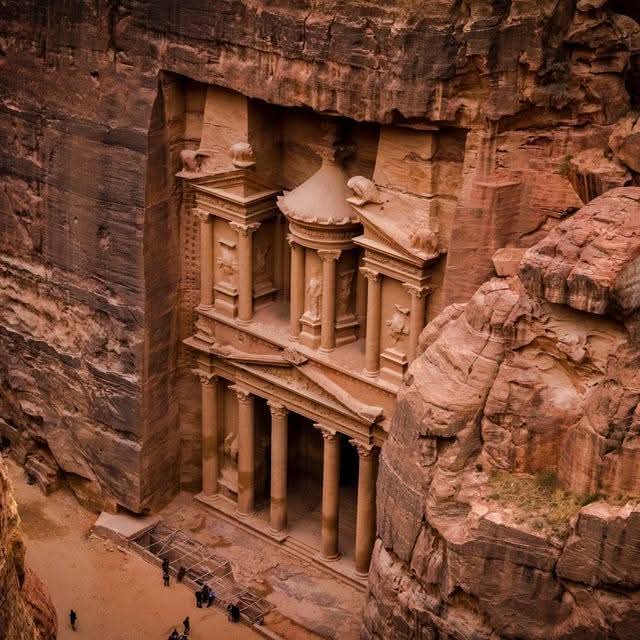
@LadyAg72 ~ what a fascinating city.
This site proves the people behind the history & creation of this city were far more sophisticated & intelligent than we can imagine.
The 2,000-year-old city of Petra, Jordan 🇯🇴, known for the magnificent temples carved into its red sandstone cliffs, is also home to an incredible feat of hydraulic engineering. An extensive water supply system turned this ancient city into a man-made oasis supporting a substantial population.
At its peak, Petra was the thriving capital of the Nabataean Kingdom, a powerful and wealthy Arab state that existed from the 4th century BCE to the 1st century CE. The city, surrounded by desert, was home to more than 25,000 inhabitants. Its lavish gardens, pools, and fountains displayed the Kingdom’s splendor and served as a major stop along a busy trading route.
Considering Petra’s location in an arid desert valley, the fact that it once grew into a bustling metropolis is nothing short of miraculous. In fact, some consider it a genuine miracle, as one of its water sources is said to be the place where Moses brought water out of a rock. But the archaeological evidence shows that it was the ancient Nabataeans who built their city’s water infrastructure. They learned from and incorporated technologies from all over the ancient world, producing a highly effective system of aqueducts and pipelines that transported nearly every drop of surface water in the surrounding area directly to the city.
The most well-preserved and widely studied of these channels is the Wadi Mataha, a ceramic pipeline built on an elevated platform along a dry riverbed. It stretched over five miles, consisting of tens of thousands of handmade terracotta pipe sections socketed together and cemented at the joints. The fact that the Nabataeans could marshal the resources and labor to construct this massive work is remarkable on its own, but the precision of its hydraulic engineering is even more impressive.
The slope of this pipeline consistently follows the very significant angle of approximately two degrees, which, according to the latest peer-reviewed research by Dr. Charles Ortloff of University of Chicago, maximizes flow rate for this specific pipeline. Deviation of even a single degree would cause a decrease in flow rate and frequent leakage. (For other supply lines, such as that along the Wadi Mousa, the optimal angle was four degrees.) How the Nabataeans had this knowledge baffles modern historians and engineers, as calculating this precise angle requires mathematics not developed in the west until nearly 2,000 years later. Petra’s water system also included hundreds of cisterns and tanks for water purification and pressurization.
Though the Nabataeans did not leave many written records, their sophisticated engineering knowledge enabled them to build a city brimming with gardens, fountains, and pools.
#archaeohistories